Showing posts with label 1960s Youth Revolt. Show all posts

Saturday, 10 June 2023

The Numbers That Matter.

Aristocratic Arithmetic: From whence comes the notion of “coming of age”. For many centuries, this was something men did at the age of 21. Why 21? Because it is 3 x7 – both of which are charmed numbers. Don’t laugh, for most of human history numbers have mattered – a lot. The tradition of holding 21st birthday parties is directly traceable to the computations of superstitious noblemen.

DID THE INDEPENDENT ELECTORAL LAW REVIEW PANEL pause to wonder why New Zealand citizens become eligible to vote at 18? It’s a long and convoluted story, very little of which has much to do with cool, calm, considered cogitation. Like most of our constitutional milestones, the age of enfranchisement is the product of superstition, tradition, and political agitation. Rationality has only ever played a bit-part in this drama.

Let’s begin at the beginning with the concept of “coming of age”. For many centuries, this was something men did at the age of 21. Why 21? Because it is 3 x7 – both of which are charmed numbers. Don’t laugh, for most of human history numbers have mattered – a lot.

Among the medieval aristocracy, the journey towards “manhood” was divided into three stages. For a male child’s first 7 years, his life was centred on hearth and home. Upon turning 7, however, the custom was to have the little boy taken into the household of another aristocrat, where his education would begin in earnest. At the age of 14, the boy’s education would turn towards the arts of war and government, a process which often involved him becoming the esquire to a knight. At 21, these boys would finally enter “man’s estate” with all the privileges and responsibilities that entailed. The tradition of holding 21st birthday parties is traceable to this superstitious aristocratic arithmetic.

None of which applied if you were born a serf – a status that mandated very hard work, for very little reward, from a very early age, for the lords whose sons were learning how to become “gentlemen”. Since it was these same lords and gentlemen who wrote the laws of the land, however, 21 became the age at which full adult male status was bestowed.

It was a very different story for girls – isn’t it always? In law they were the property of, first, their fathers, and then, their husbands. For centuries the age at which a girl could be treated as a woman was 12. It was only in the Nineteenth Century that the Age of Consent was raised from 12 to 16 – a reform which was bitterly resisted by an disconcertingly large number of members of the British House of Lords, who seemed to regard it as an unconscionable curtailment of their pleasures.

Although in egalitarian New Zealand the voting age has been the same for men and women since 1893, the same could not be said of Great Britain. The initial enfranchisement of British women in 1918, saw their voting age set at 30. Full equality was not achieved until 1930.

What was it, then, that caused the voting age to be lowered from 21 – the generally accepted age at which people became fully-fledged adult citizens – to 20, and then, in reasonably short order to 18? The answer is to be found in the great “Youth Revolt” of the 1960s and 70s.

The huge “Baby Boom” generation, raised in the most economically and socially propitious circumstances in human history, demanded to know (at least in the USA) why it was considered appropriate to draft 18, 19 and 20-year-old males to fight and die in the jungles of Vietnam, but not to give them a say in electing the politicians who were sending them there.

It was a question their grandfathers and fathers had never thought to ask when their government send them off to World Wars One and Two. Young men had always been the first to follow their country’s flag. Too young to legally buy a beer, or vote, but old enough to kill and be killed.

Well, not any more.

The parties of the Left, seeing a huge pool of what all the pollsters were telling them were “their” voters, hastened to enfranchise these devotees of Peace, Love and Rock-n-Roll. Fifty years later, both here in New Zealand and around the world, history would appear to be repeating itself. Substitute Climate Change for Vietnam and the political dynamics are surprisingly similar.

Where the Greens are rushing-in, Labour will, sooner rather than later, cease to fear to tread – especially now that the Independent Electoral Review Panel has given lowering the voting age to 16 the thumbs-up.


There is, however, a world of difference between giving teenagers the vote, and persuading them to use it.


This essay was originally published in The Otago Daily Times and The Greymouth Star of Friday, 9 June 2023.

Wednesday, 28 March 2018

Teaching Their Parents Well.

Marching For Their Lives: The huge achievement of the young organisers behind March For Our Lives is to have recognised in the National Rifle Association (NRA) and its political enablers, the same malign constellation of social and economic forces responsible for visiting the Vietnam conflict upon American youth fifty years earlier. The same glorification of physical force that gave rise to such obscene military expressions as “body count” and “search and destroy mission”, is today locked and loaded into the political Right’s fanatical reverence for the Second Amendment.

AS I WATCHED HUNDREDS-OF-THOUSANDS of young Americans marching for their lives on Saturday 24 March, these were the words in my head.

And you, of tender years,
Can’t know the fears that your elders grew by,
And so please help them with your youth,
They seek the truth before they can die.
Teach your parents well,
Their children’s hell will slowly go by,
And feed them on your dreams
The one they picks, the one you’ll know by.

Yes, I know, the song “Teach Your Children” is nearly 50 years old. Even so, there’s something so bitter-sweet about Graham Nash’s composition; something so touchingly intergenerational and solidaristic; that the Crosby, Stills, Nash & Young hit simply took up residence in my skull and refused to leave.


 Released in 1970, on the CSNY album Deja Vu, the song climbed to No. 16 on Billboard’s Pop Singles Chart. Tellingly, the social and political context of “Teach Your Children” was every bit as polarised as that into which the March For Our Lives organisers decanted so many young Americans last weekend.

In the same month that the song was released, May 1970, Ohio National Guardsmen at Kent State University had opened fire on unarmed students protesting President Richard Nixon’s invasion of Cambodia, killing four and wounding nine. CSNY band-member, Neil Young, upon learning of the so-called “Kent State Massacre”, sat down and composed “Ohio” which was recorded and pressed with record speed to come out just days after the release of “Teach Your Children”.

From both an emotional and a political standpoint, the two compositions could hardly have been further apart. Nash’s “Teach Your Children” speaks tenderly to the shared hopes and fears of young and old alike, and to the need for honest communication between the generation of “parents”, who had grown up during the Great Depression and World War II, and their post-war baby-boom “children” (the oldest of whom were then in their early-20s). Young’s song, by contrast, is a raw and angry cry of protest, capturing perfectly the shock and horror of witnessing “Amerika” – “The Establishment” – literally turning its guns on its own children.

Tin Soldiers and Nixon coming,
We’re finally on our own.
This summer I hear the drumming,
Four dead in Ohio


 The huge achievement of the young organisers behind March For Our Lives is to have recognised in the National Rifle Association (NRA) and its political enablers, the same malign constellation of social and economic forces responsible for visiting the Vietnam conflict upon American youth fifty years earlier.

The same glorification of physical force that gave rise to such obscene military expressions as “body count” and “search and destroy mission”, is today locked and loaded into the political Right’s fanatical reverence for the Second Amendment.

The same authoritarian, quasi-fascist, worship of toughness which mandated full-scale war in Indochina, manifests itself today in the compulsive need of all those Americans who cannot cope with difference to amass deadly “defensive” arsenals of semi-automatic weapons and handguns.

And just as the 1969 My Lai Massacre made clear what happens when young men are encouraged to believe that the hearts and minds of civilian populations are best won by pumping them full of lead; the deadly, twenty-year epidemic of US school shootings has demonstrated the horrific consequences of arming the narcissism and nihilism of alienated and aggrieved young men at home.

The assignment which today’s young anti-violence activists have taken on is, however, a much tougher one than the anti-war crusade of their parents’ generation. The decision to fight “international communism” in Vietnam was strategically and politically motivated. As such, it could be reversed and the war it propagated brought to an end. America’s gun culture is a considerably more intractable phenomenon. Born out of White America’s deeply-entrenched fear and hatred of “the other”, it can only be successfully overcome by completing the cultural revolution begun in the 1960s.

This is a very big ask for 15-20-year-olds. In a very real sense, the political history of the United States since the end of the 1970s has been the history of the American Right’s unceasing effort to halt and roll-back the kinder, gentler America that Graham Nash, and thousands like him, were attempting to sing into existence in the 60s and 70s.

But, if the mission confronting this new generation of activists is enormous, it is not impossible. Crucial to its success will be the extent to which today’s young activists are able to teach their parents well. And that can only mean persuading them to confront the truth about what’s wrong: about what’s always been wrong; with American society.

Forty years of right-wing counter-revolution has left its mark on the Baby-Boomers. For too many of them it proved a lot easier (and much more profitable) to give up the fight for a kinder, gentler America. For those “of tender years”, the trick will be to convince their parents and grandparents that the March For Our Lives is a march for their lives too.

Gotta get down to it
Soldiers are cutting us down
Should have been done long ago.
What if you knew her
And found her dead on the ground?
How can you run when you know?

This essay was originally posted on The Daily Blog of Tuesday, 27 March 2018.

Thursday, 13 April 2017

Is There A “Youth Vote”?

When Youth Was King: But the “Youth Vote”, even in the 1960s, was never much more than journalistic shorthand. It was born out of liberal wish-fulfilment and made vaguely plausible by left-wing academics. Discovering that many of the Left’s supporters are young does not mean that the young support the Left.
 
DO YOUNG NEW ZEALANDERS vote in ways that diverge markedly from the voting patterns of older New Zealanders? Does it still make sense to talk about winning the “Youth Vote”? And, if it does, which of our political parties stands the best chance?
 
There was a time when people took the notion of a Youth Vote very seriously indeed. By the mid-1960s, the early cohorts of the Baby Boom Generation were entering their late teens and early-twenties. Middle class children in unprecedented numbers were pouring into new and expanded university campuses. By the end of the decade, the impact of decolonisation and the Vietnam War had transformed, “students” into an important political category.
 
The oft-demonstrated political activism of college students, when combined with the explosion of what Time magazine called “Youth Culture” (forever associated in the minds of “anyone over thirty” with popular music, long hair, sexual licence, recreational drug-taking and Dr Timothy Leary’s infamous formula: “turn on, tune in, drop out”) encouraged the notion that “anyone under thirty” shared a common set of generational expectations and interests. Without this “Youth Vote”, it was suggested, the electoral success of mainstream political candidates could not be guaranteed.
 
This was by no means as fanciful as those living fifty years after the watershed year of 1968 might think. Had not President Lyndon Johnson been routed by Senator Eugene McCarthy’s “Children’s Crusade”? Supported overwhelmingly by young anti-Vietnam War student activists, McCarthy had run the President embarrassingly close in the New Hampshire primary of January 1968. Days later, Bobby Kennedy, also running on an anti-war platform, entered the race for the presidency. By March, Johnson was telling Americans that he would not seek, nor would he accept, his party’s nomination. The “Youth Vote” had driven LBJ from office.
 
Four years later, right here in New Zealand, the “Youth Vote” was being taken just as seriously. Mass demonstrations against the country’s involvement in the Vietnam War had been a feature of the early 1970s. University students comprised the overwhelming majority of these anti-war protesters. Few political scientists questioned the importance of the anti-war movement in securing the Norman Kirk-led Labour Party’s landslide election victory of 1972. Two years later, Labour attempted to lock-in the Youth Vote by lowering the voting age to 18.
 
But the Youth Vote has always been a political illusion. Middle class university students in the 1960s and 70s made up only a small part of the Baby Boom Generation. Most young Americans and New Zealanders of that era did not go to university. By the time many of them turned 18 they had been working full-time for two or three years. Factory workers and shop assistants had much more in common with their parents and co-workers than they did with placard-waving varsity students. If they voted Labour it wasn’t on account of the Vietnam War, but because voting Labour was what Mum and Dad, Grandma and Grandpa, had always done.
 
And even among the university students themselves there were sharp divisions. The long-haired, left-wing radicals might be the ones everybody saw on the television news, but back on campus there were thousands of politically conservative students who thought and voted very differently. A university education was – and remains – a middle-class rite-of-passage. And most middle-class people then, as now, support National – not Labour.
 
In truth, the “Youth Vote” has never been much more than journalistic shorthand. It was born out of liberal wish-fulfilment and made vaguely plausible by left-wing academics. Discovering that many of the Left’s supporters are young does not mean that the young support the Left.
 
So, why the Greens believe that positioning twenty-somethings Jack McDonald and Chloe Swarbrick high on their Party List will attract the support of “Millennials” (the latest journalistic coinage) is anybody’s guess. To be young does not necessarily make one Green – just ask David Seymour and Todd Barclay!
 
The best evidence for something called the “Youth Vote” is, paradoxically, the large number of young people who do not vote at all. Whether out of ignorance, indolence, or principled resistance to a perceived lack of credible electoral alternatives, tens-of-thousands of 18-25-year-olds simply do not make it to the polling booths on Election Day.
 
Of those who do make it, the vast majority come from voting households. Ballots, like apples, seldom fall far from the family tree.
 
This essay was originally published in The Waikato Times, The Taranaki Daily News, The Timaru Herald, The Otago Daily Times and The Greymouth Star of Friday, 7 April 2017.

Saturday, 19 March 2016

Shock Therapy?

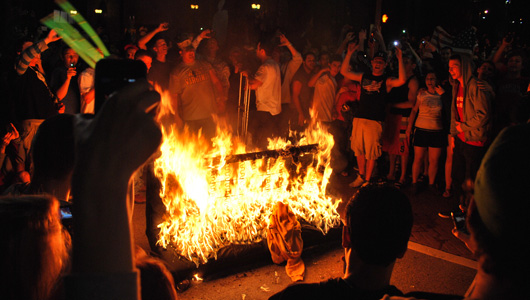
Watching The World Burn: Shocking the middle-class today isn’t about engaging in political or moral therapy. Today, it’s about shocking people literally. As in alarming, disturbing and frightening them. As in outraging, appalling and provoking them. The sofa-burning revels of Otago students are a case in point. Except, of late, even these ritual fires have been deemed too tame. New shocks are in store for Dunedin's long-suffering citizenry. 
 
AS IS THE CASE with most things arty, the French have a name for it. Épater le Bourgeois! (Shock the Middle Class!) became the catch-phrase of the French decadent poets Charles Baudelaire and Arthur Rimbaud. Their artistic mission was to cultivate a lifestyle of such unrelenting transgression as to throw into sharp relief the dull torpor of middle-class existence. Like a bracing bucketful of cold water, the uncompromising radicalism of their art was supposed to shock its victims into a new level of consciousness.
 
By the early Twentieth Century, épater le bourgeois had morphed into the notion of an artistic avant garde (advance guard) dedicated to all things new and challenging. From Picasso’s Les Demoiselles d’Avignon, to Stravinsky’s Rite of Spring, the mostly middle-class consumers of art were taken on a dizzying journey to worlds so utterly unlike their own that they could scarcely take them in. The debut performance of the Rite of Spring provoked first cat-calls and then fist-fights amongst its Parisian audience. Le Bourgeois was very épater indeed!
 
There was more than a little épater le bourgeois about the youth rebellions of the post-war era. Rock-n-Roll scandalised the buttoned-down middle-class suburbanites of the Eisenhower Era. (All those nice, white, boys and girls gyrating to “Negro Music”!) Events took an even more radical turn in the 1960s when thousands of nice, white, middle-class college students began “turning on, tuning in, and dropping out”. Mum and Dad may not have known much about Baudelaire’s or Rimbaud’s sybaritic predilections, but they harboured deep misgivings about the (very similar) hijinks of Mick Jagger and Keith Richards. As Bob Dylan wryly put it in his Ballad of a Thin Man: “Something is happening here, but you don’t know what it is, do you, Mr Jones?”
 
But, if the Middle Class was being shocked by the artistic avant garde, it was also being improved. The innovative and experimental work of all these poets, painters, playwrights, novelists, musicians and composers more than repaid the “squares” who were willing to lay aside their prejudices and wrestle with artistic expressions as exciting as they were illuminating. Regardless of whether they were listening to the Rite of Spring or Highway 61 Revisited, there was always a lot more than shock on offer. People emerged from these experiences changed – for the better.
 
In its most recent iteration, however, épater le bourgeois has undergone a dramatic change. In the past, the artistic and political avant garde shocked people for purposes that were more-or-less noble. The bourgeoisie had, after all, started out as a revolutionary class, preaching the gospel of universal emancipation. Avant garde artists were hoping to shock the smug and self-satisfied middle-classes back into loving freedom; scandalise them back into demanding justice.
 
No such nobility impels today’s avant garde. Shocking the middle-class today isn’t about engaging in political or moral therapy. Today, it’s about shocking people literally. As in alarming, disturbing and frightening them. As in outraging, appalling and provoking them. Not for any transformative purpose, but simply for the thrill of traumatising one’s fellow human-beings.
 
If you’re looking to pin the blame for this sorry state of affairs on someone or something, look no further than the Post-Modern ethos. Post-Modernism, like a carnival mirror, makes everything that is big look small. Even the possibility of nobility is denied. And if men and women are neither good nor bad, then damnation’s as pointless as redemption. Épater le bourgeois no longer has a purpose – other than to give pleasure to the people doing the shocking.
 
When I was a student in Dunedin, I cultivated a romantic persona: styling my hair like one of King Charles I’s cavaliers; writing articles for the student paper; and singing songs attacking the pretensions of my smug university city. If I ever set out to shock Dunedin’s middle classes, it was only in hopes of waking them up.
 
Forty years later, I read about a vanload of Dunedin students pulling-up alongside a car containing a woman and her dog. Suddenly the door of the van slides open, and one of the students yells at the startled driver: “If it wasn’t for the dog, we’d rape you!”
 
As performance art, it was certainly a case of épater le bourgeois. The driver was shocked. I was shocked. Whether either of us were improved is less certain.
 
This essay was originally published in The Waikato Times, The Taranaki Daily News, The Timaru Herald, The Otago Daily Times and The Greymouth Star of Friday, 4 March 2016.