Showing posts with label 1970s Counter-Culture. Show all posts

Saturday, 25 October 2014

The Songs of Yesteryear - Or, What I Was Listening To 40 Years Ago

 
Sonnet to the Fall: Penned by the group, Dulcimer's, founder, Peter Hodge, the song also features the English actor, Richard Todd, reading Hodge's poetry. Dulcimer's first album, And I Turned As I Had Turned As A Boy was released on the Nepentha label in 1970.

THIS LITTLE GEM from the almost completely forgotten English folk group, Dulcimer, captures something of the sweet innocence of the early-1970s - that wonderful bygone era of full-employment and free tertiary education. In all of New Zealand's major cities (and some of its smaller ones) there were folk clubs where traditional and contemporary compositions were played by musicians of often astonishing skill and originality. Meanwhile, the audience of mostly long-haired youngsters of both sexes drank cheap red wine out of casks, flirted, laughed and, most importantly, sang away the chill winter nights.

Mais où sont les neiges d'antan? Asked the French Renaissance poet, Francois Villon.

Where are the snows of yesteryear?

Video courtesy of YouTube

This posting is exclusive to the Bowalley Road blogsite.

Tuesday, 23 July 2013

Utopian Dreams and Schemes

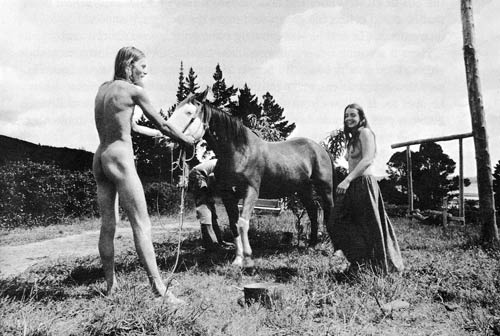
The Virtues Of A Simpler Life: Two members of the 1970s Wilderland commune attempt to persuade their workhorse to regurgitate their clothes. Though it is hard to believe in 2013, in 1974 the Kirk-led Labour Government announced its support for state-subsidised communes ("Ohu") on Crown land.

JUST TRY TO IMAGINE THIS. A New Zealand government which announces a scheme designed to, among other things: “assist people in becoming self-sufficient from the land”; “give people a chance to develop alternative social models”; “promote the virtues of a simpler life”; and “provide a place of healing for participants as well as for society as a whole”.
 
Impossible? No – it happened!
 
Forty years on, the Kirk Labour Government’s “Ohu Scheme” (state-subsidised, self-sufficient communes on Crown land) still possesses the power to shock and surprise. Taking their name from the Maori word for “working together”, and their inspiration from the Israeli kibbutzim, Kirk’s communes represent what is indisputably the high-point of utopian policy formation in New Zealand.
 
The inspirational role played by the kibbutzim (radically egalitarian and self-supporting communities established by Jewish settlers in Palestine from the early twentieth century) reflected the very close links that had grown up between the Israeli and New Zealand Labour Parties since the birth of the State of Israel in 1948. By the 1960s, spending a few weeks or months on a kibbutz had become a rite of passage for many young Kiwi socialists. The kibbutzim’s role in entrenching the ideals of solidarity and cooperation within Israeli society was openly admired by Labour activists.
 
The 60s and 70s were also the decades in which powerful intellectual challenges were mounted against the individualism and materialism of what the American economist, J.K. Galbraith, called the “Affluent Society”. All over the Western World, young people were questioning the values of consumerism and loudly contesting the moral legitimacy of any “Establishment” willing to overlook the horrors of the Vietnam War.
 
The desire to withdraw from this brutally acquisitive society, and experiment with new forms of social organisation, was strong. Culturally, this longing manifested itself in the “hippy” movement, whose followers were invited to: “Turn on, tune in and drop out.”
 
It was the confluence of these two intellectual streams: the powerful political model of the kibbutzim; and the so-called “counter-cultural” impulses of the hippies; that gave the Ohu Scheme’s promoters a fighting chance of success.
 
Even so, it is unlikely that such a utopian project would have been given the go-ahead had New Zealand not, in the early 1970s, been caught up and swept along on a great wave of progressive activity.
 
In 1972, the Royal Commission on Social Security recommended that: “The community [be] responsible for giving dependent people a standard of living consistent with human dignity and approaching that enjoyed by the majority, irrespective of the cause of dependency.” The Kirk Government responded by introducing the Domestic Purposes Benefit.
 
In 1974 – the same year that the Ohu Scheme was officially launched – New Zealand’s ground-breaking and world-beating Accident Compensation Corporation was given legislative life.
 
Kirk’s Attorney-General, the erudite and highly principled Dr Martyn Finlay, shocked conservative New Zealanders by observing that no prison should be made so secure that it destroyed all hope of escape in the minds of its inmates. An “escape-proof” prison, he seemed to be suggesting, was an affront to the indomitability of the human spirit.
 
Like the Ohu Scheme itself, Dr Finlay’s comment simply does not compute in the grim context of the twenty-first century’s second decade. Can anyone imagine John Key’s Attorney General, the coldly acerbic Chris Finlayson, suggesting that Her Majesty’s prisons be deliberately designed to protect the indomitability of the human spirit? And what awful punishment would the Justice Minister, Judith Collins, visit upon him if he did!
 
It would, of course, be very wrong to suggest that the whole of New Zealand suddenly turned into left-wing hippies in the 1970s. Because that simply isn’t true.
 
I vividly recall the day Prime Minister Kirk announced the cancellation of the 1974 Springbok Tour.
 
I was walking down Fergusson Drive in Upper Hutt when an old fellow wearing an RSA badge accosted me – presumably for the offence of being young and having long hair – and berated me for several minutes on the undemocratic character of the PM’s decision. Noticing the plethora of badges attached to my waistcoat (it was 1973!) he scrutinised them carefully for the emblems of New Zealand’s traitorous anti-Apartheid movement. Finding none, he grumpily sent me on my way. (He did not know how close I came that morning to pinning on my Halt All Racist Tours badge!)
 
But, if the progressivism and utopianism of the early 1970s was by no means universal, it was, nevertheless, entirely real. New Zealand warships were dispatched to the waters around the French nuclear testing-site at Mururoa. Racist rugby tours were cancelled. Pristine southern lakes were placed in the hands of environmental “guardians”. And, the government was prepared to set up rural communes.
 
We approach our utopias only by daring to dream. In disavowing their existence, we forget how to do even that.
 
This essay was originally published in The Press of Tuesday, July 23, 2013.

Friday, 20 August 2010

Riders of the Storm

Life-affirming: Barry Thomas plants his first seedling in "The Cabbage Patch" (1978) More than a political, or even a social, revolution, the upheavals of the late-1960s and 70s reflected a revolution of the spirit – almost, one could say, of the soul. And, like all internal human experiences, it tended to manifest itself through art.

I REMEMBER with almost cinematic clarity the day I first heard The Doors’ hypnotic/psychedelic track, "Riders on the Storm".

I was comfortably ensconced in a corner of Wellington’s Resistance Bookshop flicking through the pages of a dense little volume entitled Marxism and Alienation. The rich aroma of burning incense (and quite possibly less acceptable resinous substances) was drifting up the narrow staircase from The Merchant Adventurers of Narnia shop below. Through the windows of the bookshop I watched storm clouds massing in sympathy with the sound-effects of Jim Morrison’s song.

Across Upper Willis Street, the Wellington Settlement bustled with its usual collection of hippies, university students and bored bohemian housewives - all in search of strong coffee, hand-made leather goods, tie-dyed T-shirts and "underground" posters.

Beneath Morrison’s portentous lyrics: "Into this house we’re born/Into this world we’re thrown"; the insinuating hiss of the cymbals merged seamlessly with the patter of falling rain. Entranced, I allowed the moment to imprint itself on my memory. Never again would the counter-culture of the 1970s leave such a deep impression.

The counter-cultural "moment" was, of course, more than personal. With its surging enthusiasms and portentous "alternative" philosophies, the world-wide rebellion against the monolithic uniformities of the post-war "affluent society" entranced millions of young people.

It is recalled now mostly through clichéd media images of swaying, blissed-out hippies and angry student demonstrators – but it was so much more than that. More than a political, or even a social, revolution, the upheavals of the late-1960s and 70s reflected a revolution of the spirit – almost, one could say, of the soul. And, like all internal human experiences, it tended to manifest itself through art.

Those with a yearning to "feel the vibe" of those revolutionary times through the work of some of this country’s politically active artists should pay a visit to the "Artists as Activists: Environment" exhibition which opens today in the galleries of the NZ Academy of Fine Arts, located in Shed No. 1 on Wellington’s Queen’s Wharf.

Featuring the work of Don Binney, Dean Buchanan, Nick Dryden, Ian Hamlin, Sam Mahon, Euan McDougal, Rosemary Mortimer, Michael O’Donnell, Michael Smither, Graham Sydney, Barry Thomas, Brian Turner and Jane Zusters, the exhibition presents an array of "protest art" loosely gathered around the theme of transformation/conservation. It ends on 12 September.

Sam Mahon has this to say about the ultimate fate of the counter-cultural impulse:

Art is no longer seen as a medium for change. Along with all other revolutionaries it has been captured, branded and turned into wallpaper. The dealers and city art galleries and the public art advisory groups do not ask any more what art has to say; they inform art just as a captain of industry informs the shop floor. It seems that the safest place for art these days is the street.

To which Mahon’s fellow exhibitor, Barry Thomas, would undoubtedly say "Amen!". Since the 1970s he has driven art like a sharpened stake into the heart of the corporate/political beast.

There’s a lovely image taken of Barry in 1978, squatting bearded and bare-chested like an Antipodean Cat Stevens in the dust of a Wellington vacant lot - his hands cupped protectively around a fragile cabbage plant.

Thomas’s "Cabbage Patch" – a conceptual artistic statement against the life-negating conservatism of the Muldoon years – quite literally "grew" into a life-affirming (and edible) challenge to Wellington’s bureaucratic soul.

Like so many of the other exhibitors’ work in the show, Thomas’s forces us to focus on the deadening shadow which falls, as T.S. Elliot says in The Hollow Men: between the "idea and the reality"; the "motion and the act"; the "emotion and the response".

"There’s a killer on the road", warned Jim Morrison all those years ago. He was right. The counter-culture proved as vulnerable and short-lived as Barry’s cabbages.

Thankfully, however, New Zealand’s activist artists proved equal to the task of not only riding the storm – but recording it.

Go take a look.

This essay was originally published in The Dominion Post, The Timaru Herald, The Taranaki Daily News, The Otago Daily Times and The Greymouth Evening Star of Friday, 20 August 2010.