
 |
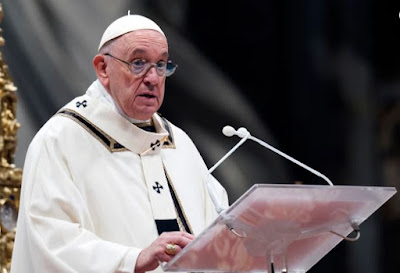
| Defender Of The Faiths: Pope Francis sees cancel culture as a threat to the open,
compassionate and forgiving human society he has always championed. |
WHAT SHOULD WE MAKE of Pope Francis’ condemnation of “cancel culture”? There will be some who argue that the opinions of an ageing male celibate who somehow learned, back in the 1970s, to sup with Argentina’s murderous generals, should not be received as the gospel truth. Others will insist that the Pope’s unique moral and political perspective is especially important in these increasingly censorious times. What is indisputable, however, is the fact that if the impact of cancel culture is sufficient to ruffle the papal cassock, then the phenomenon is clearly a great deal more dangerous than many of us cared to believe.
Francis, no mean scholar in his own right, sees cancel culture as a threat to the open, compassionate and forgiving human society he has always championed:
“Under the guise of defending diversity,” says Francis, “it ends up cancelling all sense of identity, with the risk of silencing positions that defend a respectful and balanced understanding of various sensibilities.” Shrewdly appropriating the concepts and language of those most closely associated with cancel culture, the Pontiff characterised this willingness to silence cultural and political challengers as “a form of ideological colonisation.”
This is fighting talk and no mistake. Those members of the Labour and Green caucuses for whom the rigors of cancel culture arouse nothing but enthusiasm would be wise to draw back and think carefully about what the Pope’s words might portend. As the leader of the world’s largest Christian community (and New Zealand’s largest Christian denomination) Francis, like all his predecessors, wields not only religious, but also an inescapable measure of political power. As a general rule, it is most unwise for a political party to pick a fight with the Catholic Church.
Wise, or not, Labour and the Greens have already aligned themselves with causes and policies that are alienating not just Catholics and other Christians, but also those New Zealanders who fall under the heading of cultural conservatives. They have done this with considerable confidence, most probably because the major, non-evangelical, churches long ago acknowledged the moral hegemony of secular “progressivism”.
Over the past three or four decades, the Anglicans, Presbyterians and Methodists have learned how to get along by going along with the cultural radicalism of the Powers That Be. As society’s fierce and unyielding conscience, the major denominations have almost entirely vacated the field of intellectual battle. Inevitably, politicians and public servants have come to see Christianity as a social movement populated by the sort of people who flock to hear the likes of Brian Tamaki: poorly-educated rubes, incapable of mounting a coherent argument against necessary social and cultural reforms.
Back in the days of Cardinal Tom Williams, Dean Richard Randerson, and the Salvation Army’s Major Campbell Roberts, right-wing politicians of all descriptions were constantly challenged to defend their neoliberal economic policies against the aforementioned clerics’ well-argued Christian critiques.
On contemporary social and cultural issues, however, the political class is seldom tested. The Catholic Church’s opposition to abortion and homosexuality, never intellectually robust, was ultimately swept aside by the secular advocates of reform. On the questions of indigenous rights and racial justice, however, the Left and all but the most rabid evangelical Christians tended to be allies rather than adversaries. It has been a long time since progressive New Zealand was confronted with a theologically-inspired counter-attack it could not easily brush aside.
That this has fostered a large measure of ideological hubris is evidenced by the disinclination of the progressive political class (and their bullet-makers in the universities) to debate with – rather than cancel – any individual or organisation disposed to challenge their refusal to defend freedom of expression, uphold the scientific method, acknowledge the most basic biological realities, or treat the writing and teaching of history as anything other than an opportunity to propagate the idéologie du jour.
While this intellectual arrogance remained contained within the walls of academe and/or parliamentary select committee rooms, the rest of New Zealand paid it scant attention. The realisation has, therefore, been slow to dawn on the ordinary voter that, if allowed to go unchallenged and unreproved, extreme ideas have a nasty habit of becoming extreme policies and, ultimately, extremely alarming laws of the land.
Three years jail-time for engaging in “hate speech” is a more draconian maximum sentence than the one available for male-against-female assault. Apropos of which, in a remarkable display of parliamentary unity, maleness and femaleness have themselves become matters of purely personal preference – which all other citizens are now legally bound to acknowledge and respect. Officially, New Zealand history is now the history of Māori. The rest of us, when not actually engaging in colonialist oppression, are, apparently, just passing through. Constitutionally, co-governance will steadily replace democracy. As the tyrannical creation of privileged white males, majority-rule has clearly run its course.
What better case could be made for the reality of Pope Francis’ “ideological colonisation”. Like the “godless communism” of the Māori – so deplored by the British colonisers of the nineteenth century – the democratic sensibilities of ordinary New Zealanders have become outrageous and outdated cultural shibboleths. Away with them!
When Leonard Cohen sang, in his prophetic 1992 album, The Future:
And everybody knows that the Plague is coming
Everybody knows that it’s moving fast
Everybody knows that the naked man and woman
Are just a shining artifact of the past
I wondered what he meant. But now, as he says, “everybody knows”.
Human cultures and societies are at once frighteningly fragile and reassuringly resilient. As he struggled to rescue the victims of the Argentinian junta’s vicious military rule, Jorge Mario Bergoglio had every reason to study closely the impact of a mindset dedicated to imposing just one answer to life’s challenges and mysteries. And how ultimately fruitless all such impositions turn out to be.
The absolute necessity of allowing cultures and societies to breathe. The horrors that attend every attempt to enforce ideological uniformity upon the unruly diversity of the human species. The man who would become Pope Francis learned these lessons up close and personal – not the least of which was the complicity of so many in his own church in the mortal sins that orthodoxy, rampant, both provokes and sanctions.
That this Pope has invited the Vatican’s diplomatic representatives to resist the global trend towards a dangerous and unforgiving secular orthodoxy, gives cause to hope that Francis may yet champion unequivocally what he has, to date, only hinted at – doctrinal heterodoxy.
To be “truly inclusive”, Francis told God’s diplomats, means “starting from different viewpoints” and “not cancelling but cherishing the differences and sensibilities that have historically marked various peoples”. This could only be achieved, he argued, through “reciprocal trust” and “willingness to dialogue”.
In the words of his own message marking the 2022 World Day of Peace: by “listening to one another, sharing different views, coming to agreement and walking together.”
This essay was originally posted on the Interest.co.nz website on Monday, 17 January 2022.
