Showing posts with label Australian Political History. Show all posts

Wednesday, 8 August 2018

“Who Are You Calling ‘Mate’, Mate?”

Newspeak? It is Washington’s new “Indo-Pacific” strategy, that is driving the current “Century of Mateship” propaganda exercise out of Canberra. Australia’s foundation and development as a collection of British colonies is being barefacedly elided in favour of the Orwellian contention that: “Australia and the United States are mates. Australia and the United States have been mates for 100 years. Australia and the United States will always be mates.”

NEW ZEALAND’S RELATIONSHIP with Australia is under considerable strain. Though they have yet to state their position openly, Australia’s leaders are clearly less than enthusiastic about the tradition of “automatic entry” for New Zealand’s economic migrants. It is certainly difficult to read the Australian Government’s denial of non-emergency health care, higher education and social welfare benefits to Kiwi citizens as anything other than a pretty strong signal of Australia’s rising impatience with the ANZAC myth of eternal “mateship”.

Indeed, if the programmes currently featuring on Sky TV’s “History Channel” are anything to go by, there is a concerted effort underway to attach the “mateship” label to Australia’s relationship with the United States. Under the rubric of “One Hundred Years of Mateship” Australian documentary-makers are advancing the far-from-convincing argument that the Commonwealth of Australia – one of the British Empire’s most important economic and strategic “dominions across the seas” – and the United States of America have been bosom buddies from the moment they clapped eyes on each other across the battlefields of the Western Front in 1918.

It is rare in the English-speaking nations of the twenty-first century to witness such a blatant attempt to re-write history. Up until the Second World War, elite Australia’s attachment to British imperialism was as fervent as it was unquestioning. The Aussie working-class, much of it Irish and Catholic, may have had little cause to love the English and the Scots-Irish Orangemen from Ulster, but its dangerously radical opinions were vigorously rejected by the “respectable” settlers of New South Wales, Victoria and South Australia. For these sons and daughters of the Empire, “Mother England” was the source of all economic, military and cultural power. The USA and its teeming millions were impertinent upstarts – not “mates”.

That all changed, of course, when a squadron of Japanese navy bombers, almost nonchalantly, sank the two great British battleships, HMS Prince of Wales and HMS Repulse, off the Malaysian coast on 10 December 1941 – just three days after Japan’s surprise attack on the American Pacific Fleet at Pearl Harbour. The fall of “impregnable” Singapore, which followed soon after, on 15 February 1942, brought home to Australians just how far away Mother England really was and forced them to shift their strategic gaze eastward to the United States. Every Australian understood that if the Japanese were going to be defeated, it would not be by the British, who had proved to be a busted-flush, but by the Americans. For most Aussies, therefore, the Yanks were more than their “mates” – they were Australia’s bloody saviours!

Post-World War II, however, the case for US-Australian “mateship” grows progressively stronger. The two countries have fought alongside each other in Korea, Vietnam, Afghanistan and Iraq. The view from Canberra is unequivocally that of a steadfast ally upon whom Washington can rely without the slightest hesitation or doubt. The Liberal Party Prime Minister of Australia, John Howard, confirmed this subaltern status by describing his country as America’s “deputy-sheriff”.

Howard’s Liberal successor, Malcolm Turnbull, has developed this relationship to the point where Australia now sees itself as a geostrategic bridge between the Pacific and Indian oceans. The Australian landmass is thus being presented to Washington as not only an unassailable thoroughfare for American power, but also as a barrier against the further extension of Chinese influence into either ocean.

It is this, Washington’s new “Indo-Pacific” strategy, that is, almost certainly, driving Foxtel’s “100 Years of Mateship” propaganda exercise on the History Channel. Australia’s foundation and development as a collection of British colonies is being barefacedly elided in favour of the Orwellian contention that: “Australia and the United States are mates. Australia and the United States have been mates for 100 years. Australia and the United States will always be mates.”

Which just leaves New Zealand, Australia’s former “mate”, positioned strategically off the lucky country’s eastern seaboard like an unsinkable aircraft carrier which has, unaccountably, pushed all its fighter aircraft into the sea. An unreliable aircraft carrier, whose unreliable crew has, for more than 30 years, been bloody rude to Australia’s best mates – the Americans. A crew which insists on taking shore leave in Brisbane and Sydney and Melbourne where it spreads its downright subversive views about the rights of indigenous people and nuclear disarmament and practical feminism and need to do something big and meaningful about climate change among Australia’s dangerously persuadable citizens.

Right-wing Australia would like nothing more than to close its borders to these damned annoying Kiwis. Unfortunately, that would involve tearing up the Australian-New Zealand Closer Economic Relationship and toppling New Zealand into a full-scale economic and social crisis.

Now, there are some Aussies who’d like to say “tough luck, Kiwi” and walk away. Fortunately for New Zealand, however, there are wiser heads in the discussion who warn that a New Zealand in the grip of a life-or-death struggle for survival might feel it had no choice but to extend the hand of “mateship” to its largest remaining trading partner. That if Australia goes on mistreating Kiwis, then it just might wake up one morning to discover that unsinkable aircraft carrier across the Tasman Sea bristling with Chinese bombers.

This essay was originally posted on The Daily Blog of Friday, 3 August 2018.

Thursday, 29 October 2015

Palace Coup? Shocking New Revelations About The 1975 Dismissal Of Gough Whitlam’s Labour Government.

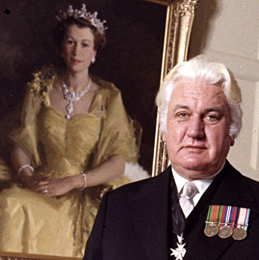
Queen's Man: Australian Research Professor, Jenny Hocking, in her just published book, The Dismissal Dossier: Everything You Were Never Meant To Know About November 1975, alleges that Sir John Kerr was in contact with Queen Elizabeth II, her Private Secretary, Sir Martin Charteris, and Prince Charles, weeks before the final dismissal of the Whitlam Government. At no point, says Hocking, did any member of the Royal Family alert the Prime Minister of Australia that his country's democratically-elected government was about to be overthrown.
 
SCEPTICISM ABOUT THE EXISTANCE of the “Deep State” is very strong in New Zealand. This country has been fortunate in avoiding the sort of constitutional crises that bring the machinations of Deep State actors into public view. Our neighbours across the Tasman have not been so fortunate.
 
It is almost exactly 40 years since the Governor General of Australia, Sir John Kerr, sacked the government of Gough Whitlam’s Labour Party. The “dismissal” of the Whitlam Government was long thought to be the work of Kerr alone; a vice-regal intervention intended to resolve a constitutional stalemate that was threatening to bring Australia to its knees. This “official” version of events is now being challenged. In The Dismissal Dossier: Everything You Were Never Meant To Know About November 1975, Australian Research Professor, Jenny Hocking, makes it frighteningly clear that Kerr had help.
 
One of the questions often asked by students of Whitlam’s dismissal is: Why didn’t the Prime Minister simply pick up the phone and dial Buckingham Palace? The Governor-General is, when all is said and done, merely the monarch’s stand-in. Should he so forget his place as to seriously contemplate dismissing a democratically re-elected government from office, then, surely, a quick conversation between the Prime Minister and Her Majesty would secure his instant removal from Government House and replacement by somebody more committed to the democratic process.
 
According to Hocking, that most simple of solutions was denied to Whitlam for the very simple reason that the Queen and her Private Secretary, Sir Martin Charteris, were forewarned of the dismissal. Kerr had taken the precaution of both writing and speaking to the Queen about what he was planning to do well in advance of 11 November 1975. Indeed, the Queen’s Private Secretary and the Governor-General had together run through the options should Whitlam attempt to secure Kerr’s removal from office. In the event of this “contingency”, Charteris informed Kerr, the Queen would “try to delay things”.
 
Had Whitlam dialled Buckingham Palace, it is highly likely that Charteris would have informed him that Her Majesty was indisposed and unable to take his call.
 
At no time during the course of these alleged exchanges, says Hocking, did the Palace think it appropriate to speak to the Prime Minister of Australia about his Governor-General’s intentions. In such circumstances it would have been very difficult for Kerr to interpret the Palace’s silence as anything other than tacit support.
 
As if all this wasn’t bad enough, Hocking claims that, in addition to the Queen, Kerr also discussed his plans to dismiss the democratically-elected government of an independent Commonwealth nation with the heir apparent to the British throne, Prince Charles. The latter’s alleged response, if accurately reported by Hocking, raises serious questions about Charles’s suitability as New Zealand’s next head of state.
 
According to Hocking, the Prince of Wales’ reply was: “But surely, Sir John, the Queen should not have to accept advice that you should be recalled at the very time should this happen when you were considering having to dismiss the government.”
 
It seems that the Royal Family was not Kerr’s only source of advice and support. The Governor-General is also said to have consulted senior members of the Australian judiciary and, shockingly, the Liberal Leader of the Opposition, Malcolm Fraser. Apparently, they, too, saw no reason to acquaint the Prime Minister with the fact that Kerr was planning to overthrow the Australian government.
 
There was another person in Australia who seemed to be extraordinarily well-informed about the future of Whitlam’s government – Rupert Murdoch. He had returned to Australia in the early months of 1975 peculiarly confident that the Labour Government would be gone by Christmas. Accordingly, the Murdoch-controlled press, well-informed by sources deep with the civil service, waged an unrelenting campaign against Whitlam’s beleaguered ministry, and was entirely supportive of the bloodless coup that toppled it.
 
Hocking’s accusations are, of course, political dynamite. They call into question not only the constitutional reliability of the House of Windsor, but all of Australia’s and the United Kingdom’s unelected power structures – their Deep States. Australians also have cause to wonder about their country’s relationship with the elected governments of the United Kingdom. After all, how likely is it, if Hocking’s allegations are true, that the Queen would have kept her own Prime Minister and his Cabinet in the dark about Kerr’s intentions? Mind you, these were the years in which rumours of coups against the Labour Government of Harold Wilson were rife. Was Her Majesty advised that it might be wisest to keep Sir John Kerr’s intentions to herself?
 
Of course Hocking’s allegations, if wide of the mark, could very easily be corrected by releasing all of the Palace’s 1975 communications with Kerr. Unfortunately, these remain sealed under a 50 year suppression order not set to expire until 2027. Even then it is most unlikely that they will be released until all of the persons involved in the events of November 1975 are deceased.
 
The Deep State does not like the light.
 
This essay was originally posted on The Daily Blog of Wednesday, 28 October 2015.