
Showing posts with label British Israelites. Show all posts

Wednesday, 13 January 2016

The Club That Rules The World.

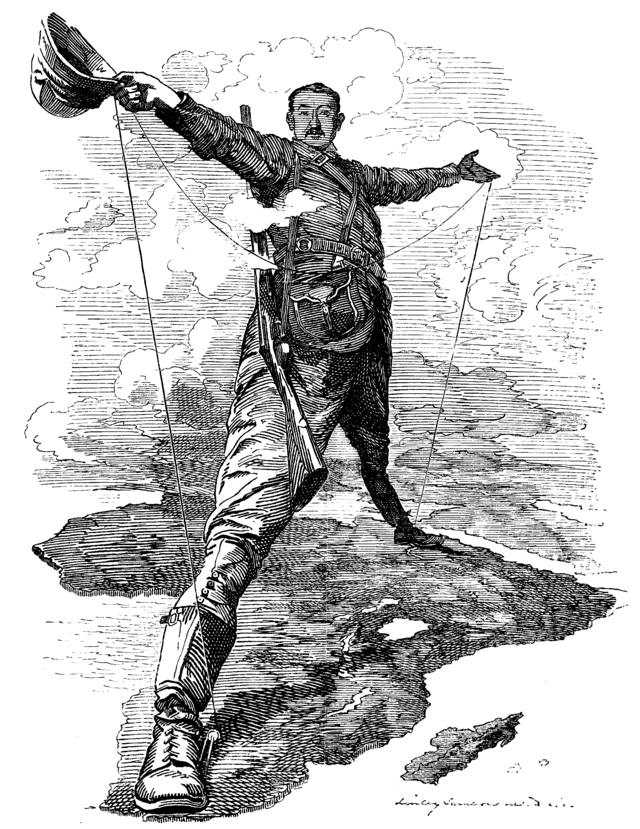
The Colossus That Was Rhodes: Britain's ur-imperialist not only dreamt of constructing a railway from "Cairo to the Cape", but also of expanding the dominion of the Anglo-Saxon powers to encompass the entire planet. A century on, the United States, aided by the United Kingdom, Canada, Australia and New Zealand, has indeed become the global hegemon. The GCSB spy-base at Waihopai is part of that hegemony.

WHAT DO CECIL JOHN RHODES and the Waihopai Spy Base have in common? The answer is: the maintenance of a world in which the Anglo-Saxon powers continue to play a dominant role. Rhodes, the great nineteenth century British imperialist, could not have imagined the raw technological power which installations like the GCSB’s Waihopai Station have added to the imperial mission, but he would have approved – wholeheartedly.
 
He would also have felt entirely vindicated by the current disposition of global economic, military and political power. His vision of the future was one in which the might of the British Empire and the United States had become fused in an Anglo-Saxon imperium to which the rest of the world paid homage.
 
Naturally, Rhodes foresaw the British Empire taking the lead role in this geopolitical drama. In the late nineteenth century, when he was at the summit of his remarkable career, the power of the USA remained veiled. (Although, the exertions of the Civil War, 1861-65, should have alerted Rhodes to America’s prodigious potential.) Even so, his most enduring legacy, the Rhodes Scholarship, was intended to create a special brotherhood of Anglo-Saxon leaders, drawn overwhelmingly from the British Empire and the USA, into whose hands the grand mission of bringing as much of the world as possible under Anglo-Saxon control could be safely reposed.
 
At the heart of Rhodes’ plan to create a global elite lay Oxford University – among whose dreaming spires the Rhodes Trust’s carefully selected scholars were expected to imbibe that noxious mixture of classical idealism, medieval obscurantism and contemporary chauvinism from which the British Empire had been fashioned.
 
Just how toxic this amalgam could be may be judged by Rhodes’ own justification for the creation of Anglo-Saxon hegemony:
 
“I contend that we are the finest race in the world and that the more of the world we inhabit the better it is for the human race. Just fancy those parts that are at present inhabited by the most despicable specimens of human beings what an alteration there would be if they were brought under Anglo-Saxon influence, look again at the extra employment a new country added to our dominions gives.”
 
Rhodes was by no means the only statesman in the British Empire to evince such crude and unabashed racism, and he certainly wasn’t the most peculiar. Not only was New Zealand’s Prime Minister from 1912 to 1925, William Ferguson Massey, a bigoted Orangeman and fervent British imperialist, but he was also a “British Israelite” – a believer in the absurd notion that the inhabitants of the British Isles are descended from one of the lost tribes of Israel and, therefrore, as God’s chosen people, destined to rule the world!
 
It is one of history’s ironies that when men felt free to believe in and give voice to such ideas, full Anglo-Saxon hegemony remained an imperial dream. A century later, with Anglo-Saxon hegemony an accomplished fact, only the most foolhardy British or American statesman would consider drawing the world’s attention to it.
 
Just occasionally however, the world’s reminded of the hegemon’s existence – as when our Prime Minister, John Key, spoke openly of the price of membership of “the club”. He was, of course, referring to New Zealand’s participation in the UK-USA (“Five Eyes”) Agreement alongside Canada and Australia. Although, helping the British and Americans to spy on the rest of the world is very far from being the only “service” members of the Anglo-Saxon “club” are required to provide.
 
Regardless of whether the power contributed is “hard” (military) or “soft” (financial and cultural) members of the Club are expected to keep their subscriptions current. Indeed, it is highly questionable as to whether resignation is even possible. Like the Hotel California, the Anglo-Saxon Club can be a hard place to leave.
 
Contributing To Anglo-Saxon Hegemony: The Waihopai Spy Base.
 
And yet, every January an apparently indefatigable group of protesters gather outside the Waihopai Spy Base to demand its closure and New Zealand’s withdrawal from the Five Eyes Agreement. The sub-text of their annual protest, however, is this country’s long association with the sins of Anglo-Saxon imperialism.
 
The protesters mission is to persuade New Zealanders to disentangle themselves once and for all from Rhodes’ vision: to cease and desist playing even the tiniest role in exerting Anglo-Saxon hegemony.
 
It’s a big ask. Who resigns voluntarily from the club that rules the world?
 
This essay was originally published in The Waikato Times, The Taranaki Daily News, The Timaru Herald, The Otago Daily Times and The Greymouth Star of Friday, 8 January 2016.

Sunday, 26 April 2015

Weep, Zealandia, Weep!

Cry The Beloved Country: Is this really where we are, 100 years after Gallipoli? Is this how far we’ve come? From a bigoted British Israelite and union-buster;  to a “relaxed” golfing partner of the US president and a “playful” hair-fetishist? From dispatching troops to Gallipoli in the name of the King-Emperor; to dispatching troops to Iraq in the name of the “Five Eyes Club”?
 
THERE ARE TIMES when it’s heart-breaking being a New Zealander. This past week has been one of those times.
 
The week began with the deafening drumbeat of ANZAC-related patriotism. Having already alienated a huge number of Australians, the almost obsessive memorialisation of the First World War is beginning to do the same to a growing number of New Zealanders.
 
Among all the individuals responsible for planning the centennial “celebrations” of the ANZAC landings, there was, apparently, no one whose job it was to make sure, one hundred years on, that New Zealanders had a clear idea of the political and economic motives that drove so many human lambs to the slaughter.
 
The historical context out of which some young men volunteered for “the adventure of a lifetime” and some did not (let’s not forget that by 1916 it had become necessary to start conscripting replacement soldiers) has been almost completely elided from the official narrative. Likewise the extraordinary curtailment of civil and political rights that followed almost immediately upon New Zealand entering the conflict.
 
To hear someone like Lieutenant-General Tim Keating, Chief of Defence Staff, couch New Zealand’s participation in the First World War in terms of standing up for the right and the good (just like today in Iraq!) was quite sickening. More than 18,000 young New Zealanders died on the battlefields of that terrible war – not for the right and the good, but for the greater glory and profit of the British Empire and its principal investors.
 
I wonder if Lt-General Keating even knows that William F. Massey, the unelected Prime-Minister of New Zealand in August 1914 (his Reform Party had won a No-Confidence vote against the Liberal’s in 1912) was a member of the British Israelites.
 
This bizarre sect was a curious mixture of religious and patriotic enthusiasm which believed that the British race was descended from one of the lost tribes of Israel, and that the British royal family’s bloodline extended all the way back to King David and King Solomon. The British Israelites were adamant that the English-speaking peoples were divinely ordained to rule the entire world.
 
Born in Ulster, Massey was also a member of the Orange Order, whose compatriots back in Northern Ireland, even as Gavrilo Princip was assassinating the Archduke Franz Ferdinand in Sarajevo, were actively plotting mutiny and rebellion against the pro-Irish Home Rule Liberal Government of Herbert Asquith.
 
Massey’s religious and political bigotry would be drawn into sharper focus as the war drew towards its end and the Reform Party linked up with the newly-formed Protestant Political Association to mobilise voters against the large number of Irish Catholics who had swung in behind the nascent Labour Party.
 
Massey’s hostility to organised labour was prodigious. The crushing of the Waihi Miners’ Strike in 1912, and of the Great Strike in 1913, were among Massey’s first and most enduring contributions to New Zealand’s political history. Working-class Kiwis didn’t call the mounted special constables (drafted in from the countryside to smash the unionists of the “Red” Federation  of Labour) “Massey’s Cossacks” for nothing.
 
I could go on, but hopefully you’ll have some idea already of how little that was “good” or “right” lay behind New Zealand’s participation in the First World War. Indeed, it was only after the outbreak of revolution in Russia in 1917 (and the mutiny of the French army in the same year) that the imperial establishment decided it might be wise to shift its rhetorical emphasis from protecting innocent women and children from the bestial Hun to “defending freedom” and “making the world safe for democracy”.
 
So many lies – and how old they’ve grown! It is nothing less than shameful that so little of the history of the period leading up to the First World War is known to the young New Zealanders who turn out in their thousands to honour the sacrifice of those who they naively believe “died for our freedom”.
 
And what, I physically cringe to think, do those same young New Zealanders now make of their 53-year-old Prime Minister, who has admitted to repeatedly tugging on the ponytail of a 26-year-old waitress?
 
Is this really where we are, 100 years after Gallipoli? Is this how far we’ve come? From a bigoted British Israelite and union-buster;  to a “relaxed” golfing partner of the US president and a “playful” hair-fetishist? From dispatching troops to Gallipoli in the name of the King-Emperor; to dispatching troops to Iraq in the name of the “Five Eyes Club”?
 
And what about the likes of your humble correspondent? That endangered species known as the “Fourth Estate”? Are New Zealand’s journalists, commentators, newspaper columnists and bloggers to be guided now, in the fulfilment of their professional ethical obligations, by the shining example of Rachel Glucina?
 
As I said: These are heart-breaking times.
 
Weep, Zealandia, weep!
 
This essay was originally posted on The Daily Blog of Friday, 24 April 2015.