
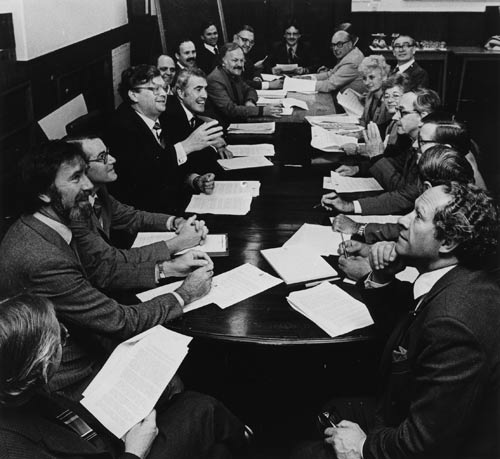
Caucus Takes Charge: Newly elected Prime Minister, David Lange, surrounded by his Cabinet, 1984. Paradoxically, electoral victory often signals defeat for a political party. When Caucus becomes Government the ability of the party organisation to hold its parliamentary representatives to account is fatally weakened.
DOES THE CASTLE STREET BRANCH of the Labour Party still
exist? Back in the 80s it boasted over 400 paid-up members – many of them
academic staff from the University of Otago. The British political scientist,
author and broadcaster, Austin Mitchell, had founded the branch in the early
1960s. Like its counterpart at the University of Auckland, the much more famous
Princes Street branch, Castle Street saw its role as trailblazing progressive
(sometimes radical) policy suggestions well ahead of public opinion: Labour’s
future manifestoes.
Back then progressive/radical reform was synonymous with
social reform: liberalising the laws forbidding abortion and homosexuality;
cutting off contact with Apartheid South Africa, declaring New Zealand
nuclear-free and even decriminalising cannabis. Given the makeup of the
branch’s activist base, discussion of these issues tended to focus not on
whether such changes should be made, but how far they should go.
Then came Rogernomics – and consensus went out the window. A
narrow majority of the active branch members opposed Roger Douglas’s neoliberal
reforms, while a determined and well-connected minority supported them
staunchly. The discussions ceased and the debates that replaced them were
bitter and hard fought affairs. And while the left may have had the numbers in
Castle Street and the wider party, in the only institution that truly mattered,
Labour’s parliamentary caucus, Roger Douglas and his allies continued to hold
sway.
Just how absolutely Labour’s future lay in the hands of its
MPs was driven home to me the night David Butcher put in a guest appearance at
the Castle Street Branch. Naturally, the left-wing members of the branch were
giving the MP for Hastings a very hard time. Most of all they wanted to know
whether he and his colleagues would abide by the party’s firm stance against
the privatisation of state assets.
Butcher’s response chilled me to my bones. The Government,
he said, was implementing the policies the country needed. He would rather lose
his seat than support policies detrimental to New Zealand’s interests.
I knew then that, as a genuine social-democratic party,
Labour was finished.
The only political leverage that the ordinary members of any
party have over their MPs is the threat of deselection. But here, in front of
us, David Butcher was affirming proudly his readiness to lose his parliamentary
seat rather than reverse Roger Douglas’s reforms. We all knew then that
Rogernomics was set to roll on – no matter what the party said or did.
We also knew that division within Labour’s ranks meant
certain defeat. Defeat, in turn, meant National. And by the late 1980s National
was as committed to pushing ahead with neoliberalism as Roger Douglas and David
Butcher. For the Labour Left it was a Lose/Lose scenario. For the Rogernomes,
however, it was Lose/Win. While they might fall as loyal soldiers in the
battle, Neoliberalism itself would triumph.
What has all this, the minutiae of branch life in the Labour
Party of 25 years ago, got to do with the political dynamics of 2014?
As it turns out, quite a lot.
Like the Castle Street Branch of the 1980s, the Labour Party
of 2014 boasts a narrow left-wing majority. That majority, after changing the
party rules, elected David Cunliffe as its leader and is in the process of
constructing a binding policy platform for the next Labour Government. At first
glance, then, the lessons of the 1980s appear to have been learned.
All but one – and that the most important of them all.
Majorities mean nothing outside the only Labour Party institution that truly
matters: the parliamentary caucus. If you cannot control the caucus, then you simply
cannot reassure the party that its best efforts will not be rendered worthless
through the calculated insubordination of a clique of rebellious caucus
members.
This is especially problematic when these insubordinate
rebels (most of whom are securely ensconced in safe Labour seats) believe it
will be easier for like-minded politicians to protect “the policies this
country needs” if David Cunliffe and all that he represents loses the
forthcoming general election.
Butcher’s gambit is as powerful today as it was 25 years
ago.
What are Cunliffe’s options? Obviously the option of splitting
the Labour Party and forming “NewLabour” – the Labour Left’s choice in 1989 –
is not available to the party leader. Which leaves the other option put forward
by Matt McCarten back in 1988.
“It seems obvious to me now that the right-wing MPs have put
their hands up and threatened the party”, Matt told Labour’s president, Rex
Jones. “So we should call a special conference of the party and expel them …
The Labour Party made a mistake selecting these people so sack them. Throw them
out and let them stand against us. They’ll lose and the Labour Party can
rebuild itself.”
“You mad little fucker!” Rex replied.
Maybe. Maybe not.
This essay was
originally published in The Press of Tuesday,
10 June 2014.
