
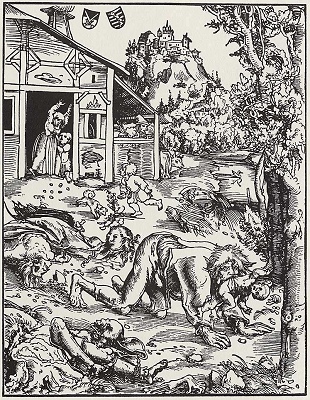
 The Beast in Man: Folklore transports the conflicts of everyday social reality into a world of symbols where they can be more easily confronted and overcome. But the silver bullet that slays the werewolf, or the wooden stake that vanquishes the vampire, are magical, not substantial, remedies. Not even that modern "Philosopher's Stone" - the Internet - can free politicians from their obligation to develop real solutions to real problems in the real world.
SILVER BULLETS; wooden stakes through the heart; Philosophers’ Stones: all magical remedies for monstrous and besetting evils - and all derived from folklore.
Not that the lore of the volk should be despised, for it has much to teach us. But before we can draw any benefit from the tales of old wives, we must first learn how to read them.
The werewolf, for example, speaks to us of the beast that lurks in all men’s hearts.
Running in packs; singling out the weak and vulnerable; killing without mercy or regret; the wolf has for centuries symbolised the rapacious soldiery that laid waste to the fields and villages of a politically and militarily defenceless European peasantry. The only way to "slay" this ravening man-beast? Pay him off.
In symbolic terms: shoot him with a silver bullet.
And the vampire? The demon that does not die, but which feeds forever upon the lifeblood of its victims?
For the exploited and brutalised serfs of Eastern Europe, bled white by a parasitic class of undying aristocratic families, what more appropriate symbol of their condition could there be than the bloodsucking nosferatu?
Two things only could defeat them: the charitable ministrations of the Church; and the time-honoured remedy of assassination and revolt.
The power of the crucifix. Or, the poor man’s sword – a wooden stake – through the heart.
The Philosopher’s Stone – red sulphur – was the mythical catalyst through which, the medieval alchemists insisted, base metals could be transmuted into gold. It was also said to be the Elixir of Life, conferring upon its possessor the gift of eternal youth.
But what else is knowledge – if not the power to take the chaos and ugliness of existence and refine it into order and beauty? And don’t the insights of the wise, when put into words, live forever? Speaking to us down the ages with the same freshness and immediacy as the day upon which they were first committed to paper – or parchment?
The search for, and belief in, magical remedies is an abiding characteristic of the weak and oppressed. Folklore is their way of transporting the unconquerable realities of their lives into a universe of symbols – within which they can more easily be confronted and overcome. Soldiers become werewolves – to be brought down with silver bullets. Aristocrats become vampires – to be impaled. Chaos and ugliness – our base existence – awaits only the transmutative power of the mysterious Philosopher’s Stone.
The folklore of the 21st Century is, of course, very different from that of the Middle Ages. Ours is a more tangible age. We do not like our symbols to change shape or melt away at the touch of the first sunbeam. We believe in electronic magic.
Like the Internet.
In a world dominated by vast and powerful institutions we often feel like atoms flowing at the behest of forces we neither understand nor control. Against the corporate wolf and bureaucratic vampire we hold up the Internet as our very own version of the silver bullet; the wooden stake; the Philosopher’s Stone.
In the waste of lovelessness that is contemporary capitalism, Facebook offers an endless supply of "friends". Amidst all the white noise of corporate communications and PR spin, blogs will make us as powerful as The New York Times (or, at least, The New Zealand Herald).
Not even our politicians are immune.
Just the other day the Labour MP, Clare Curran, announced to readers of the "Red Alert" blog that her party was embarking on a bold experiment: "We want to hear all your ideas, suggestions, and the issues you think are important regards open and transparent government", says Clare. "At this stage any contribution is welcome and valid, no matter how left field."
Welcome to the virtual political party. Not for Labour the irreplaceable human chemistry of the public meeting, the branch debate, the annual conference floor-fight. No. Now you can sit in front of a keyboard and change the world – all by yourself.
No werewolf too fierce; no vampire too terrifying; no metal too base for "OpenLabourNZ"
Forgetting, of course, that politics is always made by those in the room. The real room – not the virtual town hall.
To pay-off the soldier, impale the aristocrat, learn from the wise – you have to be there and do it.
There’s no silver bullet to beat reality.
This essay was originally published in The Timaru Herald, The Taranaki Daily News, The Otago Daily Times and The Greymouth Evening Star of Friday, 7 May 2010.
