

Noises Off: The pretty play of democracy is being slowly but unmistakably overwhelmed by an altogether darker script whose authors - hitherto operating behind the scenes - are increasingly moving their undemocratic action front-of-stage.
THE PRETTY PLAY OF DEMOCRACY goes on as usual. The familiar
characters make their entrances and exits, delivering their lines with more or
less conviction, and the plot, with one or two obligatory surprises, unfolds in
the time-honoured way. Occasionally, the writers experience a moment of sheer
collective inspiration and the audience thrills to the antics of a wholly
original character – this season’s undoubted hit being the inspired and
ebullient Kim Dotcom.
Lately, though, the audience has been distracted by loud noises
off-stage. This is most unusual – and not a little alarming. Because, say what
you like about the script, the production itself has always been first rate.
The actors, costumes, props, backdrops, lighting and sound-effects have (so
far) never failed to enthral. Which is hardly surprising. With the plot being
so familiar, all the other components of a credible theatrical performance are
required to maintain the audience’s willing suspension of disbelief.
But the volume and frequency of all these off-stage
interruptions is making the suspension of disbelief increasingly difficult. The
strong impression of persons moving about; snatches of disconcerting dialogue; strange
silhouettes, and the unmistakeable sound of scenery being dragged into position
has many in the audience convinced that, behind the scenes, another play is in
progress – one they cannot see.
This rival play, unfolding simultaneously (albeit invisibly)
behind the traditional performance is not in the least bit pretty. Indeed, its
themes and characters offer a stark contrast to those we see on-stage.
The official production celebrates democracy and its
characters recall the great politicians of the past. Crucially, the climax of
the official play never varies: the sovereign people declare their preferences
and the democratic process is the winner on the night.
The unofficial play has no place for such political
candy-floss and self-delusion. When its leading characters talk about democracy
they do so with a curled lip and a raised eyebrow – as if only the
intellectually bereft and ideologically deluded could possibly take such an
absurd notion seriously. The themes of the unofficial play are all about power
and greed and individual self-assertion. The only role played by the people is
that of a gigantic ATM. They are presented as an unfailing and inexhaustible
spigot of public wealth for private gain: sovereign only in their ill-directed
generosity and incorrigible gullibility.
In the unofficial play, a sinister combination of politician-bureaucrats
and businessmen-farmers have already met and divvied-up the nation between
them. All are in agreement that their respective
futures depend on controlling the use of and access to New Zealand’s water.
Slowly and methodically, they are re-writing the nation’s laws to exclude all
but their hand-picked allies from the decision-making processes relating to this
crucial resource. Slowly, but very deliberately, they are shielding their
decision-makers from public and media scrutiny. Where resistance has been encountered
they have not hesitated to act – indeed, they have already replaced an entire, democratically-elected
regulatory body with appointed commissioners.
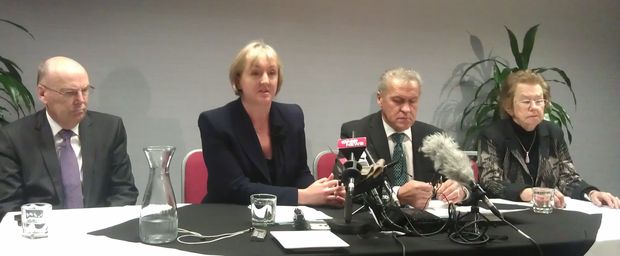
Where resistance has been encountered they have not hesitated to act: The National Government introduces Canterbury Regional Council's unelected commissioners.
In the official play, nothing is more crucial to the survival
of individual liberty and the health of democracy than the sanctity of private
property and the rule of law. In the unofficial play, however, the leading
characters laugh uproariously at these twinned principles. If someone’s private
property stands in the way of one of the many privately-owned, profit-driven
irrigation schemes they have planned for the New Zealand countryside, then they
simply invoke the provisions of the Public Works Act and relieve the owners of
their titles.
To loud objections that the Public Works Act was never meant
to be the handmaiden of private investors, the anti-heroes of the unofficial
drama do their best to assume the appearance of sage and disinterested
legislators. “Yes,” they say, “it is tragic that a handful of homes and farms
must be drowned, but it is also necessary to the long-term economic welfare of
the country as a whole. We must act in the national interest.”
It is precisely this sort of dialogue, breaking through the
reassuring lines of the official political play that is making more and more
members of the audience uneasy – even restive. Through questioning eyes they
have begun to notice how threadbare the official production is looking. What
has become of the play’s familiar props? Have those costumes faded? Why do the
actors seem to be just going through the motions? What’s happened to the
lighting – and the sound? Why can we hear more and more of the other play – and
why is the dialogue so frightening?
The pretty political play of democracy may be a familiar
one, but it has never been made weaker by reiteration. Yes, it’s imperfect,
even naïve, but unless it is performed – and
believed – then the dark shadow-players who have always acted behind the
scenes will grow in power and confidence.
The noises off-stage will become the play itself.
This essay was
originally published in The Press of
Tuesday, 8 April 2014.
