Showing posts with label J R R Tolkien. Show all posts

Saturday, 23 December 2017

The Story Goes Ever On … Merry Christmas To All Bowalley Road Readers!

The road goes ever on and on
Down from the door where it began
Now far ahead the road has gone
And I must follow if I can
- J. R. R. Tolkien

WHEN I WAS LITTLE, Christmas seemed such a big thing. It loomed in my child’s mind as the final, familiar headland, around which the Ship of the Year must pass before dropping anchor on New Year’s Eve.

And it wasn’t just the gathering pace of the festival; the choosing and decorating of the tree, the steadily mounting pile of presents, the arrival of grandparents, aunts, uncles and assorted cousins, that quickened my excitement. Underpinning it all there was an awareness of the Christmas Story itself.

We are so familiar with the biblical narrative now, that it is easy to forget its impact upon the imagination of the very young. For me, the wonder of the story of the Nativity has always been encapsulated in the lines of Oh Little Town of Bethlehem:


Oh little town of Bethlehem
How still we see thee lie,
Within thy dark and dreamless sleep
The silent hours go by.
Yet in thy dark streets shineth
The everlasting light
The hopes and fears of all the years
Are met in thee tonight

That sense of immanence, of something miraculous and terribly important taking place amidst the mundane and the ordinary; of a supernatural presence smashing through the barriers of the workaday world – as it did for those shepherds on the hillside – was incredibly powerful. It was as if a voice was whispering: “Be alert, be awake - there is more to all this than meets the eye!”

To a little boy growing up in the Otago countryside – where at night the stars burn bright and clear - the whole Christmas story glimmered with mystery and magic.

Growing older, I encountered more mystery and magic in another book – J.R.R. Tolkien’s Lord of the Rings. Superficially, Tolkien’s epic fantasy bears little resemblance to the Christian story, and yet, at their heart, the two narratives have much in common. Like the little town of Bethlehem, Tolkien’s ‘Shire’ also turns out to contain within its bucolic borders “the hopes and fears of all the years”. Like those shepherds on the hillside, Frodo Baggins and his friends are also suddenly confronted with supernatural forces that cannot be gainsaid.

The stories are also alike in their endings. In his magisterial essay On Fairy Stories, Tolkien uses the term eucatastrophe to describe that sudden, last minute lurch from ultimate disaster to ultimate victory, when, as Ruth S. Noel writes in her Mythology of Middle Earth: “imminent evil is unexpectedly averted and great good succeeds”. As Tolkien, himself, wrote of the purpose and effect of eucatastrophe: “It does not deny the existence … of sorrow and failure … it denies universal final defeat … giving a fleeting glimpse of Joy, Joy beyond the walls of the world, poignant as grief.”

Even in the resolutely materialistic Communist Manifesto of Karl Marx and Freidrich Engels the eucatastrophe is not entirely absent. For what is the Revolution if not the sudden and unexpected triumph of good over evil? And is there not just a glimmer of immanence in Marx’s heroic proletarians, secretly growing in strength and power, even as Capitalism’s Dark Lords reach out to enslave the world?

“Don’t adventures ever have an end?” cries Bilbo, as he realises the true enormity of the burden he has bequeathed to his nephew Frodo. “I suppose not. Someone else always has to carry on the story.”

And, of course, the old Hobbit is right. For the Story, like the road, goes ever on. Be it the story of the Christ Child, or the Ring of Power, or the Revolution, it beckons all of us “beyond the walls of the world” - to Paradise.

A version of this essay was originally published in The Dominion Post of 21st December 2001.

Wednesday, 5 October 2016

Sleepy Hobbits? Or, Something Worse?

At The Sign Of The Green Dragon: Have we really become “Sleepy Hobbits”? Or, something worse? The Scouring Of The Shire is, arguably, the most important chapter in J.R.R. Tolkien's Lord of the Rings trilogy. Far more than his thrilling depiction of the battles between Wizards, Orcs and Men, it shows how evil is born out of, and fed by, the fear and greed of ordinary, outwardly decent, individuals - even the Hobbits of the Shire.
 
ARE WE “SLEEPY HOBBITS” – or something worse? Certainly, it doesn’t sound very sinister. Martyn “Bomber” Bradbury’s description of the New Zealand electorate seems a lot more like gentle chiding than a full-blown assault. Kiwis are upbraided for their general failure to respond appropriately to the increasingly alarming news reaching their ears. Comparing them to the complacent patrons of Hobbiton’s Green Dragon, Martyn chastises New Zealanders for being much more interested in listening to gossip than hearing news.
 
Martyn’s characterisation acquires greater force, however, if his audience’s only reference point is Peter Jackson’s film version of Tolkien’s Lord of the Rings trilogy. Apparently, growing concerns about the project’s burgeoning length required Jackson to leave out what is, in many respects, the most powerful chapter of the entire trilogy – The Scouring of the Shire.
 
It is only when Frodo, Merry, Pippin and Sam return home that the universal impact of Sauron’s bid for absolute power strikes them. With a rising sense of outrage, and horror, they see that their beloved Shire has been transformed into what Tolkien clearly wants his readers to recognise as an industrial wasteland. Worse still, the Hobbits themselves are in the process of being industrialised. The sturdy peasants and artisans of the trilogy’s opening chapters, along with their aristocratic masters, are on the point of being turned into proletarians. They have been driven from their hobbit-holes and herded into barracks. Trees have been cut down. The old flour mill belches black smoke.
 
Not everyone, however, believes this to be a bad thing.
 
“This country wants waking up and setting to rights … and Sharkey’s going to do it; and make it hard, if you drive him to it. You need a bigger Boss. And you’ll get one before the year is out if there’s any more trouble. Then you’ll learn a thing or two, you little rat folk.”
 
Even some hobbits have succumbed to the new order. Ted Sandyman, the miller, scoffs at Sam’s anguish at the Shire’s obliterated beauty:
 
“Don’t ‘ee like it, Sam? … But you always was soft. I thought you’d gone off in one o’ them ships you used to prattle about, sailing, sailing. What d’you come back for? We’ve work to do in the Shire now.”
 
Given the way Jackson behaved when his “independent contractors” made a bid for better wages and conditions, it is, perhaps, unsurprising that he decided to keep The Scouring of the Shire out of his movie.
 
Tolkien makes it clear that tyranny warrants only one response from those it oppresses: rebellion and revolt. Led by the four veterans of the War of the Ring, the Hobbits rise up against “Sharkey”, the new “Boss”, and overthrow his new order. More importantly, they follow the disease to its source – the Wizard Saruman, whose magic, corrupted by Sauron, has wrought so much havoc, even in the Shire.
 
It is only in Jackson’s movie that the Hobbits (with the obvious exceptions of Bilbo, Frodo, Merry, Pippin and Sam) are portrayed as sleepy and complacent. The film version, similarly, misrepresents the Shire itself. According to Jackson, it is a happy (if utterly powerless) Utopia from which brave souls, very occasionally, venture out, but into which nothing untoward – excepting, briefly, Sauron’s Black Riders – ever venture in.
 
Tolkien’s fantasy is much more realistic. His Shire is not overthrown by rampaging Orcs, but by the fear and greed of its own inhabitants. As the steadfast Farmer Cotton explains to Frodo:
 
“It all began with Pimple, as we call him … and it began as soon as you’d gone off, Mr Frodo. He’d funny ideas, had Pimple. Seems he wanted to own everything himself, and then order other folk about. It soon came out that he already did own a sight more than was good for him; and he was always grabbing more, though where he got the money was a mystery: mills and malt-houses and inns, and farms, and leaf-plantations. He’d already bought Sandyman’s mill before he came to Bag End, seemingly.”
 
If that doesn’t remind New Zealanders of the fate of their own beautiful country, then Martyn’s right, we really have become “Sleepy Hobbits”! Or, maybe, something even worse. Could it be that we, too, have fallen victim to our own Pimples, our own Ted Sandymans? That far too many of us have allowed ourselves to be ordered around by the Shirrifs? The Boss? By Sharkey?
 
We must hope not. Because in our own case – in our own Shire – we cannot rely upon four returning heroes to put things right. “Raising the Shire” is something we will have to do on our own. Forging our own swords. Stringing our own bows. Summoning our own neighbours. Only when we have fashioned our own horns and bugles will we, like Tolkien’s Hobbits in revolt, be able to send their clarion blasts echoing across New Zealand’s fields, towns and cities:
 
Awake! Awake! Fear, Fire, Foes! Awake!
Fire, Foes! Awake!
 
This essay was originally posted on The Daily Blog of Tuesday, 4 October 2016.

Tuesday, 17 November 2015

Such Reckless Hate

Dark Lord? Abu Bakr al-Baghdadi, self-styled Caliph of the Islamic State, preaches an apocalyptic version of Islam in which the allies and the enemies of God engage in a final, climactic battle, which, his followers believe, will signal the beginning of the end of this world. Through its terrifying use of wanton violence, the Islamic State hopes to draw the armies of the West into its very own version of Armageddon, at Dabiq, on the border of Syria and Turkey.
 
“THE WORLD CHANGES, and all that once was secure now proves unsure. How shall any tower withstand such numbers and such reckless hate?” The sonorous language of Tolkien’s Lord of the Rings seems sadly suited to this time of tragedy. When Paris, the City of Light, grows dark with suspicion. And the French people, prime movers and inheritors of the Enlightenment, stand mute with shock before the “reckless hate” of Islamic State.
 
What is it that these killers want? Merely to sow fear and uncertainty among ordinary Frenchmen? To demonstrate their disdain for the fighter-bombers of the French Air Force? To spit in the face of President François Hollande and all the other Nato leaders? Are these haters really as reckless as they seem? Are they truly heedless of the reckoning that must surely follow their bloody assault on the commonplace and innocent pleasures of civilised existence: eating at a restaurant; watching a football match; listening to music?
 
Of course not! There’s a ruthless method to Islamic State’s madness. A chilling logic that informs all their deadly deeds. Violence, cruel and obscene, is the Islamic State’s “Ring of Power”. (If I may be forgiven for drawing, yet again, upon the works of Tolkien.)
 
It is the savage allure of violence – religious and political – that locates the Caliphate’s recruits. Terrible images of beheadings, crucifixions, stonings and mass executions, delivered to impressionable young minds via the Internet. Violence as pitiless and unflinching as that allegedly visited upon Muslims by the accursed “Crusaders”. Violence which exerts a malignant magnetism upon the rootless and alienated children of Muslim immigrant communities scattered across the West.
 
Such is the dark magic that enthrals the terror-masters’ recruits and brings them, across thousands of kilometres, to the blood-soaked lands of the Islamic State. It is there that they learn the “rules” of jihad – holy war – and are bound forever to the dark purposes of Abu Bakr al-Baghdadi’s self-proclaimed Caliphate.
 
And what purpose might that be? In his article “What does ISIS really want?”, published in the March 2015 issue of Atlantic magazine, journalist Graeme Wood observes that there is a temptation, in the West, to conceptualise jihadists as “modern secular people, with modern secular concerns, wearing medieval religious disguise – and make it fit the Islamic State. In fact, much of what the group does looks nonsensical except in light of a sincere, carefully considered commitment to returning civilisation to a seventh-century legal environment, and ultimately to bringing about the apocalypse.”
 
The apocalypse! Yes. Islam, like Christianity, contains within its ranks a growing number of devout, even fanatical, believers in the “End Times”. According to the Islamic State recruiters interviewed by Wood, these end times will begin when the West launches what proves to be a disastrous intervention in Iraq and Syria. In Woods own words: “The Islamic State awaits the army of ‘Rome,’ whose defeat at Dabiq, Syria, will initiate the countdown to the apocalypse.”
 
If Wood is correct (and there have been many challenges to his characterisation of the Islamic State) luring the “Crusaders” to this little town on the border of Syria and Turkey is critical to the unfolding of Allah’s plan for his people. Dabiq may be 300 miles north of Israel’s “Mountain of Megiddo” (Har Meghiddohn in Hebrew) but its theological location is identical. It is held to be the place of the last, decisive, battle between the allies and the enemies of God – Armageddon.
 
But, surely, no rational person could believe that such a battle is anything other than metaphorical? No rational person, certainly. But, in the Islamic State we are not dealing with rational people.
 
Which is not to say that we are dealing with fools.
 
If one’s ultimate objective is to provoke the armies of “Rome” – i.e. the Western powers – into sending an expeditionary force to Syria and Iraq, then what better way than by launching a carefully planned and ruthlessly executed attack which left 132 Parisians dead and more than 350 wounded? President Hollande, anxious to play the role of France’s avenging angel, has already declared “a state of war” to exist between his country and Islamic State. He’s telling the French people that his response to its murderous attack will be “merciless”.
 
The Russian President, Vladimir Putin, whose reputation for ruthlessness and aggression is well-established, is already calling for a combined, Russian-Nato military assault upon the Islamic State. He is determined to avenge not only France’s 132 dead, but also the 224, mostly Russian, individuals who lost their lives when an Islamic State affiliate blasted their airliner to pieces over the Sinai Peninsula.
 
The effectiveness of Islamic State’s strategy of violence is eerily apparent in the current turn of events. As if the “reckless hate” of a real-life Sauron has, indeed, given him the power to rule us all.
 
This essay was originally published in The Press of Tuesday, 17 November 2015.

Monday, 17 August 2015

The Desolation Of Mordor: Tolkien’s Fictional Wasteland Has Nothing On Baotou, The Worst Place On Earth.

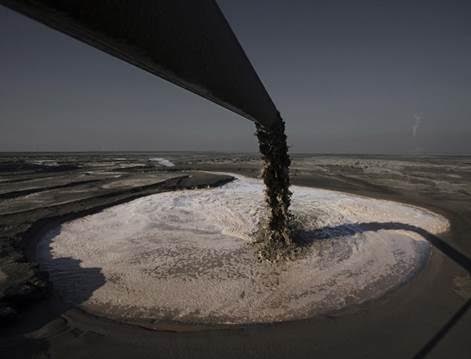
"The Gasping Pits And Poisonous Mounds Grew Hideously Clear." Toxic waste from the processing of rare earths pours into Lake Baotou in China's Inner Mongolia province. This is where 97 percent of the world's rare earths come from. Without them neither our smart phones nor our much vaunted "green technology" would work.
 
IT IS ONE of the most graphic passages in the whole of J.R.R. Tolkien’s Lord of the Rings trilogy. The description of the toxic desert on the outskirts of Mordor. Inspired by the polluted landscapes surrounding Britain’s great industrial cities in his youth, Tolkien employs the waste-dumps of Mordor as a metaphor for the diseased and poisoned nature of the Dark Lord’s character. Just as the ruined land is beyond all rehabilitation, so, too, is Sauron.
 
Here is Tolkien’s description of that terrible place:
 
“They had come to the desolation that lay before Mordor: the lasting monument to the dark labour of its slaves that should endure when all their purposes were made void; a land defiled, diseased beyond all healing – unless the Great Sea should enter it and wash it with oblivion. ‘I feel sick,’ said Sam. Frodo did not speak. 

For a while they stood there, like men on the edge of a sleep where nightmare lurks, holding it off, though they know they can only come to morning through shadows. The light broadened and hardened. The gasping pits and poisonous mounds grew hideously clear. The sun was up, walking among clouds and long flags of smoke, but even the sunlight was defiled. The hobbits had no welcome for that light; unfriendly it seemed, revealing them in their helplessness – little squeaking ghosts that wandered among the ash-heaps of the Dark Lord.”
 
Throughout the fantasy, Tolkien takes great care to reassure his readers that the “free peoples” of Middle Earth are at great pains to stand aloof from Mordor and all its works. If, however, someone were to attempt to describe the political economy of Middle Earth (at the end of the Third Age) it would have to begin with the declining empire of Gondor and its vassal states, Rohan and The Shire. A largely self-sufficient economic entity, such trade as Gondor still engaged in was principally with the Dwarf kingdom located in the Iron Hills, many hundreds of miles to the north. Tolkien hints that Gondor might also have engaged in limited commerce with the kingdoms of the “swertings” – the black-skinned peoples of the south – but only during the period when the Dark Lord was believed to be dead.
 
There can be no doubt, however, that Mordor constituted the economic powerhouse of Middle Earth. Like the ante-bellum South, Mordor boasted vast plantations in which thousands of slaves produced the food and other materials required for its sustenance. Any surplus was traded with the southern kingdoms which had, since Sauron’s return, fallen steadily under Mordor’s sway. Moreover, the Dark Lord’s military build-up, in preparation for his attack upon Gondor, would have required the production of weapons on an industrial scale. Mordor’s hunger for iron and other minerals must have been insatiable.
 
Deconstructing Tolkien’s great tale in this cold-eyed economic fashion is, of course, anathema to LOTR aficionados. The War of the Ring is supposed to be a battle between good and evil, not an economic struggle between a rapidly industrialising, slave-owning tyranny on the one hand, and an economically weak, largely agricultural, kingdom without a king, on the other. Looked at in this fashion, it becomes very clear, very quickly, that without the magical assistance rendered by Gandalf and the Elves, Gondor would have been a gonner.
 
Cold-eyed and economically determined is, however, very definitely the nature of the world in which we are required to live. A world sadly lacking in magical beings dedicated to the protection of fading empires and bucolic farming communities like the Shire. On Planet Earth, the rising power of a tyrannical industrial powerhouse is unlikely to be checked by anything remotely resembling wizards, elves or hobbits.
 
Where Tolkien’s fantasy and twenty-first century reality do intersect, however, is in the environmental degradation attendant upon our high-tech civilisation. The hideous pollution which Tolkien encountered in his youth has, like the factories and mines that created it, largely disappeared from England’s green and pleasant land. But this does not mean that Mordor-like desolation is also a thing of the past. Mordor has merely shifted its location: from the north of England and the midlands, to the seemingly limitless horizons of Inner Mongolia and the horrors of Baotou.
 
Baotou is the global centre of rare earth production: the place from which the minerals that make our post-modern, digitally-driven world possible. Only in China is such an industrial complex possible, because the inescapable environmental degradation attendant upon the extraction of Rare Earths would never be tolerated in the democratic nations of the West.
 
Read how a team of BBC journalists and photographers described their arrival at the man-made “lake” on the outskirts of Baotou. If Mordor is anywhere in this world, then surely, it is here:
 
“We reached the shore, and looked across the lake. I’d seen some photos before I left for Inner Mongolia, but nothing prepared me for the sight. It’s a truly alien environment, dystopian and horrifying. The thought that it is man-made depressed and terrified me, as did the realisation that this was the by-product not just of the consumer electronics in my pocket, but also green technologies like wind turbines and electric cars that we get so smugly excited about in the West. Unsure of quite how to react, I take photos and shoot video on my cerium polished iPhone.”
 
Baotou's Toxic Lake: "Nothing prepared me for the sight."
 
Tolkien’s great fantasy both reveals and conceals the true nature of the world human-beings inhabit. The Ring of Power – symbol of the ruthless instrumentalism through which humankind has subdued the planet – is wonderfully conceived, but its ability to instruct the reader is fatally weakened by Tolkien’s determination to make Good triumph over Evil.
 
The bitter truth, of course, is that all of us wear the Ring of Power, all the time. And all of us are irredeemably engaged in the moral self-destruction that use of the Ring inevitably entails. We New Zealanders may be “sleepy hobbits”, dozing blissfully in our beautiful little Shire at the world’s end, but that doesn’t stop us, when we’re awake, from using the wondrous consumer goods Baotou’s rare earths make possible. Our ease, and the bounteous lifestyle of which we are so proud (and of which the rest of the world is so envious) only exists because somewhere, far, far away, in the barren wilds of Inner Mongolia, giant pipes are continuously spewing their poisonous brew into a lake so ruined, hideous and deadly, that Sauron, himself, would blanche in horror.
 
This essay was originally posted on The Daily Blog of Saturday, 16 August 2015.

Tuesday, 4 August 2015

“What Has It Got In Its Pocketses?” Can Labour Ever Abandon Neoliberalism?

"It Is Mine, I Tell You. My Own. My Precious.": Like Bilbo Baggins, Labour understands that neoliberalism’s ring of power is perilous, and will forever be bending it towards the purposes of its dark transnational masters. And yet, though challenged again and again by the party’s left-wing to let it go, neoliberalism never quite makes it out of Labour’s pocketses.
 
HOW DOES A PARTY abandon neoliberalism? Even if the New Zealand Labour Party wanted to repudiate the ideology that has caused it so much grief – could it?
 
Think about the scene in Tolkien’s Lord of the Rings where Gandalf asks Bilbo Baggins if he’s passed on Sauron’s perilous ring to his nephew, Frodo. Bilbo is quite sure that he has – only to discover that it is still in his pocket. Parting with the Ring of Power is a great deal harder than Bilbo ever imagined. The same appears to be true of neoliberalism.
 
In 2013, for example, at the infamous annual conference Labour held at Ellerslie, there was an attempt made to repudiate the neoliberal legacy of Rogernomics. The party’s Draft Platform: a statement of Labour’s core principles and policies; actually contained a section condemning Labour’s fatal embrace of neoliberalism in the 1980s. By 2014, however, not the slightest trace of the anonymous author’s condemnatory prose could be found in the Party Platform. Somehow, the Ring had found its way back into Labour’s pocket.
 
I have spoken to Labour Party members about the fate of the Draft Policy Platform’s rejectionist section. Who re-wrote it? On whose instructions? Is there any official record of the original language – important for historians, if for no one else? No one has yet been able to satisfactorily answer any of these questions. It’s as if the 2013 attempt to repudiate neoliberalism never happened. (If any reader of The Daily Blog can shed more light on this murky business please do so!)
 
The furore over Jeremy Corbyn’s stunning sprint into first place in the race to replace Ed Miliband as leader of the British Labour Party is another indication of just how difficult jettisoning neoliberalism is going to be. The reaction of the British Establishment has veered wildly between loud guffaws and anguished squeaks. Politicians and journalists cannot make up their minds whether Corbyn’s success constitutes a joke or a threat. Not that it matters. If he wins, the MP for Islington North should prepare himself for the most unrelenting campaign of vilification and ridicule in British history. The members of the British Labour Party, like the people of Greece, are about to learn the hard way that “elections don’t change anything”.
 
As the veteran British political journalist, Andrew Rawnsley, put it in a recent Guardian article:
 
“The big truth that is being exposed by this battle is that Labour is really two parties and they can no longer stand each other’s company. The social democrats despair that those to the left always pull Labour into suicidally unelectable positions from which it takes years to recover before the party sees power again. The socialists rage that the pragmatists make so many compromises in the pursuit of power that it ends up not being worth it. Really, they’d be happier if they could go their separate ways. Then the electorate could choose between an offer from the centre-left and one from further left.”
 
Except that those who despair of the Left’s “suicidal” positions are very far from being “social democrats”. The people Rawnsley dignifies with the title “pragmatists” are actually the defenders of the neoliberal settlement. Their absolute determination to prevent the “socialists” from taking over the Labour Party reveals just how formidable the obstacles to genuine social-democratic change have grown.
 
Not even New Zealand’s adoption of MMP was sufficient to thwart the purposes of neoliberalism. The Alliance, NZ First and the Greens certainly offered New Zealanders a choice “between an offer from the centre-left and one from further left.” While Labour remains the dominant force on the left, however, the parties representing the “further left” face precisely the same conundrum currently taxing New Zealand’s TPPA negotiators. Yes, they can refuse to compromise and remain on the outside looking in. But, if they do, then other parties will, eventually, secure the concessions that would otherwise have gone to them. You gotta be in to win!
 
It’s a conundrum Andrew Little is finding it increasingly difficult to resolve. His caucus retains a good many hangovers from the Rogernomics Era who will be counselling caution on the TPPA. The country, meanwhile, grows increasingly apprehensive about an agreement negotiated in secret, and over whose content they have little or no say. What Labour needs to do is take a position. Either, reaffirm its support for free trade and get in behind the official negotiating team. Or, repudiate TPPA as neither a free nor fair trade agreement. One or the other, please Andrew. Because announcing “bottom lines”, when your party will play no role in sealing the deal, really does sound a bit fatuous.
 
Like Bilbo, Labour understands that neoliberalism’s ring of power is perilous, and will forever be bending it towards the purposes of its dark transnational masters. And yet, though challenged again and again by the party’s left-wing to let it go, neoliberalism never quite makes it out of Labour’s pocketses.
 
This essay was originally posted on The Daily Blog of Monday, 3 July 2015.