
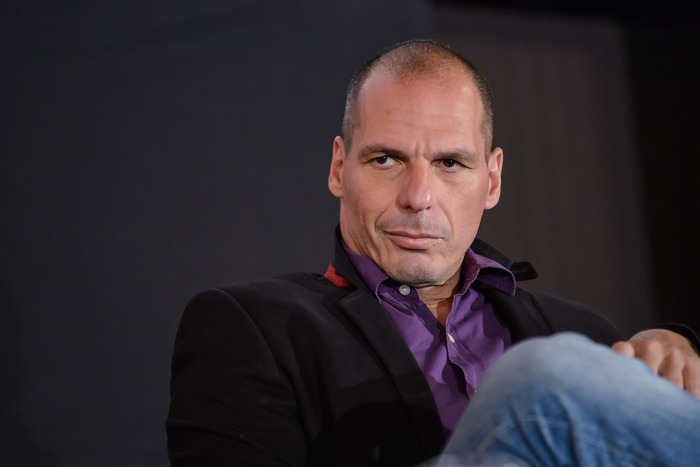
The Face Of The Resistance: Yanis Varoufakis, Greece's Finance Minister, is leading the fight against the European Commission's brutal austerity programme. Policies which, as applied to the Greek people, Varoufakis condemned, memorably, as "financial waterboarding".
“WHERE, OH WHERE is our James Connolly?” I’ve lost count of the
times I stepped forward to ask that question. Every 16 June, for the best part
of a decade, would be my guess. The song was a regular feature of the annual
“Bloomsday” celebration organised by Auckland playwright, Dean Parker. Achingly
sad, the Lament for James Connolly offered
a brief respite from the raunch and laughter more usually associated with these
perennial tributes to James Joyce’s literary hero, Leopold Bloom.
Unlike the central character of Joyce’s celebrated novel, Ulysses, James Connolly was a very real
Irish hero. A staunch nationalist, firebrand socialist, and peerless trade
union organiser, Connolly was the darling of Dublin’s hard-pressed working-class.
Seriously wounded in the Easter Rising of 1916, he was sentenced to death by a
British court-martial. Because he was too injured to stand and face the firing
squad, the British authorities, undeterred, tied Connolly to a chair and shot
him sitting-down.
It is difficult to conceive of an act more calculated to
inspire a nation’s poets and balladeers to passionate outrage. Neither in
Ireland, nor in any station of the great Irish diaspora, has the name of James
Connolly, or the manner of his death, been forgotten. The Lament For James Connolly is always heard in sobering silence.
Yanis Varoufakis is no James Connolly. Far from being the
slum-born son of impoverished immigrants, Greece’s new Finance Minister was
raised in one of Greece’s wealthiest families. Indeed, with his expensive
private education, and his industrialist father’s money, Varoufakis could very
easily have ended up as just one more pampered member of the global 1 Percent. Looking
down at their new-born son 53 years ago, his parents almost certainly did not
see him growing into the firebrand Marxist leader of Greece’s fight against
“financial waterboarding”.
What makes Varoufakis even more remarkable is his former status
as an academic economist. It’s been a very long time since the economics
profession was renowned for producing either firebrands or Marxists. On the
contrary, most contemporary economists seem content to function as the
high-priests of neoliberalism, reconciling the ways of the almighty market to
its hapless human victims. That one of their number has not only turned rogue,
but armed his critical vision with political power is as surprising as it is
encouraging.
And no one can accuse Mr Varoufakis of setting about his mission
in a dull or conventional fashion. His flamboyant disdain for sartorial
convention (he visited the British Chancellor of the Exchequer wearing a
tie-less blue shirt, knee-length riding coat and biker boots) is only matched
by his disdain for the “Troika’s” (European Commission, European Central Bank
and the International Monetary Fund) demand that Greece’s newly-elected
left-wing government adhere to its predecessors’ self-destructive austerity
programme.
After detailing the exploits of the close-cropped and darkly
handsome Varoufakis for the ZDF network, German television news-anchor, Maria
Slomka, commented: “he is someone you could imagine starring in a film like Die
Hard 6”.
That Varoufakis possesses a Bruce Willis-like potential for
blowing things up is something of which Europe’s finance ministers are only too
aware. “Grexit” – or a Greek exit from the Eurozone – is one deeply troubling
possibility. Another, even worse, is “default”. But, as Varoufakis commented on
his blog back in May 2010: “Simple logic dictates that if you cannot even
conceive the possibility of leaving a negotiation, then it is preferable never
to enter one.” In other words, if Europe is unwilling to take what Greece is
offering, then Greece will exercise its right to leave.
Following Finance Minister Varoufakis’s European tour with a
mixture of trepidation and exhilaration, the opponents of neoliberalism in this
country are asking themselves why New Zealand’s opposition finance spokespeople
are so unwilling to embrace the erstwhile Greek professor’s uncompromising
economic radicalism.
One explanation may be found in Varoufakis’s social origins.
Like Franklin D. Roosevelt, whose 1930s “New Deal” policies broke sharply with
economic convention, Varoufakis is a member of his country’s upper class. Being
one of them, he harbours no deep psychological need to win their acceptance.
Indeed, it is very easy to imagine Varoufakis echoing FDR’s famous boast: “They
are unanimous in their hatred for me, and I welcome their hatred!”
Such morale-boosting confidence is also accessible through conviction:
from the certainty that one’s programme is not only the right thing to do, but
that it will also work. It hardly seems fair that Varoufakis has both – in
spades!
Part of the reason for the New Zealand Left being in such a
deep funk at present is the absence of any progressive leader displaying even
half Varoufakis’s confidence and conviction. Thirty years of political
compromises and the ruthless application of a Labour/Green version of the “Tall
Poppy Syndrome” has left this country's hero-deprived Left lamenting: “Where, oh
where is OUR Yanis Varoufakis?”
A version of this essay was
originally published in The Press of Tuesday,
17 February 2015.
