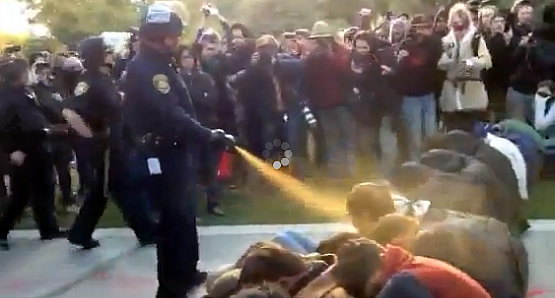
Who Should I Fight? The Police clear Auckland's Aotea Square, inciting anger and frustration. In the end, however, revolutions are not made out of testosterone or adrenalin, but from ideas people are ready to follow. Occupy Auckland identified the problem, but was less than successful in identifying solutions.
I’VE BEEN THERE you know. In that place where you are now. The place where frustration and anger overwhelm reason and the only questions are “How did it happen?” and “Why did it happen?” and “Who should I fight?”
The thing is, you can’t stay there. Frustration and anger are the flames of a mental fire that will consume you – if you let it. And when there’s nothing left to burn: when, politically speaking, you’ve been reduced to embers and ash; what good are you then? To the movement? To your comrades? To yourself?
Where do you think the expression “burned out” comes from?
It’s time to stop now. Time to take stock. Time to think about those questions.
How did it happen? That’s easy. You didn’t have a plan. Occupying Aotea Square wasn’t a plan, it was a beginning: a means to an end; a way of starting a conversation with the people of Auckland. But to have a conversation you’ve got to be ready to do two things: talk, and listen.
You had to be prepared to talk to everyone. Not just to the people who joined you in the Square, but to those who never came anywhere near the Square. And you needed to listen to everyone – including your opponents. How many of you tuned-in to the talkback shows? How many of you rang in? How many wrote letters to the Editor of the Herald? Or contacted Close Up and Campbell Live? How many got on blogs like this one to argue Occupy Auckland’s case?
And what, come to think of it, was Occupy Auckland’s case? That Capitalism is harmful to small furry animals, children, and other living things? That inequality sucks?
Gee! Who knew?
You must have known that simply naming your enemy is never enough. At some point you’ve got to decide how to fight him. I’m pretty sure I’m not the only person in Auckland who struggled to understand how erecting a dozen-or-so tents could ever achieve anything more than drawing people’s attention to the issues of poverty and inequality.
Did you ever think about inviting the Mayor to address one of your General Assembly meetings? Or the Prime Minister? Or the Leader of the Opposition? Did you ever consider asking CTU President, Helen Kelly, what her solutions to poverty or inequality might be? Or the Child Poverty Action Group’s? Or the Maori Women’s Welfare League’s? Or Plunket’s?
Did anyone ever consider asking the Mayor if he and his staff could identify any wasteland in the city that could serve as a camp ground? Or if there were areas that could be turned into community gardens? Did anyone ever think of asking Aucklanders to help Occupy Auckland grow food for families who were struggling to feed their kids? There are lots of good conversations to be had while making a garden.
How did Occupy Auckland end so badly? Easy. Not enough talking, and nowhere near enough listening.
The answer to “Why did it happen?” is even more straight forward.
Public bodies cannot tolerate a permanent challenge to their authority. Eventually they will take measures to demonstrate that they still have the power. You all knew that. I suspect there were some of you who were even looking forward to the City Council proving that it – and not you – had the power. Why? Because then you would have an answer to the third question: “Who should I fight?”
But revolutions are not made with testosterone or adrenalin. They are made by people with an idea so attractive, so compelling, so all-embracing that other people – thousands of other people – will pour into the streets to affirm it. Like they did in Tahrir Square – for Liberty. Like they did in Wall Street – for Equality. As they might have done in Aotea Square – for Fraternity.
If there had been anyone there who understood what it meant – or how to make it.
This posting is exclusive to the Bowalley Road blogsite.