|
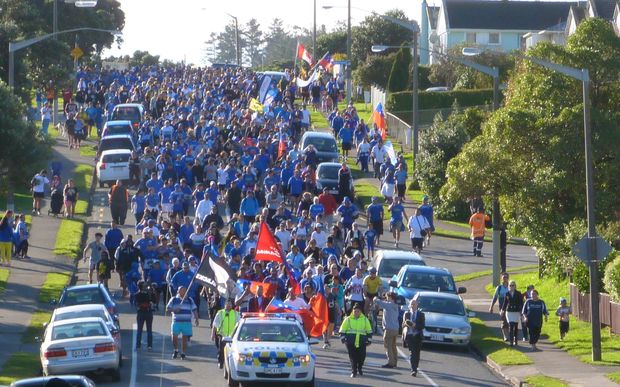
| Faith In The Essentials: Fenced-in, almost literally, by motorways. Located, seemingly permanently, at the bottom of politicians’ priority-lists. Heaped with praise for their cultural vibrancy, but not rewarded for it by the presence of white pupils in their public schools, South Aucklanders (like people of colour everywhere) provide their paler compatriots with all manner of “essential services” – at bargain basement rates. |
IT APPEARED in my Post Office Box last week: a 48-page, text-heavy, publication calling itself “The Real News”. With Auckland once again at Alert Level 3 and the rest of New Zealand at Level 2, this publication should probably be classed as “Objectionable” by the Chief Censor. It is certainly dangerous enough. Filled with just about every conspiracy and anti-vaccination theory currently circulating about the Covid-19 Pandemic, The Real News comes as close to shouting “Fire!” in a crowded theatre as I have encountered in a lifetime of defending free speech.
Just how dangerous efforts like The Real News can be was made clear by the Auckland City Councillor, Efeso Collins. Speaking to Jack Tame on TVNZ’s Q+A current affairs programme on Sunday morning – just three hours into the lockdown – Collins repeatedly warned the viewing audience that a significant number of the Pasifika people he represents believe in one or more of the many conspiracy theories currently circulating in South Auckland.
He warned of the difficulties that lay ahead in convincing his constituents to accept vaccination against Covid-19 – let alone comply with the rules of lockdown. Just a few hours after appearing on Q+A, Collins tweeted that he had received a number of messages urging him to “repent”, and calling upon “the church” to excommunicate him, for supporting a vaccine roll-out in South Auckland. Publications like The Real News, and the people who peddle their lies on social media, have a lot to answer for.
The comment that struck me most forcefully in Collins’ interview with Tame, however, was his almost throwaway statement that there were whole streets in South Auckland where English – as opposed to Samoan, Tongan or Hindi – was a foreign language. In other words, quite literally, the official messages concerning Covid-19 – and the citizen’s role in combatting it – are not being absorbed by a significant percentage of what is, almost certainly, the most volatile epidemiological environment in New Zealand.
South Auckland isn’t just the location of this country’s largest and most important airport. It is also the place where the goods that arrive in the country’s largest city from all over the world are warehoused. Though not many of Auckland’s better-off citizens often do, one can drive for kilometre after kilometre past these vast structures, out of whose high doors pass the big rigs loaded with everything New Zealand no longer makes.
It was the factories these warehouses have largely replaced that provided the original impetus for the Pacific Island migration that in the 1960s and 70s transformed Auckland into the largest Polynesian city on Earth. Though the car-assembly plants have long-since closed down, the Pasifika workforce remains.
Every night, from the suburbs of Otara, Mangere, East Tamaki, Papatoetoe and Manukau thousands of Samoan, Tongan, Cook Island, Maori and South Asian workers head into the heart of Auckland City to clean the offices of its business enterprises large and small. They perform the same role in its schools and universities, its hospitals, and – crucially – its old people’s homes. Yes, that’s right, the frail elderly – Covid’s favourite victims – are increasingly being cared for by members of the crowded migrant communities who reside, out of sight and (until now) out of mind, south of the Auckland isthmus, between the Tamaki River and Manukau Harbour.
Fenced-in, almost literally, by motorways. Located, seemingly permanently, at the bottom of politicians’ priority-lists. Heaped with praise for their cultural vibrancy, but not rewarded for it by the presence of white pupils in their public schools, South Aucklanders (like people of colour everywhere) provide their paler compatriots with all manner of “essential services” – at bargain basement rates.
The American sociologist, Mike Davis, has written a great deal about this phenomenon, most eloquently in his seminal study of Los Angeles, “City of Quartz”. More recently, however, his gaze has been drawn away from the spatial segregation of the races within the great cities of the United States and towards the sprawling super-cities of the Third World. Long before Covid, Davis recognised the terrifying potential of these vast, densely-populated communities to become the Petri-dishes for epidemiological disaster. In his terrifying 2006 study, “Planet of Slums”, Davis writes: “today’s megaslums are unprecedented incubators of new and reemergent diseases that can now travel across the world at the speed of a passenger jet.”
Touching down in South Auckland.
It stretches the imagination to believe that the people of South Auckland are unaware of the roles assigned to them by the dominant culture. Young Pasifika, Maori and South Asians, in particular, eager to participate in the excitement of twenty-first century urban life will feel keenly the limitations of opportunity implicit in their subordinate socio-economic situation. Unless delivered with extreme sensitivity, by people they trust, the messages of the New Zealand State are likely to be received with (at best) scepticism or (at worst) outright hostility. The stark contrast between what the dominant culture says – and what it does – ensures that such resistance is more-or-less baked-in.
If European New Zealanders – “Palangi” – are generally perceived as deficient in their understanding of, and respect for, the distinct and extremely proud cultures of the South Pacific, their receptiveness to suggestions that the pronouncements of politicians and public servants should not to be taken as the last word on reality is understandable.
Among the intensely pious communities of faith in South Auckland this unwillingness to be swayed by the ideas of godless scientists is very strong – as the “excommunication” demands alluded to in Efeso Collins’ tweet attest. Throw the Covid-related social media explosions of racist bullying into the mix, and the ease with which the pedlars of claims that Covid-19 is a hoax – or even a plot – are able to attract followers is readily explained.
If the growing Palangi consensus in favour of making the vaccination of South Aucklanders a priority is not to be perceived by its intended beneficiaries as confirmation of their status as essential – but unreliable – cogs in the big white machine, then Jacinda Ardern and her colleagues are going to have to radically re-jig their communications strategy.
Such an exercise would not only need to address meaningfully the many cultures of South Auckland, but also the easy assumptions and prejudices of the dominant culture itself. It will take more than words, to break through the resentment and suspicion of people who have been treated for far too long as means rather than ends. Deeds will be needed – as proof of the Government’s good faith. A sharp lift in wages and benefits might be a good start.
Without such gestures of good will, Full Court Press, publisher of The Real News, can be assured of a receptive audience for its new magazine. That cannot possibly be in the national interest. The same might also be said about the attitude of the woman I encountered in my local park, just a few hours after Alert Level 3 came into effect.
“I don’t mean to be judgemental, but …”, she growled, glaring balefully at the state house from which the unmistakeable harmonies of Pasifika hymn-singing were rising. For this Epsom matron, the music was evidence that a very clear violation of the Level 3 rules was in progress. I drew two rather different conclusions: that faith could never be dictated to by science – no matter how incontrovertible; and that this problem – if problem it was – had just moved a lot closer to home.
This essay was originally posted on the Interest.co.nz website of Monday, 1 March 2021.