|
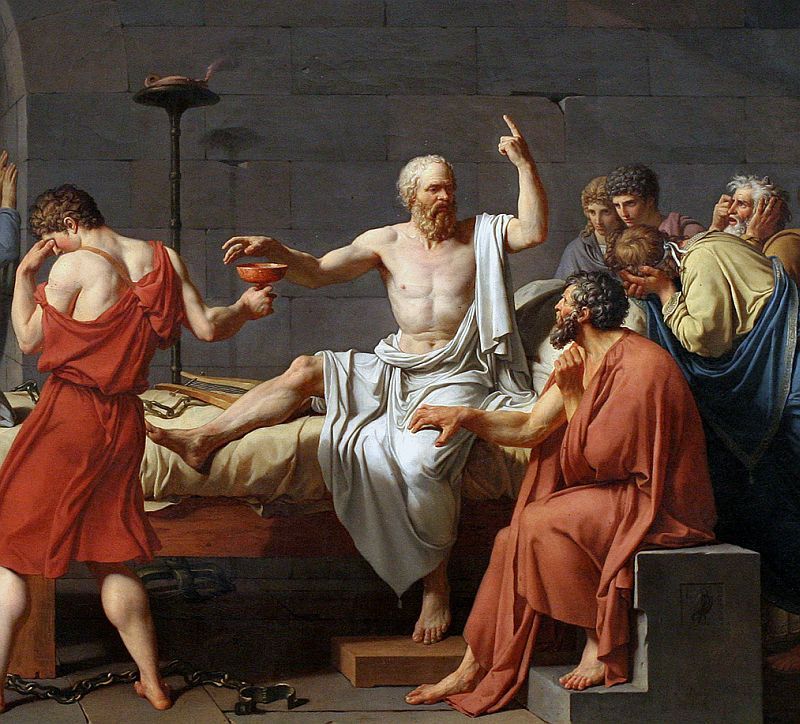
| Socrates Takes The Rap: “Corrupting the youth”, the Athenian philosopher Socrates was convicted and executed for this offence more than 2,400 years ago. It is a sure sign of generational desperation: of the old order’s fear of the values and aspirations of its younger citizens; and of a generation no longer willing to accept the traditions and moral precepts of their parents and grandparents. |
CLASHES between Police and supporters of jailed opposition leader, Ousmane Sonko, have brought the Senegalese capital, Dakar, to a standstill. Convicted of “corrupting the youth” of Senegal, Sonko will not now be eligible to stand against authoritarian President Macky Sall in the next presidential election.
“Corrupting the youth”, the Athenian philosopher Socrates was convicted and executed for the same offence more than 2,400 years ago. It is a sure sign of generational desperation: of the old order’s fear of the values and aspirations of its younger citizens; and of a generation no longer willing to accept the traditions and moral precepts of their parents and grandparents.
There are many older New Zealanders who would gladly bring a charge of corrupting the nation’s youth – if only they could decide who to bring it against. This country has, after all, witnessed two transfers of generational power. From what the political journalist Colin James dubbed “The RSA Generation” to the Baby Boom Generation; and from the Baby Boom Generation to Generation X. It is, therefore, rather difficult to determine with any exactitude who has corrupted whom – and when.
Some would argue (but they would be in their eighties and nineties now) that the rot set in when the almost-a-Baby-Boomer (he was born in 1942) David Lange took over the leadership of New Zealand from that unflinching champion of the RSA Generation, Rob Muldoon (1921-1992). Muldoon had led the backlash against the all-too-brief summer of principled statesmanship and reform unleashed by Norman Kirk’s Labour Government between 1972-74.
For the Baby-Boomers who had languished under the deeply conservative social policies of the three-term Muldoon Government, and clashed with his supporters during the 1981 Springbok Tour, the election of the Lange-led Labour government in 1984 was like the coming of spring after a long and bitter winter. In relatively short order, Lange set New Zealand’s face firmly against Apartheid South Africa, established a Ministry of Women’s Affairs, extended the Treaty of Waitangi’s purview all the way back to 1840, declared his country nuclear-free and effectively withdrew New Zealand from the ANZUS Pact. The Parliament of 1984-87 also passed Fran Wilde’s private member’s bill legalising homosexuality – defying the 800,000 signatories to a petition urging it not to.
But, if Lange’s almost-Baby-Boomer government fulfilled the dreams of anti-Apartheid demonstrators, second-wave feminists, gay-rights activists and anti-nuclear campaigners, it also dutifully followed the advice of the free-market ideologues at Treasury and the Reserve Bank. Advice endorsed eagerly by the corporate free-marketeers represented by the Business Roundtable. This peculiar fusion of social and economic liberalism would march on boldly for the next 40 years under the banners of both major parties.
Certainly, the election of New Zealand’s first unequivocally Baby Boomer Prime Minister, Helen Clark (b. 1950) did nothing to fundamentally modify the neoliberal economic regime established between 1984 and 1993. Neither did her successor, John Key. Be it Labour or National, the commitment to neoliberalism did not waver. As the years passed and New Zealand’s infrastructure, starved of the necessary investment, continued to crumble and decay, the Baby Boomers’ children, Generation X, observed the steady diminution of their prospects and arrived at the grim conclusion that theirs would be the first generation to fare worse than its predecessor – their parents’.
The election of New Zealand’s first Gen-X Labour prime minister, Jacinda Ardern (b. 1980) backed by yet another almost-Baby-Boomer, the NZ First Party leader, Winston Peters (b.1945) took office among dark mutterings about the failure of capitalism and the need to establish a “Politics of Kindness”. For a moment, it appeared as though the policies unleashed by Lange in 1984, and held in place ever since by New Zealand’s bi-partisan Boomer commitment to neoliberalism, would not survive this latest generational transition.
Economically-speaking, however, this hope turned out to be forlorn. Had it not been for the Covid-19 Pandemic, the policies of Ardern’s Gen-X finance minister, Grant Robertson (b. 1971) would have been indistinguishable from those of his mentor, Michael Cullen (1945-2021). The massive increase in state spending forced upon Robertson by Covid did not signal anything more than a temporary concession to a transitory crisis. The Finance Minister’s response to the consequential inflationary surge has been straight out of the neoliberal playbook.
On social policy, however, the Gen-X governments of Jacinda Ardern and Chris Hipkins have evinced a willingness to accommodate what a great many older New Zealanders regard as revolutionary concepts – most particularly in relation to te Tiriti o Waitangi, “co-governance”, the provision of education and health services, and trans-genderism. Though their efforts in terms of social legislation actually passed has been well short of revolutionary, the perception of this government as being excessively “woke” in its social policy ambitions is very strong.
This is curious, because the “far-left” character of what appears to be Labour Government social policy is more properly described as a manifestation of the social-radicalism that has grown steadily in the public service, the judiciary, the professions (especially journalism) and academia since the first of the Baby Boom generation’s politically radicalised graduates began emerging from the universities in the late-1960s and early-1970s. In the fields of race and gender relations, their social radicalism has come to guide state policy no less absolutely than the economic radicalism of the government’s neoliberal advisers.
In academia itself, a key fraction of the radicalised students of the 1960s and 70s would become the teachers, lecturers and professors of the 1980s, 90s and beyond. By the third decade of the Twenty-First Century, the students of the students who undertook “the long march through the institutions” have themselves emerged from the universities, as persuaded of the “truth” of radical sociology and anthropology, as their counterparts across campus about the “truth” of neoliberal economics.
It would seem, therefore, that the Jeremiahs and Cassandras of the RSA Generation were spot-on in blaming the Baby Boom Generation for “corrupting the youth” of New Zealand. Unable or unwilling to confront the economic powers-that-be, they expended their revolutionary ardour upon the deconstruction of their parents’ moral certainties. The final irony of this long-running generational saga lies in how completely moral relativism, spawn of the great “Youth Revolt” of the late Twentieth Century, has, in passing through the hands of its institutional legatees, congealed into the moral absolutism of the hapless children of the Twenty-First.
This essay was originally posted on the Interest.co.nz website on Monday, 5 June 2023.