Showing posts with label Tax Cuts. Show all posts

Saturday, 13 April 2024

In Whose Best Interests?

On The Spot: The question Q+A host, Jack Tame, put to the Workplace & Safety Minister, Act’s Brooke van Velden, was disarmingly simple: “Are income tax cuts right now in the best interests of lowering inflation?”

JACK TAME has tested another MP on his Sunday morning current affairs show, Q+A. Minister for Workplace Relations & Safety, Brooke van Velden, once boasted the only economics degree in New Zealand’s Parliament. Since the general election, however, this select fellowship of the dismal science has been augmented by fellow Act MP, Andrew Hoggard. What he would have made of his colleague’s response to Tame’s seemingly innocent question we can only guess.

The question Tame asked was disarmingly simple: “Are income tax cuts right now in the best interests of lowering inflation?”

If looks could kill, then Tame would have died then and there. Van Velden is a very intelligent woman, so, in the very few seconds she had to formulate a response to Tame’s question, she assessed the consequences of providing him with an honest answer, realised that, in this case, honesty would be absolutely the worst policy, and so, summoning her most earnest tone of voice, and with only the tiniest hint of embarrassment, she replied in the affirmative.

At this point there should have been a very loud klaxon-blast, and the word “WRONG!” should have flashed across the screen – in much the same way as incorrect answers are blasted on the British television show “QI”. Because, as Van Velden, herself, Hoggard, economics graduates everywhere, and even the reasonably well-educated person in the street, knows: cutting income taxes right now is most assuredly NOT in the best interests of lowering inflation.

I was still a teenager in the early 1970s, when inflation began to take off in New Zealand, and I remember asking my father what it was. His answer still stands as the best summation of the phenomenon I have heard. “Inflation”, he said, “is what you get when too much money is chasing too few goods.” Economists can encumber the simplicity of that definition with all kinds of impenetrable jargon; they can make it difficult and mysterious by rendering it algebraically; but, boiled right down, that is what inflation is.

If Tame had asked Van Velden another question related to inflation, her answer would likely have been entirely sensible. Zimbabwe, with a current inflation rate of 55 percent, has just issued a new currency – the “Zimbabwe Gold” (ZiG) – backed, at least partially, by the nation’s gold reserves. For those who remember the hyperinflation of the Mugabe era (I still have a Zimbabwean banknote which promises to pay the bearer, on demand, $100,000 “on or before 31st July 2007”) this will be good news. Certainly, Van Velden, if asked, would applaud the Zimbabwean Government’s efforts. At the very least, Zimbabweans will no longer be forced to rely on American currency for their day-to-day transactions.

As an economist, Van Velden would not hesitate to condemn the idea of putting additional dollars in the hands of people already under severe cost-of-living pressures. She would know that the increased spending power being injected into the economy would inevitably lead to further price rises, as the extra money chased the same quantum of goods and services.

Van Velden would also know that the prospect of tax cuts fuelling inflation would place additional pressure on the Reserve Bank to keep the Official Cash Rate higher for longer – a strategy intended to ensure that the ordinary person’s pockets remain as empty as possible, for as long as it takes to reduce demand and lower inflationary expectations – even at the cost of inducing an economic recession.

Van Velden, wearing her economist’s hat, would also understand that Finance Minister Nicola Willis, in order to avoid the consequences of being seen to replenish the reduced state revenues occasioned by tax cuts by borrowing (the example of the British Prime Minister, Liz Truss, who attempted to do exactly that, is salutary) will have no other option but to slash state expenditure dramatically. The economic and social outcomes of such policies are readily predictable. The recession will deepen, public services will falter, and the population’s pain will intensify.

It is also possible, of course, that throwing the New Zealand economy into a deep recession, and increasing social misery, will bring the inflation rate down dramatically. It is even possible that such a strategy could produce deflation – too little money chasing too many goods – with a resulting fall in retail prices. Those tempted to welcome such a turn of events should ask themselves what falling retail prices are likely to do to business profitability and employment.

It should be clear by now why Van Velden the politician and Cabinet Minister chose to answer Jack Tame’s question as she did. Tax cuts in the midst of historically high inflation and a shrinking economy are not something any responsible government should be contemplating. Had she said as much, however, her comments would be leading every news bulletin and political journalists would be speculating avidly about her own, her party’s, and the Coalition Government’s future.

On the other hand, Van Velden could have thrown all caution to the wind and affirmed that the planned tax cuts were definitely in the best interests of the country, because they would necessitate policies aimed at shrinking the size and responsibilities of the state – something hardline neoliberal economists like herself and her boss, David Seymour, have wanted for a very long time.

Cuts in spending would also reduce the ordinary working family’s room for economic manoeuvre. With more expected of them financially, the importance of holding onto their jobs, which are (just) keeping them afloat, could only grow – making them much less likely to resist their employers’ demands to work longer and harder for less. From Van Velden’s perspective, that can only be good for productivity, good for business, good for the country.

Honesty on that scale, however, would likely have a devastating impact on Act’s performance in the opinion polls. A party that grows increasingly excited at the prospect of a large proportion of the electorate sinking into poverty, economic exploitation, and despair is hardly likely to see its poll numbers rise.

Better by far to engage in a few seconds of outrageous flannelling: “I think [the tax cuts] are. I think they are for those New Zealanders who have really, really, really been struggling […] Giving them that little bit more money in their own back pocket makes it easier for them to keep up with that rising cost of living.”

Bullshit economics, but better-than-average politics. So: Jack Tame vs Brooke van Velden? I’d call it a draw.


This essay was originally posted on The Democracy Project Substack website on Monday, 8 April 2024.

Monday, 7 March 2022

It’ll Take More Than Tax Cuts, Mr Luxon.

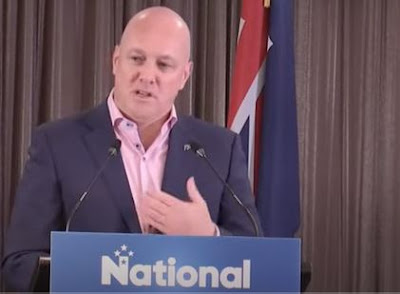
Something Old, Nothing New: In a week when smoke billowed over Kyiv and Wellington, what did National’s Christopher Luxon offer? Tax cuts.


IF EVER THERE WAS AN OPPORTUNITY for a conservative leader to seize the political initiative it was this past week. Seldom, in the post-war period, has there been such a confluence of disturbing and distressing events. War in Europe. Flames in Parliament Grounds. Covid-19 cases surging above 20,000 per day. Petrol prices topping $3.00 per litre.

A forceful demonstration of leadership by the Leader of the Opposition was required. A performance that not only addressed the hurt and confusion of New Zealanders, but also offered them reassurance and guidance.

On Sunday, 6 March 2022, the opportunity for a game-changing “State of the Nation” speech was right there in front of National’s Christopher Luxon.

Why didn’t he seize it? Why was his SOTN address such a limp and uninspiring effort? Political leaders worthy of the name possess an intuitive feel for what is on the voters’ minds. They don’t need a pollster to identify the main topics of conversation at the nation’s dinner-tables, office water-coolers, and public bars.

Given the week we have all lived through, Luxon’s speech should have been about security: what has happened to it, and how it might be restored. That is what the country wanted to hear, but that is not what the country got.

Luxon’s SOTN speech was straight out of National’s “Boiler Plate” file. Conventionally structured, rhetorically flat, and offering a policy package indistinguishable from all the other, equally undistinguished, SOTN speeches delivered over the past five years.

In a week when smoke billowed over Kyiv and Wellington: when New Zealanders had been frightened and angered by a series of shattering and bewildering events; what did National’s leader offer?

Tax cuts.

In a nation confronted with the enormous challenge of actually doing something meaningful about climate change – tax cuts. In a country where the restoration of social cohesion could hardly be more urgent – tax cuts. In a world where the red-lines of international conduct have been obliterated under the tracks of Russian tanks – tax cuts. (Although, to be fair, Luxon did address a few maudlin sentences to the people of Ukraine at the top of his address.)

This was not the speech of a serious – or even a very careful – politician. In his de rigueur castigation of Labour’s “socialism”, Luxon offered up the following anecdote:

“I remember sitting in a modest Moscow flat with a couple in their late 40s on a dark and snowy afternoon. It couldn’t have been clearer that socialism – in terms of Government control of everyday life and lack of rewards for hard work – had abjectly failed and actually created misery.”

Except that the Soviet Union blipped-off History’s screen in 1991 – when Luxon was still a university student. The earliest he is likely to have visited Moscow as an employee of Unilever was sometime after 1993. That would put his Moscow family squarely in the period of Neoliberal “Shock Therapy”. It was a time of accelerated social and economic collapse when millions of Russian workers lost their jobs, their homes, their pensions, and their hopes. The Yeltsin Years, when average Russian life expectancy actually fell.

If you’re going to sing the damnations of Soviet socialism, it helps to belong to a generation old enough to remember it!

The “Moscow Family” story is, however, illustrative of the “paint-by-numbers” approach of Luxon’s speechwriters. Clearly, the National Party possesses no one as talented as John F. Kennedy’s Ted Sorenson, or the US Republican Party’s Peggy Noonan and Pat Buchanan. Even more clearly, Luxon lacks the literary skills of a Barack Obama. The rhetorical genius of a Winston Churchill? … Sadly, no.

Does it matter?

Surely, the preponderance of recent poll data indicates that all Luxon has to do to win in 2023 is to sit still and not be Jacinda Ardern. If he can do that for the next 18 months, then all the smart money is on him becoming New Zealand’s next prime minister. Why draw attention to yourself with grandiose speeches about the state of your country and/or the state of the world? Surely, the offer of modest tax cuts is precisely the sort of small, but ideologically reassuring, gesture that will get National over the line?

Perhaps. If all the indicators pointed to New Zealand emerging from the worst of the Covid-19 Pandemic by the end of the third quarter of 2022, with life rapidly returning to normal by Christmas – well then, sitting still and saying as little as possible probably would be the best strategy. Especially if the fast-fading Covid Crisis throws into sharp relief all the unfinished and unstarted business of the Sixth Labour Government.

But is that any longer a particularly likely scenario? Is it not more probable that the Russo-Ukrainian War, internationally, and the ongoing breakdown of social cohesion, domestically, will foster a much starker, less forgiving, and more polarising kind of politics? A politics of daunting policy options and high-stakes gambles. A politics of fearless saviours and unforgiving avengers. Luxon might just pass muster as the hero of a fluffy Hollywood rom-com, but he hardly makes the cut as a Marvel super-hero.

Certainly, there is nothing in Luxon’s SOTN address to match the tone of Jacinda Ardern’s speech following the extraordinary events of 2 March 2022. This was not a “kind” speech. Indeed, it revealed the Prime Minister’s cold fury at what had transpired on Parliament Grounds. More importantly, it drew attention to the explosion of misinformation and disinformation that had fed the violence on Parliament’s front lawn, and which continues to eat away at the nation’s social cohesion. Something, she warned, that would have to be addressed.

Set forth in Ardern’s speech are the themes that will likely drive the political discourse of the next eighteen months. Perhaps the best way to encapsulate the Government’s new strategy is to cite the title of that greatest of trade union fighting songs: “Which Side Are You On?”

In its essence, it will ask the New Zealand electorate to choose between those who understand how radically the world has changed, and how much the country needs to change if it’s to keep up; and those who refuse to acknowledge that New Zealand is well beyond being restored to something approaching normality by a handful of modest tax cuts.

In the scathing words of Finance Minister Grant Robertson:

“National is still missing in action on a plan for the major issues that will define New Zealand’s future. The speech said nothing about how we will meet the challenge of climate change or seize the economic opportunities that come from a low carbon economy to provide higher wage jobs.”

Luxon will need to lift his game by a significant margin if he is not to find himself and his party positioned on the wrong side of history.

Recalling the first verse of “Which Side Are You On”:

They say in Harlan County
There are no neutrals there.
You’ll either be a union man
Or a thug for J. H. Blair.

If Luxon lets Labour manoeuvre him into the role of J.H. Blair, then he can kiss good-bye his chances of becoming Prime Minister.

To have a fighting chance, he’ll need a lot more than tax cuts.


This essay was originally posted on the Interest.co.nz website of Monday, 7 March 2022.

Monday, 9 April 2018

Should We Mourn Our Cancelled Tax Cuts?

Political Currency: Though they’ll never admit it, the logical consequence of the Taxpayers’ Union’s policies is indistinguishable from that of every other “taxation is theft” outfit: expanding the domain of public pain by deliberately reducing the opportunities for its concerted public amelioration. Like the far-Right American lobbyist, Grover Norquist, they are determined to get the state down to “the size where we can drown it in the bathtub”.

“THIS IS THE WEEK tax cuts introduced in 2017 would have come into effect.”

In reminding us of this fact, Taxpayers’ Union spokesperson, Lois Houlbrooke, laments the Labour-NZF-Green government’s decision to spend money that would otherwise have been returned to “working New Zealanders” on undeserving students and superannuitants.

“It’s as though the New Zealanders doing the most to keep the Government afloat are held in its lowest esteem.”

These “working New Zealanders” (the stock right-wing description of taxpayers as “hard-working” appears to have been discarded) are invited by Mr Houlbrooke to “mourn” the loss of their well-deserved windfalls.

A few years ago, Mr Houlbrooke’s words would have fallen on a host of receptive ears. Today, I’m not so sure. In the months since their new centre-left government was sworn-in New Zealanders have begun to realise what happens when insufficient revenue is collected and insufficient public resources expended on the things that make for a civilised society.

The scandalous condition of the Counties Manukau District Health Board’s facilities, shocking enough in themselves, have raised questions in the minds of citizens throughout New Zealand about their own DHBs. How much urgent remedial work to local health infrastructure has been deferred out of fear of ministerial rebuke? Are Middlemore Hospital’s walls the only ones filled with toxic mould? How many other DHB’s are hiding leaking sewerage pipes?

These “bricks and mortar” problems pale into insignificance, however, when we are confronted with the ongoing crisis in New Zealand’s mental health services. With roughly one in every five Kiwis afflicted with mental illness at some stage of their lives, there are close to a million people out there in need of help which, assuming it can be accessed at all, will (in all but the most acute cases) be intermittent and inadequate. The pain and suffering, not only of the mentally ill, but also of their families and friends, is immense and unending.

The British political philosopher, Maurice Glassman, in his book, Unnecessary Suffering, observes: “The distinction between necessary and unnecessary suffering defines the limits of political rationality. In delineating a domain of pain which is amenable to concerted public amelioration from a sphere of grief that is immutable, it defines the power of society to respond to the miseries of life.”

Though they’ll never admit it, the logical consequence of the Taxpayers’ Union’s policies is indistinguishable from that of every other “taxation is theft” outfit: expanding the domain of public pain by deliberately reducing the opportunities for its concerted public amelioration. Like the far-Right American lobbyist, Grover Norquist, they are determined to get the state down to “the size where we can drown it in the bathtub”.

It’s hard to avoid the conclusion that many in these groups would happily see 99 percent of humanity drowning in there with it, providing the heads of the dominant 1 percent could be kept safely above water.

Seldom has the Labour Party and its ideological allies been presented with a better opportunity to expose the National Party’s propensity to short-change the electorate. Under the rubric of “responsible economic management” (whose discredited mantras Simon Bridges has reiterated all week without shame) money that should have been spent on keeping New Zealand’s social infrastructure fit-for-purpose, was instead presented to the electorate as a financial “surplus” – fit only to be returned to the pockets of “working New Zealanders”.

As one commentator observed: “That’s like putting your household accounts into a healthy surplus by refusing to feed your kids!”

If ever there was a time for Jacinda Ardern and her Finance Minister to walk away from the “responsible economic management” falsehood – it is right now. What New Zealand has been subjected to for the past nine years does not merit the word management; had precious little to do with rational economics; and most certainly wasn’t responsible.

In its place, the Labour-NZF-Green government should pledge to govern New Zealand justly and fairly by raising the taxes required to reduce – swiftly and substantially – the unnecessary pain and suffering of its citizens.

If it didn’t sound so Orwellian, I’d favour the “Tax Heroes” meme contributed to The Spinoff by IRD: “Tax is Love”. Because, in essence, that’s what progressive taxation is all about. Healing our sick. Teaching our young. Helping our poor. Sharing our wealth.

The alternative? The procurement of private advantage through public squalor.

This essay was originally published in The Waikato Times, The Taranaki Daily News, The Timaru Herald, The Otago Daily Times and The Greymouth Star of Friday, 6 April 2018.

Wednesday, 19 October 2016

Buying Civilisation – With Higher Taxes

Jam Tomorrow - Maybe: Last Thursday morning (13/10/16) Finance Minister, Bill English told reporters that the unexpectedly large projected government surplus of $1.8 billion “means we have a few choices we didn’t have in the past”. He did not rule out tax cuts.
 
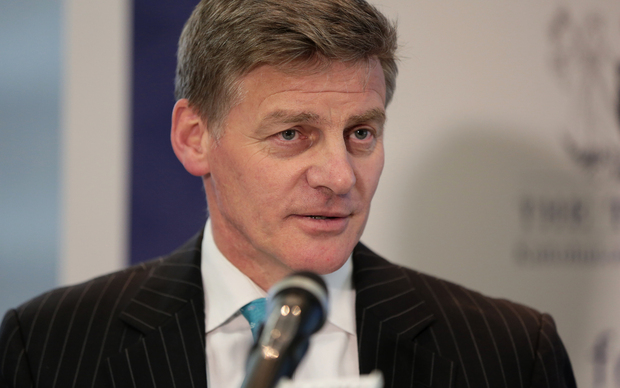
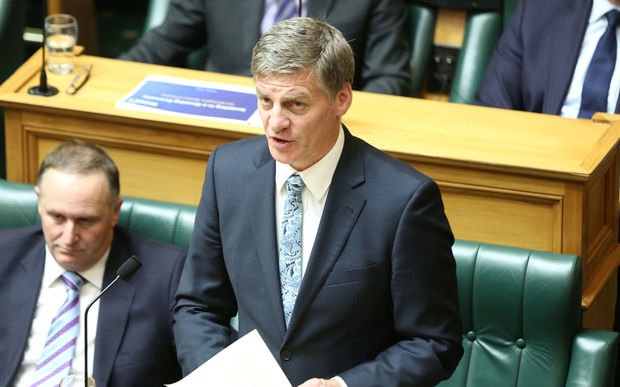
“THERE’S NEVER A BAD TIME FOR TAX CUTS”, was Rodney Hide’s message to Radio Live’s listeners last Thursday afternoon. The Finance Minister, Bill English, appeared to agree. At least, he didn’t rule them out.
 
On Thursday morning, English told reporters that the unexpectedly large projected government surplus of $1.8 billion “means we have a few choices we didn’t have in the past”.
 
Not that the National Party-led government’s fiscal goals: “reduced debt, infrastructure investment, reduced taxes for lower and middle income families”, were about to change. On the contrary, the Finance Minister remained firmly wedded to the view that the best means of achieving his government’s fiscal objectives were “expenditure control and a growing economy.”
 
Civil society’s reaction was swift and unequivocal. The very idea of deliberately reducing state revenue, when additional government spending on crucial social services is needed so urgently, was greeted with dismay.
 
“The government has left, over the last eight years or so, a social deficit, which we are now seeing literally on the streets of Auckland and elsewhere”, was how the Salvation Army’s policy analyst, Alan Johnson, responded to English’s announcement. Adding bitterly that “it doesn't appear to be interested in bridging that deficit.”
 
The NZ Council of Trade Unions’ economist, Bill Rosenberg, was equally aghast at what he identified as the National Government’s strategy of deliberate procrastination and deferral: “You can’t put off dealing with child poverty indefinitely. You can’t put off dealing with a struggling health system indefinitely.”
 
Compelling evidence that the Government’s fiscal stinginess is generating a measurable electoral backlash would lend a deadly cutting edge to Johnson’s and Rosenberg’s criticisms. Unfortunately for the institutions they represent, no such evidence exists.
 
David Farrar, the owner of the National Party’s indefatigable polling agency, Curia Research, averages-out the major polls for his Kiwiblog blogsite. His latest calculations give National 44.3 percent of the Party Vote, to the Labour-Greens’ 42.7 percent. Widespread public revulsion at National’s fiscal strategies would see a Labour-Green government-in-waiting positioned well ahead of its centre-right opponents. It isn’t.
 
If an angry electorate is out there, then the best that can be said is that it’s very well hidden.
 
Clearly, there is a very large constituency for the views on poverty expressed recently by the Police Minister, Judith Collins.
 
Asked how her government proposed to address the link between gangs and childhood poverty, Collins asserted that there was always sufficient money available for New Zealanders in need. What she saw in poor households, she said, was something quite different from material deprivation: “I see a poverty of ideas, a poverty of parental responsibility, a poverty of love, a poverty of caring.”
 
Collins’ remarks were roundly criticised by experts on social deprivation, who dismissed them waspishly as a “middle-class New Zealand myth”.
 
“Forty per cent of children in poverty are in households in paid work”, observed Associate-Professor Mike O’Brien on behalf of the Child Poverty Action Group. “Are we saying there’s a large chunk of parents who are working who are inadequate? That’s hard to sustain. This is not about behaviour. It’s about access to resources, the way we distribute opportunity.”
 
“In some ways [and] at the risk of being simplistic”, said O’Brien, “it’s easier to blame parents rather than doing something about the social and economic setting.”
 
The Associate-Professor is right: it is easier. Which is, presumably, why the National Government goes on doing it.
 
Bill English could inform the country that his surplus is unavailable for tax cuts. That, instead, the extra revenue will be spent on raising benefits, housing the homeless, and refilling the coffers of New Zealand’s cash-strapped health and education services. He could commend to voters the words of the celebrated American jurist, Oliver Wendell Holmes Jnr, who said: “I like to pay taxes. With them, I buy civilization”. But, if he did, how would “middle-class New Zealand” react?
 
Political parties tailor their policies to meet the interests and prejudices of the people who vote for them. As an explanation for poverty, “poor parenting” may infuriate the experts as a “middle-class New Zealand myth”. But, since it is overwhelmingly the New Zealand middle-class that turns out to vote in local and national elections – it’s a myth that counts.
 
On the subject of voting, it is very tempting to paraphrase Judith Collins:
 
“Poverty’s not the problem, it’s people who don’t understand the role of voting in ending poverty, that’s the problem. Poverty persists because these people no longer vote in elections, or even think they should vote in elections.”
 
Poverty plummeted in New Zealand when the working-class poor organised themselves  industrially and politically to end exploitation on the job and deprivation in the home. For their own shot at civilisation, they happily voted for higher taxes. It’s an historical lesson today’s working poor could help themselves enormously by re-learning.
 
This essay was originally published in The Press of Tuesday, 18 October 2016.

Saturday, 28 May 2016

Budget 2016: What Bill English Didn’t Say In His Speech.

Fundamental Changes, Incrementally Advanced: Bill English delivers his eighth budget. The Finance Minister understands very well the degree to which Labour’s room for political manoeuvre has been circumscribed by the events of the past 30 years. It is what gives him the confidence to contemplate policies – such as his “social investment” programme – that will alter fundamentally the way the poor and disadvantaged are managed by the New Zealand State.
 
BILL ENGLISH’S LATEST BUDGET is a masterful exercise in deception. He has done everything he can to mask the effects of the most rapid expansion in New Zealand’s population since the 1970s. The monies allocated to the core centres of state expenditure – Welfare, Health and Education – barely match the rising numbers they are expected to serve. Faced with an intensifying housing crisis, English’s response has been wholly inadequate. Determined to preserve the vital political dividend of rapidly rising Auckland property prices, English and his colleagues have steadfastly refused to address the supply-side of the housing equation. The crash programme of state house construction that would end the crisis must wait for a change of government.
 
All governments take care to tax and spend with an eye to their re-election. It is a rare political party that will sabotage its own chances of remaining in office by threatening the status and wealth of their core constituencies. In the case of the National Party, self-preservation means doing as much as is politically feasible to advance the interests of farmers, businesspeople, managers and professionals. In the case of the Labour Party, it means looking after public sector workers, low-to-middle-income private sector employees, beneficiaries and those elderly New Zealanders more-or-less reliant on NZ Superannuation.
 
English has clearly decided that the best way he can help National’s core constituencies is to retire as much public debt as possible and reduce the New Zealand state to approximately three-quarters of its present size. Dismissing these goals as “purely ideological”, while true, largely misses the point. It is simply what must be done to give National’s supporters what they most want from “their” government: lower taxes for themselves, and higher stress levels for everyone else.
 
This latter goal is a crucial aspect of right-wing politics. Only by consistently reducing the political competency of their electoral rivals’ core supporters can the Right be sure of not only making the gains they seek – but keeping them. Simply maintaining the economic and social status quo is never enough. To keep – let alone advance – the interests of their electoral base, right-wing parties must seize every opportunity to reduce the electoral heft of the Left’s.
 
This right-wing aggression presents social-democratic parties like Labour with a massive dilemma. To advance the interests of their electoral base it is necessary to advance the interests of New Zealand as a whole. Investing heavily in upgrading the nation’s infrastructure; stimulating employment growth; boosting Health and Education; building thousands of state houses and subsidizing private sector house construction: such measures benefit not only Labour’s voters, but also, thanks to their expansionary economic effects, National’s. The balance of political forces is not materially affected.
 
The only way for Labour to consolidate and increase its political advantage is by becoming as aggressive as its right-wing opponents. Providing decisive legislative support for the trade unions and intensifying the progressivity of the taxation system are the traditional methods for boosting the power of the lowest socio-economic groups. Unfortunately, any Labour Government attempting to implement such a programme in today’s political environment would instantly be identified as not only a deadly enemy of the National Party and its supporters, but also of the entire capitalist system.
 
Every weapon in the Right’s extensive arsenal would be deployed against such a government, leaving it with just two choices: submission, or revolution. Our present crop of Labour politicians made that choice a long time ago. Whatever else they may be, Labour’s Caucus are not revolutionaries!
 
English understands very well the degree to which Labour’s room for political manoeuvre has been circumscribed by the events of the past 30 years. It is what gives him the confidence to contemplate policies – such as his “social investment” programme – that will alter fundamentally the way the poor and disadvantaged are managed by the New Zealand State. That the Finance Minister’s changes are being made incrementally will in no way diminish their long-term impact.
 
English and his colleagues are also well aware of the impact their policies are having on the lowest socio-economic groups propensity to participate in the electoral process. Slashing and burning the lives of the poor has not, so far, caused them to mobilise politically (let alone electorally). On the contrary, the increasingly desperate character of their existence has made them easy prey for the three “A’s” of social dysfunction: Alienation, Apathy and Anomie.
 
None of this is acknowledged in English’s Budget Speech, nor, for the most part, in the analyses of the mainstream news media. The Finance Minister’s deception has, once again, proved highly successful. What’s more, his ruthless reduction in the real value of state spending over the past 8 years has, finally, provided him with a series of substantial budget surpluses. These are projected to be of sufficient size for English and Prime Minister Key to offer their core supporters meaningful tax cuts in 2018-19. Any ethical misgivings National’s supporters might be experiencing currently, about the condition of the poor, are unlikely to survive their Finance Minister’s election year munificence.
 
This essay was originally posted on The Daily Blog of Friday, 27 May 2016.