Showing posts with label Westminster System. Show all posts

Monday, 31 October 2022

“Governor” Of The People.

Topsy-Turvy: Justice Minister Kiri Allan has got the direction of power and control in New Zealand completely upside-down.

“AS A GOVERNOR.” That is how Justice Minister Kiri Allan described her political function on TVNZ’s Q+A. Unfortunately, Jessica Mutch McKay, standing in for Jack Tame, allowed Allan’s self-characterisation to pass without comment. Which was a pity, since it is highly unusual – unprecedented even – to hear a cabinet minister describe herself in such a fashion. In New Zealand’s down-to-earth democracy, calling oneself a “governor” is just a little bit weird.

New Zealand has had governors, of course, but not for a while. The Governor of New Zealand ruled in the name of the British sovereign, and was appointed by her government. A territory ruled by a governor may, or may not, be democratic, but everywhere and always their duties are exercised alone. There was only one governor in office at any given time in colonial New Zealand, just as there is only one governor in office at any given time in the USA’s fifty states. Being a governor is a job one does alone.

A semantic storm in a teacup? Well, no, not really. Ask a central government politician from New Zealand what they are, and by far the most common response is (or used to be) “I’m an MP.” Even when that MP was also a Cabinet Minister, it was generally left to others to introduce them as the minister of this, that, or the other. To personally flaunt one’s ministerial status in New Zealand was likely to provoke the observation that so-and-so was “a bit up themselves”.

When first encountered, the bureaucratic practice of always addressing the individual in possession of a royal warrant as “Minister” – in recognition of the office rather than the person – strikes most New Zealanders as excessively and ridiculously posh. The Kiwi instinct is to call politicians by their first and/or last names in preference to their titles. Hence, the present Prime Minister is called “Jacinda”, in exactly the same way that her predecessors were hailed as “Bill”, “John”, “Helen”, “Jim”, “David” and “Rob”. Exceptions were made for public servants, journalists, and those officiating at formal gatherings, because, well, it would be a bit rude not to. Otherwise, informality is the rule.

Parenthetically, this egalitarian informality has always struck the acutely status-conscious Brits as reprehensible. There is a famous story, dating from World War II, about the commander of the New Zealand Expeditionary Force, Bernard Fryberg, who was chastised by the punctilious commander of the British Eighth Army, Bernard Montgomery, for the way he failed to reprimand his men for not saluting senior officers. Unfazed, Fryberg responded by saying: “On the contrary, Sir, I find that if I wave at them, they generally wave back.”

A constitutional purist would, of course, object that Allan, as a member of the Cabinet, is part of the “Executive” which, under the Westminster System, constitutes the most active branch of government. Indeed, when New Zealanders refer to “The Government”, they are usually talking about the Cabinet, acting collectively. If Kiri Allan is engaged in actively governing the country, then why shouldn’t she refer to herself as a “governor”.

The most straightforward response to this question is: because she’s got the direction of power and control completely upside-down.

Historically, the Cabinet evolved out of the King’s or Queen’s council of advisers, that clique of powerful subjects among whom he, or she, distributed the great offices of state through which the realm was administered.

So far, so Henry VIII.

But, history does not stand still. The evolution of Cabinet government reflects the relentless disempowering of the British monarchy by Parliament, and the British people, to the point where, by the Eighteenth Century, its membership was restricted to those seated in the houses of parliament and appointed solely on the advice of the person commanding a reliable majority of the elected members of that parliament.

The New Zealand version of the Westminster System makes the direction of authority even clearer. Since 1950, this country has had only one parliamentary chamber – the House of Representatives. As its name implies, all the members of this “House” have been elected by the people to govern in their name. Meaning that, if anybody in this country has the right to describe themselves as “a governor”, it is the ordinary voter.

Kiri Allan sits at the Cabinet Table because the Prime Minister, Jacinda Ardern, advised the Governor-General, Dame Cindy Kiro, to issue her a ministerial warrant. The Prime Minister has that power because she commands a clear majority in the House of Representatives. If Allan loses the confidence of the Prime Minister, she ceases to be a Cabinet Minister. If Ardern loses the confidence of the House – or the next election – she ceases to be Prime Minister.

So far, so Politics 101.

Which only makes it all the more mysterious that Allan would ever begin a sentence with the words: “As a governor, …” At least until Sunday’s (30/10/22) Q+A, Allan’s reputation has been that of a rough-and-ready woman-of-the-people: someone not known for putting on airs-and-graces, but for being willing to call a spade a bloody shovel – and then use it. If Allan was to describe herself as anything, the smart money would have been on her calling herself the people’s “servant” – not their “governor”.

Certainly, Allan’s announcement – via Q+A – of her intention to go after the liquor industry is very much an example of leading by serving. She is responding to the anger and frustrations communicated to her by city councils and community advocates confronted with the paralysingly expensive legal obstructions erected by the alcohol distributors’ high-priced lawyers. That she is planning to do this by what looks suspiciously like a curbing of due-process (abolishing appeals and cross-examinations) only confirms what some observers describe as an almost reckless determination on the part of the Ardern Ministry to enact its more controversial reforms before the 2023 General Election.

Frustrated by the lethargy and incompetence of the public service; stung by mainstream media criticism; injured by social media attacks; and bitterly aware that its time is running out; the Labour Government is determined to leave a “progressive” legacy – even if it lasts only as long as it takes an incoming National-Act Government to repeal it.

It is even possible that some Labour leaders, and Allan may be one of them, are saying: “We have to give our core supporters at least some of the policies they requested – and we promised – because that’s the only way we can win.” Less optimistic (but possibly more Machiavellian) Labour strategists, by contrast, may counsel forcing National-Act to play the ruthless right-wing reactionaries, this time, so that Labour can win, next time.

If this is the way Labour’s thinking is heading, then Allan’s words are easily explained. People who know they are forcing a majority of the people to accept policies demanded by a minority, will always, under pressure, fall back on the blunt interrogatives of political power: Who has it, and who is willing to use it?

That’s why it is so easy to finish a sentence that begins, “As a governor”, with the words: “it is my will that prevails – not yours.” Easy, but a perilously long way from New Zealand’s egalitarian political traditions.


This essay was originally posted on the Interest.co.nz website on Monday, 31 October 2022.

Thursday, 5 February 2015

Firing Tony Abbott: Whose Job Is It To Make Or Break Australia’s Prime Minister?

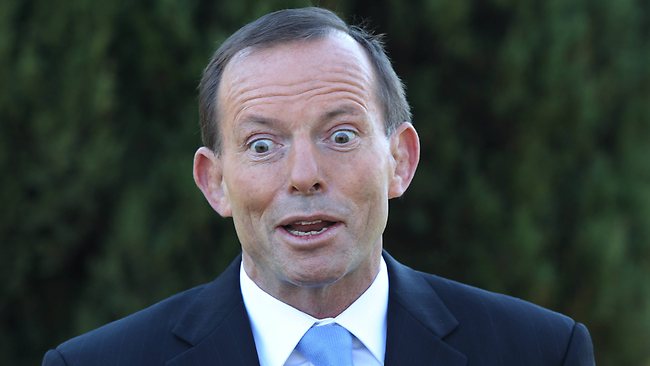
"Awh, Come On, Cobbers - Give Us A Fair Old Suck Of The Sav!"  Tony Abbott’s assertion that he is the government and the government is him, and that the House of Representatives has no right to depose him, is not only absurdly narcissistic but dangerously unconstitutional and undemocratic.

TONY ABBOTT’S QUERULOUS CLAIM that the Australian people, alone, have the right to “fire” him, misrepresents his country’s entire political system. Even worse, it suggests that the Australian Prime Minister has begun to conflate his own narrow personal interests with the broader interests of the nation as a whole. That Australia’s political leader is so heedless of his proper constitutional function is the most vivid proof of that country’s intensifying political difficulties.
 
Abbott’s argument – backed, irresponsibly, by the Murdoch press – is that he has been “hired” by the Australian people on a three-year contract, and that he should, therefore, be protected from any and all leadership challenges until that contract expires at the next election.
 
In other words, Abbott is not really a prime minister at all, but a president. Or, perhaps, given his recent knighting of Prince Philip, a king? He is clearly of the view that effective executive authority in Australia resides not in the Cabinet, whose ministers are drawn from the two elected houses of the Australian parliament, but in his own person. As is actually the case with the USA’s Barack Obama and France’s Francois Hollande, Tony Abbott wrongly believes that the buck of ultimate political responsibility stops with him.
 
Quite where his view of things leaves Australia’s official Head of State, Queen Elizabeth II, and her vice-regal proxy, the Governor-General, is anybody’s guess. The same place, one imagines, as Australia’s long history of representative democracy.
 
Central to that history, and, indeed, to the historical evolution of representative democracy throughout the Commonwealth, is the steady expansion of the constitutional authority of the elected parliamentary chamber: the House of Commons in England and Canada, the House of Representatives in Australia and New Zealand.
 
Nominally, the monarch exercises sovereignty over the realms of the United Kingdom, Canada, Australia and New Zealand. Historically, however, the power of the monarchy has been steadily reduced to the point where the sovereign now reigns but does not rule. It is in the body of elected representatives that sovereignty, for all practical purposes, has come to reside.
 
In both Australia and New Zealand the day-to-day decisions of government are made by the Sovereign’s council of ministers, the Cabinet, chaired by the Prime Minister. But even this powerful organ of executive power is, ultimately, responsible to the elected representatives of the people. The Prime Minister and Cabinet Ministers must be elected Members of Parliament, and remain in office only for so long as they enjoy the support of a majority of the House of Representatives.
 
The political dynamism of the Westminster system, as it has evolved over the past four hundred years, is located in the relationship between the relatively small fraction of the House that sits in Cabinet, and the much larger fraction that does not. This latter group is itself made up of those MPs who mostly vote in support of the Cabinet and those who range themselves in consistent opposition to its policies.
 
The survival of any “Ministry” – as the cabinet selected by the politician commanding a parliamentary majority (i.e. the Prime Minister) is rightly called – is thus dependent on that politician’s ability to retain the loyalty of the MPs who originally gave him or her the job. An effective prime minister, respected by his colleagues and warmly supported by the voting public will have little difficulty remaining in office. A prime minister who loses his colleagues’ respect and who finds him or herself despised by a majority of the electorate will (quite rightly) struggle to keep it.
 
Tony Abbott’s assertion that he is the government and the government is him, and that the House of Representatives has no right to depose him, is, therefore, not only absurdly narcissistic but dangerously unconstitutional and undemocratic.
 
It completely ignores the central reality of the Westminster system: that the Ministry must at all times enjoy the confidence of the House. If, by forfeiting the trust and support of his colleagues in the Liberal Party, Tony Abbott has called the solidity and reliability of his parliamentary majority into question, then his colleagues are perfectly entitled to depose him and install a leader with sufficient support to once again render all questions of confidence moot.
 
Or, as an Aussie Liberal MP might put it behind the closed doors of the Party Room:
 
“Tony, mate, if it was just a question of the punters hiring or firing you, we’d have no problem at all. But, as you well know, that’s not the case. If they want to fire you, sunshine, then, as things now stand, they’ll have to fire the Liberal-National Government as well. That’s us, mate! And, I’m sorry, but if you really expect us to go down with the good ship Tony Abbott, then you’re a bloody mug. With a new Prime Minister and a new Cabinet there’s every chance we can hold onto power well into the future. But, if we accept your version of the constitution, Tony, then this party has no future. So, sorry mate, but we think you ought to call it quits. For the good of the party, Tony. Piss off.”
 
The people don’t elect prime-ministers, parliamentarians do. But, that’s okay, because the  parliamentarians are chosen by the people. In the final analysis, it’s not about them, it’s about us.
 
This essay was originally posted on The Daily Blog of Wednesday, 4 February 2015.

Thursday, 4 December 2008

Oh Canada!


TRY this little thought experiment for me. Imagine that somewhere out there in the big wide world there’s a country a whole lot like ours. It’s ruled by the same Queen, most of its people speak the our language, it’s democratic traditions are of roughly the same vintage, and, along with New Zealand, it has recently come through a general election.

Okay.

Now imagine that this country is in the grip of a constitutional crisis. Imagine that the government of the day, having lost the confidence of the legislature, is seeking to have Parliament prorogued by the Governor-General in order to avoid a Confidence Motion it knows it’s bound to lose. Imagine, too, that the Governor-General has hurried back from an overseas trip to be present in the capital as the crisis unfolds. Imagine the governing party of that country launching radio attack ads against its parliamentary rivals; calling upon its supporters to flood the Governor-General’s office with letters and e-mails; and even proposing a mass pro-Government demonstration outside her official residence. Imagine the country’s trade union leaders responding by calling protest rallies of their own to condemn the Government’s "unconstitutional" intentions.

Okay.

Now answer me this question: "Don’t you think these events warrant a reasonable amount of space in our newspapers? And a reasonable amount of time on our radio and television news broadcasts?"

After all, we are talking about Canada.

I first learned of the crisis engulfing Canadian Prime Minister, Stephen Harper’s Conservative Party Government here, at the World Socialist Web Site. But, for a more balanced view of the unfolding crisis, I would also recommend this link to the Globe & Mail – Canada’s leading daily newspaper.

Stephen Harper, along with the UK Conservative leader, David Cameron, and our very own, newly-elected National Party Prime Minister, John Key, belongs to the "new" generation of English-speaking conservative leaders. Young, telegenic, and studiously non-threatening, this group already controls two out of the four old "White" Commonwealth countries – Canada and New Zealand – and Cameron seems poised to make it three out of four the moment UK Prime Minister, Gordon Brown, gives him the opportunity. (Cynics might say that if you count Australia’s small "c" conservative Labor Prime Minister, Kevin Rudd, it will soon be four out of four!)

What’s interesting about Harper’s reaction to the coming together of his parliamentary enemies, and his potential ouster from power, is its extraordinary and reckless aggression. For the Canadian voter it has been a real shock to see the hitherto mild-mannered, non-threatening Harper suddenly transformed into someone hell-bent on clinging to power at almost any cost – up to and including undermining the constitutional integrity of the Queen’s representative.

It makes me wonder what sort of John Key might have emerged in the days following our own General Election if the numbers had turned out even slightly more favourably for Labour and NZ First. If a Labour, Progressive, Green and NZ First combination had ended up controlling three or four more seats than National, ACT and the Maori Party, what would his reaction have been?

I pose this question because there is an unnerving similarity in the constitutional misrepresentation that went on here in New Zealand over the issue of whether the party winning the largest number of seats had a "moral mandate" to govern, and Harper’s insistence that there is something constitutionally suspect about the Liberal, NDP and Le Bloc Quebecois decision to support a No-Confidence Motion against his government in the Canadian House of Commons.

In both cases, the Right has wilfully misconstrued the essence of the Westminster System prevailing in both countries: that general elections are held to elect parliaments – not governments.

A government is what is formed when a political party, or group of parties, enjoys the "confidence" (i.e. the support of more than half the members) of the legislature. In neither Canada nor New Zealand do the electors choose a prime minister, they choose a member of Parliament and/or a political party to represent their locality and/or themselves. It is these representatives who ultimately decide who the PM will be.

Fortunately, the NZ electorate, by voting in a decisive fashion, was able to avoid the potential constitutional confrontation inherent in the "moral mandate" position. The Canadians have not been so fortunate.

It is frankly scandalous that the New Zealand public has not been permitted to learn about the situation in Canada. The dilemma in which the relatively new and inexperienced Governor General, Michaelle Jean, has been placed is one which could easily be replicated in New Zealand. What is unfolding in Ottawa should be the subject of lively debate among all those New Zealanders with a interest in both understanding and defending their country’s democratic traditions.

The almost total media blackout on this story reflects the entrenched notion in practically all our newsrooms that the English-speaking nations of the world constitute the bench-mark of political normality and stability, and that it is, therefore, quite impossible for them to experience anything as abnormal and destabilising as a constitutional crisis. Our news editors simply ignore (or are ignorant of) the many historical precedents – from the dismissal of Lang and Whitlam in Australia, to the judicial theft of the 2000 US presidential election.

Apparently, constitutional crises only happen in hot countries – like Thailand – and are newsworthy only to the extent that they seriously inconvenience the travelling public.

Worried Canadians on the snow-covered streets of Ottawa might beg to differ.

UPDATE: Dateline Friday, 5th December 2008.

The Canadian Governor-General, Michaelle Jean, yesterday (our time) acceeded to Prime Minister, Stephen Harper's, request that Canada's Parliament be prorogued until January 26th 2009. This link will take you to the Globe & Mail's coverage of the unfolding crisis.