Wednesday, 20 January 2016

Third Term Temptations.

First, Fill Your War-Chest: With its radically innovative and politically transgressive “Future of Work” policy package, Labour should be able to pass the hat around New Zealand’s major enterprises with every hope of receiving more than polite refusals.
 
THE THIRD TERM in Opposition is always the most dangerous. It’s the time when sticking to one’s principles is hardest, and when the blandishments of “professionals” promising easy victories are at their most persuasive. The prospect of another three years in opposition: of feeling powerless and useless; looms ahead of Opposition MPs like a prison sentence. They’ll do anything to escape. To win.
 
In 2016 Labour is in its third term of opposition, and it’s easy to imagine how desperately its caucus is looking for a way out. The party is heading into its hundredth year without a charismatic leader, shorn of just about all of the policies it campaigned on in the 2011 and 2014 elections; and as close to broke as any major party should ever be. What Labour needs is reinvigoration – reinvention even. Otherwise it risks being rejected by the electorate as too old and too irrelevant to make a difference. Yesterday’s party, filled with yesterday’s politicians.
 
Labour’s been here before – most recently in 1998. That, too, was the middle year of a National-led government’s third term, but it’s there that the similarities end. The government of Jenny Shipley was a government of rebels and turncoats and it was deeply unpopular. It was also a government made up of politicians elected under a radically new and different electoral system – MMP.
 
The Bolger-led National Government’s opponents had split their votes between three parties: Labour, NZ First and the Alliance; and most of them expected a government composed of all three. Winston Peters confounded those expectations by throwing in his lot with Bolger – a decision which inflicted near-fatal damage on his party. NZ First’s generosity notwithstanding, however, by December of 1997 Shipley had rolled Bolger and split Peter’s parliamentary ranks in two.
 
The Shipley Government never took. Lacking democratic legitimacy it was widely regarded as a political “dead man walking” towards the 1999 electoral gallows. It’s only hope of survival was the bitter enmity between Labour and the left-wing Alliance, led by Jim Anderton. If these two parties were to contest the 1999 election as rivals, and the Left presented to the voters as hopelessly divided, then there was a chance – a very slim chance – that National could come through the middle.
 
Would Labour risk it? Could Helen Clark beat Anderton’s Alliance into a poor third and win power in its own right? There were those in Labour’s caucus who believed it could, but following the Alliance’s surprisingly strong showing in the Taranaki-King Country by-election of May 1998 (Labour polled 17.53 percent to the Alliance’s 15.46 percent) Helen Clark opted to accept the olive branch offered by Anderton and publically announced Labour’s readiness to form a loose coalition government with the Alliance following the 1999 general election.
 
The rest, as they say, is history.
 
In 2016, is the Labour leader, Andrew Little, also faced with Clark’s 1998 predicament? Is he, too, confronted with the prospect of a National Party Government only too willing to repeat its propaganda victory of 2014, when the Labour/Green/NZ First/Mana opposition (not-to-mention Kim Dotcom) were successfully portrayed as a ship of fools, with everyone rowing in opposite directions? And, if so, does he really have any other option except to follow Clark’s 1998 example and announce Labour’s readiness to form a coalition government with the Greens in 2017?
 
That is certainly the option progressive New Zealanders are hoping Labour will take. Their not unreasonable assumption being that a coalition with the Greens will anchor Labour firmly on the Centre-Left, and decisively weaken the right-wing faction of Labour’s caucus. There are, however, a number of problems with this analysis.
 
First and foremost is the undeniable fact of the Prime Minister’s – and his government’s – still astonishing levels of popularity. John Key is no Jenny Shipley, and his government certainly isn’t cobbled together from rebels and turncoats. Far from being a “dead man walking”, Key’s government shows every sign of robust political health and is more than ready to make a successful bid for a fourth term. It’s a level of confidence that’s likely to keep National’s election war-chest full-to-overflowing (and Labour’s empty). It also serves as a warning to the all-important news media that, as things now stand, changing sides would not be a good idea.
 
In this gloomy context, the recent statements from Grant Robertson make bright and sunshiny sense. With his eyes not on 1998, but 1983, Robertson is readying the Labour Party for another bid to win the backing of big business. Like Roger Douglas before him, he is inviting his party to become, once again, New Zealand’s great political facilitator. Last time it was the Free Market Revolution of 1984-93 that Labour facilitated. This time it will be what the one-percenter luminaries gathering for the World Economic Forum at Davos are calling “The Fourth Industrial Revolution”.
 
It’s an extraordinarily clever move on Robertson’s part. The NZ Herald’s “Mood of the Boardroom” revealed that, while appreciated as a canny election-winner, Key is not regarded as the political and economic innovator New Zealand so desperately needs. With his radically innovative and politically transgressive “Future of Work” policy package, Robertson should be able to pass the hat around New Zealand’s major enterprises with every hope of receiving more than polite refusals.
 
Nor will he be alone. The Greens’ James Shaw is perfectly placed to act as Robertson’s seconder in the nation’s boardrooms. With his assurances that the Greens, too, are committed to developing a whole new political and economic paradigm – one equal to the enormous challenges of the 21st Century – the business community’s fears about the Greens can be sufficiently allayed to make the announcement, at Labour’s hundredth annual conference, of a Red-Green Alliance something big business can welcome – rather than condemn.
 
Will it be enough to defeat the Third Term Blues? Possibly. But it will certainly be enough to render Labour electorally competitive in ways the New Zealand electorate has not seen for 18 – maybe even 33 – years.
 
This essay was originally posted on The Daily Blog of Monday, 18 January 2016.

Tuesday, 19 January 2016

Winston's Choice.

Which Way Will He Go? This is the choice that Winston Peters must make. To go on doing what he has been doing since 1993: dog-whistling softly – but not at a pitch to arouse the entire kennel – so as to secure for himself and his followers a seat or two at the top table. Or: to do what he has all along known he has the power to do – unleash hell upon the New Zealand political class.
 
HOW DOES WINSTON PETERS wish to be remembered? In this, the middle year of John Key’s third term as prime minister, the leader of NZ First must surely be asking himself the same question. Will he be recalled, ultimately, as the gad-fly of New Zealand politics? Memorable for the amount of irritation he was able to cause – but for little else. Or, will all that came before the 2017 General Election be seen, simply, as the necessary preparation for the triumph of his final, finest, hour?
 
His Northland by-election victory, in particular, must be giving him considerable pause. Something was revealed there which can only have sent shivers down the spines of both the National and Labour parties. A vast and inchoate rage, bubbling and churning like magma just below the apparently placid surface of New Zealand politics. There can be little doubt that Peters sensed its presence – hence his unshakeable confidence that the seat was winnable. But, it is doubtful that he foresaw its size and power. On the night of his runaway win, even the wily Mr Peters must have felt a shiver or two.
 
The same sort of shivers, perhaps, that Dr Don Brash felt when he sat on his sofa and watched the National Party record an unprecedented 17 percentage point surge in the Colmar Brunton opinion poll on the strength of his Orewa Speech. Dr Brash’s right-wing populism came within an ace of victory in 2005. The ground heaved and flattened, heaved and flattened, but, crucially, the magma did not break through. New Zealand did not burn.
 
Eleven years on from Orewa, as Mr Peters undoubtedly knows, the target of “Middle New Zealand’s” rage is no longer just “Maori privilege” (although that still rankles). In 2016 the unease is generated by much larger and more profound changes in the shape of New Zealand’s population. If the dominant Pakeha fraction of Kiwi society felt challenged by the Maori Renaissance, it is experiencing the early stages of existential dread about the growing influence of Asian immigration.
 
There is more to this dread that old-fashioned racism. It originates in the pervasive sense that New Zealand is being changed in ways that most New Zealanders have neither asked for nor desired. That decisions concerning their nation’s future have been made on the basis of research and discussion about which most Kiwis remain completely unaware.
 
New Zealand’s turn towards Asia, for example, and the dramatic shift in population policy it required, have never constituted the core of a Labour or National election manifesto. Both of the major parties have, instead, quietly accepted the advice of an elite group of senior public servants and academics that New Zealand must prepare for a multicultural future, and that this option is much to be preferred to the country remaining a singularly misplaced, and increasingly isolated, outpost of European civilisation.
 
NZ First was the only political party to question the wisdom and desirability of the Asian turn – and it was viciously criticised for its pains. Taunts of racism are the political class’s stock response to any individual or organisation foolhardy enough to demand a democratic mandate for a population policy as radical as the one into which New Zealanders have been strapped.
 
Not that the major parties are unaware of the additional heat New Zealand’s unsanctioned population policies are adding to the magma bubbling and churning beneath the surface of its political landscape. Concern over the sale of New Zealand land to foreigners – out of which both National and Labour, as well as NZ First and the Greens, have sought to make political capital – is but the venting of steam and ash.
 
The whole political class is acutely aware that if New Zealanders’ concerns about the changing composition of their society; their worries about the neglect of provincial New Zealand and the growing economic power of Auckland; and their fear that the country’s future is being determined without a democratic mandate; were ever to become the core of a political party’s electoral appeal, then the whole country could erupt.
 
This is the choice that Winston Peters must make. To go on doing what he has been doing since 1993: dog-whistling softly – but not at a pitch to arouse the entire kennel – so as to secure for himself and his followers a seat or two at the top table. Or: to do what he has all along known he has the power to do – unleash hell upon the New Zealand political class.
 
If a single fissure in Northland could lay the Government low, just imagine what a nationwide rupture could do. Yes, New Zealand would burn, but fire is only a bad thing when it destroys what people value. There is much in contemporary New Zealand that its people would happily consign to the flames.
 
This essay was originally published in The Press of Tuesday, 19 January 2016.

Friday, 15 January 2016

"Flexicurity" - The Future Of Work?

The Fictional Realm: Borgen's prime-ministerial heroine Birgitte Nyborg (Sidse Babett Knudsen) is consoled by her Machiavellian spin-doctor Kasper Juul (Pilou Asbaek) in the award-winning drama series from Danish public television. Until very recently one of the world's most progressive states (its current immigration reforms are insupportable!) Denmark is able to run active labour market policies such as "flexicurity" only because the Danish working-class still enjoys effective representation in the country's political system. Would it were so in New Zealand!
 
IF ONLY New Zealand’s politics could be like those of Borgen – the Danish television series. Centred around the actions of a fictional Danish prime minister, Borgen’s politics are realistically riveting. More than this, however, they are rational. Denmark is portrayed as a nation with a conscience: the host of better angels to which, in extremis, Borgen’s heroine (yes, the prime minister is a woman) can successfully appeal. In the fictional realm, at least, the Danes remain the sort of people New Zealanders once believed themselves to be: decent, practical and courageous.
 
In population terms, Denmark and New Zealand are not that far apart: 5.6 million to 4.6 million. They are also similar in possessing large and efficient primary production sectors. Like New Zealand, Denmark’s political history has been strongly influenced by social democracy, with both countries boasting large and historically competitive Labour parties.
 
It is, therefore, unsurprising that left-wing intellectuals and Labour politicians from New Zealand have, from time to time, turned to Denmark for inspiration. In the late-1950s the left-wing political economist and public servant, William B. Sutch, urged Walter Nash’s Second Labour Government (1957-60) to follow the example of the small, highly-productive nations of northern and western Europe by radically increasing the range and complexity of New Zealand’s exports.
 
Excluding the political anomaly of the Rogernomics years (1984-1990), Sutch’s blueprint, albeit much updated and amended, has remained at the core of Labour’s economic thinking ever since.
 
Equally consistent has been the party’s predilection for adapting Scandinavian solutions to New Zealand’s social problems. Until the mass unemployment created by Roger Douglas’s free-market policies rendered the whole subject moot, the David Lange-led Labour Government borrowed heavily from the so-called “active labour market” regimes of the Scandinavian countries – especially Sweden and Denmark. Under the rubric of Grant Robertson’s “Future of Work Commission”, Labour is about to look northward again.
 
The Holy Grail? Grant Robertson's Future Of Work Commission looks set to make "flexicurity" an important part of Labour's 2017 manifesto.
 
Robertson’s buzzword-de-jour is “flexicurity”. As the name of this highly successful Danish policy suggests, the dual objective is to facilitate the maximum degree of labour market flexibility while providing the maximum level of employment security. Employers are offered considerable freedom to hire and fire, but, in return, employees are generously supported through periods of unemployment, and assisted with re-training and re-entering the labour market, by the state.
 
According to the official website of the Danish Government: “Danes are positive about globalisation and do not fear losing their jobs. Rather they seek opportunities for new and better jobs. This is partly ascribed to the flexicurity model which promotes adaptability of employees and enterprises.”
 
Small wonder that Labour’s Future of Work website links directly to this quintessentially Danish solution. In a New Zealand labour market increasingly composed of “independent” contractors, people holding down multiple jobs, part-timers, interns, and the plethora of similarly “precarious” employment relationships, the Danes’ flexicurity policies must have appeared to Grant Robertson in much the same way as the Holy Grail appeared to King Arthur.
 
Unfortunately, Robertson and his advisors failed to read the small print. New Zealand and Denmark have many similarities, but in 2016 they also feature a number of vital differences. In relation to flexicurity, the most important of these is the respective level of union density.
 
As the official Danish website puts it: “The development of the labour market owes much to the Danish collective bargaining model, which has ensured extensive worker protection while taking changing production and market conditions into account. The organisation rate for workers in Denmark is approx. 75%.”
 
The organisation rate for New Zealand workers in 2014 was approx. 19%.
 
It is typical of the contemporary New Zealand Labour Party that it has simply ignored the profound contextual differences between the workers of New Zealand and Denmark. With three-quarters of the workforce organised, the Danish Confederation of Trade Unions is a force in the land. With fewer than one in five New Zealand workers organised, the NZ Council of Trade Unions is in no position to prevent flexicurity turning into a government-backed scheme for employers to hire and fire at will. Presumably, the lone trade unionist on Robertson’s “External Reference Group” pointed this out. Presumably, Robertson wasn’t listening.
 
Borgen’s politics are rational because the balance of social forces in Denmark obliges its politicians to behave reasonably. Labour’s policies of 30 years ago predetermined the future of work in New Zealand: flexibility without security.
 
This essay was originally published in The Waikato Times, The Taranaki Daily News, The Timaru Herald, The Otago Daily Times and The Greymouth Star of Friday, 15 January 2016.

Wednesday, 13 January 2016

"Fear No Ghosts!": Little, Labour And The TPPA.

Crucial Intervention: Helen Clark's highly controversial endorsement of the TPPA struck the anti-TPPA movement like a torpedo amidships and left it dead in the water. It is now rumoured that another former Labour PM, Mike Moore, will lend his not inconsiderable advocacy skills to the promotion of the TPPA
 
ANDREW LITTLE has failed to make Labour’s response to the Trans-Pacific Partnership Agreement (TPPA) a “leadership issue”. It’s a failure that threatens not only Mr Little’s credibility, but also that of the Labour Party itself. As matters relating to the TPPA unfold over the next few weeks, it will become increasingly clear that much more is at stake here than a trade agreement.
 
In part, Labour’s stance on the TPPA has become a matter of protecting legacies. Labour’s embrace of free markets in the mid-1980s necessarily embraced the dogma of free trade. The 1999-2008 Labour Government’s success in negotiating the China-NZ Free Trade Agreement (China’s first with a recognisably “Western” government) is held up as its most important achievement. Certainly, Helen Clark regards the China-NZ agreement as the jewel in the crown of her political legacy.
 
Just how important Labour’s free trade stance is to Ms Clark became clear on 1 October 2015, in New York, when she stood alongside the National Prime Minister, John Key, and joined him in singing the praises of the TPPA. This endorsement by Ms Clark struck the anti-TPPA movement like a torpedo amidships, leaving it dead in the water.
 
Few New Zealanders grasped the significance of Ms Clark’s intervention. As a senior United Nations’ official, she is bound by the strictest protocols from intervening in the slightest way in the domestic politics of a member state. That she was willing to run the risk of being accused of breaching that protocol speaks volumes about how much personal and political capital she has invested in Labour’s continued adherence to free trade policies.
 
If Ms Clark fails in her attempt to become the United Nation’s first woman Secretary General, her intervention in New Zealand’s domestic TPPA debate may well turn out to be one of the deciding factors.
 
It is possible that Ms Clark may not be the only former Labour Prime Minister to enter into the TPPA debate. Rumours are rife that Mike Moore – indisputably New Zealand’s most fervent free-trade champion – is intending, his health permitting, to stump the country in favour of the TPPA. If the rumours prove to be true, then the anti-TPPA campaigners will be faced with a doughty opponent: Mr Moore’s promotional skills are legendary.
 
Ms Clark’s and Mr Moore’s determination to uphold Labour’s free-trade legacy will find ready allies in Labour’s parliamentary caucus. Phil Goff was this country’s leading FTA negotiator with the Chinese and he will not abandon his legacy without a fight. At his side he will likely count Annette King, Trevor Mallard, Clayton Cosgrove and David Shearer. These are not the sort of politicians a Labour leader alienates without consequences – just ask David Cunliffe!
 
It should be clear, from the above, that even if Mr Little does harbour doubts about the wisdom of supporting the TPPA (and that is by no means certain) he faces some pretty daunting obstacles when it comes to expressing them. He and his team of advisers have made a political fetish out of presenting a unified team to the electorate. An open and, in all likelihood, vituperative debate about the merits of opposing the TPPA runs the risk of reopening a multitude of old wounds. If disunity is death, then courting disunity must surely be political suicide?
 
On the other side of the debate stand those within the Labour caucus and throughout the wider party who regard the TPPA as something much more sinister than a simple trade agreement. In particular, the Investor/State Dispute Settlement Process (ISDP) contained in the agreement is seen by many New Zealanders as a mechanism for preventing the TPPA signatories from introducing economic and social measures inimical to the interests of the large, transnational corporations the TPPA appears to have been set up to serve. Not to put too fine a point upon it: the purpose of ISDP is to prevent Labour-type political parties from ever again behaving like Labour-type political parties.
 
The compromise position Mr Little has thrashed out with his colleagues is to reassure the electorate that a Labour-led government would “defy” the TPPA by passing legislation strictly regulating the circumstances in which New Zealand land may be sold to foreigners. Quite why the caucus has agreed to this we can only speculate, especially when a TPPA exemption to the same effect (which Australia, Malaysia and Singapore have already secured) is, apparently, ours for the asking.
 
The faux radicalism offered up by Mr Little and his colleagues on the question of foreign ownership in no way addresses the profound issues arising out of the TPPA’s imminent ratification  – nor is it likely to appease Labour’s critics.
 
At the site of an earlier rebel army’s defeat, Mao Zedong told his faltering troops to: “Fear no ghosts! The past does not return!”
 
Andrew Little should do the same.
 
This essay was originally published in The Press of Tuesday, 12 January 2016.

The Club That Rules The World.

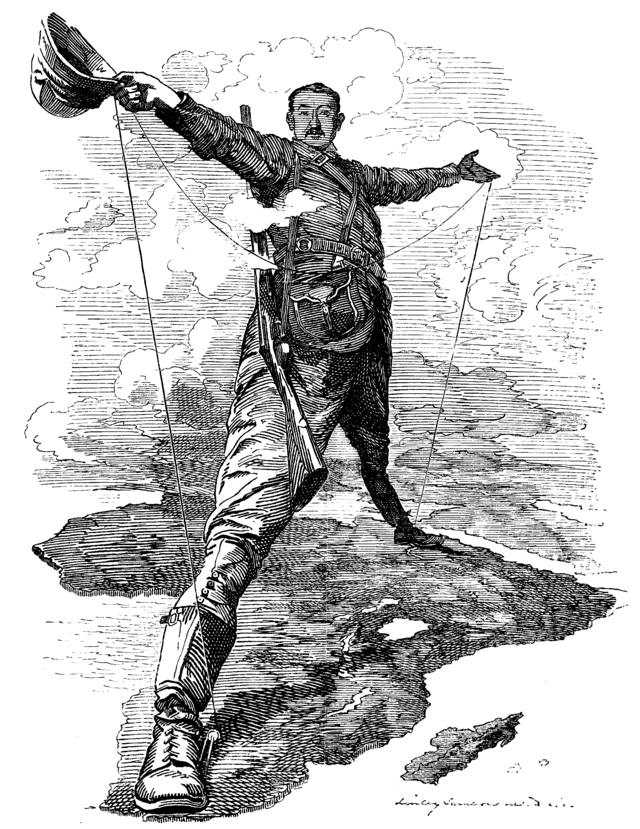
The Colossus That Was Rhodes: Britain's ur-imperialist not only dreamt of constructing a railway from "Cairo to the Cape", but also of expanding the dominion of the Anglo-Saxon powers to encompass the entire planet. A century on, the United States, aided by the United Kingdom, Canada, Australia and New Zealand, has indeed become the global hegemon. The GCSB spy-base at Waihopai is part of that hegemony.

WHAT DO CECIL JOHN RHODES and the Waihopai Spy Base have in common? The answer is: the maintenance of a world in which the Anglo-Saxon powers continue to play a dominant role. Rhodes, the great nineteenth century British imperialist, could not have imagined the raw technological power which installations like the GCSB’s Waihopai Station have added to the imperial mission, but he would have approved – wholeheartedly.
 
He would also have felt entirely vindicated by the current disposition of global economic, military and political power. His vision of the future was one in which the might of the British Empire and the United States had become fused in an Anglo-Saxon imperium to which the rest of the world paid homage.
 
Naturally, Rhodes foresaw the British Empire taking the lead role in this geopolitical drama. In the late nineteenth century, when he was at the summit of his remarkable career, the power of the USA remained veiled. (Although, the exertions of the Civil War, 1861-65, should have alerted Rhodes to America’s prodigious potential.) Even so, his most enduring legacy, the Rhodes Scholarship, was intended to create a special brotherhood of Anglo-Saxon leaders, drawn overwhelmingly from the British Empire and the USA, into whose hands the grand mission of bringing as much of the world as possible under Anglo-Saxon control could be safely reposed.
 
At the heart of Rhodes’ plan to create a global elite lay Oxford University – among whose dreaming spires the Rhodes Trust’s carefully selected scholars were expected to imbibe that noxious mixture of classical idealism, medieval obscurantism and contemporary chauvinism from which the British Empire had been fashioned.
 
Just how toxic this amalgam could be may be judged by Rhodes’ own justification for the creation of Anglo-Saxon hegemony:
 
“I contend that we are the finest race in the world and that the more of the world we inhabit the better it is for the human race. Just fancy those parts that are at present inhabited by the most despicable specimens of human beings what an alteration there would be if they were brought under Anglo-Saxon influence, look again at the extra employment a new country added to our dominions gives.”
 
Rhodes was by no means the only statesman in the British Empire to evince such crude and unabashed racism, and he certainly wasn’t the most peculiar. Not only was New Zealand’s Prime Minister from 1912 to 1925, William Ferguson Massey, a bigoted Orangeman and fervent British imperialist, but he was also a “British Israelite” – a believer in the absurd notion that the inhabitants of the British Isles are descended from one of the lost tribes of Israel and, therefrore, as God’s chosen people, destined to rule the world!
 
It is one of history’s ironies that when men felt free to believe in and give voice to such ideas, full Anglo-Saxon hegemony remained an imperial dream. A century later, with Anglo-Saxon hegemony an accomplished fact, only the most foolhardy British or American statesman would consider drawing the world’s attention to it.
 
Just occasionally however, the world’s reminded of the hegemon’s existence – as when our Prime Minister, John Key, spoke openly of the price of membership of “the club”. He was, of course, referring to New Zealand’s participation in the UK-USA (“Five Eyes”) Agreement alongside Canada and Australia. Although, helping the British and Americans to spy on the rest of the world is very far from being the only “service” members of the Anglo-Saxon “club” are required to provide.
 
Regardless of whether the power contributed is “hard” (military) or “soft” (financial and cultural) members of the Club are expected to keep their subscriptions current. Indeed, it is highly questionable as to whether resignation is even possible. Like the Hotel California, the Anglo-Saxon Club can be a hard place to leave.
 
Contributing To Anglo-Saxon Hegemony: The Waihopai Spy Base.
 
And yet, every January an apparently indefatigable group of protesters gather outside the Waihopai Spy Base to demand its closure and New Zealand’s withdrawal from the Five Eyes Agreement. The sub-text of their annual protest, however, is this country’s long association with the sins of Anglo-Saxon imperialism.
 
The protesters mission is to persuade New Zealanders to disentangle themselves once and for all from Rhodes’ vision: to cease and desist playing even the tiniest role in exerting Anglo-Saxon hegemony.
 
It’s a big ask. Who resigns voluntarily from the club that rules the world?
 
This essay was originally published in The Waikato Times, The Taranaki Daily News, The Timaru Herald, The Otago Daily Times and The Greymouth Star of Friday, 8 January 2016.

Saturday, 2 January 2016

Orbiting A Dying Sun?

A Dying Sun?  Perhaps one hundred years of Labour is enough.
 
AS THE OLD YEAR shuffles towards the wings of the political stage, the Infant Year arrives garlanded with many questions. For those who position themselves on the left of the political spectrum, the biggest of these questions concerns the future of the Labour Party.
 
Love it, or hate it, Labour is the sun around which all the other progressive parties and institutions of New Zealand’s political life must orbit. It’s gravitational pull being inescapable, Labour’s fate, and the fate of the Left in general, are inseparable.
 
Significantly, 2016 marks the centenary of Labour’s birth.
 
In July 1916, in the midst of a monstrous war whose gargantuan appetite had already consumed thousands of young New Zealand lives, representatives of the “democratic public” arrived in Wellington determined that Government plans to conscript men must be accompanied by plans to conscript wealth. The delegates were also seized by the effects of the hitherto all-conquering Liberal Party’s inability to any longer honour its mandate as the democratic public’s principal standard-bearer. Progressive New Zealand was in the mood for something new.
 
The temptation to compare and contrast the Labour Party of 1916 with the Labour Party of 2016 is irresistible. And, no matter how hard the party’s supporters try to convince progressive voters that the opposite is true, it is not an exercise from which Labour emerges with any credit. In 1916, Labour was led by heroes. One hundred years on, perhaps predictably, it is led by colourless political careerists: men and women lacking the character, courage and creative intelligence to be genuine revolutionaries – or even effective reformers.
 
Labour in 2016 is a party dominated by Members of Parliament who seem to be simply waiting their turn to form a government. Labour’s view of politics is, at best, instrumental. Her advisers argue that if the voting public can no longer be inspired (a proposition with which they heartily concur) then it must be manipulated. Cynicism on this scale, however, is only ever successful when backed-up by copious quantities of cash – and the Labour Party of 2016 is broke.
 
Accordingly, about the only thing 2016 has in common with 1916 is the growing sense among progressive voters – the democratic public – that the hitherto all-conquering Labour Party has lost its way.
 
International trends in progressive politics provide considerable encouragement for this point of view. In Europe and the United States there is growing evidence of the emergence of a new progressive paradigm: one which takes as its starting point the necessity of challenging and defeating the dominant neoliberal worldview.
 
2015 began with the stunning electoral victory of the radically left-wing Syriza in Greece, and ended with the much-better-than-expected showing of the equally radical Podemos in Spain’s general election. In September, to the consternation of just about everyone, the radical leftist, Jeremy Corbyn, was elected Leader of the British Labour Party. One month later, the first Democratic Party presidential candidates’ debate in Las Vegas was dominated by the self-proclaimed “Democratic Socialist”, Senator Bernie Sanders, and an at least rhetorically radicalised Hilary Clinton – who promised, incongruously, to “save Capitalism from itself”.
 
Not that the news has been all good for the Left. Syriza’s, and by democratic extension, the Greek people’s, brutally enforced submission to the European Union’s financial diktats offers a terrifying object lesson about the very real dangers inherent in challenging the neoliberal world order. As does the vitriol directed against Jeremy Corbyn, not only by his Tory opponents and the right-wing press, but also by members of his own Labour caucus!
 
Mention Jeremy Corbyn, Bernie Sanders, Syriza or Podemos to the New Zealand Labour Party, however, and you will be met with a mixture of impatience and hostility. As if New Zealand is in any way comparable with the UK, the USA, or Europe! As if this country has ever before fallen victim to political trends originating in these utterly alien cultures!
 
The year following the Labour Party’s foundation, revolution erupted across the Russian Empire. Labour’s leaders in New Zealand were excited, enthralled and inspired. That dour Scot, Peter Fraser, who was later to become New Zealand’s 24th Prime Minister, proudly proclaimed that: “If I was in Russia, I’d be a Bolshevik!”
 
Can anyone imagine Andrew Little proclaiming: “If I was in Greece, I’d be a member of Syriza!”
 
Perhaps one hundred years of Labour is enough?
 
This essay was originally published in The Waikato Times, The Taranaki Daily News, The Timaru Herald, The Otago Daily Times and The Greymouth Star of Saturday, 2 January 2016.

Happy New Year Bowalley Road Readers!

 
May 2016 bring happiness and fulfilment to all the readers of Bowalley Road.
 
This posting is exclusive to Bowalley Road.