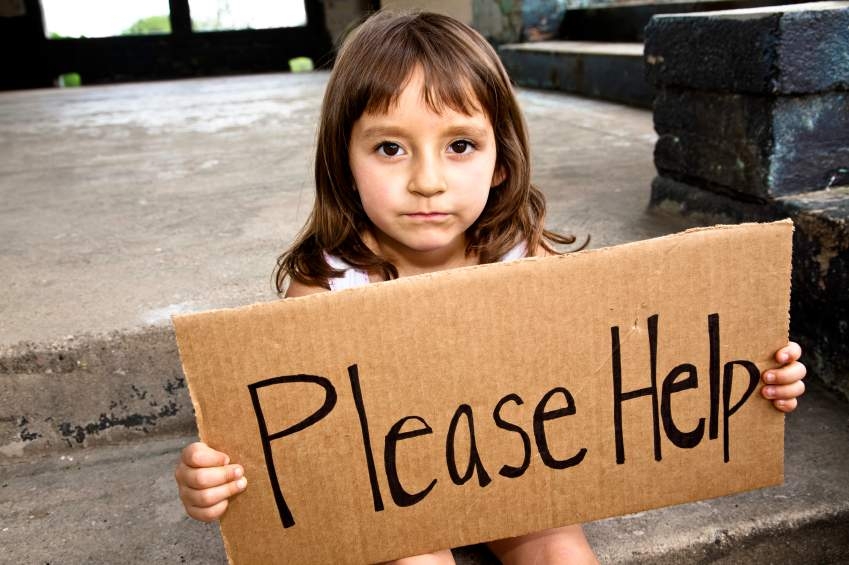
Showing posts with label Child Poverty. Show all posts

Saturday, 4 September 2021

Staying Focused: Why Labour Still Won’t Help The Poor.

Still Waiting: Triennium after triennium, this tawdry charade goes on. Labour’s leaders speak of rescuing the poor, not because they have any intention of doing so – the poor don’t even register such promises anymore – but because Labour knows that the kind, well-educated women voters, who now constitute its electoral core, get a kick out of supporting a party that talks about helping the poor – just so long as it doesn’t help them too much.

SUSAN ST JOHN’S latest cri de cÅ“ur laments the dire straits in which New Zealand’s poorest citizens still find themselves. As she has so many times before, Susan attacks the criminal inadequacy of state assistance programmes and reaffirms the sheer impossibility of private charities taking up the slack. But, once again, she fails to explain why this government, like the governments which preceded it, simply will not take the steps necessary to substantially improve the lives of the poor.

There must be a reason why a government with an clear majority of parliamentary seats, facing the worst Opposition in a generation, with the perfect excuse of a global pandemic, will still not take the drastic actions necessary to rescue its most vulnerable citizens. What is it that Jacinda and her advisors know, that Susan and all who think like her don’t know? What are the transcripts of Labour’s focus groups telling the Prime Minister that she remains so immoveable? Why, in spite of her many, many promises, does Jacinda’s government refuse to act?

It must be bad – really bad. Those focus groups must be registering consistent hostility to the sort of policy shift necessary to lift the poor and their children out of poverty. Almost certainly, that hostility is born of the focus group moderators’ honestly setting forth what it would take to make a real difference. The participants are presumably being told that such a massive redistributive effort could not be responsibly undertaken without a comprehensive increase in taxation. They’re talking Income Tax hikes, a Capital Gains Tax, a Wealth Tax, a Land Tax, maybe even a Financial Transactions Tax.

This is not the sort of news that goes down well among the 400,000 former National Party voters who gave Jacinda her absolute majority. Hell, it’s not the sort of news that goes down well among the well-heeled, Labour-voting professionals who inhabit the leafy suburbs of New Zealand’s largest cities.

There will be some in those focus groups, more honest than the other participants, who will flat-out refuse to countenance such a policy-shift as contrary to their self-interest. Others, less honest, will insist that it simply wouldn’t work. “You can’t make a poor man rich by making a rich man poor.” Redistribution of wealth on such a scale would be dismissed as counterproductive. “It would disincentivise the most productive citizens on behalf of the least productive.” Inevitably, someone would mention Venezuela.

How many times have we been here? How often have we rehearsed these arguments? Jacinda will be guided by the reports of her focus group moderators because she knows they summarise the attitudes and intentions of the New Zealanders who vote.

If she knew for a fact that the New Zealanders Susan St John so tenaciously goes to bat for would turn out in their hundreds-of-thousands to support a government that supported them, then Jacinda and her Finance Minister might just consider pissing-off a large number of Labour’s most loyal voters. But election after election, the psephologists’ scholarly judgements remain the same: the poor don’t vote. Or, at least, not in numbers to justify Labour going out on a limb for them.

Labour will go out on a limb, however, for the voters once fêted as the heart and soul of the New Zealand working-class. Skilled workers and tradespeople: the people (oh, bugger all this gender neutrality) the men once referred to as “the aristocracy of labour”; the men who used to dominate the trade unions – and the Labour Party. These men were big on “the dignity of labour”, but had no time at all for those who “bludged” off others. Back in the day, when Labour activists could still say such things, they would happily declare: “He who does not work, neither shall he eat.” These men were all in favour of giving workers down on their luck a hand-up. But, allowing fit and healthy workers to live indefinitely off state hand-outs, that they did not favour.

In the twenty-first century these mostly Pakeha men are more likely to be found running small businesses than working in a factory. That they still vote for the Labour Party is probably out of a lingering nostalgia for the days when their fathers and grandfathers were the heart and soul of the party. It’s their way of doffing a cloth cap no longer worn, to a white working-class that no longer exists. But, just let Jacinda threaten to raise their taxes and that nostalgic vote will disappear in an instant. National and Act are always just a polling-booth away.

And so, triennium after triennium, this tawdry charade goes on. Labour’s leaders speak of rescuing the poor, not because they have any intention of doing so – the poor don’t even register such promises anymore – but because Labour knows that the kind, well-educated women voters who now constitute its electoral core get a kick out of supporting a party that talks about helping the poor – just so long as it doesn’t help them too much.


This essay was originally posted on The Daily Blog of Friday, 3 September 2021.

Wednesday, 19 October 2016

Buying Civilisation – With Higher Taxes

Jam Tomorrow - Maybe: Last Thursday morning (13/10/16) Finance Minister, Bill English told reporters that the unexpectedly large projected government surplus of $1.8 billion “means we have a few choices we didn’t have in the past”. He did not rule out tax cuts.
 
“THERE’S NEVER A BAD TIME FOR TAX CUTS”, was Rodney Hide’s message to Radio Live’s listeners last Thursday afternoon. The Finance Minister, Bill English, appeared to agree. At least, he didn’t rule them out.
 
On Thursday morning, English told reporters that the unexpectedly large projected government surplus of $1.8 billion “means we have a few choices we didn’t have in the past”.
 
Not that the National Party-led government’s fiscal goals: “reduced debt, infrastructure investment, reduced taxes for lower and middle income families”, were about to change. On the contrary, the Finance Minister remained firmly wedded to the view that the best means of achieving his government’s fiscal objectives were “expenditure control and a growing economy.”
 
Civil society’s reaction was swift and unequivocal. The very idea of deliberately reducing state revenue, when additional government spending on crucial social services is needed so urgently, was greeted with dismay.
 
“The government has left, over the last eight years or so, a social deficit, which we are now seeing literally on the streets of Auckland and elsewhere”, was how the Salvation Army’s policy analyst, Alan Johnson, responded to English’s announcement. Adding bitterly that “it doesn't appear to be interested in bridging that deficit.”
 
The NZ Council of Trade Unions’ economist, Bill Rosenberg, was equally aghast at what he identified as the National Government’s strategy of deliberate procrastination and deferral: “You can’t put off dealing with child poverty indefinitely. You can’t put off dealing with a struggling health system indefinitely.”
 
Compelling evidence that the Government’s fiscal stinginess is generating a measurable electoral backlash would lend a deadly cutting edge to Johnson’s and Rosenberg’s criticisms. Unfortunately for the institutions they represent, no such evidence exists.
 
David Farrar, the owner of the National Party’s indefatigable polling agency, Curia Research, averages-out the major polls for his Kiwiblog blogsite. His latest calculations give National 44.3 percent of the Party Vote, to the Labour-Greens’ 42.7 percent. Widespread public revulsion at National’s fiscal strategies would see a Labour-Green government-in-waiting positioned well ahead of its centre-right opponents. It isn’t.
 
If an angry electorate is out there, then the best that can be said is that it’s very well hidden.
 
Clearly, there is a very large constituency for the views on poverty expressed recently by the Police Minister, Judith Collins.
 
Asked how her government proposed to address the link between gangs and childhood poverty, Collins asserted that there was always sufficient money available for New Zealanders in need. What she saw in poor households, she said, was something quite different from material deprivation: “I see a poverty of ideas, a poverty of parental responsibility, a poverty of love, a poverty of caring.”
 
Collins’ remarks were roundly criticised by experts on social deprivation, who dismissed them waspishly as a “middle-class New Zealand myth”.
 
“Forty per cent of children in poverty are in households in paid work”, observed Associate-Professor Mike O’Brien on behalf of the Child Poverty Action Group. “Are we saying there’s a large chunk of parents who are working who are inadequate? That’s hard to sustain. This is not about behaviour. It’s about access to resources, the way we distribute opportunity.”
 
“In some ways [and] at the risk of being simplistic”, said O’Brien, “it’s easier to blame parents rather than doing something about the social and economic setting.”
 
The Associate-Professor is right: it is easier. Which is, presumably, why the National Government goes on doing it.
 
Bill English could inform the country that his surplus is unavailable for tax cuts. That, instead, the extra revenue will be spent on raising benefits, housing the homeless, and refilling the coffers of New Zealand’s cash-strapped health and education services. He could commend to voters the words of the celebrated American jurist, Oliver Wendell Holmes Jnr, who said: “I like to pay taxes. With them, I buy civilization”. But, if he did, how would “middle-class New Zealand” react?
 
Political parties tailor their policies to meet the interests and prejudices of the people who vote for them. As an explanation for poverty, “poor parenting” may infuriate the experts as a “middle-class New Zealand myth”. But, since it is overwhelmingly the New Zealand middle-class that turns out to vote in local and national elections – it’s a myth that counts.
 
On the subject of voting, it is very tempting to paraphrase Judith Collins:
 
“Poverty’s not the problem, it’s people who don’t understand the role of voting in ending poverty, that’s the problem. Poverty persists because these people no longer vote in elections, or even think they should vote in elections.”
 
Poverty plummeted in New Zealand when the working-class poor organised themselves  industrially and politically to end exploitation on the job and deprivation in the home. For their own shot at civilisation, they happily voted for higher taxes. It’s an historical lesson today’s working poor could help themselves enormously by re-learning.
 
This essay was originally published in The Press of Tuesday, 18 October 2016.

Friday, 7 October 2016

Reducing Child Poverty Would Cost National Votes

Preserving The Gap: To placate a “base” already alarmed by their party’s Maori-friendly rhetoric, the National-led Government made it clear that it had no intention of matching its Maori-friendly words with Maori-friendly deeds. Not where it counted, anyway.
 
WHY WON’T John Key’s National Government commit to reducing child poverty by 10 percent? What is it that prevents the Prime Minister from accepting Children’s Commissioner Beecroft’s challenge? It’s puzzling.
 
As Leader of the Opposition, Key identified the growing “underclass” as one of New Zealand’s most pressing challenges. His highly publicised foray into McGeehan Close, one of the poorest streets in Prime Minister Helen Clark’s Mt Albert electorate, reinforced his message powerfully. Poverty was something National’s leader took very seriously.
 
Was it all yet another example of “just one of those things you say in opposition, and then forget about in government”? Only partly. If Key was to unseat Helen Clark’s government he had to convince tens-of-thousands of wavering Labour voters that it was “safe” to switch their allegiance to National.
 
Under Key’s predecessor, Don Brash, these voters were far from convinced. National in 2005 came across as too extreme; too ready to divide the country along the fault lines of class, gender and race. Key’s job (and he did it brilliantly) was to convince the electorate that National had learned the lessons of 2005. That it was now quite safe to change horses. The voters’ new mount was not about to carry them over a cliff.
 
Why, then, having won the 2008 General Election, did Key not use the powers of government to rectify the social conditions he had condemned so eloquently in Opposition? The answer, sadly, is because any serious attempt to address poverty and homelessness in New Zealand immediately inflames the inherent racial bias of the Pakeha electorate.
 
Remember Helen Clark’s first term policy of “closing the gaps” between Maori and Pakeha? Remember what happened to it?
 
National’s politicians understood how easily racist resentment against such policies might be inflamed. They were not about to risk a flanking attack by the Iwi/Kiwi die-hards of 2005. Key’s outreach to the Maori Party was already raising hackles on National’s right. He was not about to raise even more by unleashing a Kiwi version of Lyndon Johnson’s “War on Poverty”.
 
Quite the reverse, in fact. To placate a “base” already alarmed by their party’s Maori-friendly rhetoric, the National-led Government made it clear that it had no intention of matching its Maori-friendly words with Maori-friendly deeds. Not where it counted, anyway.
 
Geography is always the most inflammatory factor in social conflict. The proximity of poverty produces a toxic cocktail of responses within neighbouring communities. Considerations of property values, school zoning and crime rates not only generate policies aimed at excluding the poor, but also at keeping them bottled-up. Such discriminatory impulses are much easier to maintain and justify when poverty and ethnicity combine to form a single social threat.
 
The National Party has always understood this. It’s why it confined its state house construction within clearly-defined geographical, socio-economic and racial zones. It also explains the party’s unwillingness to allow the situation of those living inside these impoverished communities to improve at anything like the same rate as those living outside them. Far from closing the gaps, National’s priority has always been to keep them open.
 
The prospects for the poor in New Zealand took a significant turn for the worse when the terms “working-class”, “Maori” and “Pasifica” became more-or-less synonymous. At that point, the well-to-do’s age-old prejudices against the poor combined with the vicious racial stereotypes of New Zealand’s colonial heritage. The condition of the impoverished could now be explained-away by referencing their “poor choices” and the “dysfunctional cultures of violence” in which they were raised.
 
In the words of the urban historian, Dr Chris Harris:
 
“The unrelenting exclusion practiced by Pakeha society against Maori/Islander populations stands in marked contrast to the way that the state bent over backward to find people jobs and houses when the neck that wore the blue collar was white, back in the 1960s. In those days policy was all about capitalising the Family Benefit for a deposit on a house; these days it’s ‘How can we stop those people causing poverty by breeding?’ A complete double standard: ‘natalism’ for Pakeha families with 4 kids in the 1960s; Malthusianism for brown families with 4 kids in the 2010s.”
 
Combine that racist double standard with the electorally consolidating effects of soaring property prices, and the National Party’s indifference to child poverty makes a terrible kind of sense.
 
This essay was originally published in The Waikato Times, The Taranaki Daily News, The Timaru Herald, The Otago Daily Times and The Greymouth Star of Friday, 7 October 2016.

Saturday, 23 May 2015

Let Them Eat Scraps: Bill English's Budget Outflanks The Left By Mollifying The Conscience-Stricken Centre.

Never Mind The Quality, Feel The Love! Bill English's seventh Budget may be weak in terms of economic effectiveness, but politically it's a genuine sand-kicker. Labour's Andrew Little is still rubbing his eyes.
 
IT’S BEEN 43 YEARS since a National Party finance minister rose to deliver a Budget in which real increases to social welfare benefits were announced. In 1972, the then finance minister, Rob Muldoon, increased government spending by a whopping 16.2 percent – and much of it went to beneficiaries. Of course, the level of welfare spending in 1972 was considerably less than today’s. The unemployment rate, for example, was well below 1 percent and there was no Domestic Purposes Benefit. New Zealand’s generous superannuation scheme still lay in the future. Even so, 1972’s was a particularly generous budget. “That’s it,” Muldoon cheekily informed his non-plussed Labour opponents, “I’ve spent the lot!”
 
Muldoon’s cheery admission should alert us to just how different the world was 43 years ago. Economic thinking was still dominated by the ideas of John Maynard Keynes, and, as Muldoon would later quip: “Most New Zealanders wouldn’t recognise a deficit if they tripped over one in the street.” Forty-three years later, the National Party Finance Minister, Bill English, has, with considerable reluctance, increased government spending by 2.5 percent – not quite enough to keep pace with the projected rate of inflation and population growth. New Zealand’s economic performance may be one of the best in the OECD, but nobody in 2015 would dream of increasing state spending by 16.2 percent!
 
All of which gives the lie to those who, like former finance minister, Sir Michael Cullen, insist that John Key does not preside over a neoliberal administration. Because, what Bill English has given with one hand he has ruthlessly snatched back with the other. In 11 months’ time, the poorest New Zealanders will receive a $25.00 per week increase in their benefits – just enough to keep them from the clutches of utter destitution. But, as of 2:00pm on Thursday, 21 May 2015, the Government’s $1,000 kick-start grants to new Kiwi-Saver accounts ceased.
 
Which is not to say that this budget isn’t a highly successful exercise in political mollification and repositioning. In the run-up to last year’s general election, pollsters were reporting that one of the few questions registering a strong lead for Labour was about which party had the best response to the problem of child poverty. Even among National Party voters there was a clear and rising level of concern over the number of Kiwi kids living in need, and the Government’s response was generally acknowledged to be inadequate. Bill English’s budget measures will, almost certainly, have mollified these conscience-stricken voters of the Centre. At the same time they have blocked-off one of the very few remaining avenues into National territory. Labour will now have to find another way of reaching what it still insists are “soft” National voters.
 
But how “soft” are these voters, really? Bill English may have surprised the commentariat by increasing benefit levels, but he was careful to ring his $25.00 bounty with new and tougher obligations on sole parents. From the age of just 3 years, beneficiaries’ children are expected to be enrolled in early childhood educational institutions, while their parents go out to work for a minimum of 20 hours per week. Nothing “soft” about that!
 
Indeed, it was to avoid the charge that they had gone “soft on beneficiaries” (as in “soft on communism”) that Labour, for nine long years, steadfastly refused to restore benefit payments to the levels they were at in July 1991, when Ruth Richardson, in her “Mother of All Budgets”, slashed them by the equivalent of $43.00 in today’s money. No matter how many statistics the academic husband and wife team of David and Liz Craig assembled and presented; no matter how dire the evidence of real and growing hardship among beneficiary families; or even of the alarming spikes in poverty-related diseases recorded by the nation’s public hospitals; the Labour-led government of Helen Clark remained unmoved. It’s neoliberal advisers in Treasury and the Ministry of Social Development insisted that the “incentivising” gap between benefits and wages be maintained – and it was.
 
By 2015, however, the size of that gap had grown to such proportions that even Treasury was prepared to acknowledge that it might be time to relent – just a little. And, God knows! $25.00 per week is not a lot! Still, no one should be under any illusions that English’s minimal adjustments will do anything to loosen the bars of the cruel poverty trap in which as many as a quarter-of-a-million New Zealand children remain imprisoned.
 
Many years ago now, at a swanky Auckland restaurant, I found myself seated next to a well-known right-wing journalist. Not surprisingly, we ended up arguing about Rogernomics and Ruthanasia. I asked her this question: “What would you do if you were told that in order to go on receiving all the good things you currently enjoy, you would first have to consent to a person being chained up in a dungeon and fed your scraps?” Well, she hummed and hawed for a while, and then offered me this quite extraordinary reply. It would be alright, she said, because, as she became richer, she’d make sure the prisoner received more food, and that his chains were loosened, “so he could move about a bit”.
 
If you can be reconciled to that way of thinking, then you will have no difficulty whatsoever in both understanding and endorsing Bill English’s 2015 Budget.
 
This essay was jointly posted on The Daily Blog and Bowalley Road blogsites of Saturday, 23 May 2015.

Saturday, 1 November 2014

The Final Fifth: The Last Great Task For Progressive New Zealand.

"For mercy has a human heart, pity a human face" - William Blake
 
MOST OF NEW ZEALAND’S social problems are concentrated among those living at the margins of what is otherwise a relatively wealthy society. Recently released international data on child poverty has exposed an acutely stressed social strata encompassing roughly 20 percent of the nation’s population. Most of these New Zealanders are young, brown, indifferently educated and lacking in readily marketable skills. A significant number are supported by the State, but many others support themselves through part-time jobs paying at or below the minimum-wage. Some will supplement their meagre “official” income through various kinds of socially stigmatised and/or criminal activity such as prostitution and drug-dealing. Maintaining traditional family structures under such stress is further hampered by a critical shortage of affordable housing, inadequate public transportation and declining levels of unskilled and semi-skilled employment. The heaviest burden falls upon single mothers. It is estimated that approximately 250,000 children are being raised in circumstances of serious material, emotional and cultural deprivation.
 
Eighty-three years ago an even larger percentage of the New Zealand population lived in poverty. In 1931 the Great Depression had cast tens-of-thousands of families into circumstances of acute hardship. Nearly a quarter of the workforce was unemployed. Everywhere small businesses were failing. The banks and mortgage companies were throwing farmers off their land. Even those lucky enough to have a job were subject to frequent and arbitrary wage reductions. The trade unions were powerless to help. One third of the country was desperate. One third was under stress. And the remaining third lived in fear of the rest.
 
In 1932 rioting broke out in all of New Zealand’s major cities. In Dunedin a hungry crowd ransacked Wardell’s – a high-end food emporium. In Auckland Special Constables were sworn in to maintain order after thousands of enraged unemployed workers smashed the plate-glass shop fronts of Queen Street and looted all they could carry away. At the Devonport naval base, ratings armed with 303 rifles and machine-guns waited for the order to suppress the rioting by deadly force.
 
The government of the day – a coalition of rural conservatives and urban liberals – reacted to this unprecedented expression of social despair by passing the Public Safety Conservation Act (which allowed for the indefinite suppression of democratic norms) and by deporting as many able-bodied unemployed male workers as possible to work-for-the-dole labour camps in the countryside. By 1933, a terrible, sullen, silence had descended upon New Zealand. But, underneath that silence, there was a grim determination – extending across all social classes – to bring these hateful conditions to an end.
 
These are just some of the vivid tales contributing to the Great New Zealand Myth. That enduring narrative concerning the collective struggle for social justice and social progress which culminated in the election and re-election of the First Labour Government. Like all great myths it is characterised by expiation, catharsis and the eventual emergence of a new consensus about what and who we are. A happy ending – of sorts.
 
Fast-forward 83 years and what has become of the Great New Zealand Myth? There is much about it that remains unchanged. As a nation we are still susceptible to appeals for social justice, still ready to make social progress. But there are differences also. The very success of the Welfare State that Labour brought into being has given rise to some very different expectations.
 
Poverty carries no stigma when everybody is poor. Quite the reverse. Deprivation visited upon a community through no fault of its own tends to develop tremendously strong bonds of solidarity and a willingness to share and co-operate. Indeed, it was precisely these virtues of solidarity and co-operation that made the changes of the First Labour Government possible and which allowed them to endure.
 
But a welfare state – especially one underpinned by a bi-partisan commitment to full employment – slowly but inexorably changes people’s perception of poverty. When the state has given everyone access to health care, affordable housing, and an education to the fullest extent of their powers, then poverty ceases to be regarded as a collective curse and becomes, instead, evidence of individual failure.
 
And if, to this general impatience with “welfare dependency” one adds the prejudices of a comfortable Pakeha majority all-too-easily provoked by people of different colours and cultures, then that marginalised 20 percent of New Zealanders still in the grip of poverty ends up being despised as useless mouths, parasites, persons as underserving of decent citizens’ pity as they are of the State’s succour and support. It’s why progressives no longer talk about poverty per se. “Child poverty” is what you’re forced to talk about when general compassion for the condition of those children’s parents is all tapped out.
 
Buried deep in the former white working-class’s antipathy to “bludgers” and “welfare cheats” is an unspoken but politically crucial question: ‘Why don’t you people do something about your situation?’ Their class memory informs them that there was a time when their parents and grandparents faced exactly the same problems as today’s poor. The big difference, they tell themselves, is that their forebears did something about it. They joined unions. They went on strike. They rioted in the streets. They formed their own political party. They won state power. They changed the rules. They got out. ‘So, what’s stopping these buggers?’
 
Nothing. And that’s the point. The First Labour Government created a society in which anyone in possession of a good enough brain, a strong enough will and a big enough dream was free to escape from their family’s cash-strapped condition. In the years prior to 1935, the powers-that-be had built a brick ceiling over the working-class. Those who were smart and ambitious had to be smart and ambitious not just for themselves but also for their class. Eventually, these working-class leaders assembled the necessary tools and muscle to smash through the bosses’ brick ceiling and erect the ladders up which their “aspirational” offspring could climb into a new and very different world.
 
To a considerable extent it is this that explains the bottom 20 percent’s political inertness. In a proportional electoral system there is little doubt that a roused “underclass” would very quickly force the rest of society to address its problems. So, where are the Harry Hollands, the Mickey Savages, the Peter Fraser’s of today? Where is the Maori, the Pacifica, John A Lee speaking for today's “Children of the Poor”? Well, most of them, being free and clear of their origins, don’t need to. They did not have to make a revolution to get their children up and out. That’s why they’re lawyers and doctors and business-people. For this lucky few, those who would once have served as the yeast in the social bread, the underclass is in the past. It's no longer their problem.
 
The stubborn fifth of social dysfunction at the base of New Zealand society thus imposes a huge responsibility on the lucky four-fifths of New Zealanders smart and skilled and lucky enough to be at least a few pay-checks away from the lethargy and despair which so quickly disempowers the victims of poverty.  So, if there is one last, important political mission for progressive New Zealanders, then it is surely this: to fulfil the role once played by the best and the brightest of a working-class offered no means of escape. To read Saul Alinsky’s Rules for Radicals; to assemble a veritable army of “community workers”; to preach the gospel of getting up-and-in to all those who are presently down-and-out. To stay among the poor and marginalised for as long as it takes. Until the wonderful day dawns when the people they have come to break out of poverty’s prison tell them to: “Fuck off! We can do this ourselves.”
 
This essay was posted simultaneously on The Daily Blog and Bowalley Road on Saturday, 1 November 2014.

Wednesday, 27 August 2014

Child Poverty Action Group - On The March


Take steps against child poverty
in Aotearoa New Zealand.
 
Join the
 
End Child Poverty Hikoi
Britomart, Auckland
11:00am, Saturday
6 September 2014


This posting is exclusive to the Bowalley Road blogsite.

Tuesday, 21 May 2013

Child Poverty: The Manifestation Of Parental Sin?

Simple Message - Contradictory Response: In the minds of many conservative New Zealanders a battle rages between their instinctive urge to protect and defend our species’ most vulnerable members, and an equally powerful conviction that their children, as extensions of themselves, constitute a form of personal property – over whom the community and/or the state should exercise only a strictly limited authority.
 
WHEN IT COMES to children, the attitudes of New Zealanders are contradictory and hard to fathom. On the one hand, we respond with genuine anguish to media accounts of infants fallen victim to adult violence. On the other, we sign monster petitions demanding the right to administer corporal punishment to our own children. If asked, we will agree emphatically that “the needs of the child must always come first”. But, when welfare agencies and anti-poverty campaigners attempt to do just that, we attack them for undermining parental responsibility.
 
It’s as if, in the mind of every Kiwi, a battle rages between the instinctive urge to protect and defend our species’ most vulnerable members; and an equally powerful conviction that our children, as extensions of ourselves, constitute a form of personal property – over whom the community and/or the state should exercise only a strictly limited authority.
 
Nowhere are these contradictory impulses more clearly on display than in the current debate over whether or not our schools should provide their pupils with meals. Wrapped around this narrowly-focused proposal to “Feed the Kids” is a much wider debate about whether or not a substantial minority of New Zealand children (estimated at 270,000) are living in poverty.
 
Conservative New Zealanders take umbrage at the very suggestion that such a large number of their fellow citizens could be living in such conditions. They simply deny that child poverty exists. What they believe New Zealand is witnessing, in the children who arrive at school every morning hungry, unshod and ill-clothed, is evidence not of inadequate resources, but of poor parenting.
 
According to these conservative New Zealanders, thousands of Kiwi parents are making poor choices about their priorities. What’s more, the institutions of the welfare state, by failing to impose a more appropriate set of priorities and enforce more sensible parental choices, have ensured that the perfectly adequate resources allocated to welfare beneficiaries are both misapplied and misspent.
 
Underpinning this conservative view is what can only be described as an alarmingly eugenicist set of assumptions.
 
So many poor parental choices, the conservatives argue, is proof that a certain (and seemingly quite large) percentage of the population are simply not up to the role of parenting. The straightforward, and brutal, solution? Do not allow such people to breed – or, if they do, take away their children and place them with couples whose parental choices pass muster.
 
It was this sort of thinking that, in Australia, led to the “Stolen Generation”. Thousands of Aboriginal children were forcibly taken from their parents and placed with God-fearing, upstanding, middle-class White Australians. The parental choices of the latter, it was assumed, would be far superior to those of Aboriginal Australians. The cycle of poverty and abuse which plagued indigenous communities could thus be broken, and in just a few generations the Aboriginal “problem” would disappear.
 
The colossal failure of imagination which the “Stolen Generation” policy represented; the singular lack of empathy which made its implementation such a shameful chapter in Australian history; similarly disfigures the analysis of New Zealand’s conservatives.
 
It is common to hear talkback callers and conservative commentators declare that no matter how hard family life has become and no matter how tough their financial circumstances, no parent should ever be excused for allowing their child to go to school hungry.
 
The mental, physical and moral disintegration afflicting individuals subjected to prolonged periods of social isolation and material deprivation is well-attested in the academic literature. The collapse of self-esteem; the recourse to alcohol and drugs as a means of deadening intense emotional distress; the increased propensity to explosive episodes of violence and self-harm: all of these symptoms – the entirely predictable consequences of poverty – are encountered by WINZ staff, police officers, social-workers, GPs, practice nurses and teachers every day of the week. They are not, however, encountered with any frequency by those who claim there is no excuse for sending a child to school hungry.
 
The conservatives have become intellectually immune to even the logical inconsistencies of their hard-line attitudes. They refuse to differentiate the weak and broken-spirited adults of their analysis from the innocent and suffering children. As mere extensions of the pathetic human-beings they were foolish enough to choose as their mothers and fathers, the children of poverty are clearly expected to go down with the parental ship.
 
The polarisation of New Zealand society into “comfortable” and “struggling” has been accompanied by a not unrelated polarisation of political convictions. Among the comfortably-off we are witnessing a wholesale rejection of the paternalism which characterised the politics of earlier conservative leaders like Gordon Coates and Keith Holyoake. In its place we find a new enthusiasm for the politics of exclusion, punishment and shame.
 
As if our children’s only role is to embody for posterity their parents’ blameless success or guilty failure.
 
This essay was originally published by The Press of Tuesday, 21 May 2013.

Tuesday, 25 September 2012

Not So Great Expectations

A Victim Of Her Own Poor Personal Choices? Why are middle-class New Zealanders so eager to visit the sins of struggling working-class parents upon their innocent children? And why are the comfortable so blind to the social consequences of punishing the poor?

MY NEPHEW is a policeman. For the last two years he’s been part of the beefed-up policing effort in South Auckland. He has his share of “better work stories”, but most of the policing he does is “domestic related”.
 
When he told me this, I pictured him stepping between angry men and women. That’s certainly a big part of his job, but what shocked me were his stories about children.
 
“The first thing we do is check to see that the kids are all right. So, it’s: ‘Where’s the fridge?’ No fridge. You’d be amazed how many houses I’ve been in that didn’t have one. So you look for the pantry. Nothing. No food. And there’s five kids in the house.”
 
My nephew isn’t judgemental. He simply tells me: “It’s a totally different world. People’s expectations are completely different. If you haven’t seen it, you just can’t imagine it.”
 
Our failure, as a nation, to respond to the reality of poverty, especially as it affects children, is, overwhelmingly, a failure of imagination. There are hundreds of thousands of New Zealanders who simply cannot conceive how a family could live without a fridge. How a pantry could be empty of food. How children could be left to go hungry.
 
Following an item on TV3’s Campbell Live showing the full lunch-boxes of Year 6 pupils at a Decile Ten primary school and the almost total absence of lunch-boxes (and lunches!) among children of the same age at a Decile One school, the letters columns of the daily press were filled with parental indignation.
 
This wasn’t evidence of child poverty, the letter-writers railed, this was evidence of parental failure and neglect.
 
The people who take this position aren’t heartless and judgemental right-wingers (as some of my hard-line left-wing brethren have been quick to brand them) they are simply working from a different set of expectations.
 
It is probable that they have never experienced a prolonged period without money. It’s equally unlikely that they have ever faced weeks or months without enough food to eat or a place to live. The chances are similarly high that they have never been forced to beg a state servant to provide these things for themselves and their family.
 
If no one you know has ever been penniless, hungry or homeless; if your expectations of an income, a well-stocked refrigerator and a warm and comfortable home have always been met; then it is actually very difficult to attribute the absence of these necessities to anything other than poor personal choices.
 
And if someone allows their children to depart for school hungry and without a full lunch-box simply because they’ve made poor personal choices, then that person is guilty of neglecting – even abusing – his or her children and deserves to be punished severely.
 
This is clearly the thinking behind the present government’s welfare reforms. Poor personal choices are being tackled head-on. Any repeated failure on the part of a welfare beneficiary to meet a very basic set of social and familial expectations is going to be punished – hard.
 
But self-righteous retribution is a poor substitute for empathic imagination. It does, however, allow us to kid ourselves that we’ve answered the biggest question arising out of the poverty debate: How does this happen? Once we’ve decided that poverty is the result of poor personal choices, then the search for evidence can cease. We all know the causes: time to concentrate on the remedies.
 
But we don’t know the causes – not really. We don’t like to think about the expectations that poverty hard-wires into children, or of its effects on the people attempting to raise them. We don’t factor in the consequences of domestic violence on childhood development, or the impact of poor nutrition and the diseases of poverty on the little human-beings growing up in houses without fridges, where the cold and damp weakens immune systems. We don’t grasp the effect on a child’s education of always being hungry, or having to move house every few months. We can’t imagine what it’s like: always being a stranger in the classroom; an outsider in the playground. We don’t think about the sort of person a child like that grows into.
 
Are these really “poor personal choices”? Did these children ask to be born into poverty? And do we ever stop to think what sort of people (with what sort of expectations and addictions) they will grow into? Because children do not remain children forever. As the sapling is bent, so grows the tree.
 
Only a handful of us: schoolteachers, nurses, doctors and, yes, policemen, move freely between the two nations that New Zealand now encompasses. If only our hearts and minds would open as wide as our eyes when we learn what they have seen in the nation of the poor.
 
This essay was originally published in The Press of Tuesday, 25 September 2012.

Friday, 27 November 2009

What's wrong with the Maori Party?

Sovereignty? Flag it away! The Maori Party has irretrievably compromised its position vis-a-vis the Maori working-class.

FORGET ABOUT the 35,000 hectares of public land handed over to private Maori corporations. Forget about the $25-50 million taxpayer dollars pledged to these same corporations to secure the passage of the Government’s revised Emissions Trading Scheme. Forget about the dramatic shifts and reversals of the Maori Party MPs as they manoeuvred behind the scenes to secure these concessions.

The concessions are not the point.

Why? Because they constitute but a small fraction of the political failures for which history will indict the Maori Party.

The most damaging charge the Maori caucus will face is that, like Saul in the Bible, they stood to one side, holding the National Government’s cloaks, while their people got bloodied by the stones of economic privation. For this sin, not even 8,000 insulated working-class homes will win them absolution.

Better than any other party in Parliament, the Maori Party knows the hopelessness and squalor of the nation’s poorest neighbourhoods. More than any other MPs, the Maori Party MPs know the terrible things that can happen to broken and demoralised families trapped at the bottom of the socio-economic heap. If any voices should have been raised in protest; if any stands should have been made on principle; it was the Maori Party which should have cried out – and stood firm.

Let’s take a look at what’s happening to New Zealand’s poorest families.

Nearly all of these are looked after by just one parent – usually a young Maori woman.

For the sake of illustration, let’s suppose that during the boom years this solo mum managed to get herself off the DPB and into the paid workforce. By working long hours at two cleaning jobs, and with a hand-up from the State in the form of an In Work Tax Credit she was (just) able to keep her head above water.

Then – bang! Along comes the recession. The company where she does most of her cleaning shuts down. She’s laid off. Bad enough, you might say, but it gets worse. She is now working too few hours to retain her In Work Tax Credit. So, not only has she lost the income from her primary cleaning job, but she’s lost her State support as well.

Disaster? Yes, of course, but our solo mum’s troubles don’t end here. Because she can’t live off her other part-time cleaning job she decides to go back on the DPB. Unfortunately, the abatement rules for income received over and above her benefit mean that she is now paying an effective tax rate of well over 50 percent. On just two-thirds of her former income (which was, you’ll recall, only barely enough to survive on) she still has to make her rent, nurture her family and pay all her utility bills.

Her children, through no fault of their mother’s, are now being raised in severe hardship. The 2004 NZ Living Standards Survey found that living in severe hardship is associated with children not having shoes or raincoats; with postponing doctors and dentists visits because of the cost.

Social researchers further report that children raised in poverty experience poorer health, leave school earlier, have fewer qualifications, and stand a much greater chance of being unemployed in later life. These disadvantages are concentrated most acutely around Maori and Pasifika families.

But, to condemn whole ethnicities to lives of poverty and hardship is to sow New Zealand’s future with dragon’s teeth.

Nevertheless, in the months to come, and in the tradition of every flinty-faced, fiscally conservative government which came before it, this National-led Government will intensify the suffering of New Zealand’s poorest families. It will do this because the alternative, increasing the taxes of New Zealand’s wealthiest families, would invite political ruin.

Already suffering Maori and Pasifika families – their children especially – will be made to suffer even more.

We are all familiar with the social pathologies such government spending cuts engender: drug addiction, domestic violence, child abuse, murder, suicide. And when it happens we’ll shake our heads and ask: "What’s wrong with the Maori people?" And, no doubt, Michael Laws will supply us with a list.

A better question, however, might be: "What is wrong with the Maori Party?"

It was elected to defend the Morehu: the remnants of the tribes; the battered, scarred and scattered children of the four winds.

Instead, it enables their abuse.

This essay was originally published in The Dominion Post, The Timaru Herald, The Taranaki Daily News, The Otago Daily Times and The Greymouth Evening Star of Friday, 27 November 2009.