
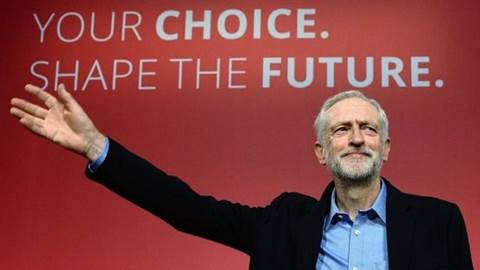
The Unintended Consequence: It was to forever silence the intra-party remnants of working-class power that the Blairite Right brought in the “one-person-one-vote” rule. Not even in their worst nightmares did they apprehend that their cynical gesture towards ‘democratisation’ would produce a Jeremy Corbyn.
JEREMY CORBYN’S RE-ELECTION should signal an outbreak of
peace and unity in the British Labour Party. Especially given his support among
Labour members has gone up, not down, since he was first elected in September
2015. Not a chance. His enemies in Labour’s parliamentary caucus simply will
not relent. The war of attrition will go on until Corbyn is no longer leader.
Why?
The answer is as bleak in its essence as it is in its
implications. From its very inception, more than a century ago, the British
Labour Party has been the product of two powerful political impulses:
working-class unionism and middle-class reformism. Though they were not
perceived to be so at the time the party was formed, these two impulses would,
ultimately, prove contradictory.
No matter how modest the ambitions of Britain’s moderate
trade union leaders, the pursuit of “a fair day’s pay for a fair day’s work”
was always destined to run into the brute realities of capitalism’s zero-sum
equations. And when that day came, as it did in the 1970s, the middle-class
reformers of the Fabian Society were never going to align themselves with
Labour’s working-class voters.
There was a reason for this reformist disdain. They simply
did not believe that working-class people were capable of managing themselves.
Working people, in the reformers’ opinion, lacked the experience, the education
and, yes, the ‘breeding’ necessary for self-government. That being the case,
Labour’s ultimate objective must be to erect a state-funded and administered
system of social organisation and control, that would allow highly trained
middle-class professionals will ‘look after’ and ‘improve’ the ‘labouring
masses’.
Policies promising the public administration of health,
education and housing services, and the public ownership of key industries, may
have sounded like socialism, but in one vital respect they were deficient. The
administrators and managers of this Brave New World would not be drawn from the
‘labouring classes’ in whose name they were being created, but from a middle
class which saw itself as the meritocratic inheritors of Britain’s louche and
incompetent aristocracy.
This dystopic game of bait-and-switch provides the theme for
some of British literature’s most famous political fables. From “The Time
Machine” and “Things To Come” by H. G. Wells’ (himself a hard-line eugenicist
and prominent Fabian) to George Orwell’s “Animal Farm” and “1984”. In British
social-democracy, no less than on Animal Farm: “All animals are equal – but
some are more equal than others.”
What the Fabian Society reformers were never game enough to
ask themselves was: “What happens when publicly administered health, education
and housing services raise up a generation of workers who are no longer content
to let middle-class bureaucrats control their lives?”
When “The Who’s” famous invitation to “meet the new boss –
same as the old boss” is rejected. When thousands of young shop-stewards
finally work out what their corpulent union bosses have always been too
frightened to admit: that “a fair day’s pay” is beyond the remit of even the
most thoroughly reformed capitalist society. What happens then?
What happens then – as every member of both the British and
New Zealand Labour Party who lived through it will confirm – is that class
struggle begins to manifest itself not only in the workplace and on the picket
line, but also in the ranks of the political party of the working-class. And
when that party has allowed itself to become “professionalised”, especially at
the parliamentary level, then the outcome of that class struggle is a forgone
conclusion.
But history is not a clockwork mechanism, or, if it is, then
there’s a ghost in the machine. Tony Blair may have filled the upper echelons of
his government and party with a plethora of “pretty straight guys”, but within
the shell of the professionalised Labour Party there still existed the
perennially disruptive trade unions and constituency party organisations. It
was to forever silence these working-class voices that Blair’s successors
brought in the “one-person-one-vote” rule. Not even in their worst nightmares
did they apprehend that their cynical gesture towards ‘democratisation’ would
produce a Jeremy Corbyn.
So now they find themselves caught between a leader
dedicated to creating precisely the sort of emancipatory labour movement that
Blair and his professionalised predecessors worked so hard to destroy in the
1970s and 80s; and a fast-growing movement of citizens determined to seize control
of their own future. Already the largest socialist organisation in Europe, the
600,000-strong British Labour Party threatens to become something much more
dangerous than the ruling class’s second eleven. Corbyn is determined to turn
Labour into a people’s movement for radical change. A project so impossibly
horrific that it has united the entire British Establishment against him.
Only two things can stop Corbyn now. Either, his
parliamentary caucus enemies will contrive some way to fundamentally constrain
his power (by forcing him to accept an elected shadow cabinet, perhaps?) Or,
the hidden hand of the “deep” British state will arrange for his removal “by
other means”.
For the newly re-elected leader and his party the moment of
maximum peril draws near. We must hope that the ghost in the machine continues
to nudge history in Labour’s – and Jeremy Corbyn’s – direction.
This essay was
originally posted on The Daily Blog
of Monday, 26 September 2016.
