Showing posts with label Free Trade. Show all posts

Friday, 24 January 2020

The Thoughtful Mr Parker.

Stunningly Wrong-Headed: So blinded are the “left-wing” believers in free markets and free trade (like Trade Minister, David Parker) that even when they are staring directly at the wreckage of the lives and communities which these “unconscionable freedoms” (to borrow Marx’s telling phrase) have left in their wake, they cannot see it.

DAVID PARKER is among the more thoughtful members of Labour’s caucus. On his Politik website, the veteran political journalist, Richard Harman, describes him as someone with “an unerring ability to get up the noses of his many critics”, a talent I have long taken as proof positive of serious cogitation. But, as Harman goes on to say, Parker is also “a sober-suited Dunedin lawyer who was a close associate of the buccaneering entrepreneur, the late Howard Patterson”. He is, therefore, a man to whom it is reasonable to attribute a solid working knowledge of free-market capitalism, and profound ignorance of the tenets of democratic socialism.

Like so many of Labour’s neoliberal-capitalism’s-about-as-good-as-it-gets brigade, Parker is no fan of populism. Truth to tell, it frightens him. Fear is, however, an important step up from scorn – which has, for some time, been the default setting for all those “centre-left” politicians who still regard Bill Clinton and Tony Blair as “pretty straight-up guys”. The sort of people who actually believe that Hillary Clinton was defeated by the Russians, rather than weighed in the balance and found wanting by her fellow citizens.

One of the reasons why Hillary was found wanting was her notorious description of opponent Donald Trump’s supporters as a “basket of deplorables”. It is actually quite hard to think of a description more calculated to enrage those working-class voters from Pennsylvania, Wisconsin and Michigan who had twice pulled the lever for Barack Obama, yet remained unconvinced that the First Lady who’d been such a strong supporter of her husband’s North America Free Trade Agreement was the sort of Democrat to put the interests of American workers ahead of American bosses. (Their doubts in this regard were, by the way, entirely justified!)

I sense that Parker struggles just as hard to see those who oppose “free trade” as anything other than deplorably ill-informed. Thinking about it, however, he has come to the conclusion that the populist push for protectionism is, in reality, a symptom of what he calls “middle-class insecurity”.

What has prompted these feelings of middle-class insecurity? Well, as Parker told last year’s Otago Foreign Policy School, the causes are “pretty easy” to identify:

 “[E]normous rises in inequality, with so much wealth going to the one per cent, not just overseas, but also in New Zealand, which is exemplified by dropping homeownership rates and a sense amongst the public that trade agreements have been made for the benefit of multinationals rather than small businesses.”

Parker’s analysis is stunning in its wrong-headedness. In concentrating upon the feelings of the middle-class, it fails to identify the central core of populism’s attraction for the working-class voters who opted for Trump over Clinton and Boris Johnson over Jeremy Corbyn. Namely, their deep-seated loathing of precisely the sort of middle-class people who dismiss them as deplorable losers in the game of life they are so obviously winning.

So bitterly do working-class people resent the disdain in which the professional middle-class enablers of the One Percent’s excesses hold them, that they are willing to vote for a narcissistic billionaire, a tousle-haired toff, and all the other killer-clowns shrewd enough to recognize their pain – and not blame them for it.

That recognition is both the key to populism’s success and the explanation for the steady collapse of social-democratic and labour parties around the world. So blinded are the “left-wing” believers in free markets and free trade, that even when they are staring directly at the wreckage of the lives and communities which these “unconscionable freedoms” (to borrow Marx’s telling phrase) have left in their wake, the Parkers of this world cannot see it. Almost unbelievably, they’ve convinced themselves that its “middle-class insecurity” that’s jeopardising their political fortunes; utterly unaware that the real cause of their parties’ electoral disintegration is old-fashioned working-class rage.

It takes a special kind of political operative to grasp this reality: someone whose driving motivation is to tear the whole rotten edifice down and begin again; someone like Trump’s Steve Bannon or Johnson’s Dominic Cummings; Neos who haven’t swallowed the Blue Pill.

Fortunately – or unfortunately – that’s not David Parker. A thinker he may be, but his thoughts never seem to stray towards the unconventional. Rather than learning his politics at the feet of a capitalist buccaneer, he’d have done better to find himself an anarchist.

This essay was originally published in The Otago Daily Times and The Greymouth Star of Friday, 24 January 2020.

Tuesday, 14 November 2017

A Very Lucky Escape.

Brave Faces At Danang: David Parker and Jacinda Ardern field questions from the news media at the meeting of Apec in Danang, Vietnam. What the new Labour-led government needed more than anything else from this meeting was what they came home with - Time.

THE TRANS-PACIFIC PARTNERSHIP (TPP) is not dead, but neither can it be said to be in the rudest of health. Considerable last-minute diplomatic scurrying was required to save the Japanese government from a humiliating loss of face. Negotiations, accordingly, are said to be “continuing”. Nothing, however, should be expected before February 2018 – at the earliest. Which means that, for the moment at least, Prime Minister Jacinda Ardern and Trade Minister David Parker, like Canada’s Prime Minister, Justin Trudeau, have taken possession of the commodity they most needed to bring home from Danang – Time.

The situation into which Ardern was flying aboard the RNZAF’s Boeing 757 at the end of last week offered no guarantee that such precious time would be on offer. Danang was fraught with multiple dangers: economic, diplomatic and political.

As the leader of a small trading nation, New Zealand’s prime minister simply cannot affect a take-it-or-leave-it attitude to something as big as the TPP. The inescapable truth confronting Ardern (as it has every one of her predecessors) is that this country’s status as a first-world nation is inescapably contingent upon earning sufficient overseas currency to import the sort of lifestyle to which most Kiwis believe themselves entitled. Bluntly: faced with the choice of announcing whether her government is “in” or “out” of a major trade agreement; no New Zealand prime minister can say “out” with impunity.

All of the official advice the Prime Minister has received to date on the TPP will have kicked-off from that position. Certainly, it will have been the argument reiterated by the Ministry of Foreign Affairs and Trade (MFAT). It will also have been the lustily repeated refrain of this country’s major exporters. Likewise, from what might be called the “globalisation lobby” imbedded in NGO-land, academia and the media.

Taken together, a very large and intimidating crowd to say “no” to!

Even larger and much more intimidating, however, are the nation states determined to see the TPP (or, as it has rather tendentiously been re-named, the Comprehensive and Progressive Trans-Pacific Partnership – CPTPP!) ratified and implemented. The agreement’s principal cheerleader (now that the USA has withdrawn) is Japan, whose diplomatic reach proved to be more than long enough to secure Justin Trudeau’s return to the negotiating table. (It may have been Canada’s wish to walk away from the TPP-11 altogether, but Japan’s “arguments” were clearly “persuasive” enough to cause its prime minister to have second-thoughts and turn around!)

If Canada, with 36.3 million people and the second-largest economy of the remaining TPP signatories, couldn’t make it all the way to the departure lounge at Danang, then what were the odds of little New Zealand making it even as far as the door? New Zealand political leaders have only to review their country’s diplomatic, military and economic experience with the USA between 1984 and 2010 to gain some appreciation of the costs associated with taking a “principled stand”. World headlines last only a few days – their consequences can last for decades.

And then, of course, you have to come home.

It is probable that the National Party was hoping more earnestly than Professor Jane Kelsey and the entire New Zealand Left that Prime Minister Ardern would take a “principled stand” on the TPP. Had she stood up and said “no”, not only would she have felt the full wrath of Japan and its allies, but, from the moment her feet once again touched New Zealand soil, she would also have felt the full blast of a searing political firestorm.

The Urgent Debate in Parliament, which Speaker Mallard would have no choice but to grant the National Opposition, would only be the beginning. Day after day, the voices of exporters, business leaders, bank economists, business journalists, media commentators, academic experts and the globalisation lobby would be ringing in the Labour-NZ First-Green Government’s ears.

The Prime Minister and her Cabinet colleagues would then have just two political options: either back-down, or double-down.

If they backed-down, then Ms Ardern and her government would stand exposed as a bunch of juvenile attention-seekers who simply had not thought through the consequences of their irresponsible actions. It would be a full-scale debacle from which they could not recover.

But, doubling-down would be even worse. By adopting a sharp-edged, radically left-wing, stance on international trade at both the diplomatic and domestic levels, Ms Ardern’s government would rapidly find itself re-positioned among the world’s “nutty” nation states. Inevitably, New Zealand would find itself drifting, economically and diplomatically, under the influence of China and Russia. For an overwhelming majority of New Zealanders, this would represent an unmandated repudiation of everything their country stands for. Politically, it would be unsurvivable.

To Ms Ardern’s and Mr Parkers’ no doubt immense relief, both of these catastrophes have been avoided. They have had a very lucky escape.


This essay was originally published in The Press of Tuesday, 14 November 2017.

Wednesday, 24 May 2017

Will the TPP Spell National’s Doom?

"John Frum, He Come." The National Government's stubborn promotion of the Trans-Pacific Partnership has been likened to the post-World War II Melanesian "Cargo Cults" whose followers constructed their own "runways" and "aircraft" to entice the recently departed GIs "John From America" (John Frum) to return bearing the miraculous "cargo" that had so suddenly enriched their lives.
 
IT WAS ONE OF THE MOST EXTREME REACTIONS to a speech that I have ever witnessed. I had written it for the newly-elected Mayor of Dunedin, Sukhi Turner, and she had made it her own. Delivering it with her trademark forthrightness, she set the Dunedin Establishment ablaze. The offending paragraph had been the one in which she accused the Dunedin business community of having a “cargo cult” mentality.
 
The anthropological term, “cargo cult”, arose from the responses of a number of isolated Melanesian populations whose subsistence communities had been overwhelmed during World War II: first by soldiers; then with all the things that soldiers need. When the war ended, and the soldiers and their “cargo” departed (as suddenly and mysteriously as they had arrived) the islanders were distraught. Desperate for the return of these bringers-of-all-good things, they laid out jungle runways and fashioned crude facsimiles of aircraft. “John Frum [John from America] he come”, they intoned to the heavens. “John Frum, he come.”
 
The point I was making in the speech, and which Sukhi embraced, was that our own local (and national) business elites were behaving very similarly to those Melanesian islanders. They also believed that if they laid out the equivalent of jungle runways (financial inducements, deregulated markets) then John Frum’s precious “cargo” – in the form of big, one-off, economy-rescuing, foreign-investment projects – would follow.
 
The firestorm created by the speech took a great deal of hosing down. (Unsurprisingly, I wrote no more incendiary mayoral speeches!) It did, however, teach me a couple of very valuable lessons. First. What are presented as highly sophisticated economic arguments in favour of globalisation are driven by some very unsophisticated (some might even say primal) human impulses. Second. The people advancing such arguments do not take at all kindly to being labelled cargo cultists!
 
That being the case, the veteran journalist, Gordon Campbell, should probably watch his back. Because, in his latest analysis of the Bill English-led National Government’s peculiar obsession with keeping the Trans-Pacific Partnership (TPP) alive, Campbell writes:
 
“New Zealand – and other nations – made concessions and spent their political capital in order to meet American corporate demands. The likes of English are still promising to observe these commitments to the letter, even though the Americans won’t be there to keep their side of the bargain. The TPP has literally become a cargo cult ritual that’s being performed in the hope that someday, one day, the Americans will return, bearing gifts.”
 
No surprise, then, that the National-led Government is so keen to enrol the Labour Party in this, to date, fruitless ritual. Labour’s return to the Free Trade fold would represent a much-needed infusion of political capital to the project. Without it, the New Zealand political class’s considerable reputational investment in TPP stands to be lost.
 
Exactly why Labour would offer its company to all this pro-TPP misery is far from clear. Such an about-face would not only alienate its prospective coalition partners in the Greens (whose opposition to the TPP remains staunch) but also enrage the September election’s likely arbiter, Winston Peters – whose adamant opposition to such agreements is well known on both sides of the parliamentary aisle.
 
Accordingly, by far the most fruitful course of action for Labour would be to make common-cause with the Greens and NZ First against any and all attempts to revive the TPP in its current, unamended, form.
 
Such an alliance would constitute a stern warning to the political class that its participation in such absurd cargo cult rituals must end. It would also signal that the days of electoral politics being a “heads we win, tails you lose” proposition for New Zealand’s “permanent interests” are over.
 
The National Party (which certainly likes to think of itself as the spokesperson for those permanent interests) should recall the fury of the tangata whenua at the sovereignty-threatening clauses of the TPP – especially the Investor-State Dispute Settlement provisions. Is its relationship with the Maori Party strong enough to withstand such a test of loyalties?
 
The three (possibly four) parties currently positioned to bring National’s nine-year-reign to an end could hardly have wished for a better issue around which to gather the forces seeking a change of government. It offers the Left a rare opportunity to bestow upon its parliamentary representatives the benediction of mass political action: the chance to allow Labour, the Greens and NZ First to be carried all the way to the Beehive’s Ninth Floor on a vast wave of popular discontent.
 
All of which poses the question: Why would English and his allies (both inside and outside of Parliament) willingly hang the weighty carcass of the deeply unpopular TPP around their collective neck? Do they really intend their final words, as the rising tide of change closes over their heads, to be: “John Frum, he come”?
 
This essay was originally published in The Press of Tuesday, 23 May 2017.

Friday, 9 September 2016

Dropping the Ball, or Saving the Game? A Response to Fran O’Sullivan.

Who's In Charge? That it was left to the Chinese President, Xi Jinping, to lead the charge against the rise in protectionism across the globe struck NZ Herald business columnist, Fran O’Sullivan, as particularly galling. Since the 1980s, it has been the West that has set the pace on trade liberalisation – particularly the United States. That this no longer appears to be the case clearly left O’Sullivan unimpressed.
 
THE DEEP ANXIETY of the “Free Trade” lobby was on full display in this morning’s NZ Herald (7/9/16). Fran O’Sullivan, that most indefatigable of the Herald’s free trade advocates, was so moved by the uncertainty currently surrounding the ratification of the Trans-Pacific Partnership (TPP) that she devoted a good chunk of her business column to the global fight against protectionism.
 
That it was left to the Chinese President, Xi Jinping, to lead the charge against the rise in protectionism across the globe struck O’Sullivan as particularly galling. Since the 1980s, it has been the West that has set the pace on trade liberalisation – particularly the United States. That this no longer appears to be the case clearly leaves O’Sullivan unimpressed.
 
Of President Barack Obama’s reticence on the subject – on display at the just concluded G20 meeting in Hangzhou, China – O’Sullivan is scathing:
 
“US President Barack Obama could hardly lead the charge given the two candidates fighting for election to president don’t have the bottle to even support the Trans-Pacific Partnership (TPP). The US previously argued TPP would enhance US economic supremacy and ‘contain’ China's ambitions.”
 
Those scare-quotes around the word “contain” indicate just how sceptical O’Sullivan has become of the United States’ capacity to any longer dictate economic terms to the world’s major economic powers – especially China. Her dismay at this turn of events is clear:
 
“Now Xi is driving the call for a more open economy, yet another sign of how badly ‘the West’ has dropped the ball in the post-Global Financial Crisis era.”
 
But if the West has “dropped the ball” in relation to the GFC, and if its political leaders no longer “have the bottle” to support free trade agreements like the TPP, then it is surely incumbent upon O’Sullivan to tell her readers why. Sadly, no such explanation is forthcoming.
 
There is, of course, a very good reason for O’Sullivan’s silence on the cause of the West’s failure. Even in the business pages of the Herald, blaming the world’s economic problems on democracy is a reputationally risky gambit. And yet, no other explanation suffices. That the very same international trends: free trade, globalisation; whose declining influence O’Sullivan so volubly laments; are also the root causes of the massive upsurge of populism across the USA and the United Kingdom is simply undeniable.
 
It’s not that Donald Trump and Hilary Clinton lack “the bottle” to back the TPP, more a case of them recognising that to do so at this juncture in American history would cost them the election. What O’Sullivan refuses to recognise is that free trade and globalisation have, over the past 30 years, imposed a tremendous economic and social cost upon the populations of the West. That the effects of free trade and globalisation were bound, eventually, to trigger a day of democratic reckoning was something their proponents preferred not to think about.
 
O’Sullivan offers a fine example of this political denial by quoting the words of the Chinese billionaire, Jack Ma. The founder of Alibaba (China’s equivalent of TradeMe) told CNN that: “We should keep on going along the path of globalisation ... globalisation is good ... when trade stops, war comes.”
 
Wa went on to dismiss the strongly antagonistic tone adopted by Donald Trump towards America’s Chinese competitors: “Every time there’s an election, people start to criticise China. They criticise this, they criticise that ... [But] how can you stop global trade? How can you build a wall to stop the trade?”
 
The answer, of course, is by erecting the very same protectionist trade-barriers that Wa’s President, Xi Jinping, was warning the G20 against. As boss of the Chinese Communist Party, Xi clearly struggles to fathom the West’s sudden falling-out-of-love with what used to be called the “Washington Consensus”. Perhaps his political empathy would be enhanced if his party’s policies were subjected to the judgement of the Chinese people every four years – like those of his Western counterparts.
 
2016 may prove to be the year in which the electorates of the West finally demonstrate to their political elites the democratic folly of pursuing trade policies that are free – but not fair. If that is what they do, then, far from dropping the ball, the voters of the West will have saved the whole capitalist game.
 
This essay was originally posted on The Daily Blog of Wednesday, 7 September 2016.

Friday, 12 February 2016

Labour's Choice: Free Trade, Or Free Nation?

Historically Incorrect: Labour's claim that it has always supported Free Trade simply isn't true. For two-thirds of its history, Labour regarded trade simply as a means to its end of transitioning New Zealand from economic colony to free and independent nation. The party's embrace of Free Trade actually dates from 1983, when Labour threw its support behind the CER agreement. Thirty-three years later, independence is as far away as ever - and the TPPA will not bring it any closer.
 
“LABOUR HAS ALWAYS BEEN a Free Trade party.” This is the bald assertion from a chorus of past and present Labour leaders desperate to escape John Key’s “anti-Free Trade” label. There is, however, a very large problem with Labour’s claim. It simply isn’t true.
 
Prior to 1984, Labour is much more accurately described as a party committed to ending New Zealand’s status as a cultural and economic colony of the United Kingdom. This mission necessitated a radical expansion of the range and sophistication of New Zealand’s exports. Obviously, such a policy also required that serious attention to be paid to the size and scope of protective instruments applied to imported goods by this country’s potential export markets.
 
By the same token, however, any broad expansion of New Zealand’s industrial base would require the development of its own array of protective instruments. For at least as long as it took new, export-oriented industrial concerns to become firmly established, the price of goods imported from their international competitors needed to be artificially boosted by tariffs.
 
Tariffs, and an import licencing system, were accordingly utilised by all pre-1984 Labour Governments. Not only was the system needed to protect infant industries, but it was also vital if New Zealand’s always vulnerable reserves of overseas funds were not to be frittered away on non-industrial imports.
 
To make the policy work, as the Second Labour Government made every effort to do between 1957 and 1960, a significant degree of state planning and co-ordination would be required. In June 1960, an Industrial Development Conference convened in Wellington to determine the way forward.
 
One of Labour’s “From Colony to Nation” mission’s strongest supporters, Industries & Commerce Secretary, Bill Sutch, recorded that:
 
“The conference recommended a Development Council, better regional distribution of industry, much more industrial research, an Industrial Finance Corporation, advisory aids to industry, the negotiation of bilateral trade agreements [and] various methods of promoting external trade.”
 
Not “Free Trade”, then, but trade as a means of advancing New Zealand’s economic independence: by expanding its industrial capability, diversifying its exports and making it less reliant on both foreign capital and the imported goods of New Zealand’s creditors.
 
Not surprisingly, Labour’s From Colony To Nation policies were met with fierce opposition from the National Party and its key backers. Farmers, importers, merchants and retailers had little to gain and great deal to lose by such a fundamental reordering of New Zealand’s economic and cultural priorities. It was from these groups, the most prominent beneficiaries of New Zealand’s colonial status, that the cry for Free Trade was most loudly voiced.
 
The commitment of Norman Kirk’s Third Labour Government to the From Colony To Nation mission was, if anything, stronger than the Second’s. Aware of the extent to which New Zealand’s limited industrial base remained overseas financed and foreign controlled, he was determined to establish a pool of domestic investment capital from which New Zealand could build its own future.
 
The precise nature of the vector which carried the Free Market/Free Trade virus into Labour’s ranks in the early 1980s is still not 100 percent clear. Part of the answer no doubt lies in the examples made of the governments of Chile’s Salvador Allende, Australia’s Gough Whitlam and the UK’s Harold Wilson, by the enemies of Democratic Socialism. The policies of the New Right governments of Margaret Thatcher and Ronald Reagan had, similarly, made it plain to New Zealand’s Labour politicians that democratic economic planning and the preservation of national independence were well-and-truly off the “Free World’s” political agenda.
 
What should not be overlooked, however, is the impact of the decision of the Bill Rowling-led Labour Opposition to support “CER” – the Closer Economic Relationship with Australia sealed by Rob Muldoon’s National Government in 1983. Critics of CER like Wolfgang Rosenberg struggled to make Rowling (his former student!) understand the consequences for Labour’s From Colony To Nation mission of facilitating Australian capital’s gradual take-over of New Zealand’s economy. To no avail. As the British colonisers were departing for Europe via the front door, the Aussies were being smuggled in the back!
 
Historically-speaking, Labour’s pro-Free Trade stance has been around for just 33 of its 100-year existence. If its dream of transitioning New Zealand from colony to nation still endures, then Labour’s opposition to the Trans-Pacific Partnership is, indisputably, the more natural fit.
 
This essay was originally published in The Waikato Times, The Taranaki Daily News, The Timaru Herald, The Otago Daily Times and The Greymouth Star of Friday, 12 February 2016.

Friday, 9 October 2015

Selling The Bigger Picture: Tim Groser Brings Home The TPP.

Adding Perspective: New Zealand's Trade Minister, Tim Groser, interjects during the Atlanta media conference announcing the settlement of the Trans-Pacific Partnership: “Look, long after the details of this negotiation on things like tons of butter have been regarded as a footnote in history, the bigger picture of what we’ve achieved today will be what remains.”
 
ON THE DAY the deal was done, Joseph Stiglitz, winner of the Nobel Prize for Economics, had this to say about the Trans-Pacific Partnership (TPP):
 
“You will hear much about the importance of the TPP for ‘free trade’. The reality is that this is an agreement to manage its members’ trade and investment relations – and to do so on behalf of each country’s most powerful business lobbies. Make no mistake: It is evident from the main outstanding issues, over which the negotiators are still haggling, that the TPP is not about free trade.”
 
Certainly a genuine free trade agreement would have offered New Zealand much more than the TPP. Rather than trying to work up some enthusiasm for a deal that offers staggered tariff reductions over decades, a genuine free trade agreement would have had New Zealanders celebrating their farmers’ full and immediate access to the vast markets of the USA and Japan.
 
Tim Groser, New Zealand’s acerbic Trade Minister, would dismiss such expectations as wholly inappropriate to what he calls the world of power politics. At the media conference marking the negotiations’ successful conclusion, Mr Groser summed-up his view of the TPP with the following interjection:
 
“Look, long after the details of this negotiation on things like tons of butter have been regarded as a footnote in history, the bigger picture of what we’ve achieved today will be what remains.”
 
By which he meant, presumably, that the TPP represents much more than the sum of its thirty (still secret) chapters: that it is in and of itself a positive contribution to the welfare of the human species.
 
And yet, on the basis of what little information has so far been released about the TPP, this is a difficult argument to stand up. What, for example, is positive about the extension of copyright from 50 to 70 years? Or the ability of powerful pharmaceutical companies to extend the life of their patents for an additional three years? Far from freeing-up the commerce of the Pacific Rim, these measures will only restrict it further. Since when was free trade about increasing the monopoly power of huge corporations?
 
“Since forever!”, Noam Chomsky would, waspishly, reply. According to the dissident professor from MIT: “Globalisation [of which the TPP is a classic manifestation] is the result of powerful governments, especially that of the United States, pushing trade deals and other accords down the throats of the world’s people to make it easier for corporations and the wealthy to dominate the economies of nations around the world without having obligations to the peoples of those nations.”
 
If this is, indeed, the “bigger picture” to which the efforts of our Trade Minister and his negotiating team have contributed, then the people of New Zealand could be in trouble.
 
Under the provisions of the TPP, the New Zealand tradition of coming up with creative collective solutions to specific social problems (ACC and Pharmac spring to mind) will no longer be permissible. Henceforth, “solutions” will be the exclusive purview of big (i.e. foreign) corporations. Massive financial compensation will be extracted from any government foolhardy enough to put itself between these corporate predators and their prey. Adjudicated by tribunals composed of three carefully vetted corporate lawyers, “Investor State Dispute Settlement” (ISDS) referrals now constitute a clear and present danger to the sovereignty of all but the most powerful nation states.
 
In the words of Professor Andrew Geddis of the University of Otago, if New Zealand signs up to the TPP “we are going to change how our country is run into something else.”
 
That “something else” may turn out to be a big deal, says Professor Geddis, or it may not. But why put our constitution at risk in the first place? Do we really want to “find ourselves reasonably frequently hanging on the decision of three private individuals who are deciding if we are allowed to have a policy in place without having to pay many millions of dollars to an overseas company.”
 
Very little in the Trade Minister’s “bigger picture”, it seems, is “free”. Nor does “trade” constitute the TPP’s dominant theme. Rather, Mr Groser’s “achievement” is mostly about the application of constant and irresistible pressure to force open the markets of weaker economies to the investors of the stronger.
 
“Managed” trade, indeed – but not by us.
 
This essay was originally published in The Waikato Times, The Taranaki Daily News, The Timaru Herald, The Otago Daily Times and The Greymouth Star of Friday, 9 October 2015.

Tuesday, 6 October 2015

Deliberate Political Sabotage: The “Darling Of The Left” Comes Out In Favour Of The TPP.

Who Loves Ya Baby? Last Thursday’s (1/10/15) statement from the so-called "Darling of the Left", Helen Clark, in which she signalled her strong support for the Trans-Pacific Partnership Agreement (as it now should be called) was no mistake. It was an act of deliberate political sabotage.
 
THE MOMENT THE WORDS were out of her mouth the political wreckage began to pile up. On Radio Live, Sean Plunket positively whooped with delight. It took only a nanosecond for the right-wing shock-jock to register the implications of Helen Clark’s public endorsement of John Key’s position on the Trans-Pacific Partnership (TPP). Now that the “Darling of the Left” had come out in its favour, Plunket reassured his talk-back audience, the TPP Debate is surely over. Someone, he said, should tell the “tin-foil hat wearers”.
 
Those who cherish Clark’s memory as Labour’s most successful leader since Peter Fraser, have offered numerous excuses for her actions. She was misquoted, they insist. She didn’t understand how her words would be distorted, others say. Living in New York, she must have been unaware of the way the TPP debate had evolved in New Zealand. Helen Clark would never have knowingly delivered such a brutal blow to her own party.
 
Bullshit.
 
Seven years after her defeat by John Key’s National Party, Clark’s interest in Labour remains undiminished. Kept informed of its every move by a coterie of loyal supporters, she cannot credibly claim to have been ignorant of the impact her little encomium on the importance of international trade would have.
 
“What always haunts a Prime Minister”, said Clark, “is: ‘Will there be a series of trade blocs develop that you are not part of?’ Because that is unthinkable for New Zealand as an export-oriented, small trading nation. So of course New Zealand has to be in on the action with the TPP and go for the very best deal it can as the agreement expands beyond the original four economies to a wider regional agreement.”
 
John Key and his Trade Minister, Tim Groser, have yet to set out the argument for signing the TPP as succinctly as Clark did in New York – or with more force. There is absolutely no way that such a well-considered statement could’ve just slipped out – by mistake.
 
Ever since taking up her position as the Head of the United Nations Development Programme, the No. 3 position in the United Nations, Clark has been scrupulously careful to avoid making any kind of statement that could, in the slightest degree, impinge on the domestic politics of her homeland – or those of any other UN member, for that matter. And yet, there she was, standing shoulder-to-shoulder with her erstwhile political nemesis, offering eloquent support to one of his government’s most controversial policies.
 
No, last Thursday’s (1/10/15) statement from Helen Clark was no mistake. It was an act of deliberate political sabotage.
 
But what could be so important to Labour’s former leader that she was willing to drive a dagger into the back of Andrew Little, its present incumbent? Was it spite? Had Clark taken umbrage at Labour’s decision to move away from the rock-solid bi-partisanship on free-trade that she and Phil Goff had made a cornerstone of their government’s foreign policy? Was she hoping to spook Little into some sort of last minute revision of Labour’s highly conditional support for the TPP? After all, the spectacle of the two people who have governed New Zealand since 1999, speaking with one voice on the TPP, was bound to pack a hefty punch. Or, maybe, it was simply a case of: ‘I’ll agree to scratch your back on TPP, if you’ll agree to scratch mine when the time comes to elect the next Secretary-General of the United Nations.’
 
No matter how reluctantly arrived at, the only conclusion to be drawn from this episode is that Clark’s transition, from principled social-democrat, to morally desiccated member of the international administrative elite, is now complete. With the benefit of hindsight, it’s clear that, throughout her career, Clark was never comfortable about stepping too far away from the well-trodden path. She may never have liked neoliberalism, but if it was the only game in town, then she would learn to play.
 
Sean Plunket is quite right about the undermining effect Clark’s words are bound to have on the Anti-TPP Movement – especially among its middle-aged and middle-class supporters. He is, however, quite wrong in his assessment of Clark’s status among genuinely progressive New Zealanders.
 
“Darling of the Left” she may have been on Thursday morning, but by Thursday evening Helen Clark was anything but.
 
This essay was originally posted on The Daily Blog of Monday, 5 October 2015.

Wednesday, 5 August 2015

Breathless And Irrelevant: Tim Groser Dismisses the TPPA’s Opponents

Scold Mode: “We need adults to do this, not breathless children to run off at the mouth when the deal is not actually finished.” Trade Minister, Tim Groser, makes clear his disdain for the TPPA's opponents.
 
TIM GROSER is not known for saying silly things. In fact, he is one of that fast-dwindling number of public figures who still possesses sufficient faith in his own intellect to insist upon writing his own speeches. It was, therefore, rather shocking to hear him dismiss the organised opposition to the Trans-Pacific Partnership Agreement (TPPA) as “irrelevant”.
 
As a former Marxist, Mr Groser should be under no illusions about the power of radical ideas to shape the discourse of whole epochs of human history. The Pope may have dismissed Martin Luther’s 1517 protests as “irrelevant” – but that did not make them so. Indeed, the “protestant” church is named after them. Nor is it wise to confuse the strength of a protest with the number of people making it. It was Rosa Parks, alone, who refused to give up her seat on that Montgomery Bus back in 1955, but her protest against the injustices of the Jim Crow South touched off an explosion of change.
 
Without Professor Jane Kelsey’s patient amassing of evidence critical of the TPPA, the current upwelling of concern about its likely consequences for New Zealand and New Zealanders would have been much smaller, and considerably less well-informed. As one of the very few Kiwi academics to take seriously the universities’ statutory duty to act as the “critic and conscience” of society, Professor Kelsey has acted as a virtual one-person think-tank, testing the claims of the free-trade crusaders – often to destruction.
 
With Mr Groser arriving home empty-handed from Hawaii, and the next round of TPPA negotiations several weeks away (at least!) how exciting it would be if, in the interim, the Trade Minister and Professor Kelsey could be prevailed upon to participate in a public debate on the pros and cons of persisting with the TPPA. Outside of election campaigns, it’s been many years since a major public debate of this sort has been attempted. If our free-to-air television networks cannot be persuaded to screen the event pro bono, it could, at the very least, be live-streamed on the Internet.
 
A metropolitan town hall packed to the rafters, with tens-of-thousands more following the action on television or the Internet, would, of course, instantly render the opposition to the TPPA extremely relevant. For this reason, alone, Mr Groser and his boss, the Prime Minister, would likely be loath to participate. Merely by appearing on the same stage as Professor Kelsey, the Trade Minister would be acknowledging her as his equal. Given Mr Groser’s recent statement that: “We need adults to do this, not breathless children to run off at the mouth when the deal is not actually finished.” Such an acknowledgement seems … unlikely.
 
Which is a very sad reflection on the state of political affairs in New Zealand. Our leaders celebrate this country’s democratic credentials at every opportunity. Indeed, our historical predilection for “punching above our weight” on foreign policy issues was put forward as one of the best reasons for seating New Zealand at the UN Security Council table. The truth, however, is that it’s been quite a while since we Kiwis did any such thing. For most of the last 30 years, top-down has, rather forcefully, replaced bottom-up.
 
Demanding a major public debate on whether or not to persist with the TPPA would, therefore, be a fine first step towards re-learning the knack of making politicians dance only to the tunes composed by “We, the People” – the voters who elected them. After 30 years of distributing those high-pitched corporate song-sheets, the politicians have, surely, had their turn?
 
Not according to Mr Groser. The Trade Minister is adamant that the negotiation of trade agreements is a matter for the people who know what they are doing – not the people per se.
 
It’s a view deeply entrenched in the Ministry of Foreign Affairs and Trade (MFAT) whose senior officials are absolutely convinced that the ministry’s remit can only be delivered by the sort of elite specialists they have, decade after decade, made it their business to recruit and retain. Mr Groser was, himself, one of their brightest stars. Imagine the celebrations when John Key awarded him the Trade portfolio. Finally, MFAT’s long-term plan for luring the United States into a state-of-the-art, New Zealand-designed, free trade agreement, had a champion worthy of its ambition.
 
Breathless Children: 1 WTO's Millennium Round: 0 - The Battle For Seattle, 1999.
 
And he’ll be damned if he’s going to let the likes of Jane Kelsey and her “breathless children” muck it up. But surely, Mr Groser, you haven’t forgotten the events of 1999 in Seattle, when tens-of-thousands of “breathless children”, braved the riot squads’ rubber bullets and pepper spray to derail the World Trade Organisation’s (still uncompleted) Millennium Round? This world contains more than politicians, diplomats and business-people. Failure to acknowledge the all-too-relevant concerns of ordinary Kiwis will only end in the irrelevancy of Mr Groser.
 
This essay was originally published in The Press of Tuesday, 4 August 2015.

Saturday, 1 August 2015

Be Careful What You Wish For: What If The Government Rejects The TPPA?

Grim Faces And Patriotic Words: With a few, well-chosen, words, Key could place the 2017 General Election beyond the Opposition’s grasp. The Left has been clamouring for New Zealand’s negotiators to reject the TPPA in its current form. But what would happen if they did?
 
TWENTY YEARS New Zealand has been pursuing this dream. Twenty years of plotting and scheming to secure a genuine free trade agreement with the USA. Twenty years of being rebuffed, fobbed-off, and quietly advised to wait in line until the time was right. And all for what? To be kicked in the teeth by Tokyo (with Washington’s tacit approval) and told to bugger-off home if we don’t like playing with the Big Boys?
 
Apparently.
 
The question is: Will we go on playing with the Big Boys? Will we humiliate ourselves by remaining on Maui; gathering whatever crumbs and scraps of concessions the Big Boys condescend to toss into our begging-bowl; and call whatever we’ve managed to collect by the time the Trans-Pacific Partnership negotiations are wound up – a victory for New Zealand diplomacy?
 
The Opposition parties better hope so.
 
If John Key and Tim Groser are obliged to lay on the table of the House of Representatives a TPPA that commits the New Zealand people to decades of inflated pharmaceutical costs; a draconian intellectual property regime specifically designed to enrich the largest US corporations; and an Investor-State Dispute Settlement process which makes a mockery of this country’s sovereignty – but which includes almost nothing in the way of immediate and tangible economic benefits for New Zealand’s exporters – then this government will be dog-tucker.
 
Andrew Little, Winston Peters, Metiria Turei and James Shaw will be able to collectively hang a “bad” TPP agreement around the Government’s neck like the Ancient Mariner’s albatross. Doctors and pharmacists will blame the National Government for the health system’s inability to supply those in need of life-saving drugs. Struggling farmers and manufacturers will condemn it for failing to achieve the promised access to US, Japanese and Canadian markets. Constitutional Lawyers will lament the truncation of democratic authority. Youngsters will resent the lengthening reach and growing ruthlessness of copyright enforcers. By 2017, that TPPA albatross will have swollen into a stinking invitation to vote National out of office.
 
So why on earth would John Key and Tim Groser sign it?
 
Well, it’s possible that John Key is just so enamoured of the United States and its President – his good golfing buddy, Barack Obama – that the idea of saying “No” to the TPPA is simply unthinkable. He may believe that his stock of political capital with the New Zealand public is still so huge that signing up to a crappy TPPA, while costly, will not put him in deficit. It may even be the case that the New Zealand ruling class lacks the moral resources to stare down the emissaries of global capital. If so, then National is lost.
 
But just imagine what the political effect would be if John Key and Tim Groser came home from Maui with grim faces and patriotic words. Picture them on the stage of the Beehive theatrette answering questions from a clamouring crowd of journalists. Consider the impact of Groser intoning, in that irritating professorial manner he has perfected:
 
“Look, in the end, it just wasn’t good enough. Perhaps we were a little naïve. I was certainly stunned by the blank refusal of the Japanese to negotiate seriously on the question of dairy access. They as good as told us to go home if we didn’t like what was on the table. And here we are.”
 
Then it’s John Key’s turn:
 
“It has always been my position, and the position of my government, that a TPPA which failed to deliver real gains for New Zealanders was not worth signing. We’ve waited 30 years for the world to open up its borders in the way New Zealand opened hers in the 1980s, and if necessary we will wait another 30 years. This country will not be bullied into signing an agreement contrary to the interests of its own people. We were not willing to sacrifice Pharmac. Nor were we prepared to compromise this country’s sovereignty. Obviously, we’re disappointed. But there a some lines that a government does not cross.”
 
With a few, well-chosen, words, Key could place the 2017 General Election beyond the Opposition’s grasp. The Left has been clamouring for New Zealand’s negotiators to reject the TPPA in its current form. But what would happen if they did?
 
Be careful what you wish for.
 
This essay was originally posted on The Daily Blog of Saturday, 1 August 2015.

Thursday, 30 July 2015

How Smart Is Tim Groser? Will We End Up Panning Or Praising New Zealand's Trade Minister?

Diplomatic Genius, Or Corporate Minion? From its humble origins as a modest New Zealand trade initiative, the TPPA has always been viewed by Tim Groser (above) as the Kiwi sprat to catch an American mackerel. New Zealand corporates just ain't that clever!
 
TIM GROSER may be a lot smarter than even his most fervent supporters claim. It’s just possible that the Trans-Pacific Partnership Agreement (TPPA) – as currently drafted – is the document he had in mind all along. That, from its humble origins as a modest New Zealand trade initiative, the TPPA was always viewed by Groser as the sprat to catch a giant USA mackerel.

With the benefit of hindsight, it is clear there was never the slightest chance that the United States was ever going to sit back and let a handful of small Pacific states set up a free-trade zone from which it was excluded. As a pretty shrewd geopolitician, Groser would also have realised that, as the US slowly disengaged from its military entanglements in the Middle East, there was a very high probability that its struggle with China in the Pacific – disrupted by 9/11 and all that it inspired – would be resumed.

A comprehensive free-trade agreement, including an increasingly apprehensive Japan – but  excluding the Peoples Republic of China – was an obvious “next move” for a United States determined to reassert its hegemony over the nations of the Pacific Rim. It was also an obvious “next move” for New Zealand, whose economic fortunes were, to a potentially dangerous degree, becoming entwined with those of its principal protector’s principal rival.
 
The plausibility of this argument depends entirely on how skilled at playing geopolitical chess you are willing to believe this country’s diplomats and trade envoys truly are.
 
Who was it, for example, who initiated the process which led to the New Zealand-China Free Trade Agreement (FTA): New Zealand or China?
 
This country’s preference, for at least the past two decades, has been an FTA with the United States. Was it the latter’s refusal to negotiate seriously (i.e. to commit to the liberalisation of its agricultural sector) that persuaded the Ministry of Foreign Affairs and Trade (MFAT) to focus its attention, instead, on the Chinese? Because, in addition to boosting our exports, the New Zealand-China FTA also provided our diplomats with the precious bonus of just a little leverage vis-à-vis our “very, very, very good” friends in Washington. Groser, himself, is at pains to reassure anybody who asks, that should the TPPA negotiations fall through, New Zealand will not be left without options. Sceptics are invited to ponder the significance of New Zealand’s early decision to join the Chinese-initiated Asian Infrastructure Investment Bank.
 
Could Tim Groser and his colleagues at MFAT really be so smart? Is it possible that, sometime in the next few days, New Zealand will put its signature to a document that gives its key exporters the best of both worlds? Not only a vastly rewarding economic relationship with the second most powerful economic entity on the planet; but also the long-sought and much-desired prize of a free-trade agreement with the world’s mightiest nation? Well, yes, it is possible. And, if it happens, Tim Groser’s much anticipated appointment as this country’s next ambassador to the United States will have been well-earned.
 
From Washington, Groser will be supremely well-positioned to judge just how serious the developing struggle between the US Eagle and Chinese Dragon has become. With the TPPA in place, he will, of course, be free to choose between these two heraldic beasts. Free access for New Zealand’s agricultural exports to all the markets of the Pacific Rim – especially those of the USA, Canada and Japan – will mean that if push eventually comes to shove, New Zealand’s economic eggs will not be concentrated in the basket labelled “Made in China”.
 
A Peoples Republic of China beset by crashing stock markets and a rapidly slowing pace of economic growth will soon be faced with even greater difficulties. Constant economic expansion has been utterly crucial to the Communist Party of China’s ability to keep its population, if not happy, then at least quiescent. Mass unemployment, sharpened by the mass impoverishment of China’s rural and urban stock market investors, could very easily panic China’s leaders into a series of ultra-nationalist distractions in the South China Sea or along the Sino-Indian border. Very quickly, having all our economic (and most of our diplomatic) eggs in a single Chinese basket could prove to be very awkward.
 
Many New Zealanders are fearful of the TPPA. They worry about the future of Pharmac and are alarmed at the prospect of becoming enmeshed in the coils of the Investor State Dispute Settlement process. While these are by no means insignificant issues, there are much greater dangers out there that we would be most unwise to ignore. Looking back, we may yet have cause to feel relieved that the TPPA was wound up in July-August 2015. And even those on the left of New Zealand politics may feel just a little bit thankful that Tim Groser was where he was, when he was.
 
This essay was originally posted on The Daily Blog of Wednesday, 29 July 2015.

Tuesday, 12 August 2014

The Responsibilities Of Power

This Land Is My Land: Yes, but if we want to keep it out of foreign hands then New Zealand will have to abandon its 30-year adherence to the doctrines of free trade and unrestricted foreign direct investment. And that will cost us more than many of us may be willing to pay.
 
SO, LABOUR’S going to block the sale of Lochinver Station. The political party which proudly attached New Zealand’s signature to the People’s Republic’s first free trade agreement with a western nation is now proposing to slap the Chinese government in the face. Forgive me, but in the absence of a wholesale repudiation by Labour of its longstanding commitment to free trade, I just don’t see this happening.
 
At the heart of the free trade doctrine lie two fundamental and related provisions: Most Favoured Nation status and National Treatment. In a nutshell, these two provisions are about non-discrimination; about governments promising not to play favourites and undertaking to treat foreigners no better or worse than they treat their own people.
 
These provisions are fundamental to free trade policies for the very simple reason that free trade is impractical without them. Without a foreign government’s undertaking that your country’s exports will be treated no better or worse than those of the “most favoured nation” with which it currently does business, what possible incentive would your own country have to open up its markets to the products of foreigners? And why would anyone attempt to establish a business in a foreign land if it was immediately lumbered with obligations and restrictions from which local businesses are exempt?
 
David Cunliffe, David Parker and Phil Goff (especially Phil Goff) understand the vital importance of reciprocity in international trade relations. The idea that they will intervene to nullify Shanghai Pengxin’s perfectly legal purchase of Lochinver Station – thereby signalling to China and rest of the world that Labour is abandoning its longstanding commitment to the core provisions of international free trade is, frankly, laughable.
 
Why, then, have they given such an undertaking?
 
The answer, of course, is because all the indications point to the conclusion that New Zealanders are adamantly opposed to the idea of their country’s farms being sold to foreigners. With an election looming, and a potential coalition partner, NZ First, promising to ban foreigners from swallowing up New Zealand’s green and pleasant land, Labour’s strategists clearly believe they have no choice except to say: “Me too!”
 
Now there is nothing intrinsically wrong with a political party opting to embrace a more protectionist stance on trade issues. New Zealand’s was, for many years, a highly protected economy with import quotas and high tariffs to protect local industries. The rest of the world accepted this because, for the most part, the rest of the world subscribed to very similar notions of economic management.
 
But, times have changed.
 
Officially, the rest of the world no longer believes in protectionism. The IMF and the World Bank, not to mention the World Trade Organisation, take a very dim view of countries which persist with (let alone re-erect!) barriers to the free movement of goods and services around the world. The fact that many larger and more powerful countries (the USA, the EU, Japan, Russia, South Korea) still maintain substantial barriers to trade, especially in agricultural products, may be a sore point with the New Zealand government, but it is not one it can do much about. From the mid-1980s, successive New Zealand governments (beginning with the fourth Labour Government) have progressively stripped away all the impediments to free trade. As a very small country, determined to achieve unrestricted access to the world’s markets for its predominantly agricultural exports, we could hardly do less.
 
All of which makes it extremely unlikely that a Labour-led Government would do anything so foolish and provocative as to over-rule an Overseas Investment Office-approved sale of Lochinver Station to Shanghai Pengxin. Not unless they actually wanted to see New Zealand’s exports held up for weeks on the Chinese docks!
 
It is critical to the future prosperity of New Zealand that its political leadership, even at the risk of incurring the electorate’s wrath, remain steadfast in its adherence to the principles of open markets and open borders. And if that means rehearsing the arguments in favour of free trade, as well as pointing out the likely consequences of denying the benefits of Most Favoured Nation status and National Treatment to a trading partner as vital to this country’s economic interests as the People’s Republic of China – then so be it.
 
It is easy to secure the approbation of the masses by telling them what they want to hear. Much harder is the task of convincing one’s fellow citizens that the cost of the changes they are demanding is well beyond what most of them would be willing to pay.
 
Small parties without prospect of ever being in a position to formulate the core policies of the state are free to promise voters the diplomatically and economically impossible. The leaders of parties large enough to make a difference have a duty to accept the responsibilities of power.
 
This essay was originally published in The Press of Tuesday, 12 August 2014.

Friday, 11 October 2013

Trading in "Free" For "Fair"?

But Will Labour Make It? With David Cunliffe announcing the return of "Red Labour" following a rank-and-file instigated "revolution from below", the Party's 30-year adherence to the Neoliberal "free trade" ideology may be coming to an end.

LABOUR’S 30-YEAR COMMITMENT to “free trade” may be coming to an end. The test will be three weeks from now when the party gathers in Christchurch for its annual conference.
 
At last year’s conference, delegates were willing to offer only the most qualified support to the Trans-Pacific Partnership (TPP) negotiations – and it required repeated interventions from former Trade Minister, Phil Goff, to secure even that limited endorsement. This time Mr Goff may not be so successful at fending off the TPP’s opponents.
 
Labour’s “Free-Traders” face some very substantial obstacles. The greatest of these is that the party’s commitment to trade liberalisation, like its commitment to the Reserve Bank Act, is emblematic of Labour’s 1980s embrace of Neoliberalism.
 
Throughout the 15-year reign of Helen Clark serious public criticism of these neoliberal shibboleths was verboten. Goff struggled (with limited success) to keep the ideological disputation in-house. David Shearer could not manage to do even that.
 
Had the news media paid a little more attention to the revolution that was taking place on the floor of last year’s annual conference at Ellerslie, and devoted a little less effort to chasing non-existent leadership challengers, they may have noticed the explicit repudiation of “Rogernomics” included in the 2012 Draft Policy Platform.
 
It is a measure of the intensity of the behind-the-scenes ideological battles that have been raging in the Labour Party since Ellerslie, that last year’s passionate condemnation of Rogernomics has been dropped from this year’s Draft Policy Platform.
 
How much of the document’s watering-down is attributable to the intervention of Grant Robertson, the preternaturally cautious chair of Labour’s policy council, is far from clear. But even in its new – and ultimately binding – iteration, the document registers an unmistakably leftward shift:
 
“Labour holds that government must play an essential role in managing and developing the economy. We reject the notion that free markets on their own will deliver either long-term prosperity or just distributional outcomes.”
 
When spoken by the new party leader, David Cunliffe, this is the sort of anti-neoliberal rhetoric that brings Labour’s newly empowered rank-and-file and affiliates to their feet a-whooping and a-hollering.
 
Considerably less inspiring is the Draft Policy Platform’s statement on international trade:
 
“Labour will support international trade and investment agreements that promote New Zealand’s economic wellbeing and support fairness, transparency, sovereignty, and sustainability.”
 
But even in this rather colourless sentence there’s more than enough to cause political problems for those caucus members determined to preserve the bipartisan consensus on free trade by backing the TPP.
 
Mr Cunliffe sent shockwaves through the trade liberalisation lobby even before he clinched the party leadership on 15 September; by warning that the TPP posed a “quite difficult and complex issue for New Zealand”.
 
His concern over such “fish hooks” as the future of Pharmac and the sovereignty-threatening potential of “investor/state disputes”, coupled with his doubts about the genuineness of the promised agricultural opportunities, must have made TPP boosters worry that Mr Cunliffe had just come from a briefing with Professor Jane Kelsey!
 
Small wonder then that business columnist, Fran O’Sullivan, whistling loudly in the dark, wrote glowingly of Mr Goff’s undimmed enthusiasm for a TPP agreement.
 
“Labour’s Phil Goff is back in business, adding his strong and rational voice to New Zealand's advocacy for the completion of the Trans Pacific Partnership.”
 
Like so many of her journalistic colleagues, Ms O’Sullivan has yet to grasp how fundamentally the rules of the political game have changed.
 
Mr Cunliffe and Labour’s rank-and-file are now locked in a radical embrace. If Labour’s new leader decides to consummate their “red wedding” by promoting “fair”, rather than “free” trade (which would ease Labour’s relationship with the Greens considerably) then there’s nothing Mr Goff, or the other fading Rogernomes of the broken ABC faction, can do about it.
 
Mr Cunliffe’s keynote speech to the Christchurch conference will undoubtedly make Labour’s new political trajectory much clearer. Expect to hear something on free trade. Just don’t expect it to be business as usual.
 
This essay was originally published in The Dominion Post, The Waikato Times, The Taranaki Daily News, The Timaru Herald, The Otago Daily Times and The Greymouth Star of Friday, 11 October 2013.

Friday, 3 February 2012

Most Favoured Nation?

Signed, Sealed, Delivered: The signing of the China-New Zealand Free Trade Agreement was hailed as the Clark-led Labour Government's crowning foreign policy and trade achievement. It is simply inconceivable that the Labour Party has forgotten that agreement's "Most Favoured Nation" clause guarantees China the same rights as our other trading partners - including the right to purchase New Zealand farmland.

AT THE RISK of being branded a “traitor”, I’m declaring my support for the Crafar Farms sale. Not because I like seeing productive New Zealand farmland pass into the hands of foreigners, I don’t. The reason I’m in favour of the sale is because I believe New Zealanders should keep their promises and fulfil their undertakings.

In 2008 this country ratified a Free Trade Agreement (FTA) with the Peoples’ Republic of China. That agreement was hailed as the most important foreign policy and trade achievement of the Helen Clark-led government of 1999-2008. Not only was it the first such agreement to be signed between China and a western-style democracy, but it also offered New Zealand businesses immense economic opportunities.

Those opportunities were, of course, reciprocal. The Chinese have been merchants and traders for the best part of three thousand years. They needed no reminding that in this world you don’t get something without giving something in return. And what we gave China was “Most Favoured Nation” (MFN) status.

In the context of the Crafar Farms Sale, MFN means: “If it’s okay to sell New Zealand farmland to Americans, Englishmen, Germans and Indonesians, then it must also be okay to sell farmland to the Chinese.” Under the terms of the NZ-China FTA, the Peoples’ Republic is legally entitled to no lesser consideration than that shown to the most favoured of our trading partners.

That’s what Prime Minister John Key meant when he said “our hands are tied”. It’s what New Zealand’s leading critic of the NZ-China FTA, Professor Jane Kelsey, meant when she stated:

If the New Zealand government had declined the Shanghai Pengxin purchase of the Crafar farm it could have faced an international law suit for breaching its free trade agreement with China […] The government cannot treat applications from Chinese investors differently from similar applications from other countries’ investors under what is known as the ‘most-favoured-nation’ or MFN rule.”

And that’s not all. Had the application from Shanghai Pengxin been declined by the Overseas Investment Office that decision would almost certainly have been challenged in a New Zealand court. And rightly so. We’d have broken our own rules.

It was all the more perplexing, then, to hear Opposition Leader, David Shearer, declaring his and the Labour Party’s opposition to the Crafar Farms sale. It’s simply inconceivable that Mr Shearer is unaware of the MFN prohibition against denying China the same right to purchase land as the nations that purchased upwards of 650,000 hectares of our national patrimony exercised when Helen Clark was Prime Minister, and Mr Shearer’s friend (and former boss) Phil Goff was the Minister of Trade.

To avoid the inevitable charges of rank hypocrisy and populist opportunism, Mr Shearer needed to accompany his statement opposing the sale with an announcement that Labour was committed, immediately upon regaining office, to repudiating the NZ-China FTA and tightening-up the legislation regulating overseas investment.

I’m still waiting for those other shoes to drop. And, frankly, I think I’ll go on waiting. Why? Because I simply don’t believe Labour is about to abandon its long-standing commitment to free-trade. Nor am I confident that Mr Shearer is any more willing to court the fury and retaliatory trade restrictions of the Chinese Government than Mr Key. Both men are well aware that this country’s future prosperity is inextricably bound up with China’s.

If foreign ownership of New Zealand land was something successive New Zealand governments wished to restrict, then they should have legislated against it before they embraced the doctrine of free-trade. And if we, the people, were serious about preserving our patrimony, then a majority of us would’ve voted for the political parties – the Alliance, NZ First, the Greens, Mana – which promised to do exactly that. But, the closest the New Zealand electorate’s come to voting against free-trade (27 percent) was the election of 1993. In 2011 the anti-free-trade vote was just 19 percent.

It’s a little late, now, to shout: “Stop!”

This essay was originally published in The Dominion Post, The Otago Daily Times, The Waikato Times, The Taranaki Daily News, The Timaru Herald and The Greymouth Star of Friday, 3 February 2012.

Thursday, 15 July 2010

Pro Patria

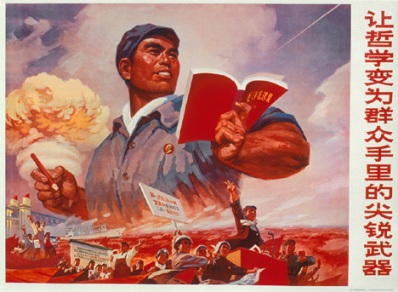
"China has stood up!": Mao Zedong's revolutionary nationalism (masquerading as Marxism) empowered the Chinese people to shrug-off both the European and Japanese imperialists who had subjugated and exploited their country for more than a century. They must find New Zealanders' willingness to sell their most valuable economic resources to foreigners deeply perplexing.

HAS NEW ZEALAND become a "creepily nationalistic" country? Is xenophobia running rampant in the heartland? At what point, exactly, does love of country become a disease?

It’s always struck me as odd that both the extreme Left and the extreme Right have no love of borders. Whether it be Karl Marx’s ringing exhortation for "workers of all lands" to "unite!"; or the proud boast of free marketeers that globalisation has made the nation state "redundant"; poor old Patria has been getting it in the neck for the best part of 150 years.

Fortunately Patria – literally, "the land of our fathers" – has a pretty tough neck.

The Socialist International, in the years leading up to the outbreak of World War One, worked hard to ensure that if the worst happened, and war did break out between the Great Powers, proletarian internationalism would trump the nationalist’s call to arms. "The bayonet", cried the socialists, "is a weapon with a worker at both ends."

But in August 1914, when the mobilisation orders were posted, workers of all lands rushed not to the barricades, but to the railway stations and the recruitment offices. The International’s call to stand shoulder-to-shoulder with the workers across the borders was drowned out by the cries of: "La Patrie en danger!"

The bayonet turned out to be what it had always been: a weapon with "Us" at one end – and "Them" at the other.

The clarion call to internationalism rang out once again in August 1991, when actually existing socialism "in one country" (and its satellites) suddenly withered away.

The disintegration of the Soviet Empire, boasted the American neoliberal scholar, Francis Fukuyama, signalled not only "the end of history", but the inevitability of globalisation. The triumph of free market capitalism and liberal democracy, he predicted, would set humanity on course for a borderless world.

Ten years later, nineteen young men – apparently unconvinced by Mr Fukuyama’s thesis – demonstrated that history wasn’t quite dead by flying their hijacked airliners into the World Trade Centre and the Pentagon.

America’s response was instructive. Less than a month after 9/11 the US Congress passed the Patriot Act, and President George W. Bush established the Department of Homeland Security.

Turns out borders mattered after all.

So, is nationalism really as "creepy" as the Auckland business community’s glamorous correspondent, Deborah Hill Cone, suggests? Or, is Patria’s claim to our love and loyalty as strong and as natural as that of our own parents’? And, is being "Pro Patria", or, to set this whole discussion in its proper context, taking a lively interest in who is, and isn’t, permitted to purchase large tracts of New Zealand farmland, really the same as xenophobia?

The short answer, according to Property Council New Zealand’s Chief Executive, Connal Townsend, is "Yes."

Interviewed by Radio New Zealand’s Checkpoint programme, Mr Townsend said that "there’s a real danger in pandering to a kind of ignorant, racist and xenophobic anti-foreigner feeling in this country, and not actually thinking sensibly about what’s actually best for our nation."

Ms Hill-Cone is even more explicit: "On the chattering classes dinner party circuit it is acceptable to be downright racist against Chinese interests buying land here".

I suspect the Chinese themselves would greet such statements with a degree of wry amusement – and be genuinely puzzled as to why those who sought to protect New Zealand’s vital economic interests are being pilloried in this way. No Chinese citizen would seriously contend that foreigners be permitted to venture into the heart of their homeland and secure exclusive control of its key resources.

Most Westerners simply don’t appreciate the Chinese people’s intense shame at being humiliated and exploited by European and Japanese imperialism. The Chinese State’s history stretches back through two-and-a-half millennia and no people could be prouder of their nation’s achievements.

When Mao Zedong created the Peoples Republic in 1949, he declared to the world: "China has stood up" – a statement whose full import could only be appreciated by a people who, for more than a century, had been forced to bow their heads to foreign invaders.

No, there’s little New Zealanders could teach the Chinese people about the love of country.

What Ms Hill Cone and Mr Townsend are teaching us, however, is how little they understand the people whose investment in New Zealand they are promoting. The Chinese may be tough negotiators – hard bargainers – but they will not be "put off" by those whose patriotism requires them to fiercely protect their nation’s resources. They would do no less – and they expect the same from their economic partners.

Indeed, I’m confident the only behaviour Chinese citizens would find "creepy" is the willingness of some New Zealanders to sell their country to strangers. Mao’s revolutionary nationalists called such people "compradors" – native-born agents for foreign businesses.

Those who did not flee to Formosa were shot.

This essay was originally published in The Press on Tuesday, 13 July 2010.