
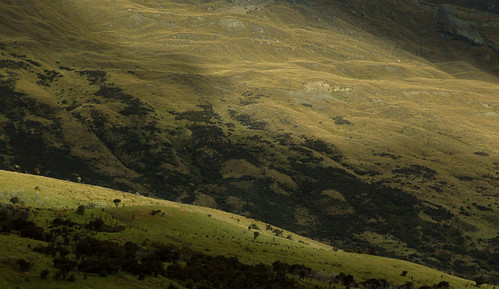
 A landscape to swallow souls: Alone in their empty land, New Zealanders have a murderous need to feel at home.
RONALD HUGH MORRIESON saw New Zealand through a whiskey-glass - darkly. The provincial society his novels describe oscillates uneasily between the sunny certainties of rural life, and the pitch-black nightmares of small-town dysfunction.
Obsessions born of boredom and isolation:
"What’s really going on behind the perpetually drawn curtains at Number 13?"
"That body the cops dug up from under the big Macrocarpa hedge surrounding the old Thompson place – did they ever find out who it was?"
What is it about New Zealand society that encourages these gothic outpourings? What transforms sullen misfits like Stan Graham and David Gray into homicidal gunmen? What leads so many "good blokes" to turn their hunting rifles on their wives – and then themselves? What’s our best guess when we hear that: "The Police are not seeking anyone else in relation to the incident."
Is it something in the water – or something in ourselves?
We’re a prickly people, prone to sudden mood-swings – as Helen Clark could testify. One minute she’s riding high in the polls, and the next thing you know she’s the grim commissar of politically-correct Helengrad.
Maori, too, know exactly how volatile Pakeha New Zealanders can be: from "bi-cultural partner", to seething enemy of "Maori privilege" – and all in the blink of Court of Appeal judge’s eye, or the time it takes to deliver a speech to the Orewa Rotary Club.
Pakeha sensitivity on racial issues is, of course, understandable. It’s difficult to feel positive about a country founded on bad faith, violence and the wholesale expropriation of the indigenous inhabitants. Much easier to construct a national mythology which declares the exact opposite to be true.
Up until the mid-1970s, New Zealand’s founding myth went something like this.
In the beginning were the Moriori – a primitive Melanesian people who were easily defeated and exterminated by a proud and warlike Polynesian race called the Maori. The arrival of Europeans profoundly disrupted Maori society, forcing their chiefs to seek the protection of the all-powerful British Empire. Almost alone among Britain’s colonies, New Zealand was founded peacefully and in good faith. The 1840 Treaty of Waitangi guaranteed native property rights and gave Maori the legal status of British subjects. Unfortunately, the warlike Maori tribes proved incapable of keeping the peace, and the British Government was required to subjugate them by military force. As the Moriori succumbed to the more powerful Maori, so were the Maori forced to give way before the more civilised Europeans. However, the dignity and valour of their Maori adversaries left a deep and favourable impression on the victorious "Pakeha" settlers. Convinced they were descended from the same Indo-European stock, the two peoples intermarried freely, producing a vigorous hybrid nation famed throughout the world for its racial harmony.
Over the course of the last thirty years, this myth has been relentlessly deconstructed by both Pakeha and Maori historians. For some New Zealanders, learning the truth about their country’s past has been a liberating experience, but for many others it has been profoundly disorienting and unsettling. Particularly galling has been the State’s effective endorsement of the revisionists’ work. For a surprisingly large number of citizens, this official repudiation of the nation’s founding myths is something akin to treason.
In small town, provincial New Zealand – Morrieson country – the State’s bi-cultural "treachery" has led to the growth of an alternative historical narrative. A curious collection of rogue anthropologists, pseudo-historians, New Age mystics, and old-fashioned racial supremacists have combined to produce a bizarre new version of New Zealand’s past.
Since rigorous historical research has made the country’s original founding myth untenable, the new "home-made" myth has been relocated in New Zealand’s pre-history.
The first people to reach these islands were not, it seems, Melanesian Moriori, nor Polynesian Maori, but a highly sophisticated band of proto-Europeans. More than a millennium before the birth of Christ, these daring sea voyagers established a dazzling antipodean civilisation. Long-since buried beneath bush and sand, it is remembered now only by the name the Maori gave to its remnants: "Waitaha".
The Waitaha myth, like the Moriori myth before it, answers a number of urgent needs in its provincial Pakeha creators. It destroys the Maori claim to indigeneity. It reaffirms the historical superiority of European civilisation. And, by extending out the length of time civilised people have dwelt in New Zealand from hundreds to thousands of years, it renders Maori culture irrelevant. Most importantly, however, these new myth-makers reassure historically disoriented Pakeha that their cultural "connection" to these islands is far stronger than that of the brutal primitives who destroyed the wonder and glory that was Waitaha.
In the tiny Northland town of Dargaville the Waitaha Myth briefly crossed the line from unofficial to official history.
While wandering through the town’s museum, Scott Hamilton, a doctoral student in sociology at the University of Auckland, spotted a "pou" – or carved gatepost marking the entrance to a Maori settlement.
According to the museum’s curator: "The carving, called Pouto Ki Rongomaraeroa, is the only one of its kind to be restored and put on display in a public place. It is different in type and design to Maori carvings, reinforcing the theory that the Waitaha had different origins and a longer history in New Zealand than Maori. The Waitaha lived in settlements around much of New Zealand’s coast."
When Hamilton took the Museum’s staff to task for passing-off pseudo-history as anthropological fact, he was told that "Maori communities and the archaeologists and historians who work with them have a ‘vested interest’ in suppressing information about a pre-Maori people."
(Visit http://readingthemaps.blogspot.com/2009/10/pseudo-history-at-dargy-museum.html for the full story.)
Welcome to the parallel universe of provincial New Zealand. A universe in which the remnants of an ancient, seafaring, pyramid-building civilisation lie buried beneath the sands of your local beach. A universe where non-indigenous Maori and wicked urban intellectuals conspire to keep ordinary Kiwis ignorant of their country’s "true" history.
To the well-educated and well-travelled inhabitants of metropolitan New Zealand, the fevered mental landscapes of their provincial cousins will give rise to genuine alarm. But Ronald Hugh Morrieson: whose Kiwi-gothic novels described every crooked feature of provincial New Zealand’s weird physiognomy; would’ve known exactly what he was looking at.
Adrift in these empty seas, New Zealanders will turn almost anything into an anchor. Alone in their empty land, Kiwis have a murderous need to feel at home.
This essay was originally published in The Independent of Thursday, 12 November 2009.

