Showing posts with label National Sovereignty. Show all posts

Friday, 9 September 2016

The Great Tightening 2.0

Trading Sovereignty For Investment Capital - Again: The suppression of local democracy is absolutely crucial to the success of the second “Great Tightening” exercise in New Zealand history. Unless the responsibility for making critical resource allocation and/or conservation decisions is taken out of the hands of elected local representatives and placed in the hands of unelected officials appointed by central government, then foreign investors will not feel sufficiently confident to risk their capital in major development projects.
 
ECONOMICALLY SPEAKING, it is difficult to define New Zealand as anything other than a colony. Its biggest export earner, agriculture, remains a price-taking not a price-making industry, and the other big foreign exchange earners: tourism and education; are essentially extractive. The former “mines” our spectacular scenery; the latter our status as a first-world, English-speaking nation.
 
That New Zealand is able to classify itself as a first-world nation is actually rather remarkable. A reliance on agricultural commodity exports and tourism is an economic condition generally associated with third-world states – most of which, only a century ago, were colonies of the major European powers. Officially, these former colonies are now free and independent states. But, if post-war history teaches us anything, it is that winning political independence, and becoming economically independent, are two very different things.
 
In order to grow and prosper, price-taking economies require a patron. For most of New Zealand’s history that role was fulfilled by Great Britain. It was British capital which financed the extensive infrastructure of its far-off farm, and it was in British markets that the produce of that far-off farm was sold. Without her capital and her markets, Great Britain’s far-off-farm would have failed. Certainly, New Zealand’s home-grown capitalists were too few and too poor to build a “Better Britain” in the South Pacific on their own.
 
More recently, the role of New Zealand’s principal economic patron has been taken over by China – which currently absorbs the lion’s share of New Zealand’s agricultural exports. If its history as a British colony is any guide, then the capital required to finance New Zealand’s future development will, increasingly, come from the Peoples Republic.
 
Like their British predecessors, Chinese investors are already attempting to secure control of the key supply chains to their domestic market. Just as New Zealand lambs were once raised on farms financed by British-owned banks; slaughtered in British-owned freezing works; transported to Smithfield in British-owned ships; and their frozen carcasses sold to British-owned retail outlets: New Zealand milk will soon be extracted from Chinese-owned cows; raised on Chinese-owned farms; processed into infant formula in Chinese-owned factories; shipped in Chinese-owned containers; and sold in Chinese-owned supermarkets.
 
One of the most interesting themes developed by the New Zealand historian, James Belich, in his 2001 book, Paradise Reforged, is what he calls “The Great Tightening”. In a nutshell, this describes the ways in which New Zealand politicians bound their countrymen ever more tightly to the British economy. New Zealand’s primary production went out to Britain; British manufactured goods came back; and woe betide anybody who got in the way (like visionary economic nationalists, socialist trade unionists, and other assorted pests).
 
It is rapidly becoming clear that a very similar tightening exercise is underway in twenty-first century New Zealand. In order to attract the foreign direct investment it believes New Zealand must have to keep its economy growing, the National Government of John Key is methodically emptying the statute books of every legislative impediment to economic development.
 
The suppression of local democracy is absolutely crucial to the success of this second “Great Tightening”. Unless the responsibility for making critical resource allocation and/or conservation decisions is taken out of the hands of elected local representatives and placed in the hands of unelected officials appointed by central government, then foreign investors will not feel sufficiently confident to risk their capital in major development projects.
 
Stripping local politicians of their power to manage and develop key infrastructure is an equally vital element of the same tightening programme. It’s what lies behind the draconian provisions of the Local Government Reform Bill currently before Parliament. Under this new law the unelected Local Government Commission will have the power to force local councils to hive-off key services, such as water reticulation, energy, ports and transportation to so-called “Council Controlled Organisations”. These Orwellian entities are, of course, anything but council controlled – as anyone living in Auckland, where they have been operating since the creation of the “Supercity” in 2010, will attest.
 
Auckland has not been the only laboratory in which the anti-democratic elements of National’s tightening have been tested. The people of Canterbury have been without democratic representation at the regional level since the Government sacked Ecan’s elected councillors and replaced them with appointed commissioners – also in 2010. With commissioners safely installed, the irrigation schemes deemed essential to dairy intensification in Canterbury could proceed without fear of democratic interference.
 
When most of the population of colonial New Zealand could trace their origins directly to Great Britain; and when the patriotic mists of Imperial Albion largely obscured the predatory commercial interests of the City of London, the first Great Tightening proved broadly acceptable.
 
The second will be very different. Those wondering how it feels to see one’s country subordinated to foreign interests should probably consult a Maori.
 
This essay was originally published in The Press of Tuesday, 6 September 2016.

Tuesday, 26 January 2016

A “Menu” Of Protest: Confronting Riot Police Shouldn’t Be The Only Protest Option On 4 February.

Off-Putting - And Then Some! There will be many “Middle New Zealanders” reconsidering their level of commitment to the anti-TPPA cause in the light of this information. Very few will want to risk either themselves of their families by participating in a demonstration where that sort of heavy-handed policing is in prospect. What's needed is a safe, non-confrontational, alternative.
 
ONE OF THE MANY INNOVATIONS pioneered by Halt All Racist Tours (HART) in 1981 was the protest “menu”. Not every opponent of Apartheid relished the prospect of going head-to-head with the infamous “Red” and “Blue” riot squads. Nor, watching the violence unleashed following the cancelled Hamilton game, were there all that many protesters willing to confront the Springbok Tour’s most rabid supporters. Rather than see a large number of its own supporters stay away from the protests, however, the HART leadership came up with the idea of offering a menu of options.
 
For the most militant, there were “Special Ops”. Some of these involved small bands of protesters taking out the television signal relay-stations essential to broadcasting the games live. Other groups blocked motorways, ran onto airport runways, and immobilised the public transport services essential for getting Rugby fans to the match venue.
 
Perhaps the most famous of these “Special Ops” came on the final day of the Tour when a light aircraft made repeated runs over the Third Test, at Eden Park, dropping flour-bombs on Springbok and All Black alike!
 
Participants in these operations knew and accepted the risk of being arrested, tried and convicted. The flour-bomber of Eden Park, Marx Jones, spent eight months in prison for his spectacular protest. John Minto was sentenced to six months jail for blockading Rotorua Airport. Special Ops were not for the faint-hearted!
 
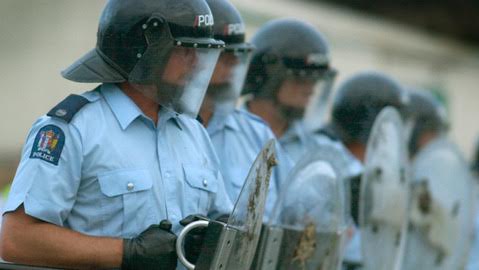
How The 1981 Springbok Tour Is Remembered: Helmeted protesters behind wooden shields face-off against Police riot squads wielding their signature PR-24 long batons. By no means all of the protests were so confrontational.
 
The next option on the protest menu involved testing the perimeter of the stadium where the Springboks were playing. This was the option that generated the images of the 1981 Springbok Tour with which New Zealanders are most familiar. The protesters are helmeted and padded-up against the Riot Squads’ infamous PR-24 long batons, and many carry wooden shields designed to prevent the sort of baton attack that injured so many defenceless protesters outside Christchurch’s Lancaster Park during the First Test.
 
The final option was intended for those who wished to avoid any kind of confrontation with either the Police or the Tour’s supporters. Many of those who availed themselves of this option were members of the mainstream Christian denominations. Others were elderly, or the parents of kids who wanted to participate safely in the anti-Apartheid protests. Such events took a variety of forms. Some groups opted for candlelight vigils and/or prayer meetings in the major centres’ churches and cathedrals. Others preferred to join strictly non-confrontational street marches protected by ordinary (i.e. non-riot-squad) police constables.
 
By offering its supporters these gradations of protest, HART maximised the full potential of the movement it had so patiently assembled over the entire decade of the 1970s. It was a shrewd tactical solution to the problem of what to do with people who wanted to do more than simply march up and down the street. The most militant opponents of the Tour were able to plan and execute radical protest actions of which HART remained entirely ignorant. Meanwhile, the perimeter-testers and the witness-bearers were able to engage in protests with which they felt morally (and legally) comfortable.
 
There is probably insufficient time for the anti-TPPA movement to develop a similar menu of protest actions against the signing of the TPPA on 4 February. “It’s Our Future” appears to be a much less structured organisation than HART, which boasted its own National Council for determining the anti-Apartheid movement’s strategic and tactical priorities.
 
Some consideration should, nevertheless, be given to the problem created by the Police’s announcement that it has been engaged for some time in “Public Order Training” – a.k.a. Riot Control. There will be many “Middle New Zealanders” reconsidering their level of commitment to the anti-TPPA cause in the light of this information. Very few will want to risk either themselves of their families by participating in a demonstration where that sort of heavy-handed policing is in prospect. In the absence of a “safe” alternative, people with jobs to lose and mortgages to pay are most unlikely to venture much further than the Town Hall on 26 January.
 
If, however, they were invited to turn up to the Auckland War Memorial in the Domain on 4 February, to recall the sacrifice of those who gave their lives for New Zealand’s national sovereignty, and to condemn John Key’s government for signing a document which puts that sovereignty at risk – thereby negating the sacrifice of so many young Kiwis – then it is my belief that many hundreds of Aucklanders who might otherwise have remained at home will seize the opportunity of registering a safe and responsible protest.
 
Something for Jane Kelsey and her comrades to think about. Because, this time, it’s not the rights and freedoms of Black South Africans that New Zealanders are fighting for – it’s their own.
 
This essay was originally posted on The Daily Blog of Monday, 25 January 2016.

Tuesday, 21 July 2015

Foreign Investors.

Foreign Investment: The Native Land Court transferred more land from Maori to Pakeha than Queen Victoria's regiments ever managed. Without land, no people may be counted free. Restricting the access of foreigners to New Zealand real estate isn't about racism - it's about the preservation of our national sovereignty.
 
IT IS THE EARLY 1860s in the Waikato. A Maori newspaper editor, and fervent supporter of the Kingitanga movement, has a great idea for a story. He summons his best journalist and explains what he has in mind.
 
“I want you to travel to all the major cities,” he says, “visit the Land Registry offices, and discover the identity of everyone who’s been purchasing land that formerly belonged to Maori.”
 
“That’s a pretty expensive exercise, Boss”, the young journalist replies, “especially when we both know what the answer will be.”
 
“You’re right,” says the editor, “but I need more than mere conjecture, more than just anecdotal evidence. What I’m looking for are cold, hard facts! Under the Treaty of Waitangi, we Maori can only sell land to the Crown. But who is the Crown selling it to? Is it being sold to New Zealanders? Or is it being purchased by foreigners with huge sums of money to invest? That’s what I want you to find out.”
 
“Hmmmm?” The journalist responds, doubtfully. “I’m not sure the Pakeha keep that sort of information.”
 
“Yes, yes, I’ve thought of that. What I want you to do is look at the surnames of the purchasers. That’ll give you are reasonably good steer. After all, somebody called McKenzie is unlikely to be of Tainui descent, is he?”
 
“No. But, there are quite a few McKenzies already here in New Zealand. How are we supposed to sort out the local sheep from the foreign goats?”
 
“I’ve thought about that, too”, says the Editor, warming to his theme. “What percentage of the total population do you think the Pakeha currently comprise – especially here in Te Ika A Maui?”
 
The young journalist scratches his head. “Surely not much short of 4 in 10? With more arriving all the time. It would be higher in Te Wai Pounamu.”
 
“Exactly so!”, says the Editor. “So, if your research shows that 8 out of 10 purchasers of former Maori lands has a surname like McKenzie, or O’Reilly, or Twyford, then doesn’t it stand to reason that overseas British investors are disproportionately involved in buying up this country from under the feet of its original inhabitants? That we Maori are fast becoming tenants in our own land?”
 
“Actually, Boss, I’m not sure it does. Couldn’t it mean that the British settlers already here are just buying up as much land as they can – as quickly as they can get their hands on it?”
 
“Oh come on!”, the Editor snorts derisively. “Most of the Pakeha disembarking at the ports don’t have a pot to piss in! Where are they going to get the money to buy land?”
 
“I’m not talking about the ones who come in steerage, Boss. I’m talking about the ones who make the voyage in private cabins. The youngest sons of good English and Scottish families who arrive here with a very healthy bank balance – courtesy of Papa back in London or Edinburgh. They’ve got plenty to spend.”
 
“Alright. But even if that’s true, the result is exactly the same – isn’t it? They apply to the Crown, and the Crown obliges them – at our expense.”
 
“But only so long as we go on selling our lands to the Crown, Boss. I mean, who else are they going to buy land from in these islands – if not from Maori? Isn’t that the whole point of the Kingitanga? To stop the sale of any more Maori land to the Crown?”
 
“Yes, of course it is! Which is why I want you to write this story for me. To give the Kingitanga the facts about what’s happening to their whenua – to their future!”
 
“The Settler Government in Auckland isn’t going to like a story that singles them out on the basis of their surnames”, the young journalist observes, ruefully. “They’re going to point to it as yet more evidence of Maori mischief-making. Yet another reason why the Governor should send troops south to destroy the Kingitanga.”
 
“No! No! Governor Grey will never make war upon the Maori people. He is a good man. He believes this country can only be improved by British capital and Maori enterprise. He also recognises the importance of Maori autonomy – he made provision for it in the Constitution Act!”
 
“He did, Boss. Yes. But the settlers seem ill-disposed to granting us that autonomy. And, I think I know why.”
 
“Tell me.”
 
“Because they want everything, Boss. Not just what Maori consent to sell them – but everything. Just think of how much we depend on them for already – and it’s only going to get worse. There’s millions of them, Boss – numbers our language has no words for. And we’re in their way.”
 
The Editor turned and gazed out over the lush Waikato countryside. There were tears in his eyes.
 
This essay was originally published in The Press of Tuesday, 21 July 2015.