
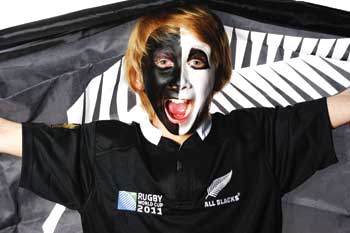
In The Shadow Of The Flag: Mass outpourings of triumphal emotion are all-too-often accompanied by an underlying consciousness of sacrifice and loss. We should never forget that those sacrifices were made so future generations could enjoy moments of joyous inclusiveness - like New Zealand's victory in the Rugby World Cup 2011 - in peace and freedom.
I WENT WALKING with my daughter last Sunday afternoon – RWC-Final Day. Landscape Road is a dead straight kilometre of bitumen and concrete linking Auckland’s much more famous Mt Eden and Dominion Roads.
Socially, the neighbourhood is what you would probably call “mixed”. To the east rise the tall trees and grand houses of Epsom. In Mt Roskill, to the south-west, the ancient lava-flats are traversed by street after street of state houses – among the first to be constructed by the First Labour Government. Along the length of Landscape Road you can see both sorts of dwellings – and a great many more that are neither grand, nor government-built: the modest bungalows of Middle New Zealand.
As we made our way down Landscape Road, the first things we noticed were the flags. They were everywhere: tied to hedges; affixed to windows; nailed to fences; flying from rooftops. I’d never seen so many. And it wasn’t only the New Zealand Ensign that was on display. Outnumbering our national flag by a margin of 2:1 was the silver-fern-on-a-sable-field that is the “All-Blacks” flag. Ranged alongside these quintessentially Kiwi emblems were the flags of the many nations out of which New Zealand itself has been fashioned: England, Scotland, Wales, Ireland, Tonga, Samoa, South Africa.
I remarked to my daughter how unusual it was for New Zealanders to indulge in this sort of overt display; how we tended to scoff at the ultra-patriotism of the Americans and their habit of flying “Old Glory” over anything and everything: from the overcrowded trailer parks of the poor; to the quiet suburban streets of the middle class; to the luxurious mansions of the obscenely rich. And yet, right there, fluttering before us, was proof that New Zealanders – no less than Americans – are capable of being swept up in the fierce passions of national pride.
“Can you imagine how upset New Zealand will be if the All-Blacks lose tonight?”, I said.
My daughter stood still, looked around at the multitude of fluttering pennants, and slowly shook her head.
But, as all the world now knows, the All-Blacks didn’t lose. And, with their re-claiming of the Webb-Ellis Cup, all that longing, all that confidence, which the flags down Landscape Road represented, has been vindicated.
And how we celebrated. To see literally hundreds-of-thousands of Aucklanders pour into the heart of their city to share in the elation of this long-anticipated sporting victory put me in mind of the vast crowds thronging Tahrir Square in Cairo or Martyrs’ Square in Tripoli. What a fortunate nation, I thought to myself: that its people can turn out in such numbers for something so innocent, so free of death and misery, as a sporting trophy.
How wonderful that our joy in the All-Blacks’ triumph was so emotionally unalloyed. That, beneath the revels, there ran no deeper sadness; no heart-rending knowledge that the price of victory must be counted in the bodies of the fallen.
Historically-speaking, New Zealand is no stranger to those feelings: following two world wars we were forced to undertake our own, grim, calculation of victory’s cost. And let us remember that it was for the possibility of just such moments of happiness, inclusiveness, unity and pride; moments shared by a free people, living in a tried and tested democracy, that New Zealand “laid upon the altar the dearest and the best” she had to offer.
So, as we once again avail ourselves of those democratic instruments, purchased at such expense by our ancestors, let us strive to preserve, in the allocation of our support, that same happiness, inclusiveness, unity and pride that illuminated the nation last Sunday night. Let us give our support only to those who would use our votes as tools for creation – not as weapons to exclude, threaten or destroy.
What made Sunday’s victory so special was that the joy it brought was available to everyone. That, in the shadow of those flags, we were all New Zealanders – all winners.
This essay was originally published in The Dominion Post, The Timaru Herald, The Taranaki Daily News, The Otago Daily Times, The Greymouth Star and The Waikato Times of Friday, 28 October 2011.

