

What's Wrong With This Picture? In this cartoon from the Presidential Election Campaign of 1860, Black Americans in Victorian finery are depicted as a warning of what will happen to America if the Republican Party's candidate, Abraham Lincoln, becomes President. Clothing as a status marker carries with it a powerful political charge when the person wearing it is assumed to occupy an inferior social position.
THERE WAS A VICIOUSNESS about the United States presidential
campaign of 1860 that, with hindsight, seems horribly portentous. No matter how
many times the South’s politicians did the political math the result was always
the same. The newly-formed Republican Party was going to win a majority in the
Electoral College, and its anti-slavery candidate, Abraham Lincoln, was going
to become the sixteenth President of the United States.
In desperation the slave-owning South and their Democratic
Party allies in the northern states threw everything they could at “Honest
Abe”. Given the hugely divisive issue at the heart of the campaign, racial
slurs abounded. Plucking the most tightly-wound string of the American
electorate’s fiddle, Lincoln’s opponents accused him of believing in racial
equality, miscegenation and plotting secretly to turn America into a mongrel
state.
Naturally, the pro-slavery parties’ cartoonists had a field
day. One of their favourite visual taunts was to portray black men and women
sashaying around beneath “Honest Abe’s” approving gaze in the clothing of the
upper-classes.
To racially prejudiced Americans (which in 1860 constituted
the overwhelming majority of US citizens) the image of a black person decked
out in the lavish Victorian finery of the period was profoundly offensive. It
implied that Blacks might one day disport themselves in exactly the same
symbols of economic success and superior social status as Whites.
The anti-Republican cartoons were also intended to warn
voters about the Abolitionists’ determination to not only free the slaves, but
also to have them declared United States citizens with exactly the same civil
and political rights as their White brothers.
It must also be noted, however, that in addition to making
White Americans angry these images of “gussied-up niggers” also made them
laugh. The whole idea was so preposterous, so outlandish – like an ape in
evening dress – that it could not be taken seriously. Racial equality was thus
revealed as a wild abolitionist fantasy – proof of just how far beyond the pale
the Republicans and their candidate had positioned themselves.
One hundred and twenty years later, proof of American
racism’s cultural tenacity was clearly evident in the presidential election
campaign of 1980. The Republican Party’s candidate, Ronald Reagan (whose party
had, in one of History’s most poignant ironies, become the preferred party of
the old Confederacy) launched his campaign at the Neshoba County Fair, an
annual event held on the outskirts of Philadelphia, Mississippi, the town where
three civil rights workers were murdered by the Ku Klux Klan in 1964.
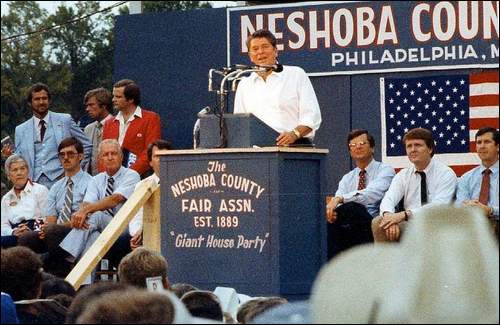
The White Man's Candidate: Resplendent in his white shirt-sleeves, Ronald Reagan launches his 1980 Presidential Campaign on the outskirts of Philadelphia, Mississippi, where, just 16 years earlier, three civil rights workers were murdered by the Ku Klux Klan. American racism has a remarkable cultural tenacity.
America’s racists grasped the dark symbolism of Reagan’s
choice immediately. He was identifying himself proudly and unmistakably as the
White voters’ candidate. Not that they needed much convincing. Four years
earlier, in his first run at the Republican presidential nomination, Reagan had
introduced America to the person he dubbed the “Welfare Queen” – a Black
American woman living on the South Side of Chicago:
“She has eighty
names, thirty addresses, twelve Social Security cards and is collecting
veteran's benefits on four non-existing deceased husbands. And she is
collecting Social Security on her cards. She’s got Medicaid, getting food
stamps, and she is collecting welfare under each of her names. Her tax-free
cash income is over $150,000.”
Reagan’s words
served a purpose identical to those 1860 cartoons’ depicting Black Americans dressed
in upper-class attire. His Welfare Queen, with her “tax-free cash income” of
over $150,000, played to exactly the same prejudices. The notion of a Black
woman earning $150,000 was clearly preposterous: only the most egregious
defrauding of the welfare system could possibly produce such a creature.
Reagan’s message
was clear: Liberal America, by promoting racial equality and demanding that the
equal rights of citizenship, won at such cost under Lincoln’s presidency, be
enforced in every state of the union had created (at the ever-escalating
expense of the long-suffering taxpayer) a feckless underclass of welfare
cheats, drug addicts and gang-bangers. Reagan didn’t have to say that the
people he was talking about were Black. The people who cheered him on knew that
already.
Disreputable
politics? Undoubtedly. But also highly effective – which is why so many
politicians throughout the English-speaking world have tried so hard to emulate
Reagan’s success.
Including some New
Zealand politicians?
I would certainly
like to think not. The idea that there might be some Pakeha politicians who,
without resorting to the derogatory terms of our not-too-distant racist past,
and almost certainly without reflecting on how their words were likely to be
misinterpreted, might nevertheless call attention to the way a non-Pakeha
person was dressed, and to how much money they might have spent on their
ensemble – is a very troubling one.
To the minds of
some undoubtedly oversensitive wee sausages those 1860 cartoons might be
recalled, along with Ronald Reagan’s quip about welfare queens.
Just how
would a racist politician say “gussied-up nigger” in 2014?
This essay was originally published in The Press of Tuesday, February 04, 2014.
