’ Lakeside State Park holiday resort, just a few miles out of Port Huron, Michigan. That was where, on 15 June 1962, the concept of “participatory democracy” was born. Sharing its birthday was the movement that would become known as the “New Left’, along with the organisation that would give shape and purpose to the youth revolt of the 1960s and 70s – Students for a Democratic Society (SDS).
But, what has “The Port Huron Statement” and the notion of participatory democracy got to do with New Zealand politics in 2022?
The answer to that question is inextricably bound up with another question: At what level should decisions that impact directly upon the daily lives of citizens, and the communities in which they live, be made? How we answer that question is of immense importance, because the happiness of citizens and communities is all-too-often a reflection of their proximity to such decision-making; and of how responsive the decision-makers are to their wishes and concerns.
In October 1964, the Berkeley Free Speech Movement had a slogan, inspired by the instructions printed on the plethora of forms which the University of California at Berkeley required its students to complete. It read: “Please do not fold, spindle or mutilate – I am a human-being.”
Those words capture brilliantly the deep sense of youthful alienation to which the SDS was already giving voice. Everywhere institutions were getting bigger, more complicated, less intelligible and, increasingly, unaccountable. The student activists of the SDS saw it all around them in the ever-expanding universities of the post-war era. These vast “knowledge factories”, dedicated to furnishing corporate America with the highly-skilled and well-adjusted managers and professionals it demanded, left their youthful raw material feeling used and abused.
And it wasn’t just the universities that were folding, spindling and mutilating. The bureaucracies of the private sector: General Motors; General Electric, Dow Chemicals, IBM; were, if anything, larger (and certainly less responsive) than those of the public sector. Even more troubling, Abraham Lincoln’s “government of the people, by the people, for the people” also showed signs of succumbing to the sins of bigness. The opaque political machines of the Democratic and Republican parties had turned folding, spindling and mutilating into an art form.
What did it say about American democracy, that Jack Kennedy, the best and the brightest presidential candidate in nearly 30 years, had to be elected by the votes of dead Democrats – courtesy of organised crime? Or that the very same Mafia “outfits” controlled so many of America’s trade unions? Not the SDS’s sponsors in the United Auto Workers maybe, but most definitely Jimmy Hoffa’s Teamsters!
Big Business, Big Government, Big Unions, Big Universities – Big Gangsters! – there had to be a better way! Because, as the Free Speech Movement’s leader, Mario Savio, so eloquently put it:
Stirring rhetoric! But if Savio believed the sentiments he was expressing were new, then he was wrong. Outrage at “the operations of the machine” is not a new thing, it goes back a long way. And the sort of people and institutions who have given voice to that outrage might surprise you.
in which the principle of subsidiarity was for the first time clearly enunciated by the Catholic Church:
 |
| Pope Pius XI |
Just as it is gravely wrong to take from individuals what they can accomplish by their own initiative and industry and give it to the community, so also it is an injustice and at the same time a grave evil and disturbance of right order to assign to a greater and higher association what lesser and subordinate organizations can do. For every social activity ought of its very nature to furnish help to the members of the body social, and never destroy and absorb them.
It is important to locate these words in their historical context. Only then can the motivation of the Church – itself a large, rigid, and highly intricate hierarchy, with a global bureaucracy to match – be rendered intelligible.
The targets of Pius’s encyclical were, on the one hand, the unchecked rapaciousness of laissez-faire capitalism ,and the amoral individualism which it had spawned; and, on the other, the totalitarian ambitions of Italian Fascism, German National Socialism and Soviet Communism, which sought to drag all free-standing and self-regulating entities into the inescapable and smothering embrace of an ideologically-driven state.
Pius argued that not only was the “body social” made healthier by governmental diversity, but so too was the social soul. Bad things happen wherever the duties of church and state are merged. Because, as the novelist Robert Harris so rightly observes: “If those with morals lack power, then those with power will lack morals.”
Historians are divided over how resolutely the Catholic Church defended the principle of subsidiarity – especially under the pontificate of Pius XI’s, Secretary of State, Cardinal Pacelli, who succeeded him as Pope Pius XII in March 1939. Branded “Hitler’s Pope” by his detractors, Pius XII nevertheless knew a thing or two about navigating acutely vulnerable vessels through pirate-infested waters. That two of the three pirate kings of the 1930s were dead by the time Pius XII brought all his little ships safely home is often forgotten by his critics. Also forgotten is the critical role played by the pontiff so often described as Pius XII’s spiritual successor, Pope John-Paul II, in bringing down the Soviet Union – the last of the pirate kingdoms.
Certainly, it was under the watchful eye of Pius XII that the principle of subsidiarity became the foundation stone of Christian Democracy throughout Western Europe. And it wasn’t just the Catholic countries that embraced the new doctrine. The German Christian Democrats would become that country’s natural party of government. In the protestant Netherlands it also sent down deep roots. Yes, it helped that the Federal Republic of Germany’s first Chancellor, Conrad Adenauer, was a much-admired anti-Nazi. But, after Hitler, and in the grim shadow of Stalinism, Christian Democracy was able to hold out the promise of moderation and respect. People had seen what bigness could do: the principle of subsidiarity acknowledged the beauty and resilience of small things.
Villages, towns, cities, regions: in each of these places stood institutions tested and refined by the passage of centuries; modes of governance which recognised the special needs and preferences of their communities; bodies which interposed themselves between the peremptory claims of the national, and the long-established rights and cherished privileges of the local. The gauleiters and commissars had swept all these away with totalitarian contempt, but the Christian Democratic parties organised and celebrated their return. No wonder people voted for them!
“Ah, but that is Europe!”, I hear you say. “Europe isn’t merely old, it is ancient. History there isn’t measured in decades, but in centuries and millennia. Obviously, subsidiarity works well alongside traditions as old as these. But, can it work in New Zealand? Ours is a nation which came into existence less than two centuries ago? What traditions do we have to rival those of Italian city-states, French villages and German market towns? Also, Europe is full of people: 500 million in the EU alone! In a nation whose population has just passed 5 million, how far down can power be passed before it ceases to be able to pay for itself?”
For nearly four decades now this country’s political and economic leaders have studiously avoided the question of how government – national and local – is expected to pay for itself. That’s because, in 1984, they convinced themselves that the responsibilities of government should be contracted out to the “Free Market”. Taxes could be cut, public enterprises privatised, and the burden of regulation lightened to the point where it could scarcely be felt at all, and everything would be fine, because the Free Market knew best and the Free Market would provide.
Except, of course, the Free Market isn’t really interested in keeping the water drinkable, the streets lit, the rubbish carried away, and the power on, or in providing any of the other services that absolutely must be provided if people are to remain healthy and their communities habitable. That is to say, the private sector will not provide any of these services without first receiving an ironclad guarantee that they can be provided at a profit.
And what can Local Government say: except “Yes, Sir”?
And what can Local Government do: except impose more user-charges and strike ever-higher rates?
And what alternative does Local Government have when the rate-payers cry “Enough! No more!”: except to let their communities’ crucial infrastructure rot, and put off until tomorrow all the things that are crying out so urgently to be done today?
And what does Local Government know: if not that the day must come when the pipes burst, and the water becomes contaminated, and people get sick, and some die, and the country’s mayors, councillors and managers are all lined up by the news media to take the blame and wear the shame?
It’s madness – utter madness – and it’s getting harder and harder to conceal the fact.
More importantly, it’s wrong. There is something dark and malignant behind the reality that our country no longer seems to work. Something every bit as dark and malignant as Hitler and Stalin: and just as totalitarian.
Pope Pius XI knew what it was. Remember the words of his
Quadragesimo Anno? He called it “a grave evil and disturbance of right order”. It flows from that other source of the Church’s growing alarm in 1931. The forces powering the rise of Mussolini and Hitler and Stalin. Untrammelled capitalist greed, and the ruthless pursuit of individual wealth and power without heed for the consequences. Not for the rest of humanity. Not for the world they inhabit.
Do not fold, spindle or mutilate – I am a human-being.
Because the abandonment of the principle of subsidiarity (even in its birthplace, Europe) and the universal enthronement of the most successful totalitarian ideology in human history, Neoliberalism, is very surely, but not at all slowly, destroying the biosphere – and with it the future of human civilisation.
And to whom, as the planet swelters and pandemics sweep the globe, will people turn for aid and comfort in the years that lie ahead? To the failed politicians in a distant capital city? To the same political class whose reckless inaction precipitated the very crisis in which they now find themselves engulfed? To the powerless servants of science, whose fate, like Cassandra’s, was to see the future clearly, but not be believed? No, they will not. They will turn to their local councils: to the politicians and bureaucrats who serve their regions, districts, cities and towns.
That word “serve” is used advisedly. It’s an old-fashioned word and an old-fashioned concept, but in spite of it falling out of favour, both linguistically and politically, service of one sort or another is inescapable. How does Bob Dylan put it?
You may be a preacher with your spiritual pride
You may be a city councilman taking bribes on the side
You may be workin’ in a barbershop, you may know how to cut hair
You may be somebody’s mistress, may be somebody’s heir
But you’re gonna have to serve somebody, yes
You're gonna have to serve somebody
Well, it may be the devil or it may be the Lord
But you’re gonna have to serve somebody
The temptation is always to serve the already powerful: the people with the money; the One Percent – for want of a better term. But, it’s a temptation that should be resisted. It is never a good idea to be found standing too close to those who end up wearing the blame. No matter how much sense it may have made in the past to range oneself alongside those who scorn the very idea of popular participation, and who consider democracy to be an extremely inefficient form of government; it makes sense no longer.
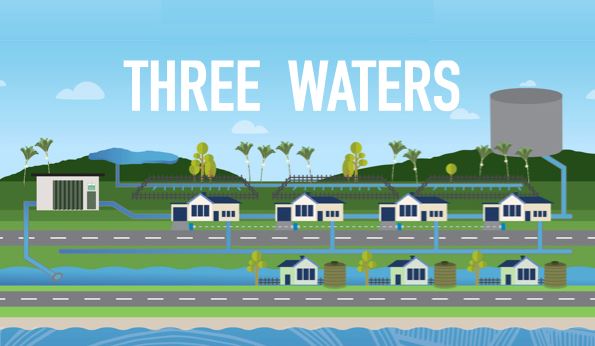
Powering-up is what got us into this mess. Creating bigger and bigger local government organisations – Three Waters anyone! – sealing them off ever more hermetically from public scrutiny; making them less and less accountable to the individuals and communities they were intended to serve; none of it has made these local services any more efficient or effective – quite the opposite, in fact.
By assigning to “a greater and higher association what lesser and subordinate organizations can do” the energy and creativity of the “body social” has indeed been absorbed and destroyed – just as Pope Pius XI predicted. Only by powering-down; only by adopting the principle of subsidiarity; can the sort of institutions that make the practice of participatory democracy feasible be brought into existence.
Is participatory democracy really that important? Yes, it is, because without returning effective political power to the people, there is no possibility of also returning their resources. No one involved in the management of local government will have failed to notice the way in which central government has mastered the art of passing its responsibilities downwards – while withholding the resources needed to carry them out. Such is the fake subsidiarity of Neoliberalism: making the victims of central government parsimony responsible for administering their own deprivation. Like inviting someone to open a bank and then refusing to supply them with cash.
Does subsidiarity have revolutionary implications? Yes, of course it does. It will, however, be a revolution made on behalf of the particular, not the general. Yes, it will entail a radical re-ordering of our institutions, but not in the name of grand and universal objectives. This will be a revolution favouring the little and the local. The sort of change delivered by careful and patient husbandry, rather than by levelling bulldozers and snarling chainsaws. A revolution that has no interest in cutting things (or people) down, only in letting them grow.
It is to New Zealand’s local authority politicians, bureaucrats and engineers that we must look for leadership in this revolution because, in truth, who else is there? Only they have the expertise and the experience to keep the water drinkable, the streets lit, the rubbish carried away, and the power on. Only they understand the importance of maintaining the services that absolutely must be maintained if people are to remain healthy and their communities habitable … when the pandemics rage and the skies change colour.
It was Tip O’Neil, Speaker of the US House of Representatives, who popularised the observation “all politics is local”. Now, he was the sort of old-style Democratic Party machine politician that the SDS wanted to get rid of. What those young student activists failed to grasp, however, is that the only thing worse that a full pork barrel is an empty one. And that the only way to keep the pork coming is to never let the politicians wheeling and dealing in the far away capital city forget where their votes come from.
In the end, subsidiarity is about decisions that are hand-crafted – not mass-produced. It’s about governing in a way that keeps neighbours talking
to one another, not shouting
at one another. It’s about individuals passing some things up, so that other things can be passed down to their families and communities. Most of all, it’s about designing government machinery that does not fold, spindle or mutilate the human-beings it is supposed to serve – and which every citizen can learn to operate.
This essay was originally posted on The Daily Blog of 21 April 2022.