Respecting Family Treasures - and Maori Taonga: My Grandfather's sword (just visible below his elbow) now rests in the Oamaru Museum, where I trust it will continue to be accorded the same deep respect it always demanded - and received - from my family. Photograph of Captain William Marshall, Otago Mounted Rifles, courtesy of Margaret E. Trotter (nee Marshall).
CAN WEAPONS OF WAR inflict harm – even when they’re not in use? When displayed in a glass case in a museum, are greenstone mere and taiaha to be classified simply as "inanimate objects" – archaeological "artefacts"? Or are they something more than that? Something quite capable of harming any pregnant or menstruating woman who draws near?
Do weapons have a life of their own? That is the essense of the controversy currently swirling around the Museum of New Zealand - Te Papa. (See here and here.)
According to Maori cosmology the answer is a most emphatic "Yes." Any weapon that has shed blood, taken life, is imbued with tremendous spiritual force. It partakes not only of the life force of the person it was used against, but also of the spirit of the warrior who wielded it and of the craftsman who fashioned it. In the Maori world, weapons are objects of power. Touching them – even approaching them – is fraught with danger.
It is for this reason that pregnant and menstruating women are enjoined to remain at a safe distance from these potentially harmful objects. An instrument of death: shaped for violence, guided by anger, steeped in pain and suffering; should not be permitted to come anywhere near the bearers of life – or the sacred blood that nourishes it.
Those who embrace the scientific method will bridle at such notions. Things of stone and wood become dangerous only when manipulated by the hand and brain of Homo Sapiens. When not under conscious human direction mere and taiaha are harmless lumps of matter: nothing more, nothing less.
To those who subscribe to the core values of secular humanism, Te Papa’s tacit endorsement of Maori cosmology must also seem outrageous.
In the modern secular state, religious belief and practice is relegated strictly to the private sphere. In the public sphere reason alone is supposed to prevail. And reason dictates that differences of gender and ethnicity must in no way detract from the democratic rights and duties of free and equal citizens. To allow animist superstition to in any way prevent women – regardless of their reproductive condition – from exercising their civil rights is the nearest thing to a "sin" that secular humanism will allow.
All right and proper, I suppose, but it is very … well … thin.
We should never forget that the triumph of 18th Century Enlightenment values was challenged almost immediately by the much more visceral cultural impulses of Romanticism. Reason and science may have released us from the grip of religious obscurantism and superstition, but it also cast us adrift in a world stripped bare of meaning and mystery.
Very few human-beings are able to thrive in such a barren emotional environment, which is why so many people respond to and take comfort in what Science would undoubtedly reject as the irrational manifestations of fear and awe.
Like the mysterious power of weapons.
My Grandfather was an officer in the Otago Mounted Rifles who fought in the Boer War.
On the wall above our beds, as we were growing up, my brother and I could see the Mauser rifle Captain William Marshall had brought back with him from South Africa. It was a splendid example of German precision engineering – long and heavy and absolutely deadly. On the rifle’s stock its original owner had carved his name: "Van Rijn".
I can’t tell you how often I stared at that weapon, wondering about the man from whom my Grandfather took it as a trophy of war. Was it someone he had killed with his own hands? Or, did he prise it from Herr Van Rijn’s lifeless fingers in the aftermath of some forgotten skirmish on the High Veldt?
The spirits of both men seemed to me to linger in that rifle.
Invariably, whenever I lifted the weapon down from the wall, the hairs would rise on the back of my neck.
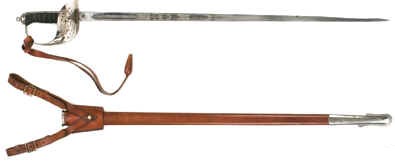
For true power, however, nothing came close to my Grandfather’s sword. It was kept in a special sheath of oilskin and only taken out on special occasions. The mixture of fear and awe that I experienced as a small boy as the long blade emerged from its leather scabbard is easily imagined.
For it was a thing of both beauty and power. Its greased blade was engraved with the most intricate filigree and just below the hilt a brass Star of David was inset. The initials of the King-Emperor, Edward VII, took pride of place on the finely-wrought guard to show at whose pleasure my Grandfather served.
It was a treasured heirloom of my family – a taonga filled with potent magic.
It rests now in the Oamaru Museum – where I hope it is accorded the same deep respect it always demanded – and received – from me.