
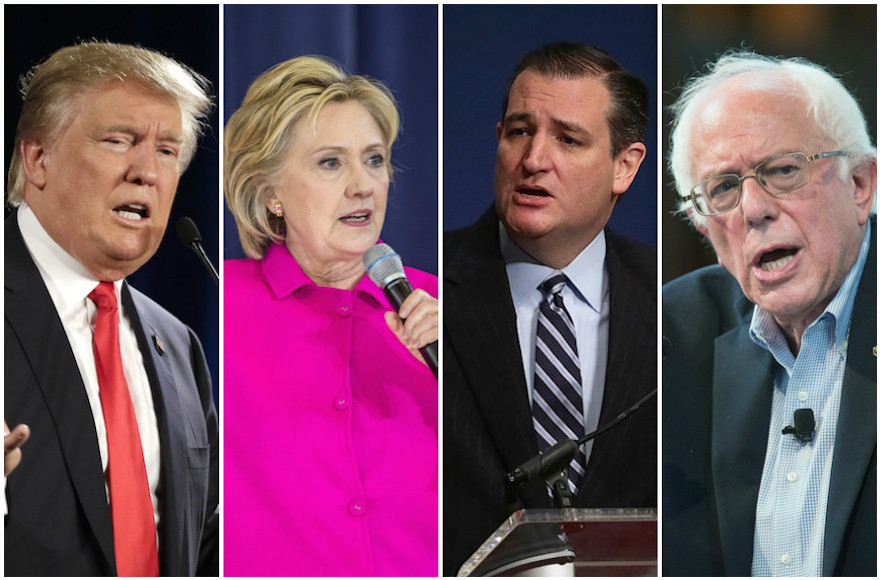
E Pluribus Unum: Out of the four leading contenders for the Presidency, the American electorate and/or the Republican and Democratic Party "grandees" must contrive to winnow down the choice to just two (or three, if they fail) and then to just one. Not since the 1850s has the American Republic been confronted with an electorate less disposed to swing in behind the last man - or woman - standing.
THE AMERICAN PRESIDENTIAL election campaign is entering a
critical stage. The results of the forthcoming primary elections in the big,
delegate-rich, north-eastern states of New York, New Jersey and Pennsylvania will
go a long way towards determining which of the Republican and Democratic
candidates square-off against each other in November.
For the Democratic challenger, Senator Bernie Sanders from
Vermont, it’s make-or-break time. If he cannot inflict a series of decisive
defeats upon front-runner Hillary Clinton in these three great Democratic Party
redoubts, then his candidacy will be dead in the water and the Democratic Party
Convention in late July will be the Clinton coronation her supporters have
always predicted.
On the Republican Party side, the race could get a whole lot
more complicated. A failure by Trump to come storming back in his home state,
New York, may well end his hopes of winning the 1,237 delegates he needs to
secure the Republican nomination. If neither Trump, nor his principal rival,
Texas senator Ted Cruz, has the numbers to win on the first ballot, then the
world will be treated to a spectacle unwitnessed in twenty-first century
American politics – a brokered convention.
Will the assembled Republican delegates, no longer pledged
to dance with the candidate they came with, install Trump or Cruz anyway? Or,
will they swing their support behind the allegedly “moderate” Governor of Ohio,
John Kasich? The possibility that the candidate may turn out to be someone
entirely unlooked for: someone “drafted” by the convention delegates
themselves; cannot be discounted.
What is it that has produced these high levels of political
volatility and uncertainty in American society? How has the usually elite-driven
process of selecting a presidential candidate been transformed into this rowdy
festival of unguided democracy?
Before answering that question, it is worth pausing for a
moment to consider the implications of the previous sentence.
Because whatever its critics may say about the American
system, this year’s presidential race is proof that the great republic is still
very much the creature of “We, the People of the United States.” Trump is
selling populism; Cruz conservatism; Sanders idealism; and Clinton is retailing
pragmatism. “Step right up!” their respective barkers shout: “You’ve paid your
money – now make your choice!” And, in the lengthy and complex process of
choosing, millions of Americans are demonstrating not only their ideological diversity,
but also their unifying faith in the ongoing utility of the ballot-box.
Whether that ballot-box can any longer deliver a President
equal to the challenge of representing the burgeoning diversity of the American
electorate is the core question being posed by the 2016 campaign. Somehow, the
populism, conservatism, idealism and pragmatism which have whipped the contest
into its present state of inchoate frothiness must be settled and distilled:
firstly into two candidates; and then, on 8 November, into a single individual.
The number of times this seemingly impossible task has
actually been accomplished by the American electorate is impressive. Theodore
and Franklin Roosevelt managed to keep all four balls in the air, and so did
Dwight Eisenhower. Lyndon Johnson did it in 1964, as did Richard Nixon in 1972
and Ronald Reagan in 1980, and then again, even more emphatically, in 1984.
For all their eloquence and glamour, neither John F. Kennedy
nor Barack Obama succeeded in triggering the sort of landslides granted to
Johnson and Reagan. Bringing together the clamouring tribes of the American
polity proved to be beyond both presidents. Although Kennedy’s assassination
did engender a kind of unity – if only of shock and grief.
The current roilings of American politics: its vicious and
uncompromising partisanship; the disquieting thought that many of the issues at
stake may not be susceptible to resolution by simple majorities; have recalled
for US historians the deadly politics of the decade immediately preceding the
outbreak of the American Civil War in 1861.
The historic outcome of the presidential election of 1860,
which saw Abraham Lincoln elected with just 39.8 percent of the popular vote,
was made possible by a fatal split in the ranks of the Democratic Party. That
such a split – this time in the ranks of the Republican Party – is being openly
canvassed only adds to the sense of historical déjà vu. Should Trump’s clear plurality of the Republican primary
vote be discounted by the machinations of party grandees, his supporters may
not go quietly into that good night of political impotence.
A third party challenge by Trump could throw the 2016
Presidential Election to the Democratic Party in circumstances that call into
question the legitimacy of its mandate. As in 1860, it will be race and the
threat it poses to the status of White Americans, that threatens not only the
coherence, but also the very survival of the American republic.
Tomorrow’s New York Primary is worth keeping an eye on.
This essay was
originally published in The Press of Tuesday,
19 April 2016.
