Showing posts with label The NZ Left. Show all posts

Friday, 27 August 2021

“No Jab, No Job!” – Preventing The Injury Of All By One

Intramuscular Solidarity: A trade union movement dominated by the working-class wouldn’t have a bar of all this anti-vax nonsense. The idea that some ignorant believer in conspiracy theories peddled by right-wing nutters on the Internet should be allowed to refuse vaccination – putting countless other Kiwis at risk – would strike them as complete bullshit. A working-class-led trade union movement would have been in the ear of  Workplace Relations and Safety Minister Michael Wood for weeks, urging him to institute a “No Jab, No Job!” policy ASAP.

ALL TRADE UNIONISTS are familiar with the slogan: “An injury to one is an injury to all.” It encapsulates the principle of solidarity and signals the determination of the collective not to be picked-off one-by-one. Employers who are not brought up sharply by their employees’ union for harming one of its members, will very soon feel emboldened to harm them all. Much more challenging, from the union’s point-of-view is how to guard against the behaviour of a single worker imperiling the health and safety of their co-workers. How to prevent the injury of all by one.

It might be expected that, with the Delta Variant of the Covid-19 virus rampaging through Auckland, and mass vaccination being presented as the most important escape-route from the pandemic, the institutions dedicated to the protection of workers’ health and safety would be leading the charge against those who refuse to acknowledge the obligations of social solidarity. Why then, are the trade unions not at the forefront of a “No Jab, No Job!” movement? In the midst of a pandemic, a refusal to be vaccinated (without medical justification) is surely the crowning example of individual indifference to the welfare of the whole. Is it not the duty of the trade unions to take a resolute stand against such anti-social selfishness?

In the context of a Labour Government with an absolute parliamentary majority, is it not, similarly, the duty of the Minister of Workplace Relations and Safety, Michael Wood, to do all within his power to ensure that the obligations of solidarity are backed-up by the full force of the law? If, upon inquiry, that same Minister discovered that employers presenting their employees with the “No Jab, No Job!” alternative would almost certainly be acting unlawfully, then, surely, his next step would be to arrange for the law to be changed? After all, this is exactly what was done to ensure that “border workers” were all fully vaccinated. If “No Jab, No Job!” was good enough for customs officers and stevedores, then why not for every other group of New Zealand workers?

Wood was unable to provide a clear answer to questions such as these when he appeared (by Zoom) before the relevant parliamentary select committee. A superb chance to cast himself in the role of a hard-nosed, no-nonsense, champion of the working-class was squandered. Instead Wood chose to present himself as the inconsistent and mealy-mouthed champion of, well, God knows what.

The employers of workers already on the payroll, he informed the committee, could not say “No Jab, No Job!”, but, it would be perfectly okay for them to demand it of their next job applicant as a condition of employment. What a principled stand! Almost as principled as dodging the questions relating to the employers’ legal obligation to provide a safe and healthy work environment for their employees. Isn’t New Zealand lucky to have a Minister of Workplace Relations and Safety who is willing to place the rights of anti-vaxxers ahead of the rights of everyone else in the workplace – and the country?

Wood’s failure is emblematic of the more general failure of the entire New Zealand Left. To prevent certain classes of citizens from feeling hurt or offended by the free speech of their fellow citizens, leftists are all in favour of breaching the Bill of Rights Act and jailing “hate speakers” for three years. Those same “leftists” would not, however, dream of overruling the Bill of Rights Act’s prohibition against forcing medical procedures upon citizens – even at the cost of undermining the nation’s collective effort to defeat the Covid-19 Pandemic.

A trade union movement dominated by the working-class wouldn’t have a bar of this sort of “leftism”. The idea that some ignorant believer in conspiracy theories peddled by right-wing nutters on the Internet should be allowed to refuse vaccination – putting countless other Kiwis at risk – would strike them as complete bullshit. A working-class-led trade union movement would have been in the ear of Michael Wood for weeks, urging him to institute a “No Jab, No Job!” policy ASAP.

Sadly, however, New Zealand’s trade union movement isn’t led by the working-class (of which fewer than 10 percent now belong to a trade union) but by a council dominated by middle-class public servants of every description. A surprising number of these regard the right to refuse having their bodies polluted by injections of unwanted fluids as sacred, and not to be overruled for any reason – not even to preserve the health, safety, livelihoods, and lives, of their fellow citizens.

The idea that there are circumstances (fortunately rare) in which the safety of all might require the injury (but only to the pocket) of one, would strike them as barbaric. Unless, of course, the “one” was engaging in Hate Speech!


This essay was originally posted on The Daily Blog of Friday, 27 August 2021.

Tuesday, 15 October 2019

Losing Labour's Mills-Tone.

Nothing Left To Say: Labour's pollster, Stephen Mills, remains swaddled-up in the comforting myths of the 1980s. As if the experience of Roger Douglas’s genuinely radical post-Muldoon policy agenda was literally a once-in-a-lifetime thing – as much as the party could possibly absorb for at least the next 50 years.

MEMO TO THE Prime Minister’s Office: Please tell Stephen Mills to stay off the radio. When the boss of Labour’s polling agency, UMR, comes across on RNZ’s Nine to Noon “Politics” slot (14/10/19) as considerably further to the right than both Kathryn Ryan and Matthew Hooton then, believe me, it’s time to tell your pollster, very politely, to stick to his stats.

Listening to Mills in the aftermath of Justin Lester’s shocking loss to Andy Forster in the Wellington mayoralty election provided depressing confirmation of Labour’s current malaise. The party has no use for new thinking – about anything. It remains swaddled-up in the comforting myths of the 1980s. As if the experience of Roger Douglas’s genuinely radical post-Muldoon policy agenda was literally a once-in-a-lifetime thing – as much as the party could possibly absorb for at least the next 50 years.

Mills confirmed this quite unconsciously, when Matthew Hooton noted the irony of Muldoon’s massive energy projects taking on a prescient quality in light of the massive infrastructure challenges currently facing New Zealand. All Mills could offer by way of reply was a reflexive jibe about Hooton coming out in favour of “Think Big”. The man showed no inclination to step outside the dusty orthodoxy of the past 30 years. It’s as if Mills’ watch stopped in 1984 and he’s never felt the slightest inclination to re-wind it.

These jibes are a not uncommon feature of Mills’ commentary repertoire. A little while ago he derided a critic of government policy as “one of the last seven Marxists living in New Zealand”. At least that little joke raised a smile, but only if one was willing to ignore its unpleasant, red-baiting subtext.

Because, as the sorry fate of David Cunliffe testifies, open hostility towards anything further to the left than Tony Blair’s bland Third Way has long been de rigueur in Labour’s senior ranks. It’s why you will never hear Jacinda Ardern (who worked for a time in Blair’s administration) or Grant Robertson (who remains Michael Cullen’s prize protégé) offer a word of support or praise for Jeremy Corbyn. This hostility to any hint of socialism (even the “democratic socialism” enshrined in the NZ Labour Party’s constitution) is even stronger among those of Jacinda’s political advisers who learned their trade from the Clinton/Obama Democratic Party in the United States.

The kind of politics such rigidly orthodox and pathologically risk-averse conduct produces leaves most voters cold. It’s grey practitioners accept as gospel the fundamental neoliberal proposition that the last people who should be allowed within a mile of important policy decisions are politicians. These latter, say the neolibs, are best left to senior bureaucrats – preferably those with a background in the private sector. It explains why, in ordinary people's eyes, today’s politicians appear more interested in addressing the priorities of business leaders and bureaucrats than those of the broader electorate. It also explains why the priorities of the voters are addressed so selectively.

The fate of Wellington’s Justin Lester illustrates the learned helplessness of modern political leaders to perfection. Faced with the utter failure of the Regional Council’s public transport re-vamp, Lester responded that, as Wellington’s Mayor, it was not, actually, his responsibility to fix the bus service. Ditto with the proposed, highly controversial, property development at Shelly Bay. That was a private sector initiative. All of these excuses were grounded in administrative fact. But, it is very poor politics to keep telling people that there is nothing you can do to help them – especially in an election year!

Which is why, with Lester’s fate firmly in their minds, Jacinda’s advisers in the PM’s Office should urge Mills to get off the air. As the supposed voice of the “Left” his only contribution to the progressive cause is to rubbish every idea that doesn’t come straight out of The Big Blairite Book of Conventional Wisdom. The notion that democratic politics was once, and could be again, about something more than securing the narrow interests of big business – as interpreted by its bureaucratic and media enablers – is conspicuous by its absence from Mill’s Monday morning political discourse. Astonishingly, RNZ’s listeners are more likely to hear that sort of talk from Hooton, speaking for the Right, than from the Left’s supposed spokesperson.

Quite why RNZ continues to offer-up the likes of Mills (and his stand-in, the former Labour Party boss, Mike Williams) as representatives of the Left is a mystery. There was a time when genuine left-wingers like Laila Harré were given the job. Back then, listeners could be assured of hearing ideas that most assuredly did not fit the description of “conventional wisdom”. Nor was it the practice of the Left’s champion to tell her audience what they couldn’t have, because what they were asking of their elected representatives were things they couldn’t do.

It is difficult to imagine an approach to political debate more likely to foster voter disengagement than the one currently in evidence on RNZ. Kathryn Ryan and her producer are certainly not doing the Left in general, nor Labour and the Greens in particular, any favours by allowing them to be represented by a person so strongly wedded to the notion that his clients will always be better served following public opinion than leading it. Or, that the art of politics consists in persuading the voters that their political leaders are making new mistakes – rather than repeating old ones. Indeed, the real question that is left hanging in the air after half-an-hour listening to Stephen Mills is not why anyone wanting real change would vote for the parties of the Left, but why they would bother voting at all.

This essay was originally posted on The Daily Blog of Tuesday, 15 October 2019.

Monday, 7 May 2012

Right versus ... Centre Right?!

A Dog In The Fight? Is Josie Pagani really the right (or should that be left) person to speak for one half of the entire political spectrum? Shouldn't Radio New Zealand-National's Nine-to-Noon programme attempt to broadcast ideologically, rather than party-politically, aligned representatives of the Left Bloc of New Zealand politics?

IS IT JUST ME, or is Josie Pagani sounding more and more like a wet member of the National Party caucus? Radio New Zealand–National’s Nine-to-Noon show invites this former Labour candidate onto the air every fortnight to represent the “Left” in a political discussion with the Right’s Matthew Hooton. The question is: Why?

Leaving aside Mr Hooton’s frequent and worrisome conflicts-of-interest. (I’ve lost count of the number of times he’s recused himself on the grounds that his Exeltium PR firm is currently representing a prominent newsmaker?) How in the name of “fair and balanced” do the producers of Nine-to-Noon justify Ms Pagani’s participation?

For a start (and given that she shares the “Left” spot with former Labour Party president, Mike Williams, this is not a problem Ms Pagani has all to herself) why does Nine-to-Noon allow members of political parties to speak for one half of the entire political spectrum? Is a former Labour Party candidate (and staunch political ally of one of David Shearer’s key advisers) ever likely to say anything remotely complementary about Hone Harawira’s Mana Party? Is she ever likely to offer anything but faint praise to the Greens? Not really. (Or, at least, not often.)

The commentators representing the Left and the Right should be ideological – not party political – representatives. Someone like Laila Harre, who, in her post-Alliance incarnation, served Nine-to-Noon as an acute and admirably dispassionate assessor of the Left’s overall performance, is what’s required. (Not now, of course, since she’s recently joined up with the Greens!)

As things now stand, the Left’s position is being “represented” by two people who stand well to the right of most Labour members and MPs. So far to the right, in fact, that someone visiting New Zealand from, say, France or Sweden, would have immense difficulty in identifying them as left-wing political analysts at all. Ms Pagani, in particular, constantly peppers her commentary with right-wing Kiwi catch-phrases like “nice-to-haves”, “Moroccan cooking courses” and “the people writing the cheques”.

For pity’s sake! All this does is legitimate the National Party’s critique of what little remains of Labour’s left-wing credentials, and moves the “mainstream” political frame even further to the right. Given that the programme’s host harbours a thinly-disguised (and, when revealed, quite visceral) antipathy towards the Left, one might have thought that Ms Pagani would make some effort to at least hold the line against the right-ward drift of “Overton’s Window”. Apparently not.

Don't get me wrong, I'm not saying that Ms Pagani should never be invited to participate on Ms Ryan's programme, just that there are plenty of other non-partisan left-wingers Nine-to-Noon could approach. The CTU’s highly competent Helen Kelly and Peter Conway spring to mind. Or, the SFWU’s extraordinarily articulate Alastair Duncan. Up here in Auckland there’s Professor Jane Kelsey, while down in Dunedin there’s Dr Bryce Edwards and his political studies colleague (and Nights with Bryan Crump regular) Dr Brian Roper. Nine-to-Noon might even cock a snook at Afternoons With Jim Mora and recruit Martyn 'Bomber' Bradbury. Hell, I’d even nominate myself – if I didn’t know that Ms Ryan would rather drink rat poison and jump off the Skytower than have me anywhere near her show.

Radio New Zealand–National owes its listeners more than Nine-to-Noon’s anachronistic obsession with the “two main parties”. Politics under MMP isn’t driven by the two main parties, it’s driven by the two main blocs. Public radio’s listeners have a right to hear much more informed and dispassionate assessments of the relative strengths and weaknesses of the Left- and Right-wing blocs from commentators without a dog in the fight; and much less from those whose unfortunate pooches are getting bitten and bloody down in the ring.

This posting is exclusive to the Bowalley Road blogsite.

Tuesday, 10 April 2012

To Play The Queen

A Bold Move: The Green's appointment of Laila Harre as its Auckland-based Issues Director signals its intention to resist the tidal drag of Labour's rightward drift. It's an ideological flanking manoeuvre David Shearer will ignore at his peril.

THE APPOINTMENT OF LAILA HARRÉ as the Green Party’s Auckland-based Issues Director should be sending shivers down David Shearer’s spine. Henceforth, hundreds-of-thousands of former Alliance Party voters will no longer have to hum-and-haw about which left-wing party to support. Ms Harré, a former Alliance leader, is one of the Left’s most intelligent and articulate spokespeople. The clarity and radicalism of her thinking has been evident since her maiden speech to Parliament in 1996:

A government cannot both embrace the full force of globalisation and retain sovereignty over key economic decisions. A government cannot deliver a first class health and education service accessible to all regardless of wealth without a substantially more progressive income tax system. A government cannot deal with fundamental issues of biosecurity and ecological diversity by adopting a market model which will by definition subsume these needs to the perceived interests of foreign investors ….. These fundamental issues of difference between the Alliance and Labour must be resolved, and not simply disguised by clever packaging.

That the issues identified by Ms Harré sixteen years ago remain at the heart of contemporary political debate on the Left is proof of her analytical perspicacity. They certainly constitute the “fundamental issues of difference” that Labour and the Greens have yet to resolve.

Which brings us back to the shivers that should be running up Mr Shearer’s spine. Because, in just about every particular of Ms Harré’s 1996 challenge, the gap between Labour’s position and the Greens’ isn’t narrowing, it’s growing wider. Rather than increasing the progressivity of our income tax system, Mr Shearer intends to decrease it. And, far from attempting to free himself from the “embrace” of globalisation, Mr Shearer remains as committed as his predecessors to “free-trade” and “productive foreign investment”.

Mr Shearer’s principal policy advisers: His chief-of-staff, Stuart Nash; his policy consultant, John Pagani; and the Labour Right’s faction-leader, Trevor Mallard; would appear to have no intention of permitting either the Caucus, or the wider Labour Party organisation, to address these fundamental policy differences. Which can only mean that they intend to mask the ideological gulf separating Labour and the Greens with “clever packaging”.

The Greens are having none of it. Ms Harré’s appointment makes that clear. If Mr Shearer and his minions are signalling their intention to take Labour to the right; the Greens, by appointing a radical social-democrat as their Issues Director, have communicated their party’s strong disinclination to follow suit. More than this, the Greens are warning Labour that if it is no longer interested in the votes of the Auckland working-class, then they will gladly take them off their hands.

Ms Harré is not only a former Alliance leader and MP, but also a highly successful trade-union organiser. She masterminded the “Nurses Are Worth More” campaign of 2003-04, and was for four years the General Secretary of the National Distribution Union. In Auckland, where Labour’s organisation is weak (and where Mr Shearer and his allies have thrown their support behind organisational “reforms” which threaten to keep it that way) the Greens have installed a woman of proven organisational and motivational talent.

What we are witnessing is a fascinating historical reversal. Labour conquered power by first organising the working-class vote, and only then extending its reach into the educated middle-class and small proprietors. The Greens are expanding in the opposite direction: from their core base of support among the educated middle-class; to the small proprietor; to the working-class; and potentially to the much-despised “underclass” of beneficiaries and alienated youth.

Mr Shearer and his allies are, therefore, pursuing a potentially fatal strategy. By leading the party to the right they risk losing their working-class base, which, following the last election, is all that remains to them. The Labour leadership do not seem to appreciate that the Greens have already made off with the educated middle-class vote, and have won over a significant number of small proprietors. To leave their Auckland working-class flank exposed to Ms Harré’s organisational flair risks replicating here what has already occurred in Germany: the Greens supplanting Labour as the dominant left-wing party.

Labour members who would rather not see their party pushed into second place need to act swiftly and decisively. Not simply on the question of: “Who should be leading the party?” But on the more important question of: “How should the party be led?”

A crucial aspect of the Greens’ success as a political movement has been the open and transparent nature of its decision-making processes. In short, it’s commitment to democracy. If Labour’s membership wishes to make progress on those “fundamental issues of difference” between their party and the Greens, they must demonstrate an equally vigorous commitment to democratic values.

This essay was originally published in The Press of Tuesday, 10 April 2012.

Thursday, 22 March 2012

Failing The Crown

Propaganda Gift: The ill-conceived Police raid on Ruatoki gifted the defenders of the "Urewera Four" with a defining image of the whole botched "Operation Eight". Both the Police, in their gathering of evidence, and the prosecuting attorneys, in their presentation of it, were guilty of failing the Crown.

A DISASTER from beginning to end. It is difficult to draw any other conclusion from the Crown’s $4 million failure to secure the conviction of the Urewera Campers.

The failures began with the Police decision to rely upon technological, rather than human, evidence gathering. If ever there was a case that warranted the insertion of an undercover policeman or woman, or the ‘turning” of one or more of the participants, this was it. The activities being contemplated, discussed and planned for by the Campers were, above all, political. Securing any kind of serious conviction would, therefore, be based on the defendants’ ideas, and the lengths to which they would go to turn those ideas into reality.

Convincing evidence of this kind can only be gathered and presented by people who were actually there when such discussions were taking place. The successful prosecution of pre-emptive anti-terrorism charges will always turn on the state of mind of the terrorist; on why he or she was willing to acquire the skills necessary to carry out terrorist acts – and apply them. It was the failure of the Police, and all the other agencies of our national security apparatus, to understand this crucial aspect of the case (not to mention their inept and apparently illegal use of surveillance technology) which largely explains the Crown’s inability to secure a conviction.

The State’s failure was compounded by the decision of the Assistant Police Commissioner for National Security, Jon White’s, decision to mount a full-scale anti-terrorist operation at Ruatoki. Once again, this represented a failure of human intelligence-gathering (most of the homes raided produced no evidence of terrorist intent). But, much worse than this, it reflected White’s utter incapacity to understand how the brutal actions of his force would be interpreted by Tuhoe, Maoridom and the wider New Zealand population.

The televised images of Police officers, clad all in black, wearing helmets and body armour, and carrying automatic weapons, essentially invading a sleepy little Bay of Plenty village, was an absolute gift to the accused’s defence team – and they made full use of it. From the very beginning, it drew people’s attention away from the Campers and their actions, and focused it, instead, on the behaviour of the Police.

A cleverer man than White would have sent a small – lightly armed – group of Police officers into Ruatoki, and only to those places where they had rock-solid intelligence that illegal weapons were being stored. These officers should have been under strict orders to get the hell out of town at the first sign of serious trouble and call for back-up. That way, the presence of Police “ninjas” would have made some tactical sense. The public would have seen them responding to terrorism – not initiating it.

The Police’s next mistake was relying on the hurriedly drafted Terrorism Suppression Act for the their main prosecutorial weaponry. The quality of legal advice supplied to Commissioner Howard Broad was clearly remiss in this regard – something which should give his successor, Peter Marshall, serious pause for thought.

It’s one of those delicious historical ironies that the Police were unable to charge the accused with sedition. This is because, just nine days after the 15 October arrests, the New Zealand Parliament, in its infinite wisdom, voted to remove sedition from the statute book. Had that tried and tested (if somewhat archaic) offence been available, the Police would’ve been required to prove only that the Urewera Campers intended to “incite, procure, or encourage violence, lawlessness, or disorder”. Such a charge would also have stripped the case of its unhelpful associations with 9/11 and Osama Bin Laden.

With their clients charged with sedition, and denied the propaganda value of the Ruatoki raid, the defence team would have faced an altogether more daunting task.

Which brings us to the final and most serious failure of the Crown’s servants: the actual prosecution of the case.

The Crown Prosecutor’s, Ross Burns, strategy seems to have been one of “show and tell” – and that’s about it. In the reported parts of the trial it did not appear that any of the Crown’s lawyers understood the faintest thing about left-wing revolutionary theory, or had even the most rudimentary grasp of recent left-wing history. Nor did the Crown appear to have any idea why Tuhoe might have a grievance against the Crown, or what the historical precedents might be for the Tuhoe people taking up arms against Pakeha rule.

To the Jury, it must have seemed as if the Crown was asking them to believe that one day a group of Pakeha pacifists and war-resisters simply got out of bed and decided the armed struggle was the way to go. And that Tame Iti suddenly decided that shooting flags was old hat, and that, henceforth, he’d shoot people. Not surprisingly, they didn’t buy it.

How different the outcome of this historic trial might have been if the Crown had used it as a means of educating New Zealanders about the psychological stages through which hitherto peace-loving people are led to embrace the cause of revolutionary violence. How unquestioning support for an oppressed people and their struggle for reparation and cultural autonomy can lead ordinary middle-class kids all the way to terrorist training camps.

Had the Crown Prosecutor, equipped with eye-witness accounts from people who had participated in all the debates and discussions, and joined in all the “training”, taken the Jury into the minds of the defendants; allowed the jurors see how, in the absence of an active and effective public conscience, violence becomes more than an option for the revolutionary; it becomes a duty: well, he just might have secured a “Guilty” verdict.

Perhaps we should all be glad that the New Zealand State’s national security apparatus, and its prosecutors, are so utterly inept in the arts of espionage, propaganda and the successful prosecution of “activists”. The evil agents of “State Terrorism” in the USA and the UK are obviously made of sterner (and certainly more competent) stuff.

But those on the Left who are celebrating the outcome of this trial as some sort of “victory” should think again. The public has been treated to a risible defence. The very idea of dedicated peace activists and anti-imperialists training in the Urewera bush so they could join the mercenary army of private security-firms contracted to the US and NATO occupiers of Iraq and Afghanistan, is so absurd as to be laughable.

It’s sad in a way. From the very beginning, the defence team’s strategy was to paint these representatives of the New Zealand Left as a bunch of bumbling Walter Mittys; people who played at revolution because they hadn’t a hope in hell of ever mounting a really serious challenge to authority. The whole point was to sell the defendants to the Jury as a quartet of harmless little do-gooders who’d picked up guns and Molotov cocktails for reasons that, like the peace of God, passeth all understanding.

I do not blame the defence lawyers for keeping their clients off the witness stand. When the Crown’s case was being presented so incompetently, it was, undoubtedly, the smart thing to do. That being so, however, the only conclusion which can reasonably be drawn is that the accused escaped conviction on the most serious charges brought against them because those whose responsibility it was to prove their guilt failed the Crown.

The accused’s moral responsibility: to explain to New Zealand exactly what they were doing in the Ureweras, and why; remains similarly unfulfilled.

This posting is exclusive to the Bowalley Road blogsite.

Friday, 13 January 2012

The Auckland Ports Dispute: An Injury To All

Together We Stand: If the New Zealand Left fails to launch a counter-offensive against the, to date, highly successful campaign by the Right to break the Maritime Union and set the scene for the privatisation of the Ports of Auckland, then it will sustain a significant, perhaps historic, strategic defeat. There is much more at stake on the Auckland wharves than the wages and conditions of 300 waterside workers.

THE LOOMING CONFRONTATION on Auckland’s wharves will be a test for the whole of the New Zealand Left. If the clear pattern of escalation by the Ports of Auckland Ltd’s (POAL) Board of Directors is not answered by a broad counter-mobilisation from the Left, then not only POAL, but the entire New Zealand Right, will score a significant – perhaps historic – victory. As they were in 1913 and 1951, Auckland’s wharves have once again become the crucible of class conflict in New Zealand.

It is hardly a coincidence that this dispute flared within days of National’s election victory. Hard-liners in the Auckland business community know that if POAL can take down the Maritime Union of New Zealand (MUNZ), one of the very few New Zealand trade unions with sufficient strength to protect the living standards and working conditions of its members, then Prime Minister Key and his Labour Minister, Kate Wilkinson, will feel free to introduce a further round of swingeing workplace “reforms”.

And it is not simply at the level of central government that a management victory on the Auckland wharves would free the hands of the Right. If the highly popular, left-leaning Mayor of Auckland, Len Brown, can be manoeuvred into a position where he is seen to be acting against the interests of working people, then there is every possibility that his electoral base in the south of the city will desert him in next year’s local government elections. This would open the way for a right-wing council and mayor to take power on a programme of privatising the city’s assets – including POAL.

Clearly, there is a lot more at stake on the Auckland wharves than the wages and conditions of MUNZ’s members. The defeat of MUNZ in Auckland will open the way for a further and rapid erosion of trade union rights across the rest of New Zealand, as well as providing additional fuel for the Right’s campaign to privatise what remains of New Zealand’s public estate.

What, then, should the Left be doing?

There is already a measure of co-operation between MUNZ and the NZ Council of Trade Unions (CTU). Together these bodies have released a fact-sheet on the dispute which puts paid to most of POAL’s half-truths and misrepresentations of the union’s position. But much more than this needs to done. MUNZ should consider seriously “handing over” the dispute to the CTU in the way unions enmeshed in serious disputes in the 1960s and 70s “handed them over” to the National Executive of the old Federation of Labour.

By involving all of New Zealand’s trade unions in the dispute’s resolution, MUNZ would be saying to the POAL management: “This fight is now a national issue.” It would empower the CTU President, Helen Kelly, to speak out nationally on the issues at stake and, as workers’ awareness grew, the CTU’s affiliates could be advised to prepare for large-scale solidarity actions in support of MUNZ’s members.

Because New Zealand’s draconian employment laws outlaw sympathy and protest strikes the CTU’s response (at least initially) would have to be confined to organising demonstrations and raising funds to support striking workers’ families. What the CTU could also do, however, if POAL refuses to negotiate with MUNZ in good faith, is call upon young unemployed workers and students to take a leaf out of California’s “Occupy Oakland” play-book and prepare to occupy the wharves.

Makes more sense than sitting in a pup-tent in Auckland’s Aotea Square.

The CTU and the Occupy Movement should not, however, be expected to fight POAL alone. Mayor Brown, rather than allow himself to be alienated from his South Auckland base, should announce immediately his intention of organising a series of rallies throughout Auckland’s working-class suburbs where he will declare his support for trade union rights, pledge to keep the Ports of Auckland in public hands and ask for Aucklanders’ support in dismissing the POAL Board of Directors should a settlement of the dispute not be effected quickly.

Nor should the Leader of the Opposition, David Shearer, be allowed to repeat the error of his predecessor, Walter Nash, by attempting to keep the Labour Party neutral in this dispute. Here, before him, lies his “Orewa moment”: a chance to demonstrate to Labour’s electoral base that the Left is far from vanquished.

That “an injury to one” remains “an injury to all”.

This essay was originally published in The Otago Daily Times, The Waikato Times, The Taranaki Daily News, The Timaru Herald and The Greymouth Star of Friday, 13 December 2012.

Monday, 18 April 2011

Selfish Bastards!

All Smiles: The failure of Labour's caucus to address the fatal disconnection between themselves and their traditional supporters threatens to drag the entire centre-left to an historic electoral defeat. Reid Research has Labour support at just 27.1 percent - a level not seen since 1996. And still they smile.

LABOUR IS DRAGGING the whole of the centre-left to an historic defeat and the selfish bastards don’t give a damn.

The latest Reid Research Poll, commissioned by TV3, puts Labour at 27.1 percent – its worst performance since 1996.

Fifteen years ago, however, Labour’s parlous polling didn’t matter so much because, overall, the centre-left was on a roll. With Jim Anderton’s Alliance and Winston Peters’ NZ First regularly polling between 15 and 20 percent apiece, the combined vote of the Opposition parties hovered around 60 percent of the electorate. In 1996, with the first MMP election looming, Jim Bolger’s National Government was staring down the barrel of a humiliating defeat.

That is most emphatically not the case now. Seven months out from the 2011 General Election it is the parties of the Right that can count on 60 percent-plus of the electorate’s support. And, as Kiwiblog’s David Farrar points out, the combined Labour-Green vote has fallen to a derisory 35 percent. Even if you throw in the 2.8 percent of centrist voters who support NZ First, the result falls well short of 40 percent.

What this means is that the centre-left is heading for an electoral catastrophe even worse than the disaster which befell it in 1990. (And before you all remind me that the 4th Labour Government wasn’t a centre-left government, for the purposes of this argument it’s enough that upwards of a third of the electorate still considered Labour to be a centre-left party.)

If you look at the popular vote figures for 1990, you’ll find that when the votes of the Labour Party, the NewLabour Party and the Greens are combined, the result – 47.15 percent – is just 0.67 percentage points behind National’s winning tally of 47.82 percent. This is almost exactly the same difference which separated the combined Labour-Values vote from Rob Muldoon’s winning tally of 47.6 percent in 1975.

I’m presenting these figures merely to reinforce the severity of the crisis which looms ahead of the entire centre-left. Labour’s pathetic performance as the largest opposition party has not, so far, sent the voters flocking to its electoral competitors – the Greens and NZ First. On the contrary, Labour’s failure to articulate a clear and persuasive alternative to the National-led Government’s policies seems to have been interpreted by voters as proof that there isn’t one.

The conclusion of nearly two-thirds of the electorate that “there is no alternative” (or, at least, no acceptable and/or believable alternative) to John Key’s policies constitutes a potentially devastating political judgement – not only upon the leadership of the Labour Party, but also upon the leadership of the Greens and (to a lesser extent) NZ First. If nothing changes between now and November 26, the centre-left will sustain its worst electoral defeat in New Zealand political history.


WHAT HAS BROUGHT US to this parlous state? Surely, in the midst of a recession, with high unemployment, falling real wages and constantly rising prices the messages of the centre-left should be falling upon ears that are more than usually receptive? As the old Stalinists used to say: New Zealanders are “objectively” ready for a change of government.

But what the Stalinists never quite grasped (until Hitler’s armies were battering at the gates of Moscow) is that human-beings are almost never motivated by what is objectively in their best interests. Politics is driven by how people respond subjectively to the options placed in front of them.

And the brutal truth about New Zealand politics at the moment is that, subjectively, the voting public is drawn – overwhelmingly – to John Key and his National Party colleagues. Whether the centre-left commentariat likes it or not, these guys strike a chord with roughly two out of every three voters – to such an extent that they are willing to overlook the real-world consequences of National Party rule for themselves and their families.

Now, John Key, Stephen Joyce and Gerry Brownlee are all pretty likeable guys – but they’re not that likeable. For roughly 15 percentage points of electoral support to have vacated the centre-left camp something else has to be going on. Much as we hate to admit it, what seems to be happening here is not so much a case of people running to something, as it is of people running from something.

And what they are running from, comrades, is us – the centre-left.

They don’t like us and they don’t trust us. Why? Because long, long ago they got the very strong impression that we don’t like them.

We don’t like their values. We don’t approve of their culture. And we’re so infuriatingly certain that we know – so much better than they do themselves – what’s good for them.

We call them racists if they resist our bicultural programmes. We call them homophobes if they’re less than 100 percent supportive of queer culture. We call them sexist if they energetically celebrate all the delightful differences between men and women. We want their votes – you bet. But we would really rather do without the voters themselves.

Then, amazingly, we’re surprised and hurt when they turn away from us. In truth, what we should really be surprised about is how many ordinary Kiwis, in spite of our insufferable arrogance and condescension, still decide to stick with us!

And if you want to know why Phil Goff has become electoral poison it’s because he let these people down. For a moment there they thought he was going to turn Labour away from its effete social liberalism and back towards the robust proletarianism of yesteryear. But he didn’t. At the first sign of resistance from the social liberals in his caucus, he retreated. When push came to shove, Phil just didn’t have the balls.

In working-class New Zealand, if you step up for a fight, then you bloody-well-better throw a punch.

Of course, it’s not just Phil. In the whole damned caucus there doesn’t seem to be one person willing to address the problems I’ve outlined here. The selfish bastards are more concerned with clambering all over each other as they ascend the greasy pole, than they are with looking after the ordinary working-class Kiwis who’re going to be hammered flat if (as now seems certain) National wins a second term.

Bitter? Too bloody right I am!

Let me leave you, then, with this link to a wickedly clever little country song by Alan Jackson called “It’s Alright To Be A Redneck”.

As you watch and listen, think about the demographic the music video is aimed at, and ask yourself: “Aren’t these the sort of people who used to vote for our political parties?”

Then ask: “Why the fuck would they vote for us now?”

This essay is exclusive to the Bowalley Road blogsite.

Wednesday, 2 March 2011

Oh, For A Well Mannered Left


IN A RECENT POSTING, Cactus Kate fulminates against the Left’s presumption that only they know how to care about their fellow human-beings. Her caustic polemic reminded me of the editorial I wrote for the Autumn 2003 issue of N.Z. Political Review.

"Oh, For A Well-Mannered Left" drew attention to the curious fact that "the Right treats humanity like cattle and individual human-beings like princes, while the Left loves humanity with a passion but treats individuals like shit."

The whole editorial is reproduced below.

WHY IS IT that I can get a friendlier discussion about New Zealand politics out of an ACT regional conference than I can out of practically any gathering of New Zealand lefties? Come to think of it, why was a gathering of right-wing ACT party members confident enough to invite an avowed social-democrat like Chris Trotter to address them, when a gathering of socialists and communists were unwilling to grant him speaking rights at a post-9/11 rally?

Why is the Left so bloody unpleasant?

In the end, I think it comes down to the stark differences between conservative and radical political cultures.

Conservatives operate on the not unreasonable assumption that, since they already control most of the things that really matter in our society, their paramount political responsibility is to hold on to what they’ve got.

Having firmly settled upon their guiding strategy, conservatives feel free to debate its tactical ramifications without rancour. What’s more, like any good general taking up a defensive position, they possess an insatiable appetite for reliable intelligence about their political enemies’ intentions. If they’re going to be attacked, they would like to know when, by whom, and with what.

All of which contributes to a conservative culture of civility and curiosity. Historical memories of aristocratic honour and noblesse oblige mingle with more recent bourgeois values inherited from the Enlightenment – like the spirit of scientific inquiry – to produce the personal generosity, social ease, and intellectual flexibility so characteristic of conservative politicians the world over.

Radical political culture is altogether different.

For a start, there are long-standing and very sharp disagreements among radical leftists about "the movement’s" ultimate objectives. You can be a radical socialist, a radical Maori nationalist, a radical feminist or a radical ecologist and, depending on which camp you belong to, identify Capitalism, Pakeha Privilege, Patriarchy and/or Industrial Civilisation as the primary target of your political assault.

Worse still, because the radical’s default-mode (and here we are talking about radicals of both the Left and the Right) is opposition to the status quo, radical movements evince a praxis which encourages not only intellectual aggression, but all-too-often verbal and physical violence as well. Add to this volatile mixture the radical’s confusion over objectives (and the interminable tactical squabbles that it generates) and you have the perfect recipe for a culture of competition and intransigence.

Such cultures are highly intolerant of dissent. Indeed, intellectual subtlety of any kind tends to be frowned upon as proof of insufficient "staunchness". As a consequence radicals display all the attributes of (if I may continue to employ a military metaphor) the classical attacking force: an insistence on unity and unquestioning obedience; the strong validation of personal sacrifice and loyalty to the group; and a preoccupation with ends as opposed to means. Small wonder that so many radicals employ the language of combat – campaigns, rallies, marches, attacks – to describe political behaviour.

There is a paradox here. Conservative political culture, whose raison d’être is the preservation of social inequality and economic exploitation (not to mention the institutional violence these things create and upon which ruling class power rests) tends to produce individuals of considerable personal charm and genuine liberality. While radical political culture, which sets its face against the violence and injustice of entrenched privilege, all too often produces individuals who are aggressive, intolerant and utterly indifferent to the suffering which their relentless quest for justice causes.

In short, the Right treats humanity like cattle and individual human-beings like princes, while the Left loves humanity with a passion but treats individuals like shit.

I can’t help thinking that the revolution would come a lot sooner if the Left set about achieving its own radical objectives with its conservative opponents’ infinitely better manners.

As Gilbert Shelton’s wonderful 1970s poster put it: "Remember kids, when you’re out there smashing the State, to keep a smile on your lips and a song in your heart."

EIGHT YEARS ON, little appears to have changed. Perhaps all of us, Left and Right, should ponder the truth of the following line of dialogue from an old Hollywood movie I saw many, many years ago – but which I've never forgotten:

"It’s a whole lot harder to love just one person than all humanity – but it’s not one bit less noble."

Friday, 26 November 2010

Is Another Aotearoa Possible?

The Utopian Viewpoint: The dream of building a new and much improved society is as old as Plato. The perennial problem with such utopian schemes, however, is that what promises to be a collective dream all-too-easily translates into an individual nightmare. New Harmony by F. Bate 1838 (This carefully planned industrial community was proposed by the utopian British Capitalist, Robert Owen.)

"ANOTHER AOTEAROA Is Possible" – that’s the hopeful title of a conference getting underway in Mangere tomorrow morning. This grand political hui – featuring some of New Zealand’s leading leftists – was conceived with not one, but two agendas. Or, to employ the steely jargon of yesterday’s revolutionaries: a Maximum Programme and a Minimum Programme.

For the Maximum Programme to prevail, the radical Unite Union leader, Matt McCarten, had to attract 5 to 10 percent support in last Saturday’s Mana by-election. If he’d ended the evening with 1,200 to 1,500 votes, Te Wananga O Aotearoa’s Mangere campus – the conference venue – would almost certainly have witnessed the birth of a "New Left Party".

Unfortunately for the Conference organisers, Mr McCarten ended up attracting the support of just 3.6 percent of Mana voters. This failure to surpass even the 5 percent MMP threshold means that tomorrow’s conference agenda will default to its Minimum Programme: "a day of dialogue with activists against injustice and inequality".

Apparently, "Another Aotearoa" is not possible – at least, not this weekend. Rather than the perennial struggle against injustice and inequality, surely this is the problem everyone attending tomorrow’s conference should come to grips with:

"Why isn’t it possible?"

The British historian, Simon Schama, argues that revolutions are born of two volatile and often conflicting emotional states: Hope and Desperation. What, then, are New Zealanders’ hopes? And how desperate are they to fulfil them? That’s what the "New Leftists" attending tomorrow’s conference have to determine.

There can be little dispute that many of the people living in electorates like Mana are becoming increasingly desperate. Recently released statistics detailing the declining real incomes of Maori and Pasifika families make that shamefully clear. But, to give their desperation a radical political edge, someone or something must inspire them with hope.

If the low turnout of 55 percent is any guide, hope’s in pretty short supply among Mana’s desperate poor. With so many of the Left’s natural constituency unwilling to even participate in the by-election, the best Labour’s Kris Fa’afoi and Unite’s Matt McCarten seemed capable of inspiring was either an apathetic shrug of the shoulders or a grudging trip to the polling booth.

This lack of enthusiasm on the part of the poor was in sharp contrast to the mood of the actually wealthy or "aspirational" supporters of National’s Hekia Parata. Their generally hopeful disposition brought the Right’s feisty Maori diva perilously close to relieving Labour of it’s ninth safest seat.

The genius of Capitalism lies in the way it combines the promise of personal transformation with "equal" access to the cultural, legal and financial mechanisms required to bring it about. Of course, not everyone possesses the knowledge, the confidence, or the skill to make these mechanisms work for them. But most people do not attribute these deficiencies to weaknesses in the capitalist system – they attribute them to weaknesses in themselves.

Social-democracy’s appeal lay in its determination to make the capitalist’s promise of equal access to the mechanism’s of personal transformation real. Public health, public education, gainful employment: make these things universally available and the social barriers to individual achievement will disappear.

After that, however, it’s up to you.

The Far Left has always rejected this "reactionary" proposition. And therein lies its problem.

Presumably, the new Aotearoa will be a place from which injustice and inequality have been banished – an unquestionably desirable Minimum Programme. But this new, this "other" Aotearoa must offer the individual something more than just social security. Our brave new world needs a Maximum Programme.

Because, if the urge to enlarge the scope of individual achievement; "to strive, to seek, to find and not to yield" until one has tested the boundaries of human experience, "become all that you can be", is also banished from the New Left Party’s utopia, then I fear it will never clear even the lowest threshold of public acceptance.

"A man’s reach should exceed his grasp," wrote the poet Robert Browning, "or what’s a heaven for?"

This essay was originally published in The Dominion Post, The Timaru Herald, The Taranaki Daily News, The Otago Daily Times and The Greymouth Evening Star of Friday, 26 November 2010.

Thursday, 12 August 2010

I am NOT a "Trotterite"!

The Joys of Caricature: I am not now - nor have I ever been - a "Trotterite". Drawing by Murray Webb.

IT’S ALWAYS PUZZLED ME that a man of "Idiot Savant’s" dogmatic certitude should be such a wuss.

With the Comments function of his No Right Turn blog safely switched off, Mr Savant hurls down rhetorical thunderbolts upon the heads of his enemies without the slightest fear of contradiction.

Those of us with a little more respect for the rules of open debate leave our Comments function switched on and are thus required to defend our postings mano a mano.

Clearly, being held accountable for his own words is not something Mr Savant relishes – and that’s a pity, because it forces the people he attacks to come back at him directly (and very publicly) on their own blogs.

Right, now that I've got that off my chest, the first thing I’m going to say about this recent, highly tendentious posting by Mr Savant is that, in the fine tradition of Karl Marx disclaiming the title Marxist: "I am NOT a Trotterite!"

By "Trotterite" Mr Savant appears to mean any person who opposes "social engineering" – which he defines as "any moves to ensure equality for anyone who isn’t a white male".

This is, of course, very far from the more usual definition of social engineering as: "The practical application of sociological principles to particular social problems." Or, less benignly: "The manipulation of the social position and function of individuals in order to manage change in a society." (The Free Online Dictionary).

The other defining characteristic of the Trotterite, according to Mr Savant, is that he or she is passionately of the view that the NZ Labour Party should "throw women, Maori, children and gays under a bus in a quest for the votes of its traditional base" which he supposes to be "racist, sexist and bigoted" working-class males.

Obviously, we would be very foolish to take Mr Savant’s definition literally. No one I know (or have ever known) in the Labour Party has ever advocated the murder of women, Maori, children or gays. And I suspect any Labour politician who bowled up to a canteen-full of working-class males and told them how glad he was to meet so many racist, sexist, bigots, would very soon be departing in an ambulance!

So, what is it about the ideas of these so-called Trotterites that Mr Savant really finds so objectionable? Essentially, it is their refusal to regard identity politics as an unequivocally progressive and unproblematic phenomenon.

For Mr Savant the goals of identity politics are indistinguishable from those of classical liberalism.

In his own words: "[W]hen you get down to it, the core idea running through the heart of the left … is a demand for equality for all. That equality has never just been economic, but also political and social … to be who we are, not what some stuck-up ‘lord’ wants us to be … Either you stand for the equality of all, or you’re supporting lords and peasants again. There is no middle ground on fundamental rights."

The first and most obvious riposte I would offer to this curiously naïve statement is that Mr Savant fundamentally misunderstands what the Left is all about.

For the Left, the quest for equality is not an end in itself but the means to achieving its ultimate objective – a just distribution of social and economic power.

Since Mr Savant mentions the Peasants Revolt of 1381 in his posting, let's take a look at its celebrated slogan: "When Adam delved and Eve span – who was then the gentleman?" In this revolutionary challenge to the social relations of the English countryside the rebel priest, John Ball, is asking (in the language of the Bible): How did we get from a world in which men and women worked for themselves, to a world in which they work for a master?

Why is the question revolutionary? Because it implicitly calls for the creation of a new social order in England. Not a social order in which the serf is equal to the lord, but an order in which there are no lords – or peasants.

This is what Mr Savant doesn’t "get" about the Left. That it is not simply about "the equality of all", but about transforming society to the point where power and wealth are so justly distributed that the word "equality" merely describes the way human-beings interact with one another.

What Mr Savant is doing is what the Marxists (whom he also profoundly misunderstands) call "fetishising" equality. It’s why he reacts so vituperatively when the claims of his beloved identity politicians are challenged.

He simply cannot see that it matters not one whit whether the person sacking you is male, female, Maori or gay: what matters is that they are wielding power over you – power which the social and economic system has vested in them in spite of not because of their gender, ethnicity or sexuality.

Mr Savant wrongly believes "identity" to be an entirely unproblematic concept and that anyone who attempts to clarify its relationships with the distribution of social and economic power is some sort of feudal throwback.

What he’s forgetting, of course, is that the over-riding importance assigned to one’s identity - whether you were a "lord" or a "peasant" - pretty much defined the medieval mindset.

Identity and Equality – far from being indistinguishable – are antithetical.

What the Left seeks is justice.

Monday, 14 December 2009

Who's Left?

Who's Left? Phil Goff poses before the biker rally against ACC levy increases. Over the past fortnight, the identity and efficacy of the New Zealand Left has become the subject of a fruitful on-line debate.

PHIL GOFF will head-off this week for a well-earned summer-break. He departs for his Clevedon life-style block with the mixed messages of the 3 News Poll ringing in his ears, and the burden of composing January’s "State of the Nation" speech weighing heavily on his mind.

As he contemplates the best possible theme for that scene-setting New Year address, Phil will be turning over in his mind the same questions that every thoughtful person to the left of the National Party has been asking themselves this past fortnight:

What is "The Left" in 2010? And: How can "The Left" become more effective?

Kiwipolitico’s "Pablo" has posted an interesting response to these questions. Having dismissed the Labour Party as "no longer a genuine Left party", he constructs a rough template for how those parties and movements to the left of Labour might operate as an effective political bloc. In essence, his template calls for the Left to divide itself into a "political" branch and a "social movement" branch, and that these two branches should further separate themselves into "moderate" and "militant" wings.

"The political branch would encompass Left/progressive political parties such as the Greens and the Alliance as well as fringe parties willing to cooperate in a common venture such as the Communists, Socialist Workers and the like."

I do not believe we need go any further than this suggestion to recognise the sheer impracticality of Pablo’s suggestions. For a start, the Greens would want no part of such an unwieldy alliance. (Once bitten, twice shy!) And besides, the whole political thrust of the Greens since the 2008 General Election has been towards the political centre. A party that rejected Sue Bradford is hardly likely to tie itself to "the Communists, Socialist Workers and the like".

The other problem with Pablo’s proffered solution to the Left’s palpable weakness is that none of the Marxist parties, and hardly any of the now not-so-new social movements carry very much in the way of political "heft".

Back in the days of the USSR, the Socialist Unity Party’s 500+ membership (most of it strategically located in the trade union movement) carried with it the unmistakable chill of Moscow. As such, it was a force to be reckoned with. Moscow funded the party newspaper. Moscow trained and indoctrinated the SUP’s leading cadres. And Moscow’s international propaganda apparatus supplied the party with its talking points and kept it resolutely "on message". Mutatis mutandis, the same could be said for those parties drawing their inspiration from the Chinese, the Cubans, the Albanians, and whatever faction of the Trotskyist "Fourth International" was currently in vogue in these shaky isles.

The sudden collapse of "actually existing socialism" in Russia and Eastern Europe cast its New Zealand representatives adrift without a compass. Deprived of their international sponsors, the various parties’ tiny membership bases were incapable of supporting an organisational infrastructure sophisticated enough to confer political relevance. Nor were the Marxist groups capable of furnishing the wider Left with a figure of sufficient ideological skill or political charisma to carry the Marxist message into the political mainstream. In the 20 years since the fall of the Berlin Wall this situation has only gotten worse. The parties and organisations of the Marxist Left have become a row of empty seed-pods, mournfully rattling in the dry neoliberal wind.

The so-called "New Social Movements" have fared little better. Essentially, the movements promoting Feminism, Gay Rights and Environmentalism represented the "unfinished business" of modern bourgeois reformism – which, in the guise of "Progressivism" (and in order to forestall a bloody revolution) had interposed itself between the capitalist "Robber Barons" and the rapidly-growing socialist movements of the late-19th and early-20th Centuries.

Unfortunately, like all reform movements, the mass campaigns for the emancipation of women, gays and lesbians did not long survive the moments when their legislative shackles were struck off. And, in the years that followed, those bold enough to look couldn’t help but notice that the people who had won the most out of these last, great reforms of bourgeois liberalism were – surprise, surprise – the liberal bourgeoisie.

Environmentalism has always drawn its political power from the cultural legacy of the Romantic Movement of the early-19th Century. The transformation of Nature: from something to be feared and conquered, to the moral and spiritual regenerator of a human species marooned among the "dark satanic mills" of capitalism and scientific rationality; is what lies at the heart of nearly all First World social movements to conserve the natural environment. Even today, when science has turned upon its capitalist master, its is the redemptive aspects of environmentalism which generate the largest part of its political energy.

The quest for redemption remains a constant feature of bourgeois radical reform movements. Once a revolutionary social force, the bourgeoisie abandoned the poor and the dispossessed the moment its own political ambitions were fulfilled. Worse still, when the lower orders – taking as their text the bourgeois gospel of liberty, equality, fraternity – attempted to extend the blessings of democracy downwards, the bourgeoisie slaughtered them in their thousands. It is this terrible legacy of bad faith and betrayal that bourgeois radical reformers have striven to expunge. From the Romantic Poets to the reformist Greens, the demand has always been for the bourgeoisie to live up to its own ideals.

In no other aspect of modern New Zealand life is the radical bourgeois quest for redemption made more manifest than in its embrace of the Maori nationalist struggle for tino rangatiratanga.

The Treaty of Waitangi, in which Christian abolitionism, with its slogan "Am I not a man and a brother?" combined with romantic notions of "the noble savage" to produce the politically explosive concept of "Maori sovereignty", has become the key talisman of this redemptive project. It has fatally masked the true character of New Zealand’s colonial history, which is unique only to the extent of its indigenous people’s recovery from the "fatal impact" of European settlement. Not surprisingly, elite Maori have seized upon this politically privileged need of Pakeha middle-class radicals to be forgiven for the sins of their colonial fathers, to reclaim as much of their patrimony as possible. But, it is a dangerous game they play. The New Zealand State was founded, first and foremost, on the strength of the colonists’ racial solidarity. If left with no other choices, it will be defended by the same.

Pablo’s "Left" turns out, therefore, to be a will-o-the-wisp. The rattling husks of the old Marxist parties offer no way forward, while the ageing social movements, the Greens, and the supporters of tino rangatiratanga stand revealed as the rebellious offspring of a bourgeois liberal project mired in bad faith, betrayal and greedy self-interest.

Poor material out of which to fashion a revolution, if I may make so bold.

Which brings us to that other party – the one Pablo condemns for no longer being a "genuine Left party".

In Labour, all of the above tendencies have found a political refuge (not least bourgeois bad-faith and betrayal). But these tendencies do not have the party all to themselves. Alongside the bourgeois radical reformers, the environmentalists and the Maori Sovereigntists are a substantial – indeed still a majority – of solid working-class Maori and Pakeha New Zealanders. And Labour is the only mass political party in this country that can still make such a boast.

Which is why, on this occasion, I must concur with Kiwipolitico "Lew’s" response to Pablo’s posting: "I think the major thrust of activity should be toward reforming the Labour Party as the core of the moderate political wing of the movement. How possible that may be is a very open question."

And the subject of a future posting.

Friday, 25 September 2009

Sue Bradford Resigns

Former (as of 30th October 2009) Green Party MP, Sue Bradford.

THE SHOCK ANNOUNCEMENT of Sue Bradford’s resignation from Parliament raises a number of troubling questions about the political trajectory of the Green Party under its new leadership.

Referring to her failure to defeat Metiria Turei for the Greens’ co-leadership position, Bradford declared: "The Party made a clear and democratic decision, but of course it was personally disappointing and I’m ready for a change."

Clearly, there was a lot more to Bradford’s defeat than the party hierarchy was willing to admit at the time. With the benefit of hindsight, it is clear that the struggle for the female co-leadership role was merely a reflection of a much wider internal struggle over the Greens' long-term ideological direction.

During the 2008 election campaign, Bradford had spiked a major push by the then female co-leader, Jeanette Fitzsimons, and male co-leader, Russel Norman, to reposition the Greens as a fundamentally non-ideological political movement, capable of working with either of the major parties.

Bradford’s hard-line stance against entering into any kind of deal with National can now be seen for what it was: the last stand of the Green Left. Turei’s May 2009 victory was the Green Party rank-and-file’s emphatic response. The days of uncompromising eco-socialism are over.

Bradford’s defeat leaves the remaining representatives of the eco-socialist tradition, Keith Locke and Catherine Delahunty, in a dangerously exposed position.

Looking back at the Greens’ 2008 Party List in the light of Bradford's resignation, it is now possible to see how far the rank-and-file have moved away from the heady mixture of peace, pot and planetary justice that the Green Party of Rod Donald, Nandor Tanczos and Sue Bradford so colourfully represented in 1999. Of the Class of 2008, Kennedy Graham and Kevin Hague both have links to the National Party. Only Delahunty bears the slightest resemblance to the MPs of the Greens' glory days.

With the tragic death of Donald in 2006, and the burning-off of Tanczos, and now Bradford, the transformation of the New Zealand Greens (once hailed as the most radical Green Party in the world) into a thoroughly middle-class and politically moderate political movement, will gather speed.

Bradford’s Party List replacement, Dave Clendon, fits the new paradigm perfectly. As "a sustainable business advisor who is of Ngapuhi/Te Roroa and Pakeha heritage", he presents a very different ideological profile to Bradford’s hard-edged, class-based, street-level activism.

According to a Green Party media statement: "Bradford had the unique distinction of seeing three Members’ Bills passed into law in the last Parliament. Respectively, they lifted the youth minimum wage to adult rates, extended the length of time some mothers in prison can keep their babies with them, and amended s59 of the Crimes Act so that children receive the same legal protection from assault as adults".

That the party was willing to lose such an effective legislator, and so accomplished a parliamentarian, speaks volumes about how far the new-look Green Party wants to distance itself from Bradford's radical/revolutionary persona.

It will be very interesting, now, to watch the response of the New Zealand electorate. Will the next round of polls register a rise, or a fall, in the Greens' popularity? Will the departure of the politician who introduced the "anti-smacking bill" make "Middle New Zealand" look more - or less - favourably upon the Green MPs who remain?

If it's more, Locke and Delahunty should watch their backs.

Friday, 1 May 2009

May Day 2009

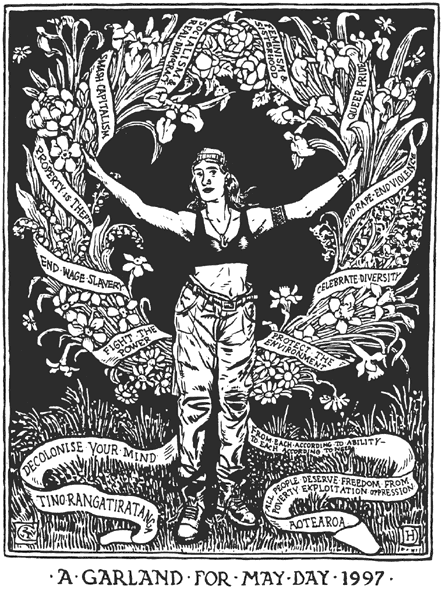
This homage to Walter Crane's famous woodcut was commissioned from leading New Zealand graphic novelist, Dylan Horrocks, by New Zealand Political Review in 1997.

TODAY is May Day. As the sun sets this evening, a dedicated handful of left-wing activists will make their annual excursion up Auckland’s Queen Street. Above their ranks, red flags will flutter and brightly-coloured banners will proclaim the time-honoured slogans of international labour solidarity. Upon reaching the Town Hall, speeches will be delivered, and words like "revolution" and "workers’ power" will float out over Aotea Square.

From the thousands of working-class Aucklanders hurrying to catch their trains and busses out of the central city, this dwindling collection of communists, socialists and anarchists will receive only the briefest of puzzled glances. The big questions preoccupying the Proletariat on its way home this May Day will be: What shall I cook the family for tea? And, what’s worth watching on TV tonight? Winning a world, by losing their chains, probably won’t get a look-in.

In Paris, the former premier, Dominique de Villepin talks fearfully of May Day turning into revolution. In Wellington, Prime Minister John Key is all smiles.

And why not? The latest 3News/Reid Research poll places the Labour Party 26 percentage points behind National. The Green Party, which should be well into double-figures, continues to stagger along the edge of the sub-five-percent MMP precipice. And the rest of the vote-seeking Left: the Alliance, RAM and the Workers’ Party; together, would barley muster one tenth of one percent.

As if this burden of electoral unpopularity wasn’t enough to bear, there’s another poll showing more than two-thirds of Kiwi voters are content with their country’s current course. According to the Australian-based polling agency, Roy Morgan, our Government Confidence Rating is "at the highest recorded, 151.5 (up 8.5 points) with 68.5% (up 3.5%) of New Zealanders saying New Zealand is ‘heading in the right direction’, compared to just 17% (down 5%) that say New Zealand is ‘heading in the wrong direction’."

Given what is actually happening in New Zealand and around the world, those numbers are truly astounding.

Our own Treasury (whose dire economic predictions are constantly being trumped by reality) told us nearly six months ago to expect 10 percent unemployment by the end of the year. While every reputable economist not employed by a bank (and even some of them) is warning that: a.) things are going to get a lot worse before they get better; and b.) John Key and Bill English have no viable policy options other than slashing government spending.

And still, 68.5 percent of us think John Key’s leading us into the "broad sunlit uplands" of peace and prosperity.

Okay, a lot of the blame for this has to be laid at the feet of this country’s most listened-to commentators, nearly all of whom are vehement right-wing talkback hosts who’ve spent the last three years campaigning quite unashamedly for a change of government, and who are so generously remunerated that, to their ears, all this gloomy chatter about "the most serious economic crisis in 70 years" sounds utterly bizarre.

On Sunday, one of these right-wing divas, fresh from the glittering emporiums of London’s Oxford Street, even went so far as to reassure her adoring public that she saw no evidence of a recession in the United Kingdom. The IMF, currently predicting a disastrous 4.1 percent contraction in the UK’s economy, would probably beg to differ.

But even were the entire commentariat channelling this sort of economic denial, it would not, of itself, be enough to explain that 68.5 percent confidence rating. For self-delusion on this scale, a lot more than the "there is no depression in New Zealand" mantra of National-friendly media personalities is required. To generate such a response, a huge amount of denial must be present in the electorate as well.

But what are the voters denying? Easy. They’re denying they need anybody’s help to survive and prosper; they’re denying that their social and economic security’s got anything to do with Labour, or the working-class traditions of solidarity and struggle it stands for. They’re also denying the all-too-visible signs that "nice Mr Key" and his right-wing mates are preparing to rip the guts out of what’s left of the welfare state.

Why are they denying these things? Because if two-thirds of them didn’t believe New Zealand was "heading in the right direction", they’d have no excuse for not heading up Queen Street with the Left.

This essay was originally published in the Dominion Post, The Timaru Herald, The Taranaki Daily News, The Otago Daily Times and The Greymouth Evening Star of Friday, 1 May 2009.