
Showing posts with label Wedge Politics. Show all posts

Friday, 5 March 2010

Gut Feelings

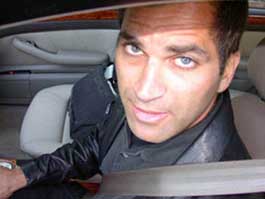
George Clooney meets Vin Diesel: For ten years Mark Ames (above) entertained Muscovites with The eXile - a magazine in the anarchic and outrageously brutal satirical tradition of Hunter S. Thompson. Forced to flee the Russian Federation in 2008, Ames returned to the United States with an even sharper satirical eye and a much heavier journalistic heart.

MARK AMES is an unusual man. When he decided to set up a satirical magazine in Moscow, in the late 1990s, most of his American compatriots regarded him as more than a little eccentric. But using his magazine to publish withering satirical attacks on the Russian Government? Most of his Moscow readers regarded that as certifiably insane.

But "that" is exactly what Mr Ames did. For ten outrageous years his dangerously provocative publication The eXile gave Muscovites a glimpse of what a genuinely free press might look like. The eXile featured the sort of fearless journalism that only a citizen of the United States, believing in the efficacy of his First Amendment rights, knows how to produce.

But not even Mr Ames could withstand the sort of pressures brought to bear on The eXile by Russia’s authoritarian President/Prime Minister, Vladimir Putin. Since 2008, when he and his colleagues were forced to flee the Russian Federation, The eXile has become an online-only media phenomenon.

Russia’s loss has been the USA’s (and everybody else’s) gain. The same searing honesty and excoriating wit which once skewered Moscow’s vicious and vapid kleptocracy has now been turned on America’s own dysfunctional society – and its even more dysfunctional political system.

Just last week, Mr Ames’ s lashed the liberal establishment – represented in this case by the eminent American economist, Paul Krugman – for its apparent inability to understand the true nature of the Republican Right.

"In just a few short paragraphs," he wrote, "Krugman unintentionally reveals why liberals are still getting their asses handed to them in every serious battle with the Republican Right: the liberal establishment is still convinced it’s competing in a middle-school civics class debate."

The liberals’ fatal mistake, according to Mr Ames, is that they refuse to let go of the myth that all the American people want from their politicians is the Truth.

"But what if the Truth is that Americans don’t want to know the Truth? What if Americans consciously choose lies over truth when given the chance—and not even very interesting lies, but rather the blandest, dumbest and meanest lies? ….. If I’m an obese 40-something white male living in Ohio or Nevada, locked into a permanent struggle with foreclosure, child support payments and outsourcing threats, then I’m going to vote for the guy who delivers a big greasy portion of misery to the [liberal elite’s] dining room table, then brags about it on FoxNews. Even if it means hurting myself in the process."

It’s the last line that stings the most. Because, as Mr Ames so rightly puts it: "The left’s wires short circuit when confronted with this awful possibility."

Indeed they do, because, for all its faults, the socialist left, remains a child of the 18th Century European Enlightenment. Just like neoliberals, socialists are convinced that people are not only hard-wired to recognise their own interests, but also to pursue them rationally. Socialism and neoliberalism, as coherent ideological systems, depend upon this being true.

But what if Mr Ames is right? What if most people don’t think with their brain but with their gut?

In other words, what if most people are emotional, rather than analytical thinkers: responding to issues not on the basis of fact and logical thought, but according to the feelings those issues arouse? What if, far from being convinced by individuals with the facts at their fingertips, most people react in the same way as the American fundamentalist preacher who, in the midst of his church’s campaign to supplant Darwinism with "creation science" at the local high school, uttered this oft-quoted cri de coeur : "We feel as if we’re under attack from the educated and intelligent sector of our culture."

Wouldn’t that explain why it’s proving so difficult for Labour and the Greens to get any political traction on issues like National Standards, Climate Change, Tax Reform and Crime & Punishment?

Certainly, the Russia Mark Ames spent ten years satirising offers scant encouragement to those who put their faith in rational self-interest. For ten years Russians sampled the wares of liberal democracy – Mr Ames’ magazine among them. In the end, however, they preferred Vladimir Putin’s version of democracy: one party rule, a state-controlled media, and the ruthless repression of dissent.

When asked to nominate Russia’s greatest hero, they invariably vote for Joseph Stalin.

This essay was originally published in The Dominion Post, The Timaru Herald, The Taranaki Daily News, The Otago Daily Times and The Greymouth Evening Star of Friday, 5 March 2010.

Monday, 27 April 2009

The Gumping of New Zealand

Tom Hanks plays Forrest Gump in Robert Zemeckis' award-winning movie.

With the latest Roy Morgan and 3News/Reid Research polls reconfirming the extraordinary popularity of John Key’s National-led Government, it is time for the Left to stand back and confront some very hard truths about the New Zealand electorate. For a start, we simply have to resign ourselves to the fact that a very large number of former Labour voters are now convinced that the Right has more to offer them than the Left. How did that happen? And what (if anything) can/should progressive New Zealanders do about it?

NEW ZEALAND is being Forrest Gumped. Like the character in the Tom Hanks movie, the heroes of John Key’s new political order are simple men and women. Confused by complexity and irritated by conflict, they mostly experience politics as a series of random and largely inexplicable events. For them, if I may paraphrase Forrest Gump: "Political life is like a box of chocolates, you never know what you’re gonna get."

International recession, environmental crisis, tax cuts, job losses: the content of the daily news blows in, blows out, like a summer squall. When it rains our Kiwi Forrest Gumps pull on their coats and pull in their heads. When it shines, they shake their coats dry and smile.

Ideas don’t count for much in this new political order. What matters most is the relationship voters form with their leaders. To succeed in today’s electoral environment, a politician must be likeable. The more voters like you, the more they trust you. Labour lost in 2008 because, sometime shortly after the election of 2005, a solid majority of the electorate simply stopped liking and trusting Helen Clark.

Key, on the other hand, has always come across – and continues to present himself – as a thoroughly likeable bloke. People trust him. So much so that, in David Farrar’s latest poll-of-polls, National commands 53.6 percent support, to Labour’s 29.9 percent.

Like I said, we live in simple times.

And hasn’t it always been thus? Haven’t half of humanity always found themselves on the wrong side of life’s great bell curve? We can’t all be blessed with Albert Einstein’s brains, Picasso’s creativity, or Nelson Mandela’s greatness of heart. Harnessing heredity’s meagre legacy to the hard business of making a life for themselves and their loved ones is as much as most folk dare aspire to. And more than a few make a mess of even that.

Were I writing these words in Eighteenth Century England, the mathematical certainty of human mediocrity wouldn’t be a problem. Three hundred years ago, what the "common people" did was a matter of supreme indifference to their rulers.

As Thomas Gray put it, in his Elegy Written in a Country Churchyard:

Far from the madding crowd’s ignoble strife
Their sober wishes never learned to stray;
Along the cool sequester’d vale of life
They kept the noiseless tenour of their way

In our post-modern, consumer-driven, liberal-democratic, capitalist society, however, mediocrity is a very big problem. Why? Because the simplest citizen’s vote carries exactly the same political weight as the most intelligent citizen’s. And the dollars they spend count for just as much, if not more, as the dollars spent by the rich. Modern economies can withstand a cessation of spending by the wealthy few. But, when the numberless, anonymous families who inhabit our suburbs start cutting back, things can go very wrong, very quickly.

And that’s the most terrifying aspect of the 21st Century’s "madding crowd" – the vital role that "ordinary" people’s "self-esteem" now plays in just about everything we do. The moment that post-modern citizens begin to suspect they’re being cheated – or, even worse, condescended to – advanced capitalist societies become highly unstable. Just recall the wrenching political realignment occasioned by Don Brash’s charge that Maori were receiving special privileges. Or what happened when working-class Kiwi parents became convinced that a bunch of childless left-wing politicians was telling them how to raise their kids.

The political empowerment of mediocrity requires that the ideas of the average person, no matter how ill-informed, be accorded exactly the same respect as the ideas of the most learned doctors, scientists and professors. More even. Because why should anybody take seriously the opinions of people who believe they’re smarter and better than everybody else?

While political parties remained strong enough to filter-out the demands of the ignorant and prejudiced, capitalism and progress marched together. The mass parties of the Left were especially important in this regard. As the inheritors of the Enlightenment’s rational scepticism, they kept their poorly paid, poorly housed and poorly educated followers in step with the steady advance of the physical and social sciences.

By the mid-20th Century, however, it had become clear to the political defenders of capitalism that the rational application of science to society’s ills could only end in some form of socialism. Their solution was to turn the latent ignorance and prejudice of the Left’s mass following against both itself and its "elitist", "liberal" and "intellectual" leaders. The Right’s weapons of choice were Race and Religion.

As the American political scientist, Joseph E. Lowndes, argues in his excellent From the New Deal to the New Right: Race and the Southern Origins of Modern Conservatism, by breaking up the social-democratic majority which had emerged from the Great Depression and World War II, and then electorally corralling it – first under the rubric of the "Forgotten Americans", then the "Silent Majority", and finally "Middle America" – the Right was able to install ignorance and prejudice as the prime drivers of contemporary political life.

All of the above terms, says Lowndes, were intended to: "describe a people under attack by an invasive federal government, threatened by crime and social disorder, discriminated against by affirmative action, and compromised by moral and cultural degradation."

The rise of reality television; the full scale assault by creationists and climate-change deniers on settled science; the dumbing-down of practically all forms of journalism and entertainment; and the unceasing disparagement of "academics" and "intellectuals"; all point to the Right’s cynical enthronement of the simple and the stupid as the ultimate arbiters of what is – and what is not – politically possible.

Which is, of course, the central theme of Robert Zemeckis’ hugely popular film. By the light and magic of Hollywood, Forrest Gump, the wise fool, gets to participate in all the seminal moments of recent American history. The film-maker not only ensures the meek inherit the earth, he allows them to utterly falsify and remake it.

Where the American Right has led, our home-grown conservatives have followed. A nation once celebrated for its unparalleled levels of political participation has been taught to scorn the very term. The birthplace of Rutherford has become the spiritual home of climate change denial. The country where progressive ideas once came to be born, has become the place where reactionary ideas go to die.

Proof, perhaps, that when Forrest Gump said "stupid is as stupid does", he knew what he was talking about.

This essay was originally published in The Independent of 23 April 2009.