Showing posts with label William Massey. Show all posts

Tuesday, 17 March 2020

The Grim Tutorial Of The 1918-19 Influenza Pandemic.

Forgotten Precedent: If you look hard, it is possible to locate memorials to the victims of the 1918-19 Influenza Pandemic. For the most part, however, the horrors of those dreadful months were simply rolled-up with all the other bloody horrors of the war. In popular memory, these two, equally traumatic, global experiences merged into a single tragic narrative which was now – praise be to God! – over. Best not to dwell. Best not to ask too many questions. Best not to learn too many lessons.

WHY WERE SO FEW lessons learned from the deadly Influenza Pandemic of 1918-19? The current best estimate of the death toll from “Spanish Flu” (which actually originated in the United States) is 50-60 million – many times the number of people killed in the First World War. With the global population estimated at 1.8 billion in 1918, the Spanish Flu killed 3.0 percent of all the human-beings on earth. In the face of such stunning mortality, national governments might have been expected to pledge themselves to doing all within their power to prevent a recurrence. Why is it that in every city, town and village of New Zealand memorials abound to the 18,000 men who fell during the four years of the First World War, while only a handful recall the 9,000 victims who perished in just six terrifying weeks at the peak of the 1918-19 pandemic?

The answer lies in the extraordinary degree of censorship imposed upon their citizens by all the governments engaged in the First World War. In order to “maintain morale” on “the home front” it was considered vital to shield the families and friends of the men in the trenches from the realities of industrialised warfare. Great Britain’s wartime Prime Minister, David Lloyd-George, famously told a journalist friend: “If the people really knew [the truth] the war would be stopped tomorrow. But of course they don’t know and can’t know.”

That they were required to post casualty lists numbering in the tens-of-thousands was bad enough. Belligerent governments (including our own) were absolutely determined to keep the soldiers’ loved ones in blissful ignorance of the way their sons, brothers and husbands had died – and of how little was gained by their sacrifice.

As the death-toll mounted and the horrors of the war multiplied, political and military leaders found themselves holding a tiger by the tail. They had kept so much hidden, from so many, for so few tangible gains, that they had no option but to keep hiding the truth from their respective peoples. To make their job easier they cultivated an atmosphere of extreme intolerance for any behaviour or expression capable of being construed as dissent or disloyalty. Those found guilty of opposing the war (future New Zealand prime ministers among them) were imprisoned. Kiwi conscientious objectors – most famously Archibald Baxter – suffered the infamous tortures of “Field Punishment No. 1”.

It was into this fraught environment that an avian variety of influenza crossed the species barrier into pigs, and then into humans, on a Kansas farm early in 1918. “Patient Zero” was an infected farm boy who carried the virus with him to military training camp, from whence it travelled with infected troops to the battlefields of France and Belgium. In a terrifyingly short period of time it had been carried back into the home countries of the infected soldiers. The death toll rose relentlessly and exponentially: the virus killed hundreds, then thousands, then millions.

And the authorities deliberately muted their official response. In Britain and its empire especially, which was staring down the barrel of a German victory in the early months of 1918, the political and military leaders were desperate to keep any suggestion that, back home, their loved ones were falling like ninepins from their fighting men. With revolution raging in Russia, Allied politicians were in no mood to allow the Bolshevik “virus” to spread.

In frightening anticipation of the policy of the current British government, the pandemic was simply allowed to “let rip” among Britain’s helpless and unprotected population. Perhaps the most tragic moment came on Armistice Day, the 11 November 1918, when hundreds of thousands of citizens were permitted to gather in the streets, hugging and kissing, to celebrate the war’s end. It is difficult to imagine a more effective way of hastening the virus’s spread!

Obviously, local measures were taken to keep people safe, but with censorship still in place, the pandemic had burned itself out before its worldwide impact was generally comprehended. Everyone the virus could get had been gotten, there was no one left to infect.

Tragically, the appalling decisions of New Zealand politicians and military administrators, both at home and in our newly acquired colony of “German Samoa”, allowed the virus to come ashore and do its deadly work. The ship returning William Massey, New Zealand’s prime minister, from Europe had reported the infection on board but was, astonishingly, allowed to dock. No one, seemingly, had the courage to order the PM placed under quarantine. The New Zealand military officer “in charge” of Samoa, was similarly informed that there was sickness aboard an arriving vessel. He, too, permitted its passengers to disembark. The virus swept across western Samoa, killing upwards of a quarter of the territory’s native population.

If you look hard, it is possible to locate the burial sites of the 1918-19 Influenza Pandemic’s victims. Row upon row of tiny gravestones, or, verdant swards of cemetery lawn marking mass graves. Very occasionally, there is a larger memorial. The reality, however, is that the horrors of the pandemic were simply rolled-up with all the other bloody horrors of the war. People were encouraged to merge these two, equally dreadful, global experiences into a single tragic narrative which was now – praise be to God! – over. Best not to dwell. Best not to ask too many questions. Best not to learn too many lessons.

And yet, some lessons were learned. In 1920 the Health Organisation of the League of Nations was formed, building upon the rather haphazard pre-war efforts to co-ordinate the international fight against deadly diseases. In 1948, following a second, even more appalling global conflict, the now defunct League’s Health Organisation morphed into the World Health Organisation (WHO) of the newly former United Nations. It is no accident that one of the core principles of the WHO is the early, accurate and comprehensive communication of “outbreak” data across the planet.

Political and military reluctance to rapidly and truthfully acknowledge, and then take steps to combat, outbreaks of highly infectious and deadly disease, as happened at the end of the First World War, is every bit as dangerous to public health as the deadliest virus. Such is the grim tutorial from the Influenza Pandemic of 1918-19. It is to be hoped that the governments of the United Kingdom, the United States – and New Zealand – are paying close attention.

This essay was originally posted on The Daily Blog of Tuesday, 17 March 2020.

Friday, 8 July 2016

Centenary Essay: "Labour's First Fight Was For Freedom."

The Battle Cry Of Freedom: Three years after its founding conference, in the general election of 1919, voters were invited to join “Labour’s Liberty Campaign”. Guided by the ghost of Richard John Seddon, the sturdy young Labour Party is depicted rolling up its sleeves to do battle with Massey and his cohorts on behalf of the “Democratic Public”. Labour’s first fight was a fight for freedom.
 
IN EARLY JULY, 1916, leftists and liberals of every stripe gathered in Wellington to form a new political party.
 
New Zealand was at war. In the 23 months since August 1914, thousands of the Dominion’s young men had been killed, and thousands more wounded and maimed. The government of William (Bill) Massey appealed for more recruits.
 
The Prime Minister’s appeal was powerfully seconded by the Dominion’s leading newspaper proprietors, who urged the youth that remained to do their duty by King and Country. Many responded, but nowhere near enough to refill the depleted ranks of the NZ Expeditionary Force.
 
In 1915, legislation requiring all single men to register for possible military service alerted the war’s opponents to the near-certainty that Massey’s coalition government was preparing to introduce conscription.
 
In January of 1916, socialists and trade unionists met in Wellington to debate the ethics of conscripting men – but not wealth. At the conclusion of their conference a Manifesto Against Conscription was issued. Arguing that true equality of sacrifice was impossible to guarantee, the Manifesto insisted that war service remain voluntary:
 
“Thousands of our comrades strenuously opposed to compulsion in any form have gone as volunteers, and while their backs are turned we must use every effort to preserve intact the civil rights our people have won. There must be no surrender of principles which have raised British citizenship above serfdom.”
 
It wasn’t enough. As predicted, Massey opted for conscription. His Military Service Bill would become law on 1 August 1916. Equally predictably, in the first week of July, those responsible for the Manifesto Against Conscription: Peter Fraser, Bob Semple and Harry Holland; along with just about every other left-wing leader in New Zealand; began arriving in Wellington. Words had not been enough: now it was time for deeds.
 
The creation of the New Zealand Labour Party was largely the work of trade unionists. Yes – but not exclusively so. What’s more, those early labour leaders were a far cry from the dour union bosses remembered by Kiwis who came of age in the 1950s and 60s.
 
Seventeen months before the New Zealand Left began gathering in Wellington, the American union song-writer, Ralph Chaplin, had penned the words to that greatest of union anthems, Solidarity Forever. Here’s the final verse:
 
In our hands is placed a power greater than their hoarded gold,
Greater than the might of armies magnified a thousand fold.
We can bring to birth a new world from the ashes of the old,
For the union makes us strong.
 
It was precisely this “new world” of socialism and freedom that Massey and his mounted constabulary (Massey’s Cossacks!) had fought so hard to forestall just two years before Chaplin wrote his song. In the “Great Strike” of 1913, the “Red” Federation of Labour had been crushed. It is easy to imagine Massey’s fury, three years later, as he watched those indomitable “Red Feds”, Fraser, Semple and Holland, abandon the path of industrial militancy for the parliamentary road.
 
One hundred years on, the reader may wince at a phrase like “socialism and freedom”. It is, however, used advisedly. The men and women who formed the New Zealand Labour Party in July 1916 were driven by the conviction that, without economic justice and social equality, political freedom was forever being stillborn. We would be much mistaken, however, were we to believe that they considered freedom to be, somehow, less important than justice and equality.
 
Remember the words of the Manifesto Against Conscription: “we must use every effort to preserve intact the civil rights our people have won”. Labour’s founders knew that without political freedom, neither economic justice nor social equality could ever be attained.
 
Three years after its founding conference, in the general election of 1919, voters were invited to join “Labour’s Liberty Campaign”. Guided by the ghost of Richard John Seddon, the sturdy young Labour Party is depicted rolling up its sleeves to do battle with Massey and his cohorts on behalf of the “Democratic Public”. Labour’s first fight was a fight for freedom. Entirely fitting for a party whose leaders had been jailed for sedition and court-martialled for standing against conscription.
 
One hundred years later, the attainment of economic justice and social equality still depends on exercising fearlessly “the civil rights our people have won.”
 
Labour and Freedom must march together.
 
This essay was originally published in The Waikato Times, The Taranaki Daily News, The Timaru Herald, The Otago Daily Times and The Greymouth Star of Friday, 8 July 2016.

Wednesday, 13 January 2016

The Club That Rules The World.

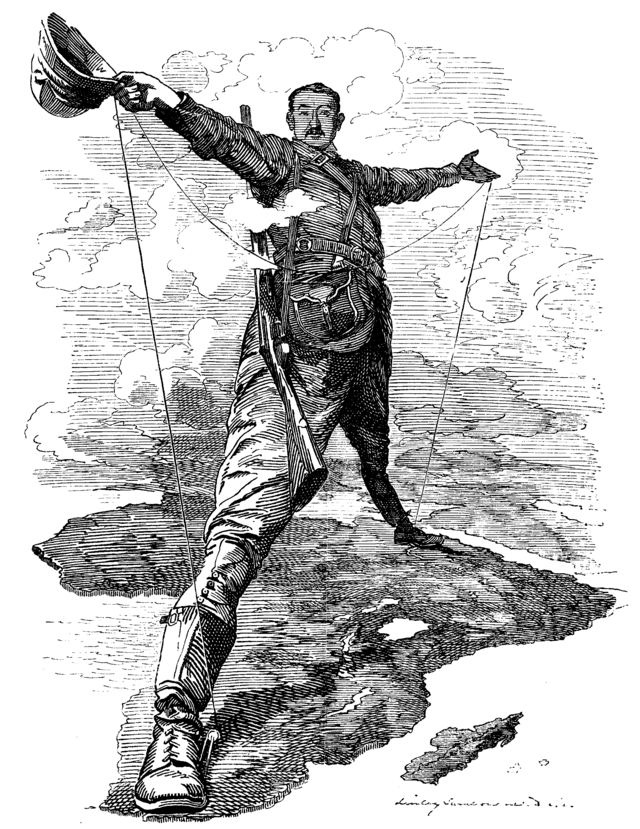
The Colossus That Was Rhodes: Britain's ur-imperialist not only dreamt of constructing a railway from "Cairo to the Cape", but also of expanding the dominion of the Anglo-Saxon powers to encompass the entire planet. A century on, the United States, aided by the United Kingdom, Canada, Australia and New Zealand, has indeed become the global hegemon. The GCSB spy-base at Waihopai is part of that hegemony.

WHAT DO CECIL JOHN RHODES and the Waihopai Spy Base have in common? The answer is: the maintenance of a world in which the Anglo-Saxon powers continue to play a dominant role. Rhodes, the great nineteenth century British imperialist, could not have imagined the raw technological power which installations like the GCSB’s Waihopai Station have added to the imperial mission, but he would have approved – wholeheartedly.
 
He would also have felt entirely vindicated by the current disposition of global economic, military and political power. His vision of the future was one in which the might of the British Empire and the United States had become fused in an Anglo-Saxon imperium to which the rest of the world paid homage.
 
Naturally, Rhodes foresaw the British Empire taking the lead role in this geopolitical drama. In the late nineteenth century, when he was at the summit of his remarkable career, the power of the USA remained veiled. (Although, the exertions of the Civil War, 1861-65, should have alerted Rhodes to America’s prodigious potential.) Even so, his most enduring legacy, the Rhodes Scholarship, was intended to create a special brotherhood of Anglo-Saxon leaders, drawn overwhelmingly from the British Empire and the USA, into whose hands the grand mission of bringing as much of the world as possible under Anglo-Saxon control could be safely reposed.
 
At the heart of Rhodes’ plan to create a global elite lay Oxford University – among whose dreaming spires the Rhodes Trust’s carefully selected scholars were expected to imbibe that noxious mixture of classical idealism, medieval obscurantism and contemporary chauvinism from which the British Empire had been fashioned.
 
Just how toxic this amalgam could be may be judged by Rhodes’ own justification for the creation of Anglo-Saxon hegemony:
 
“I contend that we are the finest race in the world and that the more of the world we inhabit the better it is for the human race. Just fancy those parts that are at present inhabited by the most despicable specimens of human beings what an alteration there would be if they were brought under Anglo-Saxon influence, look again at the extra employment a new country added to our dominions gives.”
 
Rhodes was by no means the only statesman in the British Empire to evince such crude and unabashed racism, and he certainly wasn’t the most peculiar. Not only was New Zealand’s Prime Minister from 1912 to 1925, William Ferguson Massey, a bigoted Orangeman and fervent British imperialist, but he was also a “British Israelite” – a believer in the absurd notion that the inhabitants of the British Isles are descended from one of the lost tribes of Israel and, therefrore, as God’s chosen people, destined to rule the world!
 
It is one of history’s ironies that when men felt free to believe in and give voice to such ideas, full Anglo-Saxon hegemony remained an imperial dream. A century later, with Anglo-Saxon hegemony an accomplished fact, only the most foolhardy British or American statesman would consider drawing the world’s attention to it.
 
Just occasionally however, the world’s reminded of the hegemon’s existence – as when our Prime Minister, John Key, spoke openly of the price of membership of “the club”. He was, of course, referring to New Zealand’s participation in the UK-USA (“Five Eyes”) Agreement alongside Canada and Australia. Although, helping the British and Americans to spy on the rest of the world is very far from being the only “service” members of the Anglo-Saxon “club” are required to provide.
 
Regardless of whether the power contributed is “hard” (military) or “soft” (financial and cultural) members of the Club are expected to keep their subscriptions current. Indeed, it is highly questionable as to whether resignation is even possible. Like the Hotel California, the Anglo-Saxon Club can be a hard place to leave.
 
Contributing To Anglo-Saxon Hegemony: The Waihopai Spy Base.
 
And yet, every January an apparently indefatigable group of protesters gather outside the Waihopai Spy Base to demand its closure and New Zealand’s withdrawal from the Five Eyes Agreement. The sub-text of their annual protest, however, is this country’s long association with the sins of Anglo-Saxon imperialism.
 
The protesters mission is to persuade New Zealanders to disentangle themselves once and for all from Rhodes’ vision: to cease and desist playing even the tiniest role in exerting Anglo-Saxon hegemony.
 
It’s a big ask. Who resigns voluntarily from the club that rules the world?
 
This essay was originally published in The Waikato Times, The Taranaki Daily News, The Timaru Herald, The Otago Daily Times and The Greymouth Star of Friday, 8 January 2016.

Monday, 13 July 2015

Memory and Forgetting: Why Knowing Labour’s History Is So Important.

The Spirit Of Progressivism: The Czech-born writer, Milan Kundera, wrote that: “The struggle of man against power is the struggle of memory against forgetting”. In a curious way, the Labour Party was founded to keep the memory of the Liberal Party’s achievements, and of its vision of an economically just and socially progressive New Zealand, alive.
 
IT WAS 99 YEARS AGO, this week, that the principal elements of the New Zealand Left began arriving in Wellington. At a time of extraordinary social stress, they were gathering in search of unity and a clear way forward. Yes, the trade unions were well represented, but they were by no means the only progressive voices present. The New Zealand Labour Party, which was born 99 years ago, in July 1916, saw itself, rather, as a vehicle for the “democratic public” – that fraction of New Zealand society for whom political participation has always meant more than simply endorsing the decisions of the powerful.
 
The trade unionists and journalists, clergymen and temperance campaigners who came together that July were both alarmed and appalled at the imminent introduction of military conscription. They saw it as evidence of just how completely the war was swallowing New Zealanders’ civil liberty. The ruthless brutality of Bill Massey’s government; it’s willingness to deploy deadly force against its opponents; was raising doubts about the true purposes of the war.
 
What, exactly, were so many young men dying to defend? What had become of progressive New Zealand? Of “God’s Own Country”? The relentless din of wartime propaganda made it difficult to remember the 20-year-long Liberal Era of John Ballance and Richard Seddon. Censorship and sedition trials made it difficult – even dangerous – to object to what had taken its place. War mania had rendered rational argument impossible. The “democratic public” of New Zealand felt themselves to be (and, almost certainly, were) a beleaguered minority.
 
Over the course of the next twelve months much will be written and spoken about the formation of the New Zealand Labour Party. The celebration of the party’s centenary will be used, as all such occasions are, to bolster the authority of those currently in command of both the party and the wider labour movement. Every effort will be made to convince the Labour Party members and trade unionists of today that their present leaders are worthy successors to the men and women of 1916.
 
That is why it is so important that New Zealand’s left-wing historians spend the next twelve months acquainting today’s progressives with the facts of Labour’s history. They must loudly give the lie to those who attempt to deny the radicalism of Labour’s past; and who argue that moderation and compromise have always been the party’s watchwords. The blatantly political purpose of such historical revisionism is to promote the idea that the extreme timidity and ideological conservatism of today’s Labour Party is nothing out of the ordinary; that Labour has always been timid and conservative.
 
Nothing is more likely to ensure Labour’s demise than the triumph of this right-wing revisionist account of its history. Labour’s future depends upon how truthfully her struggle on behalf of the “democratic public” is retold. The progressives of today deserve to know how a beleaguered minority, in spite of vicious government persecution and constant media vilification, eventually transformed itself into a radical majority, and how that radical majority changed this country forever – and for the better.
 
The Czech-born writer, Milan Kundera, wrote that: “The struggle of man against power is the struggle of memory against forgetting”. In a curious way, the Labour Party was founded to keep the memory of the Liberal Party’s achievements, and of its vision of an economically just and socially progressive New Zealand, alive. Over the course of the next year the struggle to prevent Labour’s huge contribution to the history of New Zealand from being forgotten, or, worse still, misrepresented, must be waged unceasingly.
 
If the “democratic public” is ever again to become a radical majority, then the memory of how it fought – and won – the battles of the past needs to be kept alive in the hearts and minds of every progressive New Zealander.
 
This essay was originally posted on The Daily Blog of Friday, 10 July 2015.

Sunday, 26 April 2015

Weep, Zealandia, Weep!

Cry The Beloved Country: Is this really where we are, 100 years after Gallipoli? Is this how far we’ve come? From a bigoted British Israelite and union-buster;  to a “relaxed” golfing partner of the US president and a “playful” hair-fetishist? From dispatching troops to Gallipoli in the name of the King-Emperor; to dispatching troops to Iraq in the name of the “Five Eyes Club”?
 
THERE ARE TIMES when it’s heart-breaking being a New Zealander. This past week has been one of those times.
 
The week began with the deafening drumbeat of ANZAC-related patriotism. Having already alienated a huge number of Australians, the almost obsessive memorialisation of the First World War is beginning to do the same to a growing number of New Zealanders.
 
Among all the individuals responsible for planning the centennial “celebrations” of the ANZAC landings, there was, apparently, no one whose job it was to make sure, one hundred years on, that New Zealanders had a clear idea of the political and economic motives that drove so many human lambs to the slaughter.
 
The historical context out of which some young men volunteered for “the adventure of a lifetime” and some did not (let’s not forget that by 1916 it had become necessary to start conscripting replacement soldiers) has been almost completely elided from the official narrative. Likewise the extraordinary curtailment of civil and political rights that followed almost immediately upon New Zealand entering the conflict.
 
To hear someone like Lieutenant-General Tim Keating, Chief of Defence Staff, couch New Zealand’s participation in the First World War in terms of standing up for the right and the good (just like today in Iraq!) was quite sickening. More than 18,000 young New Zealanders died on the battlefields of that terrible war – not for the right and the good, but for the greater glory and profit of the British Empire and its principal investors.
 
I wonder if Lt-General Keating even knows that William F. Massey, the unelected Prime-Minister of New Zealand in August 1914 (his Reform Party had won a No-Confidence vote against the Liberal’s in 1912) was a member of the British Israelites.
 
This bizarre sect was a curious mixture of religious and patriotic enthusiasm which believed that the British race was descended from one of the lost tribes of Israel, and that the British royal family’s bloodline extended all the way back to King David and King Solomon. The British Israelites were adamant that the English-speaking peoples were divinely ordained to rule the entire world.
 
Born in Ulster, Massey was also a member of the Orange Order, whose compatriots back in Northern Ireland, even as Gavrilo Princip was assassinating the Archduke Franz Ferdinand in Sarajevo, were actively plotting mutiny and rebellion against the pro-Irish Home Rule Liberal Government of Herbert Asquith.
 
Massey’s religious and political bigotry would be drawn into sharper focus as the war drew towards its end and the Reform Party linked up with the newly-formed Protestant Political Association to mobilise voters against the large number of Irish Catholics who had swung in behind the nascent Labour Party.
 
Massey’s hostility to organised labour was prodigious. The crushing of the Waihi Miners’ Strike in 1912, and of the Great Strike in 1913, were among Massey’s first and most enduring contributions to New Zealand’s political history. Working-class Kiwis didn’t call the mounted special constables (drafted in from the countryside to smash the unionists of the “Red” Federation  of Labour) “Massey’s Cossacks” for nothing.
 
I could go on, but hopefully you’ll have some idea already of how little that was “good” or “right” lay behind New Zealand’s participation in the First World War. Indeed, it was only after the outbreak of revolution in Russia in 1917 (and the mutiny of the French army in the same year) that the imperial establishment decided it might be wise to shift its rhetorical emphasis from protecting innocent women and children from the bestial Hun to “defending freedom” and “making the world safe for democracy”.
 
So many lies – and how old they’ve grown! It is nothing less than shameful that so little of the history of the period leading up to the First World War is known to the young New Zealanders who turn out in their thousands to honour the sacrifice of those who they naively believe “died for our freedom”.
 
And what, I physically cringe to think, do those same young New Zealanders now make of their 53-year-old Prime Minister, who has admitted to repeatedly tugging on the ponytail of a 26-year-old waitress?
 
Is this really where we are, 100 years after Gallipoli? Is this how far we’ve come? From a bigoted British Israelite and union-buster;  to a “relaxed” golfing partner of the US president and a “playful” hair-fetishist? From dispatching troops to Gallipoli in the name of the King-Emperor; to dispatching troops to Iraq in the name of the “Five Eyes Club”?
 
And what about the likes of your humble correspondent? That endangered species known as the “Fourth Estate”? Are New Zealand’s journalists, commentators, newspaper columnists and bloggers to be guided now, in the fulfilment of their professional ethical obligations, by the shining example of Rachel Glucina?
 
As I said: These are heart-breaking times.
 
Weep, Zealandia, weep!
 
This essay was originally posted on The Daily Blog of Friday, 24 April 2015.

Tuesday, 21 April 2015

“Prepared To Make Any Sacrifice” – How New Zealand Went To War in 1914.

Signed, Sealed, Delivered - I'm Yours! The Governor of New Zealand, the Earl of Liverpool, prepares to read the message from the King-Emperor, George V, which officially signalled this country's participation in the First World War. A conflict that would, ultimately, claim the lives of 18,000 young New Zealanders.
 
HOW DO YOU THINK New Zealand went to war in August 1914? No, this is not an operational question about military units, points of embarkation and troop carriers. What’s being asked here is a constitutional question. Essentially, by what process were New Zealanders impelled into a state of war?
 
Did Parliament declare war on Germany? Were the ties of empire invoked? Was the German Emperor’s dismissal of Belgium’s 1839 Treaty of Neutrality as a mere “scrap of paper” held up by the then Prime Minister, Bill Massey, as an indisputable casus belli – cause for war? Were the Members of New Zealand’s Legislative Council and House of Representatives enjoined to stand by their King-Emperor and commit the Dominion’s armed forces to helping Britannia put Germany’s upstart Kaiser back in his box?
 
Massey’s conservative Reform Party would certainly have voted for war. But what about the Opposition? Would the Liberal Party leader, Joseph Ward, have dared oppose Britain, France and Russia’s war with Germany? Not likely. With an election looming in December, Ward would, almost certainly, have thought it better to play the “national unity” card.
 
After all, the Liberal Party had not been defeated at the ballot-box. Bill Massey was Prime Minister only because, two years earlier, he had managed to carry a Vote of No Confidence against Ward’s predecessor. Reform was desperate for a popular mandate – especially after the divisive events of 1912-13.
 
Which is why, on the question of whether or not to join Mr Asquith’s War, Ward would undoubtedly have thought it best to allow no daylight at all between his own party’s position and the Government’s. (And it very nearly worked: the 1914 General Election, which Massey won, was one of the closest in New Zealand’s political history.)
 
But the Liberals were not the only occupants of the Opposition Benches in August 1914. Alfred Hindmarsh’s United Labour Party had two votes to cast – as did the new, more left-wing, Social Democrats. What would Paddy Webb, the firebrand socialist from the West Coast seat of Grey, have to say about New Zealand joining an imperialist war? And James McCombs, the SDP Member for Lyttelton? Why would a left-wing intellectual, and the newly-elected representative of Lyttelton’s working-class, vote for a war between Kings and Kaisers?
 
The truth is, we shall never know how the New Zealand Parliament would have voted on the question of whether to join Great Britain, the French Republic and the Russian Empire in a war against Germany and Austria-Hungary – for the very simple reason that all the key decisions that led New Zealand into the First World War were made in London – not Wellington.
 
The Governor: Arthur William de Brito Savile Foljambe, Fifth Earl of Liverpool.

New Zealanders officially learned that they were at war Germany and Austria-Hungary only when, on 5 August 1914, the Governor of New Zealand, one Arthur William de Brito Savile Foljambe, fifth Earl of Liverpool, stood upon the steps of Parliament, in front of a crowd of 15,000 Wellingtonians, and read the following missive from the King-Emperor, George V.
 
“I desire to express to my people of the Overseas Dominions with what appreciation and pride I have received the messages from their respective Governments during the last few days. These spontaneous assurances of their fullest support recall to me the generous self-sacrificing help given by them in the past to the Mother Country. I shall be strengthened in the discharge of the great responsibilities which rest upon me by the confident belief in this time of trial my Empire will stand united, calm, resolute, trusting in God.”
 
To which the Governor, Liverpool, responded:
 
“New Zealand desires me to acknowledge Your Majesty’s gracious message, and to say that come good or ill she, in company with the other dominions and dependencies of the Crown, is prepared to make any sacrifice to maintain her heritage and her birthright.”
 
And that was that. Flanked by the Speakers of the Legislative Council and the House of Representatives, and with the Judges of the Supreme Court and an assortment of MPs providing him with a fine patriotic backdrop, the Governor acknowledged the cheers of the King-Emperor’s subjects and returned to Government House.
 
Liverpool’s words were very far from being empty. In the years ahead, and in the company of “the other dominions and dependencies of the Crown”, New Zealand would send nearly a tenth of her population – 100,000 young men – to “maintain her heritage and her birthright” as a member in good standing of the British Empire. Fully 18,000 of that terrible tithe of New Zealand’s population would lose their lives in the service of King-Emperor, and a further 41,000 would be wounded.
 
Exactly how Liverpool, the man who in October 1913 – less than a year earlier – had authorised the deployment of military and naval personnel - "Massey's Cossacks" - to suppress what came to be known as the “Great Strike”, was in any position to know what “New Zealand” thought about sending her sons to war is difficult to discern. There had been no debate by those “New Zealand” had elected to represent her. Nor is it clear by whose leave Liverpool authorised the making of “any sacrifice” in the name of victory. Not a single vote had been taken.
 
Amidst all the commemorations, and all the tearful invocations of the 18,000 young men who did not “grow old, as we that are left grow old”, it is as well to remember that it is not in the monarchical tradition to ask the King’s (or the Queen’s) subjects if they want to – let alone whether they should! – go to war. It remains a matter for the “Executive” alone.
 
This is as true today, as a much smaller force of New Zealand soldiers prepares to depart for the Middle East, as it was in 1914, when thousands of volunteers embarked for their fateful rendezvous with terror, disfigurement and death on the sheer slopes of Gallipoli.
 
A version of this essay was originally posted on The Daily Blog of Monday, 20 April 2015.

Sunday, 25 April 2010

The Blood of Its Sons (ANZAC Day 2010)

Blood for Butter: The sacrifice of so many young New Zealanders was made not for democracy or freedom - but for the future prosperity of the nation's farmers. Painting of the Battle for Chunuck Bair by Ion Brown.

WHEN WAR BROKE OUT in 1914, Britain was fortunate to have as her point man in New Zealand a prime minister who recognised in the British Empire not only the source of his country’s income and guarantor of its continued prosperity, but also the secular manifestation of a divinely sanctioned racial hegemony. Not content with his participation in the mysteries of Freemasonry and the Grand Orange Order, William Ferguson Massey also belonged to a bizarre sect known as the British Israelites.

The central belief of the British Israelites was that the original inhabitants of the British Isles were descended from one of the "lost tribes" of Israel. God, having originally singled out the Jews as the instruments for perfecting his earthly creation, apparently decided to re-tool the project by hiving-off a tithe of the chosen people and relocating them in the wet and misty isles of Albion. Careful Biblical exegesis had further convinced the British Israelites that the British monarchy was traceable not merely to Norman brigands and Anglo-Saxon war-chiefs, but to the ancient throne of David and Solomon. Clearly, the British race was destined to rule the earth from pole to pole. That it already controlled a quarter of its land surface, and all of its seas, was proof of God’s approbation. Equally clearly, it was the duty of every Briton – old and new – to further God’s plan by ensuring that their King-Emperor got his holy mitts on everything else.

Nobody seemed to mind that the King-Emperor, George V, was a German, or that his father, Edward VII (of Saxe-Coburg-Gotha) had spent most of his reign inveigling the French and the Russians into an aggressive diplomatic and military alliance against his own despised nephew, Kaiser Wihlem II (his mother’s grand-son). One might have thought that a fanatical Protestant like Bill Massey would have recoiled in horror from the news that the heir to David and Solomon’s throne was plotting and scheming with the republican papists of France against the honest Lutherans of the House of Hohenzollern. And how pleased would his prime-ministerial predecessor, "King Dick" Seddon have been to discover that Britain had somehow become the ally of George V’s cousin "Nicky" – Tsar of all the Russias? Wasn’t it Nicholas II’s father, Tsar Alexander III, who had so frightened the parliament of New Zealand that it was persuaded to appropriate vast sums for the installation of gun emplacements at the heads of most of New Zealand’s major ports?

Such machinations were, of course, the common fare of the heavily armed imperial gourmands whose insatiable appetite for territory and markets and left very little of the earth’s surface unshaded by their respective flags. So long as the sea lanes between New Zealand’s ports and the London docks were kept open for the ever-growing fleet of ships bearing the dominion’s refrigerated cargoes to the British consumer, New Zealand politicians were content to leave the complex minuet of international diplomacy to men like Britain’s aristocratic foreign secretary, Sir Edward Grey.

Which presumably explains why Belich, with uncharacteristic reticence, could write: "New Zealanders in 1914 did not investigate the causes of conflict, and we can follow their example." While the dereliction of that sentence’s second half cries out for correction, the first part is no more than the truth. It really didn’t matter to most middle-class New Zealanders how or why the languid gentlemen of Whitehall came to the conclusion that Britain must go to war with Germany. It was enough for them that the King-Emperor’s government had called upon his subjects for aid. Certainly all those loyal sons of the Empire who had been drilled to obedience as high school cadets, and who now devoted their weekends to manoeuvres with their province’s regiment of "mounted rifles", neither asked for nor expected a more detailed explanation.

The war propaganda of the time depicted Britain as a mighty lion summoning his pride, and Canada, Australia, South Africa and New Zealand as "young lions" answering the imperial roar to range themselves proudly at their sire’s side. Few queried the war’s ostensible casus beli – Germany’s violation of "poor little Belgium’s" neutrality, and the Austro-Hungarian assault on "brave little Serbia". The mentality that had scrawled "God save the King!" above crude renditions of the Union Jack on the walls of the Waihi Miners’ Hall just two years earlier, was not attuned to the critical questioning of imperial policy.

For a brief period, however, a tiny chorus of protest did manage to make itself heard over the marching bands and cheering crowds. The Red Feast, a poem penned by the radical trade unionist, Ralph Chaplin, and re-printed in the working-class (and in those years unashamedly left-wing) newspaper Truth shortly after the outbreak of hostilities in 1914, makes it clear that the enthusiasm for martial sacrifice was not, quite, universal:

Tear up the earth with strife
And give unto a war that is not yours;
Serve unto death the men you served in life
So that their wide dominions may not yield.
Stand by the flag – the lie that still allures;
Lay down your lives for land you do not own.
And spill each other’s guts upon the field;
Your glory tithe of mangled flesh and bone.
But whether in the fray to fall or kill
You must not pause to question why or where.
You see the tiny crosses on that hill?
It took all those to make one millionaire.

Not that such open defiance of political conformity was permitted for very long. The proto-fascist impulses manifested in the ranks of Massey’s Cossacks barely ten months prior the outbreak of World War I, were swiftly augmented by all the powers of a state at war. Newspapers were seized or censored, street-corner orators (a good many of them future cabinet ministers and prime ministers) were arrested and imprisoned for sedition. And for those who refused to fight: the Christian pacifists and socialists who sought the protection of "conscientious objection"; Massey’s government reserved a suite of sadistic punishments, escalating in severity from internment in special concentration camps, to the extraordinary fate of this country’s most famous conscientious objector, Archibald Baxter – being bound to a cross in the middle of no-man’s land (Baxter’s inspiring memoir I Shall Not Cease is recommended reading for anyone who still refuses to believe that a great many New Zealanders embraced fascism long before it had a name.)

And so New Zealand’s human lambs were placed under British command, packed into troopships and dispatched for the slaughterhouse of France – at least they would have been had the First Lord of the Admiralty, Winston Churchill, not devised a "cunning plan" to outflank the Central Powers, knock the Ottoman Empire out of the war, unleash the armies of Bulgaria and Greece upon the Austro-Hungarians and open up a secure line of supply to the Tsar’s ill-equipped armies.

The Dardanelles Campaign – to which the Australian and New Zealand Army Corps was diverted without so much as a by-your-leave in 1915 – was not undertaken in the name of freedom and democracy (Tsar Nicholas II had little time for either concept) but to strengthen the sword-arm of one of the most brutal autocracies on the face of the planet. The King-Emperor’s cousin, for whom so many young Australians and New Zealanders were about to be sacrificed, had made his name a by-word for tyranny less than ten years prior to the Gallipoli landing. In 1905 thousands of workers and peasants had gathered outside the Tsar’s Winter Palace in St Petersburg, naïvely believing that their "Little Father" would redress their grievances. Nicholas’s troops had cut them to pieces. When the Red Feds dubbed Massey’s strike-breakers "Cossacks" they were alluding to the vicious Tsarist cavalrymen responsible for "Bloody Sunday".

Nearly a century has passed since the heroism on the heights of Chunuk Bair, but every 25th April thousands of young New Zealanders travel to the memorials erected along the Gallipoli Peninsula to recall the blood sacrifice of the dreadful, and ultimately futile, Dardanelles campaign. When questioned, they speak of the high ideals and noble causes for which those who were killed and maimed in the Great War sacrificed themselves. They do not know, because they have not been told, that the ANZAC’s died for an imperial economy which, even in 1915, had ceased to be internationally competitive. They do not know, because they have not been told, that Britain’s decision to go to war with Germany was not taken in defence of "poor little Belgium", but in the hope that, between them, France and Russia would destroy the British Empire’s principal economic rival. They do not know, because they have not been told, that the ANZACs slaughtered tens of thousands of young Turks so that the British and their French allies could carve up the territories of the Ottoman Empire between them – an act of diplomatic depravity which continues to generate death and despair across the Middle East to this very day. They do not know, because they have not been told, that in the very same year that Colonel Malone’s men were dying on Chunuk Bair, their Prime Minister was concluding an agreement with the British Government whereby it would "commandeer" every ton of butter and cheese that New Zealand could produce. They do not know, because they have not been told, that the Bill Massey’s government did not dispatch 19.4 percent of its male population to the killing fields of Gallipoli and Flanders to "make the world safe for democracy", but to keep safe and, if possible, expand New Zealand’s "protein industry".

Belich puts it like this:

"During the Crimean War of the 1850s, the leader of the Italian state of Piedmont-Sardinia, Count Cavour, decided to help out Britain and France in their struggle against Russia. He sent several thousand troops, and a few bewildered Piedmontese and Russian peasants killed each other outside Sebastapol. Cavour had nothing against Russia. He wished to create a moral debt in the official minds of Britain and France, which would make them sympathetic to his desire to liberate and unify Italy. He succeeded, and French troops helped free Italy from the Austrians a few years later. Massey, Ward and Allen might not have known much about Count Cavour, but I think they were playing his game. The objective of the New Zealand war effort was to entrench and augment the special relationship with Britain that we have called recolonisation. The method was to create a moral debt in British minds to New Zealand in particular by exceeding the unquestioning loyalty and eager sacrifice even of the other dominions."

Thus did New Zealand’s political and economic elites elect to repay Britannia’s imperial mortgage: in the butter and cheese of its dairy factories, and the blood of its sons.

The above posting is excerpted from No Left Turn: The Distortion of New Zealand’s History by Greed, Bigotry and Right-wing Politics, by Chris Trotter, published by Random House, 2007.