Thursday, 10 March 2011

A Reluctant Jeremiad (Thoughts On The Latest Vice-Regal Appointment)

A Career of Blameless Excellence?: We must all hope that Lieutenant-General Jerry Mateparae is, indeed, that rarest of beings: a senior military officer who has never failed to do what was right - in a shooting war. It's certainly not something that can be said of the last Governor-General with a military background - Sir Bernard Fergusson. Not unless you consider torture and murder to be accepatble instruments of military policy.

THE APPOINTMENT of Lieutenant-General Jeremiah "Jerry" Mateparae as New Zealand’s next Governor-General has puzzled many New Zealanders. Hardly surprising, given that the last vice-regal appointee from a military background was British-born Sir Bernard Fergusson, way back in 1962.

Since Fergusson’s term came to an end in 1967, all those appointed to the position have been native-born New Zealanders – and none have been soldiers.

Sir Arthur Porritt was a distinguished doctor. Sir Keith Holyoake and Dame Catherine Tizard were politicians. Sir Paul Reeves was an Anglican Archbishop. All the others: Sir Dennis Blundell, Sir David Beattie, Sir Michael Hardy Boys, Dame Silvia Cartwright and the present Governor-General, Sir Anand Satyanand, were judges.

There’s a very good reason why Fergusson was the last Governor-General with a military background. How many senior military officers are there who, at some point in their careers, have not found themselves involved in matters that really couldn’t stand the light of day? When the application of deadly force is the essence of one’s profession, moral failure is practically inevitable.

Fergusson was no exception to this rule. Had he been forced to withstand the same degree of scrutiny to which Presidential nominees to the United States Cabinet are subjected, Fergusson would never have made it to Government House.

It is highly unlikely that Keith Holyoake, New Zealand’s Prime Minister at the time of Fergusson’s appointment, was unaware of the very large skeleton rattling around in his new Governor-General’s closet. That it was not deemed sufficiently important to block Fergusson’s nomination merely confirms how subservient to the "Mother Country" New Zealand’s politicians still were in the early-1960s.

Their reticence is understandable. It was a time when the United Kingdom absorbed more than three-fourths of New Zealand’s primary exports. "God Save the Queen" kicked off the programme in every movie theatre. And royal visits sent normally undemonstrative New Zealanders into paroxysms of royalist fervour.

If Downing Street and the Palace considered Brigadier Fergusson the right man to take up the same vice-regal duties as his father and grandfathers, then not even his role in the torture and murder of an 16-year-old Jewish boy was going to persuade the New Zealand Government to disagree.

The tortured teenager’s name was Alexander Rubowitz, and he’d been murdered 15 years earlier in what was then the British Mandate of Palestine.

Members of a Special Police Unit had arrested Rubowitz as he was pasting up posters on behalf of Lehi – a Zionist resistance organisation. He was bundled into an unmarked car and driven several miles down the Jericho Road. There he was tortured by the counter-terrorist unit’s leader, Captain Roy Farran. When Rubowitz refused to reveal the names of his comrades, Farran repeatedly struck him on the head with a stone, killing him. Farran then ordered the boy’s body stripped and disposed of in a roadside ditch.

The counter-terrorist unit responsible for Rubowitz’s death was the brainchild of Palestine’s Assistant Inspector-General of Police, Colonel Bernard Fergusson. He had persuaded his superiors to set it up in February 1947 to seek out and destroy the Zionist terrorist cells against which the British army of was fighting a vicious guerrilla war. The unit itself was made up of former SAS soldiers and modelled on the "Special Night Squads" established by Orde Wyngate (with whom Fergusson had served in Burma during World War II). Wyngate’s units – which were little more than death squads – had been highly effective in quelling the Palestinian Arab Revolt of the 1920s and 30s.

It was to Fergusson that Farran confessed the murder of Rubowitz on 7 May 1947. The record shows that the British authorities first instinct was to cover the whole thing up. Indeed, had it not been for the dogged efforts of a British CID officer the disappearance of Rubowitz (whose body was never found) would have remained a mystery. Even so, Farran escaped any punishment for the boy’s murder. At the trial, Fergusson’s refusal to testify – on the grounds that any answers would constitute self-incrimination – caused the prosecution’s case against Farran to collapse.

Fergusson, himself, was packed-off back to the United Kingdom where his staunch defence of a self-confessed murderer, and involvement in the cover-up of a war-crime, did not appear to do his career the slightest harm. He retired from active duty with the rank of Brigadier in 1958.

That Holyoake and his advisers were aware of Fergusson’s record in Palestine seems highly likely. The rumour-mills of the armed services grind away with no less energy than those of other large institutions. In the early 1960s, however, Fergusson’s moral failure would never have surfaced in the New Zealand press. Nevertheless, the fact that the New Zealand Government never again allowed Downing Street and the Palace to choose our Governors-General, and that no military person has been appointed to the position for 44 years, strongly suggests that Fergusson’s role in the "Farran Affair" made a strong impression.

Which is why the appointment of Lieutenant-General Jerry Mateparae is such a puzzle. Our news media has come a long way since 1962. In today’s much more transparent political environment, the slightest hint of a skeleton lurking in the closet of a Governor-General Designate is certain to be revealed.

Did no one in authority pause to consider the sheer unlikelihood of a senior military officer, in command of military forces engaged in the subjugation of a guerrilla army, in a theatre of war rife with reports of "terrorist suspects" being tortured and murdered, emerging from the process entirely innocent of even one serious moral failure?

It is surely a critical weakness of our current constitutional practice that the proper scrutiny of those chosen to fill the role (in the Queen’s absence) of New Zealand’s Head of State cannot be undertaken until after their appointment has been announced.

We must all hope that Jerry Mateparae is, indeed, that rarest of beings: a senior military officer who has never failed to do what was right – in a shooting war.

Wednesday, 9 March 2011

Reflections On The Christchurch Earthquake: Starting Over

What Sort Of Future?: Cantabrians must decide whether they want to reproduce an architechtural past that was itself a kind of lie, or construct a new city that is less a copy of Mother England and more a statement about 21st Century New Zealand.

IS GERRY BROWLEE RIGHT? Should we bulldoze the slate clean? Should Christchurch start over with architectural blueprints more akin to the aspirations and values of 21st Century New Zealanders?

These are reasonable questions: and I take my hat off to Mr Brownlee for having the political courage to raise them. He also deserves our praise for the gruff honesty with which he so firmly declared his preference for the bulldozer.

Whether Mr Brownlee was simply displaying the instincts of a practical politician when he called for all but the two great cathedrals, the Provincial Chambers and the Arts Centre to be cleared away; or voicing his support for a new architectural vision of Christchurch, I cannot say.

My suspicion is that, like so many Cantabrians, his eyes and his heart have grown weary of the rubble and the ruins. A dusty vacant lot pregnant with the hope of something new would please him more, I think, than being reminded constantly of the old. The longer these tombstones to the Christchurch that was remain standing, the harder it is to imagine the Christchurch that will be.

But simply bulldozing flat the heartbreaking remnants of 19th and early-20th Century Christchurch is not a sufficient answer to the painful sense of loss which they inspire. If there is no clear commitment from local and central government to a creative, generous, and most importantly, a long-term plan for the reconstruction of Christchurch, then for the sake of all Cantabrians – let the ruins stand.

At least while the ruins remain in place, the sites they occupy cannot be filled with graceless, lowest-bidder structures dedicated to nothing more uplifting than the crass utilitarianism of bureaucratic administration. The last thing Cantabrians need is for their once beautiful Neo-Gothic city to be transformed into an antipodean version of Europe’s post-war urban landscape: an environment of rigid right-angles, reinforced concrete, stainless steel and glass.

This would add to the disaster that God made, a tragedy for which we alone are responsible.

It is easy to understand why the founders of Christchurch built their new city in the Neo-Gothic style. Not only was it the architectural fashion of the time, but the resulting structures replicated for the city’s emigrant population all the reassuring lines and forms of the towns and cities they’d left behind. Their civic buildings and places of worship were conceived in the same spirit as Christchurch’s spacious parks. They were the architectural equivalents of English oaks and elms.

Is that what we want the new Christchurch to be? A city (and a community) built in a quite conscious imitation of England? An exercise, it should be remembered, that extended well beyond mere architectural imitation. Canterbury was not only to boast the spires and towers, trees and flowers, of Mother England but also her rigid class system - and all the social deformities that came with it.

The Neo-Gothic architecture for which Christchurch is so rightly famous also has its disreputable side. For let us not forget that its great masterpieces – of which the Westminster parliamentary complex is undoubtedly the greatest – were constructed in the midst of industrial and political revolutions.

All architecture is political. The ideological impetus behind the Gothic revival reflected the nostalgia of a beleaguered ruling class for the political and religious certainties of the Middle Ages. Had history taken a slightly different course, the built environment of Nineteenth Century London (and Christchurch) could just as easily have been inspired by the democratic values and revolutionary construction techniques of the ultra-modern Crystal Palace – home of the Great Exhibition of 1851.

This is why Cantabrians must quiz Mr Brownlee much more closely about his intentions. Because the future shape of Christchurch is, inescapably, a political question. If it is conceived in an atmosphere of crude austerity – where cheapness is the highest virtue – not only Cantabrians but all New Zealanders will be the losers.

This past dreadful fortnight Mayor Bob Parker has acquitted himself with real distinction. Now he must turn his attention to the all-important question of how the future shape of Christchurch will be decided.

If the process is not democratic: if the people (and that includes the people of Bexley and Aranui every bit as much as the people of Ilam and Fendalton) are not drawn into the process – and kept there – then Christchurch’s reconstruction will default to the blueprints of cash-strapped central and local government politicians and profit-driven private-sector developers.

The result will be a Christchurch configured not according to the imaginations and aspirations of its citizens, but to the cost-accounting imperatives of bureaucrats and businessmen.

If that is allowed to happen, Cantabrians will have no stake in their new city. The past they’ll recall with nostalgic affection. The future will happen somewhere else.

This essay was originally published in The Press of Tuesday, 8 March 2011. 

Monday, 7 March 2011

Whose Media?

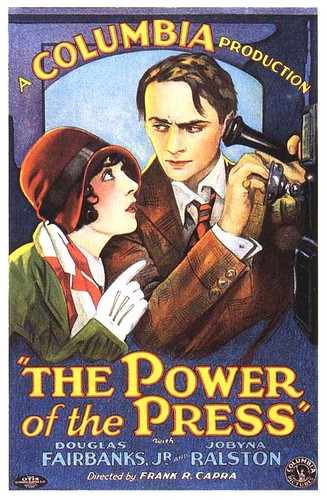
The Journalist As Hero: News is what somebody, somewhere, doesn't want you to know. That's what freedom of the press used to be all about - at least in the eyes of 1930s Hollywood. But questioning authority and speaking truth to power has become passe. Now, apparently, the news media's role is to reflect the strong baseline of our common experience a.k.a The Lowest Common Denominator. The hero of this new endeavour is not the journalist but the propagandist.

AS THE MUCKRAKING American journalist, Upton Sinclair, wisely observed: "It is difficult to make a man understand something when his salary depends upon his not understanding it."

I think of Sinclair every time I hear a bank economist pontificating on the state of the New Zealand economy. Why, oh why, I ask myself, does the news media persist in seeking credible economic information from people with such an obvious vested interest in presenting the privately-owned financial sector in the best possible light?

Why doesn’t the news media approach an academic economist for this sort of commentary? Someone whose salary depends upon the rigor of their critical thinking – not the profits of their employer? Someone, in short, without a dog in the fight?

Delving into the history of who the news media goes to for economic information (especially the public broadcasters, Radio New Zealand and TVNZ) offers some interesting insights into exactly what the media is and who it is for.

Prior to the political triumph of neoliberal dogma in the late-1980s and early-1990s, it was the long-established custom of public broadcasters to approach academic economists for commentary on all manner of financial, commercial and fiscal affairs. But shortly after the election of the Bolger-led National Government in 1990 this practice ceased.

A memo was circulated among Radio New Zealand’s news and current affairs staff indicating who was, and more importantly who was not an acceptable source of economic commentary. What was most notable about this list (apart from the inclusion of all the major banks’ official economists) was its obvious bias towards neoliberal economics. [Don’t bother trying to get your hands on this document because "officially" it doesn’t exist. I learned of its existence from broadcasters who’d seen it and read it but who couldn’t, or wouldn’t, supply me with a copy.]

In the early 1990s, many of the economic professors and associate professors in New Zealand’s universities were still followers of the Keynesian school of economics. When approached for commentary their responses were more often than not highly critical of the policies of both the National Government, and its ideological cheerleaders in the Treasury and the Business Roundtable.

By disseminating the views of these highly critical academic economists the public broadcasters were engaging in a high-risk game of poker with the whole neoliberal establishment.

Just how risky this game could get was demonstrated in 1990 when TVNZ found itself legally besieged by an outraged Labour Cabinet following the broadcast of For the Public Good – a current affairs documentary exposing the links between the politicians behind Rogernomics and Big Business. The producer and many of the staff who worked on For the Public Good soon found themselves not only unemployed but effectively blacklisted in New Zealand. The lesson was not lost on the public broadcasters who remained.

When the Bolger Government’s rising dissatisfaction with the public broadcasters’ coverage of economic affairs was translated into thinly-veiled threats of funding-cuts or even outright privatisation, the management staff at Radio New Zealand decided discretion was the better part of valour – and issued the infamous memo.

Stories like this one give the lie to the rather matter-of-fact description of the news media’s functions supplied last Monday (28/2/11) by Lew at Kiwipolitico.

"The media’s job is right there in the name:" says Lew, "to mediate events for a society which, by and large, will never experience them firsthand but which nevertheless relies on a strong baseline of common experience."

It’s precisely at that "strong baseline of common experience" that Lew and I part company over the news media’s role.

When journalists attempt to tailor their coverage to the requirements of the lowest common denominator (for isn’t that what the expression "baseline of common experience" really means?) they may well be serving the commercial and political needs of those who own, run and influence the news media, but they are certainly not serving the public.

Lew’s comments were made in the context of the Christchurch Earthquake, so let’s take an example from that tragedy to illustrate my point.

According to Lew: "It is incumbent upon the media to present more than a desiccated, dispassionate view of the Canterbury quake, for it is not a desiccated, dispassionate situation for those involved. As a matter of fairness to Cantabrians, if the events they cover speak to narratives of courage and tenacity, or loss or anguish or triumph or solidarity or whatever, then the media has a responsibility to convey those narratives more or less faithfully. And as a matter of national cohesion they need to convey a sense of the magnitude and intensity of it all to the rest of the nation."

Now, cast your mind back to the media coverage of the young man who was brought before a Christchurch court and charged with looting light-fittings. Anyone looking at the television footage could tell that the accused had been severely beaten. His eyes and mouth were badly swollen and his face covered with cuts and bruises. But to my knowledge not a single journalist commented on this obvious fact. Nor did I hear anyone make reference to the obvious collusion between the Police, the Court and the news media which transformed the accused’s appearance before the judge into a full-scale media event.

Presumably, the journalists present saw this carefully organised "perp walk" as a chance to build "national cohesion" around the most suitable means of deterring looting in Christchurch. Accordingly, each of them toed the "baseline of common experience" – in this case our common revulsion at looting in the midst of tragedy.

But the media was wrong about that young man. He turned out to be less of a looter than he was a mentally disabled human-being utterly unequal to the task of defending himself against either physical assault or the charges brought against him. It’s doubtful he was even capable of grasping the extreme seriousness of his situation.

Journalists less concerned with building "national cohesion" and keeping within the bounds of society’s "common experience" would have questioned the authorities, not colluded with them. They would have tried to find out who beat the boy. Was it the Police? The Army? Or was he left to the tender mercies of his cell-mates?

When they learned that the items he’d stolen were light-fittings, they would have immediately known that they weren’t dealing with a case of looting, but with something entirely different. (Who risks imprisonment for light-fittings?!)

But, because the journalists present at the court decided to act in our name, rather than in the name of what Lew dismisses as "a desiccated, dispassionate view of the Canterbury quake", we were all tainted by the cruelty and injustice meted out to a sad autistic boy.

In that makeshift courthouse, the assembled journalists’ "first rough draft of history" was a lie.

And only more lies will follow while the profession of journalism allows the prejudices of its fellow citizens; the political priorities of its leaders; the commercial imperatives of its employers – not to mention its own generous salary packages – to deflect its members from their fundamental duty to question authority and speak truth to power. 

Friday, 4 March 2011

Reflections On The Christchurch Earthquake: Getting Through

Blood, Toil, Tears, and Sweat: Winston Churchill's words to the people of Britain during its "finest hour" in 1940 were so magnificently inspiring precisely because they were so utterly uncompromising. The political force-field created by the Christchurch earthquake can be harnessed by our politicians, but only if they display the unflinching honesty and unshakeable resolve of Britain's wartime leader.

THE CHRISTCHURCH TRAGEDY has generated its own political force-field. Events of such gravity always do. When something as big and brutal as Christchurch’s devastating earthquake shatters the ordered symmetry of our daily lives, we expect our political leaders to respond with measures of equal force.

These measures don’t always have to be practical – although it’s on the ground that the authorities’ performance will always, ultimately, be judged. Often, in moments of crisis, the words of our leaders can be just as important as their deeds.

Recall Winston Churchill’s words, upon assuming the mantle of wartime leadership in 1940. "I have nothing to offer", he told a hushed House of Commons, "but blood, toil, tears and sweat."

That steely realism: so bereft of sentiment; so empty of comfort; stiffened the sinews of the British people. At such critical moments, citizens aren’t looking for soft words of pity and consolation. What they want is speech of unflinching honesty and unshakeable resolve.

"You ask, what is our aim?", Churchill went on. "I can answer in one word: victory; victory at all costs, victory in spite of all terror, victory, no matter how long and hard the road may be; for without victory, there is no survival."

New Zealand is about to be tested in ways only marginally less gruelling than the ultimate audit of war. We are faced with the abrupt cessation of more than a tenth of our national economy – for how long we cannot tell. If the rebuilding of the earthquake-devastated Japanese city of Kobe is any guide, Christchurch may require as much as a decade to fully recover.

The leader who successfully harnesses the political force-field of the Christchurch earthquake will be the leader who tells New Zealanders clearly and without prevarication exactly what he or she expects of them. Because any politician who suggests that Christchurch can be rebuilt or that the New Zealand economy can successfully weather this crisis without a supreme and united national effort, is insulting the intelligence of the electorate.

Not only that, they are insulting the thousands of ordinary Kiwis: farmers, workers, businessmen, students, beneficiaries and retirees; who have added their skills and energy to the unstinting efforts of tens-of-thousands of dedicated public servants.

The men and women who have rushed to bring practical assistance to their fellow New Zealanders are showing the way forward to any political leader with the wit to see it. We are not going to get Cantabrians through this crisis except by means of a co-ordinated and collective effort. And New Zealand will only find the money to rebuild and restore Christchurch if every New Zealander pays their fair share of the cost.

That means the top ten-percent of income earners will have to give up the generous tax windfalls of last year’s Budget – as well as pay a special levy on incomes in excess of $100,000 p.a. It will require the rest of us to pay higher EQC levies. And all of us will have to invest in Earthquake Recovery Bonds with the same sort of patriotic enthusiasm that our parents and grandparents once invested in War Bonds.

Getting through will also require New Zealanders to dispense with many of the economic articles-of-faith that have been drummed into them this past quarter-century. The notion that "Government isn’t the solution to the problem. Government is the problem" (to quote Ronald Reagan’s infamous formulation) must go.

The other lesson which the heroic altruism of ordinary Cantabrians should be teaching our political class is that New Zealanders feel much more like themselves when they’re helping – not hurting – their neighbours. Any political party that believes a national reconstruction effort can be successfully undertaken while unemployed Kiwis and solo mums are being stigmatised, or while the sick and disabled are being harassed and harried into non-existent jobs, is criminally deluded.

Rebuilding Christchurch, and its crucial contribution to New Zealand’s national life, requires, above all else, the same unity of purpose that allowed the Allies to overcome fascism in World War II.

The earthquake’s political force-field will simply annihilate any politician or party which, by unfairly distributing the burdens of recovery, sets New Zealander against New Zealander – in mutual ruin.

To paraphrase Churchill: At this time we are entitled to claim the aid of all, and say: "Come then, let us go forward together."

This essay was originally published in The Dominion Post, The Timaru Herald, The Taranaki Daily News, The Otago Daily Times and The Greymouth Star of Friday, 4 March 2011.

Wednesday, 2 March 2011

Oh, For A Well Mannered Left


IN A RECENT POSTING, Cactus Kate fulminates against the Left’s presumption that only they know how to care about their fellow human-beings. Her caustic polemic reminded me of the editorial I wrote for the Autumn 2003 issue of N.Z. Political Review.

"Oh, For A Well-Mannered Left" drew attention to the curious fact that "the Right treats humanity like cattle and individual human-beings like princes, while the Left loves humanity with a passion but treats individuals like shit."

The whole editorial is reproduced below.

WHY IS IT that I can get a friendlier discussion about New Zealand politics out of an ACT regional conference than I can out of practically any gathering of New Zealand lefties? Come to think of it, why was a gathering of right-wing ACT party members confident enough to invite an avowed social-democrat like Chris Trotter to address them, when a gathering of socialists and communists were unwilling to grant him speaking rights at a post-9/11 rally?

Why is the Left so bloody unpleasant?

In the end, I think it comes down to the stark differences between conservative and radical political cultures.

Conservatives operate on the not unreasonable assumption that, since they already control most of the things that really matter in our society, their paramount political responsibility is to hold on to what they’ve got.

Having firmly settled upon their guiding strategy, conservatives feel free to debate its tactical ramifications without rancour. What’s more, like any good general taking up a defensive position, they possess an insatiable appetite for reliable intelligence about their political enemies’ intentions. If they’re going to be attacked, they would like to know when, by whom, and with what.

All of which contributes to a conservative culture of civility and curiosity. Historical memories of aristocratic honour and noblesse oblige mingle with more recent bourgeois values inherited from the Enlightenment – like the spirit of scientific inquiry – to produce the personal generosity, social ease, and intellectual flexibility so characteristic of conservative politicians the world over.

Radical political culture is altogether different.

For a start, there are long-standing and very sharp disagreements among radical leftists about "the movement’s" ultimate objectives. You can be a radical socialist, a radical Maori nationalist, a radical feminist or a radical ecologist and, depending on which camp you belong to, identify Capitalism, Pakeha Privilege, Patriarchy and/or Industrial Civilisation as the primary target of your political assault.

Worse still, because the radical’s default-mode (and here we are talking about radicals of both the Left and the Right) is opposition to the status quo, radical movements evince a praxis which encourages not only intellectual aggression, but all-too-often verbal and physical violence as well. Add to this volatile mixture the radical’s confusion over objectives (and the interminable tactical squabbles that it generates) and you have the perfect recipe for a culture of competition and intransigence.

Such cultures are highly intolerant of dissent. Indeed, intellectual subtlety of any kind tends to be frowned upon as proof of insufficient "staunchness". As a consequence radicals display all the attributes of (if I may continue to employ a military metaphor) the classical attacking force: an insistence on unity and unquestioning obedience; the strong validation of personal sacrifice and loyalty to the group; and a preoccupation with ends as opposed to means. Small wonder that so many radicals employ the language of combat – campaigns, rallies, marches, attacks – to describe political behaviour.

There is a paradox here. Conservative political culture, whose raison d’ĂȘtre is the preservation of social inequality and economic exploitation (not to mention the institutional violence these things create and upon which ruling class power rests) tends to produce individuals of considerable personal charm and genuine liberality. While radical political culture, which sets its face against the violence and injustice of entrenched privilege, all too often produces individuals who are aggressive, intolerant and utterly indifferent to the suffering which their relentless quest for justice causes.

In short, the Right treats humanity like cattle and individual human-beings like princes, while the Left loves humanity with a passion but treats individuals like shit.

I can’t help thinking that the revolution would come a lot sooner if the Left set about achieving its own radical objectives with its conservative opponents’ infinitely better manners.

As Gilbert Shelton’s wonderful 1970s poster put it: "Remember kids, when you’re out there smashing the State, to keep a smile on your lips and a song in your heart."

EIGHT YEARS ON, little appears to have changed. Perhaps all of us, Left and Right, should ponder the truth of the following line of dialogue from an old Hollywood movie I saw many, many years ago – but which I've never forgotten:

"It’s a whole lot harder to love just one person than all humanity – but it’s not one bit less noble."

Tuesday, 1 March 2011

In Remembrance: 12:51pm, Tuesday, 22nd February 2011

Two Minutes Silence: For the dead, the injured, the broken and bereaved of New Zealand's second city. Kia Kaha Christchurch!

Reflections on the Christchurch Earthquake: Acts of God and Acts of Man

Does Anyone Know Where The Love Of God Goes?: In the face of the earth's blind indifference to human suffering, it is only our species' instinct to reach out and offer assistance that offers the hope of recovery. When disaster has a human origin, however, our altruistic impulses are often deliberately thwarted. Why is that?

I WONDER if Paula Rebstock will be brave enough to tell the thousands of quake-struck Cantabrians who have just lost their livelihoods to get busy "job-seeking".

She wouldn’t dare.

The heartbreaking events of last Tuesday have disrupted the lives of thousands of Christchurch families. Looking east across the city’s devastated eastern suburbs one is daunted by the massive scale of this disaster.

Most New Zealanders have become uncomfortably familiar with the grim scenes of tragedy in Central Christchurch. But very few Kiwis yet grasp just how many Cantabrians are struggling to survive in ordinary suburban streets much like their own.

In these streets you will not find the wrenching drama of the collapsed CTV and Pyne Gould Group buildings, but do not believe for one moment that the after-effects of Tuesday’s killer quake will be any less crushing.

If someone is trapped in a building, the task is simple: get them out. But what do you do when the tasks looming ahead of you are too numerous and frightening to contemplate?

How do you cope when liquefaction has sunk and twisted the foundations of your home and filled the rooms with raw sewage? How do you keep track of Civil Defence advice when there is no electricity to power your radio – and the bathroom transistor lies in pieces on the floor? How do you keep up your family’s morale when the nearest drinkable water is twenty-minutes walk, and sixty-minutes wait, from your front gate? When the family toilet is a hole in the ground?

How can you plan ahead when your employer’s business lies in ruins on the other side of the police cordon? How is he supposed to even make up last week’s pay? And, if, as you suspect, your job has gone, is the company in any position to offer redundancy? How will you continue to pay the mortgage on a house you can no longer live in, from an income stream that no longer exists?

Multiply these questions a thousand-fold and you begin to get some idea of what lies ahead for the people of Christchurch.

And, naturally, their fellow New Zealanders are responding with generosity. There’s simply no question of WINZ employees grilling quake-afflicted mums and dads about their job-seeking efforts. No one’s going to threaten them with "sanctions" if they can’t produce evidence of positions applied for, and interviews attended. When people’s joblessness, homelessness, acute depression and deteriorating health are attributable to an Act of God, we do not blame them – we do everything within our power to help them.

So why is the Chair of the Welfare Working Group, Paula Rebstock, who wouldn’t dream of denying assistance to the victims of the Christchurch earthquake, so ready to harass and punish the victims of man-made disasters?

When a firm goes belly up. When a Board of Directors decides to shut down their uncompetitive New Zealand factories and relocate the manufacturing side of the business to Thailand. When a public-servant-hating Government throws scores of innocent, hard-working New Zealanders out of their jobs. It’s then that the people on the receiving end, through no fault of their own, are confronted with many of the same questions currently challenging the residents of Christchurch’s eastern suburbs.

They may not have experienced physical liquefaction, but the solid foundations upon which they believed their lives had been built have crumbled and sunk away just the same. The power and the water may still be on in their houses, but how do they keep these utilities flowing with no money coming in? How do they pay the mortgage? And, when in it comes to shame and embarrassment, telling family and friends that you’ve lost your job is right up there with having to squat over a hole in the backyard.

Help will come quickly to the people of the eastern suburbs. It must – or Cantabrian morale will collapse, psychological depression will set in, family violence will soar, and a calamitous natural disaster will be compounded by the effects of a social catastrophe.

Paula Rebstock tells us that the number of New Zealanders on benefits is already a social catastrophe, and her report proposes a series of harsh and uncompromising measures to shrink the welfare rolls. It seems to regard beneficiaries not as the victims of disasters they did not make, but must somehow endure: unemployment; spousal abuse or abandonment; mental illness; physical and/or intellectual disability: but as hopelessly dependent children.

Beneficiaries, according to Ms Rebstock, have become the prisoners of their own, and others’, low expectations – and only paid work can set them free.

I dare her to use that sort of exclusionary and condescending language to describe the struggling families of the eastern suburbs.

What the innocent victims of God’s acts, and Man’s, need most is our help – not our disdain.

This essay was sent for publication in The Press of Tuesday, 1 March 2011.

POSTSCRIPT: The Government’s assistance package, announced on Monday, 28 February, further highlights the curious distinction our political leaders continue to draw between Acts of God and Acts of Man. If you’ve lost your job because of the earthquake you’re immediately entitled to receive $500.00 per week (close to the minimum wage). But, if you’ve lost your job because your employer has just been bought out by a multinational company, you’re entitled (after a stand-down period of 12 weeks) to an unemployment benefit of just $294.00 per week (56 percent of the minimum wage). Nothing could better illustrate the punitive assumptions built into our welfare system.