Tuesday, 4 November 2014

“By Their Fruits Shall Ye Know Them”: There’s nothing ‘moderate’ about John Key’s government.

Wolves In Wolves' Clothing: What Key and Joyce, both inveterate poll-watchers, clearly grasped after National’s last-minute failure in 2005 was that when push came to shove, the New Zealand electorate just wasn’t ready to take yet another wild ride into political and economic upheaval. National had to learn how to "make haste slowly".
 
NEW ZEALAND’S LOVE AFFAIR with John Key, like most enduring relationships, is based on trust. Ever since he wrested the leadership of the National Party from the scary Don Brash, it has been Key’s unwavering mission to present both himself and the party he leads as ordinary, decent and (most important of all) non-threatening. Looking back over the past six years, only a fool would say he hasn’t been extraordinarily successful.
 
Had Brash won the 2005 election New Zealand would have been plunged into a period of acute political instability.
 
Faced with a government determined to relegate the Treaty of Waitangi to the status of an historical relic, and abolish the Maori seats altogether, the Maori Party, the Greens and (with much less enthusiasm) the Labour Party would have found themselves mobilising not only a furious Maoridom, but also a very significant swathe of Pakeha society as well. The resulting clash of a very significant minority of the population with “the racist Right” would have made the 1981 Springbok Tour protests look like a tepid historical dress rehearsal. After three years of increasingly violent and ultimately fatal confrontations, it’s likely that Brash, the National Party and their rabid Act allies would have been consigned to electoral oblivion. The Right’s electoral rehabilitation would have taken at least a decade.
 
In a very real sense, then, National (and New Zealand) dodged a bullet in 2005. And the two National Party politicians who appreciated just how big a bullet it was that had whistled over their heads were John Key and Steven Joyce. It’s not that these two politicians underwent some sort of Road to Damascus conversion from far-Right fanatics to kitten-eyed moderates – far from it. What they grasped was that any further attempts to impose the entire right-wing agenda in one fell swoop were bound to produce exactly the same electoral failure.
 
Brash had taken his inspiration from Roger Douglas and Ruth Richardson. All three of these politicians were “policy aggressors” determined to overturn “the conventional wisdom” in the name of a radically reconfigured New Zealand economy and society. But what Key and Joyce, both inveterate poll-watchers, clearly grasped was that National’s last-minute failure in 2005 was only partly due to Brash’s personal stumbles. When push came to shove, the New Zealand electorate just wasn’t ready to take yet another wild ride into political and economic upheaval. If National was to capitalise successfully upon the electorate’s growing disenchantment with “Nanny Helen’s “ “political correctness” and a Labour Party fast becoming unrecognisable to “Middle New Zealand”, then the negative legacies of Richardson, Shipley and Brash had to be expunged.
 
And nobody does expunge like John Key. In spite of the fact that in his earliest incarnation as a National Party back-bencher, the MP for Hellensville boasted a decidedly reactionary political profile, John Key, as Leader of the Opposition, proved to be extraordinarily adept at presenting himself as “Mr Moderate”, “Mr Bloke-Next-Door”, “Mr Guy-I’d-Like-To-Have-Beer-With” or (if you were a woman) “Mr Guy-I’d-Like-To-Shag”. If Brash’s mentors had been Douglas and Richardson, the policy aggressors; Key’s were Sir Keith Holyoake, Jim Bolger and Clark herself: incrementalists all.
 
But just because, as a politician, you’ve decided to make haste slowly, doesn’t mean that you don’t get to where you’re going in the end. A dispassionate review of the Key Government’s legislative achievements since 2008 could only conclude by observing that notwithstanding all the taunts of National having turned into “Labour-Lite”, this is a very right-wing government indeed. It’s unrelenting hostility to all forms of environmental protection; its opening of our land and sea to mineral exploration and extraction; its blank refusal to take any meaningful action against Climate Change and its determination to protect the dairy industry from any and all forms of practical regulation: these are only the beginning of what is now a very long list National’s reactionary victories.
 
And just consider what has characterised the opening shots of National’s third term. Dismissed as mere technical adjustments, the Government’s changes to the Employment Relations Act place New Zealand at the far right-wing reaches of the OECD. (As the CTU president, Helen Kelly, quite rightly points out.) Then there is Bill English’s and Paula Bennett’s extraordinary decisions in relation to state housing. At a time when people are living in caravan-parks and cars, the idea of selling up to a third of the nation’s state houses represents a sudden and utterly unmandated return to the darkest days of Jenny Shipley. And as if these measures weren’t reactionary enough, it now seems certain that Key will commit New Zealand military forces to the confused and almost certainly ineffective US-led war against the Islamic State.
 
“Moderate”? “Labour-Lite”? Not really. John Key’s government is every bit as bad as its predecessors. It is, however, a great deal better than most of them at pretending it isn’t. And to those who find it impossible to see “that nice Mr Key” as being anything other than the soul of reason and common sense, I can only offer the words of St Matthew’s Gospel:
 
 “Beware of false prophets, who come to you in sheep’s clothing, but inwardly they are ravenous wolves. You will know them by their fruits.”
 
This essay was posted simultaneously on The Daily Blog and Bowalley Road on Tuesday, 4 November 2014.

National's Housing Policy: Squander and Squalor.

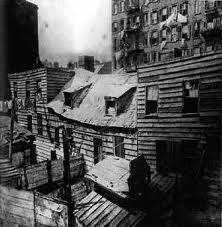
Free Market Solutions: In 1890, Jacob Riis, one the world's first 'photo-journalists', published How The Other Half Lives, depicting the lives of New York's slum-dwellers. This is what affordable housing for the poor looks like when the provision of this vital social need is left to the tender mercies of "the free market".

WHAT IS IT ABOUT the National Party and state housing? What is it about supplying safe, warm and affordable housing for the poorest New Zealanders that they do not understand? Are Bill English and Paula Bennett so wedded to the notion that ‘the market must decide’ that they are willing to live with the squalor it inevitably engenders?
 
All around us we see the consequences of allowing market forces to set New Zealand’s housing policy. Young, well-qualified Kiwis, holding down good jobs on good pay, cannot afford to buy a house. While young families, struggling to survive of a benefit, cannot even find one. Property developers and builders, responding to market signals, construct dwellings for those in search of large and expensive dwellings. The smaller, cheaper homes New Zealand so desperately needs exist only in the dreams of the homeless, and on the drawing-boards of progressive architects.
 
And what is the National Government’s response? To sell up to a third of the state houses entrusted to it by the wisdom and compassion of earlier generations of New Zealanders! When thousands of their fellow citizens are living in damp, over-crowded houses; or caravan parks; or their cars; Mr English and Ms Bennett are proposing to reduce the State’s stock of housing for the poor. Why in God’s name would they want to do that?
 
National’s comeback is that the provision of social housing is best left to religious, charitable, and other not-for-profit institutions. The State, they say, is a poor landlord. The country’s poorer citizens, they insist, will be better off in the care of the Salvation Army; or their local Iwi; or a city council.
 
Really?
 
From what possible source will the not-for-profit sector acquire the resources to construct social housing on a scale even remotely commensurate to the urgent need of the homeless? What bank is going to lend money to an institution whose prospective clients are required to endure the most precarious of living conditions? There are very good reasons why very poor people are refused mortgages. (As the whole world discovered in 2008, when the US and UK banks’ insane decision to lend money to people who couldn’t possibly pay it back triggered a global financial crisis.)
 
Nor is there the slightest historical justification for believing that the housing needs of the poor can in any way be satisfied by the charitable impulses of churches, individual philanthropists, or even – heresy of heresies! – by the good offices of the free market’s mysterious “invisible hand”.
 
We have all, at some time, used the expression “how the other half lives”. But how many of us realise that it has its origin in a scandal arising out of market-driven housing “solutions”? It was in 1890 that one of the world’s first “photo-journalists”, Jacob Riis, published How the Other Half Lives: Studies among the Tenements of New York, a collection of photographs depicting the horrendous living conditions of the city’s slum-dwellers. The free-market’s “solution” to New York’s ever-increasing demand for affordable housing was to construct gimcrack, windowless, disease-ridden, fire-traps where whole families were forced to eke out their sorry existence in a single, fetid room. To their credit, New York’s middle-classes were shocked into action. Their radical reforms owed little to market forces.
 

State Provided Solutions: A street of "State Houses" in New Zealand.
 
And neither did the radical reforms of the First Labour Government. Because, fundamentally, market failure was the problem. Daringly, Labour’s reformers borrowed the capital required to house the homeless casualties of the Great Depression from “NZ Inc”, in the form of Reserve Bank credit. We paid ourselves back out of the increased revenue generated by the housing programme itself (state houses were built, as a far as possible, out of local materials) and, over time, out of the rentals of the tenants themselves. (Being immortal entities, states can wait a long time for their loans to be repaid!)
 
Has the Government truly forgotten that there is NO non-squalid market-driven solution to a market-induced crisis in affordable housing? Mr English and Ms Bennett certainly haven’t forgotten. If you press them they will admit that their own government may end up lending the potential purchasers of state houses the money needed to acquire our long-ago amortised assets. Yes, that’s right, National’s “market-driven” solution to the housing crisis is to require taxpayers to heavily subsidise private investment in property they already own because the new owners’ “independence” from the State better qualifies them to manage the nation’s stock of social housing than the State itself.
 
But even if that were true, the State’s alleged indifference as a landlord is almost entirely attributable to the National Party’s longstanding antipathy to the idea that when it comes to putting a roof over people’s heads we are, and must remain, “our brothers’ keeper”.  Ultimately, the Government’s market-driven alternative can only be achieved by squander and squalor.
 
This essay was originally published in The Press of Tuesday, 4 November 2014.

Saturday, 1 November 2014

The Final Fifth: The Last Great Task For Progressive New Zealand.

"For mercy has a human heart, pity a human face" - William Blake
 
MOST OF NEW ZEALAND’S social problems are concentrated among those living at the margins of what is otherwise a relatively wealthy society. Recently released international data on child poverty has exposed an acutely stressed social strata encompassing roughly 20 percent of the nation’s population. Most of these New Zealanders are young, brown, indifferently educated and lacking in readily marketable skills. A significant number are supported by the State, but many others support themselves through part-time jobs paying at or below the minimum-wage. Some will supplement their meagre “official” income through various kinds of socially stigmatised and/or criminal activity such as prostitution and drug-dealing. Maintaining traditional family structures under such stress is further hampered by a critical shortage of affordable housing, inadequate public transportation and declining levels of unskilled and semi-skilled employment. The heaviest burden falls upon single mothers. It is estimated that approximately 250,000 children are being raised in circumstances of serious material, emotional and cultural deprivation.
 
Eighty-three years ago an even larger percentage of the New Zealand population lived in poverty. In 1931 the Great Depression had cast tens-of-thousands of families into circumstances of acute hardship. Nearly a quarter of the workforce was unemployed. Everywhere small businesses were failing. The banks and mortgage companies were throwing farmers off their land. Even those lucky enough to have a job were subject to frequent and arbitrary wage reductions. The trade unions were powerless to help. One third of the country was desperate. One third was under stress. And the remaining third lived in fear of the rest.
 
In 1932 rioting broke out in all of New Zealand’s major cities. In Dunedin a hungry crowd ransacked Wardell’s – a high-end food emporium. In Auckland Special Constables were sworn in to maintain order after thousands of enraged unemployed workers smashed the plate-glass shop fronts of Queen Street and looted all they could carry away. At the Devonport naval base, ratings armed with 303 rifles and machine-guns waited for the order to suppress the rioting by deadly force.
 
The government of the day – a coalition of rural conservatives and urban liberals – reacted to this unprecedented expression of social despair by passing the Public Safety Conservation Act (which allowed for the indefinite suppression of democratic norms) and by deporting as many able-bodied unemployed male workers as possible to work-for-the-dole labour camps in the countryside. By 1933, a terrible, sullen, silence had descended upon New Zealand. But, underneath that silence, there was a grim determination – extending across all social classes – to bring these hateful conditions to an end.
 
These are just some of the vivid tales contributing to the Great New Zealand Myth. That enduring narrative concerning the collective struggle for social justice and social progress which culminated in the election and re-election of the First Labour Government. Like all great myths it is characterised by expiation, catharsis and the eventual emergence of a new consensus about what and who we are. A happy ending – of sorts.
 
Fast-forward 83 years and what has become of the Great New Zealand Myth? There is much about it that remains unchanged. As a nation we are still susceptible to appeals for social justice, still ready to make social progress. But there are differences also. The very success of the Welfare State that Labour brought into being has given rise to some very different expectations.
 
Poverty carries no stigma when everybody is poor. Quite the reverse. Deprivation visited upon a community through no fault of its own tends to develop tremendously strong bonds of solidarity and a willingness to share and co-operate. Indeed, it was precisely these virtues of solidarity and co-operation that made the changes of the First Labour Government possible and which allowed them to endure.
 
But a welfare state – especially one underpinned by a bi-partisan commitment to full employment – slowly but inexorably changes people’s perception of poverty. When the state has given everyone access to health care, affordable housing, and an education to the fullest extent of their powers, then poverty ceases to be regarded as a collective curse and becomes, instead, evidence of individual failure.
 
And if, to this general impatience with “welfare dependency” one adds the prejudices of a comfortable Pakeha majority all-too-easily provoked by people of different colours and cultures, then that marginalised 20 percent of New Zealanders still in the grip of poverty ends up being despised as useless mouths, parasites, persons as underserving of decent citizens’ pity as they are of the State’s succour and support. It’s why progressives no longer talk about poverty per se. “Child poverty” is what you’re forced to talk about when general compassion for the condition of those children’s parents is all tapped out.
 
Buried deep in the former white working-class’s antipathy to “bludgers” and “welfare cheats” is an unspoken but politically crucial question: ‘Why don’t you people do something about your situation?’ Their class memory informs them that there was a time when their parents and grandparents faced exactly the same problems as today’s poor. The big difference, they tell themselves, is that their forebears did something about it. They joined unions. They went on strike. They rioted in the streets. They formed their own political party. They won state power. They changed the rules. They got out. ‘So, what’s stopping these buggers?’
 
Nothing. And that’s the point. The First Labour Government created a society in which anyone in possession of a good enough brain, a strong enough will and a big enough dream was free to escape from their family’s cash-strapped condition. In the years prior to 1935, the powers-that-be had built a brick ceiling over the working-class. Those who were smart and ambitious had to be smart and ambitious not just for themselves but also for their class. Eventually, these working-class leaders assembled the necessary tools and muscle to smash through the bosses’ brick ceiling and erect the ladders up which their “aspirational” offspring could climb into a new and very different world.
 
To a considerable extent it is this that explains the bottom 20 percent’s political inertness. In a proportional electoral system there is little doubt that a roused “underclass” would very quickly force the rest of society to address its problems. So, where are the Harry Hollands, the Mickey Savages, the Peter Fraser’s of today? Where is the Maori, the Pacifica, John A Lee speaking for today's “Children of the Poor”? Well, most of them, being free and clear of their origins, don’t need to. They did not have to make a revolution to get their children up and out. That’s why they’re lawyers and doctors and business-people. For this lucky few, those who would once have served as the yeast in the social bread, the underclass is in the past. It's no longer their problem.
 
The stubborn fifth of social dysfunction at the base of New Zealand society thus imposes a huge responsibility on the lucky four-fifths of New Zealanders smart and skilled and lucky enough to be at least a few pay-checks away from the lethargy and despair which so quickly disempowers the victims of poverty.  So, if there is one last, important political mission for progressive New Zealanders, then it is surely this: to fulfil the role once played by the best and the brightest of a working-class offered no means of escape. To read Saul Alinsky’s Rules for Radicals; to assemble a veritable army of “community workers”; to preach the gospel of getting up-and-in to all those who are presently down-and-out. To stay among the poor and marginalised for as long as it takes. Until the wonderful day dawns when the people they have come to break out of poverty’s prison tell them to: “Fuck off! We can do this ourselves.”
 
This essay was posted simultaneously on The Daily Blog and Bowalley Road on Saturday, 1 November 2014.

Friday, 31 October 2014

Ghost Dancing?

Ghost Dancing circa 1890: With the buffalo effectively exterminated, the material basis for the Native American cultures of the Great Plains was destroyed. The Ghost Dance, it was believed, would reconstitute the basis for an independent indigenous existence. Has the removal of the material basis for a self-conscious industrial working-class similarly undermined the social base and cultural integrity of the New Zealand labour movement? Are the four contenders for the Labour Party leadership simply Ghost Dancing?

OF THE FOUR CONTENDERS for the leadership of the Labour Party, it is David Parker who pursues most consistently the “traditional” Labour member’s support. “Labour was formed by working people, for working people”, is one of Mr Parker’s favourite riffs. And lest any member of the party should doubt his commitment to Labour’s “core values”, he chose Labour Day as the time and the Savage Memorial as the place to launch his Auckland campaign.
 
But how much sense does it make to pursue the votes of Labour’s traditionalists when so little of the world that made them (and the Labour Party for that matter) still remains? Is it even possible to be a party of the New Zealand proletariat when the New Zealand proletariat (or, at least, the New Zealand proletariat as it was configured from 1935-1985) no longer exists?
 
Which is not to say that, globally-speaking, the industrial working-class, with all its vast potential for upsetting the applecart of industrial civilisation, has ceased to exist. Far from it. What should be said, however, is that if you’re looking for a mass of exploited toilers recognisable to Karl Marx and Friedrich Engels, then you’ve a much better chance of finding them in China than you have in the post-industrial societies of the West.
 
Over the past 40 years, western capitalists have solved the problem of having large and self-assertive working-classes in their own backyard by ruthlessly shipping their employees’ jobs overseas to places where unions, civil rights and most other democratic practices are conspicuous by their absence. If you want to see the equivalent of Henry Ford’s vast River Rouge car assembly plant nowadays, you’ll have to visit Shenzhen.
 
Think of the political economy of globalisation in terms of the fate of the American buffalo.
 
Before the great waves of European settlers washed over the American prairie, it was the preserve of Native American tribes and unimaginably large herds of buffalo. So long as the buffalo endured, settlers would not only have to contend with the indigenous peoples the great beasts supported, but they’d also find it impossible to transform the prairie into profitable farmland.
 
Obviously, both had to go. In the space of just 45 years the buffalo herds (the largest of which sometimes stretched from horizon to horizon) were reduced from more than 30 million to just a few hundred. And with the destruction of the buffalo the indigenous cultures of the prairies found themselves robbed of the very substance of their being. After a brief but doomed burst of resistance they were reduced to objects of anthropological curiosity and Hollywood fantasy.
 
The social-democratic welfare-states that grew up in the West in the 1930s and which reached their peak effectiveness in the early 1970s had the same relationship with factory-based production as the indigenous tribes of the prairie had with the buffalo. It was the factory-based process of mass production that underpinned the full-employment upon which the welfare state depended. Also dependent on the jobs of secondary industry were the trade unions – out of whose economic and political influence the social-democratic and labour parties of the West had emerged. Take away those jobs and in remarkably quick succession the unions, their parties and the welfare state itself would crumble and die.
 

Rust Belt Ruin: The continuing export of Western factory jobs has undermined the unions, their parties and the welfare state itself.
 
The mass slaughter of the buffalo came to an end in the mid-1880s submerging the tribes in existential despair. Five years later, however, the Bureau of Indian Affairs began to receive reports of a strange religious phenomenon sweeping the reservations – the “Ghost Dance”.
 
A Paiute shaman, Wovoka, prophesised that if the tribes danced the Ghost Dance, then the living and the dead would be reunited, the world re-made anew, and all its peoples could live in peace. Among the Lakota nation, however, the new religion took on a more millennial character. The dance would bring back the buffalo, said the Lakota chief, Kicking Bear, and by wearing “Ghost Shirts” warrior-dancers would be rendered impervious to bullets. On 29 December 1890, at Wounded Knee in South Dakota, this belief was put to the test – with tragic results.
 
Could David Parker be Labour’s Wovoka? Is his invocation of a political movement created “by working people, for working people” as tragic, in its way, as the Native Americans’ longing for the buffalos’ return? Could we be witnessing Labour’s Ghost Dance?
 
This essay was originally published by The Waikato Times, The Taranaki Daily News, The Timaru Herald, The Otago Daily Times and The Greymouth Star of Friday, 31 October 2014.

Thursday, 30 October 2014

A Very Weird Story: Deconstructing Darren Aronofsky's "Noah".

An Heretical Work: Darren Aronofsky's Noah is an attempt to reconstruct from the ill-fitting fragments of the much older and more finely textured myth of the Great Flood, a religious homily about human power, human guilt, and human redemption. That he failed matters much less than that he tried at all.
 
NOAH is a curious movie. Conceived as a biblical epic, it’s target audience was originally the millions of Americans who regard the Bible as "the inerrant word of God". With the sin-filled works of Hollywood forbidden to these true-believers, Christian movie-makers have developed a lucrative niche market for church-backed big-screen offerings that faithfully reproduce the scriptural plot-lines.
 
But if fidelity to the Genesis story was central to Director, Darren Aronofsky’s, original pitch for Noah, the final cut presents the viewer with something altogether different. Essentially, Aronofsky and his co-writer, Ari Handel, have taken the biblical tale and re-worked it into a homily on the human urge to dominate and the damage it inflicts upon both the social and the natural world. Not surprisingly, when Paramount Pictures attempted to secure the support of the Christian distribution networks for Aronofsky’s final offering, the response was less than enthusiastic.
 
The ease with which Noah’s screenwriters’ were diverted from their original intentions is understandable because, read closely, the Book of Genesis is a very weird story. What, for example, are we supposed to make of this?
 
“And it came to pass, when men began to multiply on the face of the earth, and daughters were born unto them, that the sons of God saw the daughters of men that they were fair; and they took them wives of all which they chose.”
 
Or this?
 
“There were giants in the earth in those days; and also after that, when the sons of God came in unto the daughters of men, and they bare children to them, the same became mighty men which were of old, men of renown.”
 
These verses are just there in the sixth chapter of Genesis – apropos of God knows what! One thing, however, is clear: that in the years following Adam’s and Eve’s expulsion from the Garden of Eden some very peculiar things were going on. Odd enough for Aronofsky and Handel to incorporate these fallen sons of God, these angels, into their movie’s plot-line. They called them “The Watchers”
 
Exactly what America’s stern guardians of evangelical Christian orthodoxy made of this plot device when asked to view the final cut of Noah one can only guess. In all probability they did not want the younger members of their congregations speculating about why angels might want to “come in unto the daughters of men”. Aronofsky’s and Handel’s use of the expression “The Watchers” posed even bigger problems.
 
Any good dictionary of religion (not to mention Google!) will lead any person curious to learn more about the Watchers to another very strange collection of stories about what happened in the years between the expulsion from Eden and the Great Flood. The Book of Enoch is, if possible, even weirder than Genesis. So weird that for more than 2,000 years both the Judaic and the Christian religious authorities have thought it best to keep Enoch out of both the Torah and the Bible.
 
Because, according to Enoch, the Watchers didn’t just content themselves with seducing the daughters of men, they had a much bigger agenda:
 
“It happened that when in those days the sons of men increased, pretty and attractive daughters were born to them. The Watchers, sons of the sky, saw them and lusted for them and said to each other: Let’s go and pick out women from among the daughters of men and sire for ourselves sons”.
 
To these, the offspring of the “sons of the sky”, the Watchers passed on all manner of useful knowledge. Enoch helpfully vouchsafes to us the names of some of these Watchers and what they taught:
 
“And Azâzêl taught men to make swords, and knives, and shields, and breastplates, and made known to them the metals of the earth and the art of working them, and bracelets, and ornaments, and the use of antimony, and the beautifying of the eyelids, and all kinds of costly stones, and all colouring tinctures. And there arose much godlessness, and they committed fornication, and they were led astray, and became corrupt in all their ways. Semjâzâ taught enchantments, and root-cuttings, Armârôs the resolving of enchantments, Barâqîjâl, taught astrology, Kôkabêl the constellations, Ezêqêêl the knowledge of the clouds, Araqiêl the signs of the earth, Shamsiêl the signs of the sun, and Sariêl the course of the moon.”
 
If you’re beginning to think that all this is beginning to sound like the script of one of those Ancient Aliens “documentaries” that infest the History Channel, then you’d be entirely justified. That Aronofsky and Handel declined to take their screenplay in that direction was, perhaps, a mistake. It would have made a lot more sense to re-tell the story of Noah as a terrifying example of what happens when ordinary human-beings get caught up in the quarrels of horny “Sons of the Sky” bearing gifts.
 
As it is, the screenplay of Noah is neither fish nor fowl. It’s certainly not a biblical epic in the tradition of The Ten Commandments or The Greatest Story Ever Told, but neither is it a work of science fiction like Stargate. Instead, Noah is that rarest of things in this irreligious age, an heretical work.
 
Sensing that the biblical version of the Great Flood is but a fragment of a much older and more finely textured myth, Aronofsky and Handel have attempted to construct from its ill-fitting remnants a story about human power, human guilt, and human redemption. That they failed, producing a film so filled with gross failures of logic, motivation, and theology that not even the participation of Russell Crowe, Emma Watson and Sir Anthony Hopkins could save it, is not to be wondered at. Myths are generally the work of many literary hands, refined over centuries. It’s takes a scholar of J.R.R. Tolkien’s stature to make a believable myth from the contents of a single mind.
 
What can be said, however, is that Aronofsky’s and Handel’s Noah possesses the power to set those whose temperament leans towards the mystical on a fascinating path of inquiry. It also reminds us that the world depicted in the Bible is a very strange one. A world choc-full of all manner of supernatural beings – only some of whom are benign (or even decent!)
 
No wonder the Christian Right refused to endorse it.
 
This essay was posted simultaneously on The Daily Blog and Bowalley Road blogsites on Thursday, 30 October 2014.

Tuesday, 28 October 2014

If Ebola Goes Global

Reassuring Image: Among the peoples of the West, the latest Ebola outbreak is generally being categorised as just another of those terrible things that happen “over there” in the hot, poor and indifferently-governed places of the world. The Ancient Greeks would have called this hubris.
 
IT BEGAN with a two-year-old child: a little Guinean boy whose father and brothers regularly supplemented the family diet with “bush-meat”. That’s what killed him. Something deadly in the carcase of a hammer-headed fruit bat (Hypsignathus monstrosus) carried home for the cooking-pot somehow found its way into his bloodstream.
 
A “megabat”, boasting a wingspan of nearly a metre, the hammer-head offers bush-meat hunters in the West African highlands a substantial meal. Unfortunately for the two-year-old, and then for his mother, sister and grandmother, Hypsignathus monstrosus is also one of the recognised asymptomatic carriers of the Ebolavirus.
 
Officially, the World Health Organisation (WHO) estimates that upwards of 10,000 West Africans have contracted the deadly Ebola virus, and that this latest outbreak of the highly contagious haemorrhagic disease has a terrifying case fatality rate of 70.8 percent. Unofficially, WHO is saying that the number of cases could be three or four times greater than the official estimate. They are also deeply fearful that in spite of positive stories about the disease’s containment, it may already be moving inexorably across the African continent. If (or perhaps that should be ‘when’) it reaches the densely populated cities of the East African coast, the number infected will soar into the hundreds-of-thousands. And if it continues to move along Africa’s traditional trade routes north, into Sudan, Somalia and Egypt, and further east, into India, then the world will be faced with a global pandemic of truly catastrophic proportions.
 
Among the peoples of the West, however, the latest Ebola outbreak is generally being categorised as just another of those terrible things that happen “over there” in the hot, poor and indifferently-governed places of the world. With our highly sophisticated public health systems geared-up and ready to respond, any infected person somehow making it across our borders faces instant containment and state-of-the-art medicine. For the fortunate minority of the planet’s population blessed with a white skin, all remains well.
 
For the moment.
 
Because, as American historian, Mike Davis, writes in his deeply depressing book, Planet of Slums: “[T]oday’s megaslums are unprecedented incubators of new and reemergent diseases that can now travel across the world at the speed of a passenger jet.”
 
Not that Ebola needs to be airborne. Every single day frail and criminally overloaded boats set sail from North Africa for Southern Italy. How long will it be before a lethal percentage of these thousands of illegal economic migrants arrives bearing the deadly virus? In the crowded slums of Naples, Rome and Milan, Ebola will spread with the same awful alacrity that brought it to Guinea, Sierra Leone and Liberia.
 
Perhaps this is simply the price we have to pay for twenty-first century capitalism’s “world without borders”? To discover that, in Davis’s words, “economic globalisation without concomitant investment in a global public health infrastructure is a certain formula for catastrophe.”
 
And even if the navies of the European Union were prepared to repel all boarders, the economic consequences of half-a-world afire with a deadly pandemic cannot be so easily sent to the bottom of the Mediterranean. One can only imagine how the already fragile global economy would respond to Ebola’s spread across the world. Fear and panic would grip Wall Street. Global transportation links would be severely, perhaps fatally, disrupted. Xenophobia would run rampant across the Western world. The long-discarded doctrine of economic self-sufficiency would instantly return to fashion. And, if the pandemic was to sweep up from South Asia and engulf China, the entire edifice of global industrial civilisation would shudder on its foundations.
 
It’s happened before. In the middle decades of the Fourteenth Century the whole of Eurasia was ravaged by a pandemic caused by the flea-borne microbial pathogen Yersinia pestis. The Black Death, as it came to be known, left entire regions depopulated. Villages and even cities were emptied of all but the dead. In Southern France and Spain the death rate may have climbed as high as 70-80 percent. The best estimates put the overall death toll at 100 million victims – more than a fifth of the total human population! It may have taken medieval civilisation another 150 years to finally expire, but there is no disputing the identity of its killer. Yersinia pestis.
 
Located where we are, at the bottom of the world, it is easy to dismiss all these grim speculations as unhelpful scare-mongering. Certainly, we must hope that they are nothing more than that. Our economic survival depends upon the unhindered flow of seaborne imports and exports and airborne tourists. New Zealand could not long endure in a world frozen solid by the ravages of Ebolavirus. The bitter truth being that if the death toll of any global pandemic ever exceeds one billion souls, then the world will have little pity to spare for a faraway nation of 4.5 million.
 
This essay was originally published in The Press of Tuesday, 28 October 2014.

Saturday, 25 October 2014

The Songs of Yesteryear - Or, What I Was Listening To 40 Years Ago

 
Sonnet to the Fall: Penned by the group, Dulcimer's, founder, Peter Hodge, the song also features the English actor, Richard Todd, reading Hodge's poetry. Dulcimer's first album, And I Turned As I Had Turned As A Boy was released on the Nepentha label in 1970.

THIS LITTLE GEM from the almost completely forgotten English folk group, Dulcimer, captures something of the sweet innocence of the early-1970s - that wonderful bygone era of full-employment and free tertiary education. In all of New Zealand's major cities (and some of its smaller ones) there were folk clubs where traditional and contemporary compositions were played by musicians of often astonishing skill and originality. Meanwhile, the audience of mostly long-haired youngsters of both sexes drank cheap red wine out of casks, flirted, laughed and, most importantly, sang away the chill winter nights.

Mais où sont les neiges d'antan? Asked the French Renaissance poet, Francois Villon.

Where are the snows of yesteryear?

Video courtesy of YouTube

This posting is exclusive to the Bowalley Road blogsite.