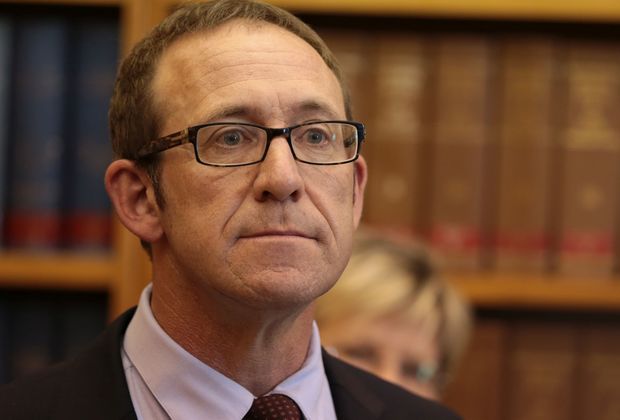
"We Nailed It!" New Zealand's representative to the United Nations, Jim McClay, takes a moment as his country's election to the UN Security Council is announced. Prime Minister Key told reporters that New Zealand got there on the strength of its reputation for being "someone that stands up for what's right". Why then did we, just a few weeks later, refuse to support a resolution condemning neo-Nazism?
NEW ZEALANDERS experienced a justifiable surge of national
pride when their country was elected to the United Nations Security Council.
New Zealand’s UN ambassador (and former Deputy Prime Minister) Jim McClay
buried his face in his hands with heartfelt relief. Our foreign minister,
Murray McCully, exclaimed “We nailed it!”
Speaking outside his Parnell residence, a clearly delighted Prime
Minister told reporters that: “It’s a very good result. There’s a lot of
responsibility over the next two years. I think it will be quite a challenging
time to be on the Security Council. There are some very big issues – as we see
in the Middle East at the moment – and it will be a demanding time for New
Zealand.
Commenting on the outstanding success of the Ministry of
Foreign Affairs and Trade’s six-year-long campaign, Mr Key observed: “We put on
display the credentials of New Zealand. Which is seen as an honest broker.
Someone who stands up for what’s right.”
That’s certainly how most Kiwis regard their country. From
the very beginnings of the United Nations, New Zealand has stood up for the
rights of smaller countries. We made ourselves their champion in the
unsuccessful fight to locate the international organisation’s ultimate
authority in the General Assembly.
In the aftermath of the most destructive war in human
history, New Zealand’s Prime Minister, Peter Fraser, argued passionately (but
unavailingly) against vesting veto power in the five permanent members of the
UN Security Council. He had more success in ensuring that economic and social
rights were included alongside civil and political rights in the UN’s Universal
Declaration of Human Rights.
Why then did New Zealand, the “honest broker”; the country which
always “stands up for what’s right”; fail to support a resolution sponsored by
the Russian Federation condemning the “glorification of Nazism” and declaring
the “inadmissibility of certain practices that contribute to fuelling
contemporary forms of racism, racial discrimination, xenophobia and related
intolerance”?
If ever there was a “no brainer” for New Zealand diplomacy –
this was it. Who on earth, apart from the extremist political hoodlums it identifies,
could fail to support such a resolution?
Well, apparently, we could. When the Russian Federation’s
resolution was put to the General Assembly’s Social, Humanitarian and Cultural
Affairs Committee on 26 November 2014, New Zealand, along with 56 other UN
members, abstained. Included among the abstainers were every member of the
European Union (EU). Not even Germany, Nazism’s birthplace and the nation state
responsible for the most horrific manifestations of race hatred in human
history, was prepared to join the 120 other UN members who voted in favour of
the resolution.
Only three UN members could be found among neither the
supporters nor the abstainers. Canada, Ukraine and the United States of America
had voted against the resolution.
Why? What could possibly persuade the democratic nations of
Europe, North America and Australasia to refrain from declaring their alarm at
“the spread in many parts of the world of various extremist political parties,
movements and groups, including neo-Nazis and skinhead groups, as well as
similar extremist ideological movements”? Or, for that matter, from expressing
deep concern at “all recent manifestations of violence and terrorism incited by
violent nationalism, racism, xenophobia and related intolerance”?

Beating The Tin Drum: Members of the Patriot of the Ukraine party marching to the beat of a neo-Nazi revival in Eastern Europe that New Zealand refuses to condemn.
The answer, of course, is to be found in the well-documented
involvement of the US State Department and the governments of the EU in the
February 2014 overthrow, by armed neo-Nazi demonstrators, of the
democratically-elected government of Ukraine. That both the USA and the EU were
prepared to recognise, for the first time since World War II, a European
government which included openly fascist and neo-Nazi politicians, rendered
support for the Russian Federation’s resolution diplomatically implausible.
Accordingly, the Western democracies argued strongly that
supporting the Russian Federation’s resolution would be tantamount to endorsing
the latter’s annexation of Crimea, and ignoring its ongoing military and
economic support for the breakaway Russian-speaking provinces of Eastern
Ukraine.
Utter foolishness.
President Vladimir Putin’s Russia is prey to the very same
fascistic and neo-Nazi forces that its UN anti-racist resolution condemns. The uncomplicated
endorsement of its content would, therefore, have allowed the democratic
countries to serve notice on both the Russian Federation and Ukraine that violent
racist xenophobia remains totally unacceptable to the United Nations’
membership.
Sadly, the United States refused to tolerate even implied
criticism of its hard-won Ukrainian protectorate. Canada cravenly concurred. And
the EU, rather than alienate the Americans, abstained.
As an “honest broker” who “always stands up for what’s
right”, New Zealand was gifted an early opportunity to show the 145 UN members
who voted for her that their support had not been misplaced. Reminding the
world of Nazism’s 20 million Russian victims, and reconfirming its unalterably
evil nature would, surely, have done more for international understanding – and
our reputation – than sitting on our hands?
This essay was
originally published by The Press of Tuesday,
16 December 2014.