|
| Excitement And Pride: The reason why normally kind and respectful people are capable of such appalling violence, the single factor that explains every pogrom, every lynching, in history: the absence of consequences. The knowledge that if you do terrible things, then nothing will happen to you. The realisation that those in authority do not care if you do them. Hell, they want you to do them! |
WHEN THE SETTLERS from Har-Bracha approached the security checkpoint the Israeli Defence Force soldiers waved them through. That wasn’t supposed to happen. Not when the West Bank of the Jordan was a bubbling cauldron of hate and violence. The idea of allowing Israelis from the Jewish settlements to enter Palestinian territory should have been as unthinkable as allowing Palestinians to pass in the opposite direction. But, the soldiers – like everybody else in Israel – knew that, only the day before, two brothers from Har-Bracha had been killed by a Palestinian gunman. It was payback time. Ignoring their orders, knowing full well what was likely to happen, the soldiers opened the gates and let the settlers pass. Within the hour, the nearby Palestinian village of Zaatara was ablaze.
The forces of law and order do not exist in a social vacuum. They are members of their communities, citizens of their nation, and just as likely to get caught up in the ebb and flow of public emotion as everybody else. They’re not supposed to. In theory, they are expected to remain aloof from the tidal tug of popular passions: impartial upholders of the law; keepers of the peace.
In theory.
When the white police officers and/or sheriff’s deputies whose presence in the rigorously segregated black communities of the Jim Crow South suddenly disappeared from the streets, everybody knew that trouble was on the way. The unheralded withdrawal of these racially charged armies of occupation could only mean one thing. That, for the next few hours, law and order would take a terrifying leave of absence.
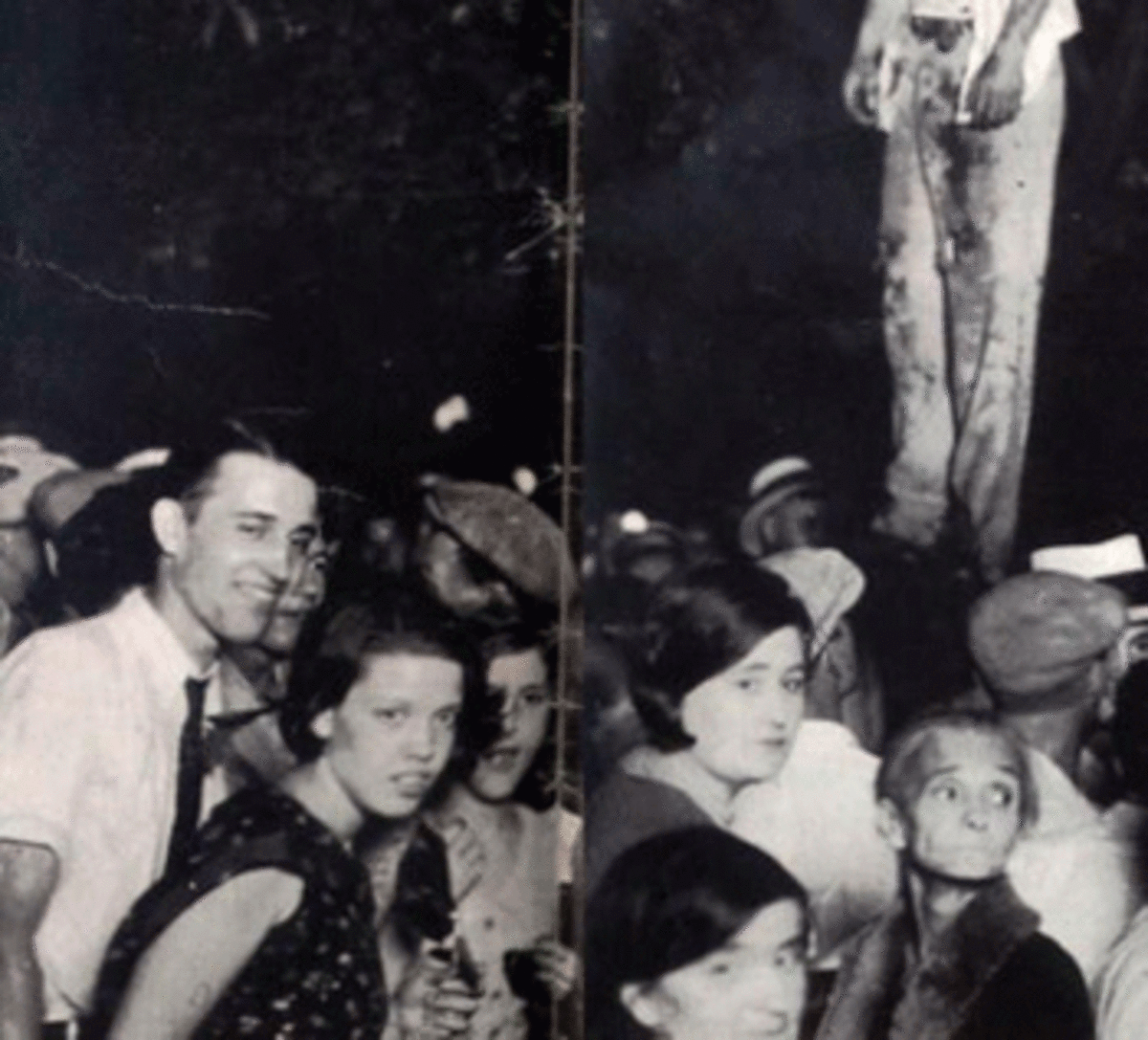
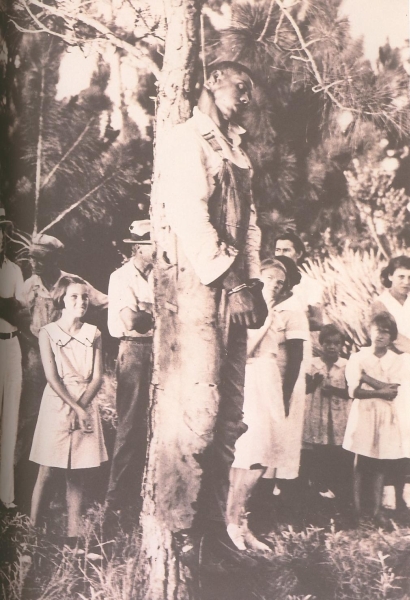
The photographic images that have come down to us from this America of a century ago are hard to look at. Not only on account of the “strange fruit” hanging from the poplar trees on the outskirts of town. More difficult to stomach, or even to comprehend, than the charred bodies are the lynch-mobs that gathered to witness and celebrate the victims’ agonising demise.
Men and women, resplendent in their boater hats and summer frocks, look directly at the camera, their faces alive with a chilling mixture of excitement and pride. There is no shame here, no guilt. Would they have brought their children with them to observe the spectacle if they believed they were doing wrong? They wanted their kids to understand that this was something that simply had to be done every once and a while – to keep the community safe.
The local newspapers would recount these lynchings in enthusiastic prose. The dastardly deeds that sparked the community’s righteous anger. The apprehension of the perpetrator by the aroused populace, and his inevitable demise. The grim warning left hanging where those most in need of its terrifying message could not fail to receive it.
Such blatant abrogations of the rule of law – be they in the Deep South of a century ago, last month on the West Bank of the River Jordan, or last weekend in Auckland’s Albert Park – are able to occur for one reason, and one reason only, because those participating in them do so in the confident belief that they are doing “the right thing”. Because the government, the news media, and even the forces of law and order have all conspired – wittingly or unwittingly – to convey the impression that the extra-legal enforcement of “the right thing” will incur no penalty.
Eye witness accounts of the attack upon Kellie-Jay Keen-Minshull in Albert Park describe how the frenzy of the protesters suddenly increased when they realised that the Police were not going to interfere in their righteous punishment of the “Nazi-adjacent”, “anti-trans activist”.
And that’s the reason why normally kind and respectful people are capable of such appalling violence, the single factor that explains every pogrom, every lynching, in history: the absence of consequences. The knowledge that if you do these terrible things, then nothing will happen to you. The realisation that those in authority do not care if you do them. Hell, they want you to do them!
Considering that when the mob came, proudly bearing their threatening banners and placards, and the Police stood by and did nothing – not even when elderly people were being punched, kicked, thrown to the ground and begging the Police to assist them – it is a small miracle that “Posie Parker” escaped with her life.
This essay was originally published in The Otago Daily Times and The Greymouth Star of Friday, 31 March 2023.