Friday, 27 September 2013

"Predistribution": A Suitable Socialist Synonym?

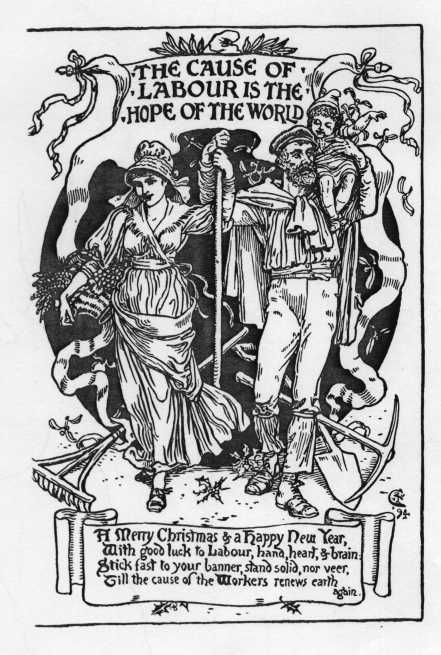
No Need For Synonyms in 1894! This Socialist "Christmas Card", by Walter Crane, hails from a time when "the cause of labour" could be openly and proudly proclaimed. For most of the twentieth century, however, left-wing activists (especially in the USA) were required to devise "suitable synonyms for Marxist terms". Even today, those advocating the cause of Labour are forced to reach for synonyms like "predistribution" to prevent the Right's horses from taking fright.
 
IT’S NOT EASY BEING A SOCIALIST in the United States of America.
 
Long ago: back in the days when I was still impressionable enough to remember such things; I watched a documentary film about the “New Left” in America. “The trick, in this country,” remarked one of the young radicals interviewed, with an engagingly conspiratorial wink, “is coming up with suitable synonyms for Marxist terms.”
 
The young Marxist theorists who penned the first clear declaration of New Left principles – “The Port Huron Statement” – accordingly softened the scary Marxist notion of “the dictatorship of the proletariat” into the much less daunting concept of “participatory democracy”.
 
Seizing control of the means of production, distribution and exchange became the much more acceptable “struggle for economic democracy”, or, as the authors of the Port Huron Statement put it back in 1962: “the economy itself is of such social importance that its major resources and means of production should be open to democratic participation and subject to democratic social regulation”.
 
If attaching the most cherished word in the American political lexicon to left-wing political ideas secured them a hearing from ordinary American workers, then American socialists were only too happy to oblige.
 
I was reminded of this long ago search for non-inflammatory left-wing phraseology only a few days ago. The memory trigger was a newspaper article which claimed that Labour’s new leader, David Cunliffe, was a believer in “predistribution”.
 
How I laughed. Even before researching the term, it was clear to me that in “predistribution” I was dealing with a classic example of a suitable socialist synonym.
 
Coined by the Yale University economist Jacob Hacker in 2011, the term seeks to identify the income that flows into a worker’s hands from sources unconnected to the State. Unlike “redistribution”: the special subsidies, tax advantages and income transfers that flow to the victims of economic and social inequality from the general revenue; “predistribution” identifies the process of reducing entrenched inequalities by increasing the workers’ share of the private sector’s gross profits.
 
Now, how would a Labour leader do that?
 
Well, a New Zealand Labour leader would only have to look back over the course of this country’s history to find the answer.
 
The Liberal Government of John Balance “predistributed” workers’ incomes by handing over the determination of their wages to a special “arbitration” court made up of three arbitrators, representing workers, their employers, and the state.
 
The workers’ representative on the Arbitration Court was, of course, chosen by the New Zealand trade union movement. Indeed, without a strong trade union movement to exact an increased share of the private sector’s profits for its members, “predistribution” has little chance of long-term success.
 
The First Labour Government understood this very well, which is why within a year of winning power in 1935 it had legislated for universal union membership and facilitated the formation of New Zealand’s first effective trade union peak organisation, the Federation of Labour.
 
A Labour leader could, of course, try to “predistribute” without a large and effective trade union movement. This could be done by lifting the minimum wage to $15 per hour and/or legislating for the payment of a “living wage” to particularly poorly-paid categories of workers.
 
From the perspective of a Labour Government, however, it would make much more sense to facilitate the design of a brand new institutional framework for twenty-first century collective bargaining.  Achieved by means of a comprehensive, bottom-up exercise in democratic consultation, these new institutions would become the primary instruments for “predistributing” the national income.
 
Only a trade union movement that had emerged from such an all-encompassing and demonstrably democratic process could legitimately claim the right to play such a vital role in the nation’s economic life. And only while it spoke in the indisputable accents of ordinary working New Zealanders could it hope to survive Labour’s periodic electoral rebuffs.
 
Assuming, of course, that such a massive exercise in “participatory democracy” hadn’t already removed the need for socialist synonyms altogether.
 
This essay was originally published in The Dominion Post, The Waikato Times, The Taranaki Daily News, The Timaru Herald, The Otago Daily Times and The Greymouth Star of Friday, 27 September 2013.

Tuesday, 24 September 2013

Moving The Centre

Centre Of Attention: In Stanley Kubrick's science-fiction masterpiece, 2001: A Space Odyssey, the mysterious black monoliths serve as catalysts for change. Political scientists attribute similar transformational powers to the political centre. In reality, the political centre is a malleable and constantly shifting phenomenon; its allegiances determined by the exogenous political pressures exerted from either side.
THE CENTRE FILLS the politician’s sky like the monoliths in Stanley Kubrick’s 2001: A Space Odyssey. In much the same way as his mysterious black stele are credited with being the prime motivators of human enlightenment and progress, the political centre is deemed to be the fount of all moderation and wisdom. Without it’s decisive intervention, say the pundits, electoral victory is impossible.
 
In reality, the political centre is the most malleable of all electoral clay: capable of being shaped and moulded into practically any shape its sculptors can conceive.
 
The voters who congregate at the extremes of the political spectrum have needs and interests that are clear, permanent and compelling. But the needs and interests of those in the centre are tied inextricably to those of the rich and the poor, and are, consequently, nothing like so constant. Accordingly, those who mass in the centre tend to oscillate wildly between the two extremes: their manic swings to left and right corresponding to the strength of the latter’s economic appeal.
 
Consider the role of the manager. Forty years ago the number of people in managerial positions was relatively small. Then along came the neoliberal revolution and the number of managers in the economy exploded.
 
As New Zealand society was restructured along “free market” lines, those workers lucky enough to keep their jobs were expected to work longer and harder for less. All those new managers were hired to make sure that they did.
 
Like the commissars of Stalin’s Soviet Union, the new managers’ prime mission was to protect and defend the revolution. In fact, their livelihoods depended on its survival.
 
Now, which way do you suppose that new managerial strata voted? For the neoliberal revolution’s friends – or its enemies?
 
The same political dynamic is at work among those who contract for services formerly supplied by the state.
 
By drastically reducing the size of the civil service and contracting out a great many of the services formerly provided in-house, the neoliberals did not, in fact, save a great deal of taxpayers’ money. On the contrary, one American study revealed that the cost of services provided by private contractors was, on average, a third higher than the cost of those same services when supplied by a public provider.
 
But, saving money was never the true objective of those responsible for contracting out public services. Neoliberalism’s purpose was to destroy the ethos of public service altogether and replace it with the ethos of individual enrichment by way of profit-taking.
 
A state that is able to provide its citizens with services that are efficient and cost-effective is a state those same citizens might learn to value and support. Even worse, it might come to be seen as a system worth extending into areas of the economy still dominated by the quest for private gain.
 
The whole point of neoliberalism was – and is – to prevent that from happening.
 
Like the new breed of managers, thousands of new contractors found their own futures and the future of the neoliberal revolution inextricably intertwined.
 
They, too, know on which side their ballot papers are buttered.
 
Now consider what might happen to the people in the centre if the neoliberal revolution was overthrown.
 
Imagine a political party which promised to reduce expenditure on taxpayer funded services by 33 percent – by taking the provision of those services back in-house.
 
Imagine a government which, instead of following economic policies that led to the sacking of thousands of low-paid workers, encouraged the creation of a new kind of workplace. One in which the skills and creativity of the whole workforce was brought to the task of lifting productivity. Such workplaces would have little further need for managers of the neoliberal variety.
 
Managers’ socially useful skills would not, however, go to waste if a reforming government invited them to become an integral part of the social entrepreneurialism it was pledged to unleash.
 
All across New Zealand (and in Christchurch particularly) there is a huge amount of work to be done repairing damaged lives and damaged communities.
 
In her valedictory speech to Parliament, Lianne Dalziel talked about building a “resilient society”. That is a construction job to which the skills of these former managers could readily be applied. Deploying taxpayer resources to foster not dependence but resilience is a public enterprise to which most New Zealanders will gladly contribute.
 
The political centre currently cleaves to the right because the neoliberal order, so ruthlessly imposed over the last 30 years, makes it worth their while to do so.
 
All that is required to shift their allegiance is the effective presentation of a social and economic manifesto that makes it worth their while to do something else.
 
Kubrick’s monoliths were significant not for what they made us do, but for the possibilities they allowed us to see.
 
This essay was originally published in The Press of Tuesday, 24 September 2013.

Friday, 20 September 2013

A Red Wedding?

An Important Reconnection: The Labour Party rank-and-file have elected themselves a leader determined to reacquaint the Party not only with the broader labour movement, but also with the progressive yearnings of a battered New Zealand electorate.

IT WAS ONE of the most shocking episodes in television history. Those who had not read George R.R. Martin’s Game of Thrones watched with rising horror as a large percentage of the television series’ most sympathetic characters were brutally butchered before their disbelieving eyes. Not for nothing was House Frey’s massacre of Robb and Catelyn Stark, Robb’s pregnant wife, and 3,500 of House Stark’s loyal bannermen dubbed “The Red Wedding”.
 
Nor was Martin forced to rely solely upon his (excessively?) bloodthirsty imagination when writing this memorable scene. History furnishes many grim precedents for the all-encompassing massacre of political rivals.
 
Nearly 1,600 years ago the Anglo-Saxon chieftains Hengist and Horsa invited Vortigen and his Romano-British supporters to a great feast to celebrate the pact of peace which their two warring armies had just concluded. But, unbeknown to their guests, the Saxons had concealed daggers in the soles of their boots, and at the cry “nima der sexa!” – “bring out the knives” – Hengist’s and Horsa’s men fell upon their 300 weaponless guests and slew them.
 
This terrible betrayal of the ancient laws of hospitality was remembered as “The Night of the Long Knives” – a name which, 1,500 years later, was joined to the equally bloody purge of Adolf Hitler’s political rivals on the night of 30 June 1934.
 
Inevitably, there will be some who reach for the “Red Wedding” or “Night of the Long Knives” metaphors to describe the (readily predictable) demotion of a handful of the newly-elected Labour Leader, David Cunliffe’s, bitterest caucus opponents.
 
In the five days since his decisive first-ballot win on Sunday, four of Mr Cunliffe’s most formidable adversaries: Trevor Mallard, Chris Hipkins, Darien Fenton, and his principal rival for the leadership, Grant Robertson, have lost their jobs.
 
Not so many casualties really – and none of them the least bit surprising. Into each change of leadership a little blood must fall.
 
The real Red Wedding occasioned by Mr Cunliffe’s triumph has been the restatement of the marriage vows binding Labour’s parliamentary contingent to the wider party organisation. The two had been growing apart for years – to the point where following last year’s annual conference a divorce seemed imminent. What rescued the partnership? The party’s rule changes.
 
In the past, the newly-elected MP’s primary political focus had been the relationship he or she enjoyed (or endured) with his or her caucus colleagues. These were, after all, the people who could push an ambitious MP up the greasy poll of politics – or keep him down. But now, thanks to the new rules, Labour MPs not only need to remain on good terms with their caucus colleagues, but they also need to further the policy objectives of the party’s rank-and-file and address the needs of its affiliated trade union members.
 
This reaffirmation of the bonds between the party and its MPs may yet prompt a larger and much more important reconnection.
 
For most of its history New Zealand has been defined by the achievements of two great progressive political parties: the Liberals and Labour. The century-long quest for security and equality which they began so enthralled the New Zealand electorate that not even the Liberals’ or Labour’s political opponents dared to step outside, or challenge, the overarching social consensus they had fashioned.
 
Certainly, only Labour enjoyed the popular trust and confidence required to establish a regime whose steady elaboration would not only shatter that consensus but open up a vast gulf between the labour movement and New Zealanders’ progressive instincts.
 
What’s more, the fourth Labour Government’s embrace of neoliberal economics freed the Right of New Zealand politics from the constraints of a consensus which had drawn its teeth and blunted its claws.
 
One of the principal enablers of Labour’s treachery was the parliamentary caucus’s essential autonomy from the party and, by extension, the people the party was founded to represent. With no need to heed the will of the party, the personally and politically ambitious were able to go on exploiting Labour’s key institutional weakness.
 
Not any more. The Labour Party’s recent constitutional reforms allow the rank-and-file membership to put a collar on caucus-centred ambition. And now they’ve elected themselves a leader determined to reacquaint the Party not only with the broader labour movement, but also with the progressive yearnings of a battered New Zealand electorate.
 
A very “red” wedding indeed.
 
This essay was originally published in The Waikato Times, The Taranaki Daily News, The Timaru Herald, The Otago Daily Times and The Greymouth Star of Friday, 20 September 2013.

Wednesday, 18 September 2013

Letting The Bad Do Good In Syria

Russia Eclipses America: Sergey Lavrov, the Russian Foreign Minister, seized the initiative over Syria by turning a throwaway comment from the American Secretary of State, John Kerry, into a plan to forestall an American strike against the Assad regime and open the way for peace negotiations.
 
ONE OF THE GREAT QUESTIONS in life is: why do bad things happen to good people? A few days ago the TV news carried a story of an frail Syrian grandfather who had lost his entire family in a bombing raid. The news crew found him sitting outside the ruins of his village.
 
“They are all gone, and I am left behind”, he lamented. “Why did God spare me and not them?”
 
An equally perplexing question, in the light of even more recent developments in the Syrian civil war, is: can good things come from bad people?
 
The Russian Federation, presided over by the autocratic Vladimir Putin, is a dark and menacing state in which persistent critics find themselves imprisoned on trumped-up charges, and effective critics are found murdered in the street.
 
And yet, this vast kleptocracy, with its protective screen of political praetorians, is currently the only permanent member of the United Nations Security Council in possession of a viable plan for preventing a military escalation in Syria. It is even possible that Russia’s plan to collect and destroy President Bashar al Assad’s chemical weapons stockpile could end up establishing the conditions for a negotiated peace.
 
The Russian plan – to which Syria swiftly assented – set the diplomatic machinery in motion at top speed. It also fell like a life-belt over the flailing hands of President Barack Obama, facing imminent defeat and humiliation at the hands of his own legislators.
 
The plan itself was inspired by a throwaway suggestion, elicited by a British journalist’s question addressed to the US Secretary of State, John Kerry, and dismissed by him as impossible in almost the same breath.
 
Asked what Assad could do to avert a military strike, Kerry responded that he could “turn over every single bit of his chemical weapons to the international community in the next week. Turn it over. All of it. Without delay, and allow a full and total accounting before that, but he isn't about to do it and it can’t be done.”
 
The Russian Foreign Minister, Sergey Lavrov, thought differently. With his Syrian counterpart fortuitously in the Russian capital, negotiations were instantaneous and intense. It did not take long for both men to agree that Kerry’s throwaway suggestion offered the framework for a consensus resolution on Syria which all five veto-weilding members of the UN Security Council could sign.
 
Cynical? Opportunistic? Yes, Lavrov’s move was all of those. And yet, without the Russians’ determination to pick up and run with Kerry’s suggestion, the Syrian situation would have remained intractable and the likelihood of an American attack would have grown.
 
Lavrov’s diplomatic flexibility, his capacity to seize upon Kerry’s words and fashion a new and workable alternative to a punishing American attack, owes a great deal to the authoritarian character of the Russian state.
 
The pluralistic nature of American politics; the rigid separation of powers enforced by the US Constitution; the multiple and effective opportunities for democratic engagement available to American citizens: all these contribute to the slow pace US diplomacy.
 
Sergey Lavrov, unlike John Kerry, has only to convince one man before proceeding. The same is true of Syria’s foreign minister. Kerry’s master, however, has many hoops to jump through before shouting: “Go!” Autocracies may be cruel and rapacious, but they can also be extremely efficient.
 
And therein lies history’s terrible irony. The United States of America, the world’s richest and most powerful state, also claims the role of the world’s sole moral arbiter. The American people are encouraged to view their great republic as “the indispensable nation”. To the Americans, and the Americans alone, belongs the responsibility of dividing the world’s nations into the good, the bad and the ugly. When America goes to war it is “to make the world safe for democracy” (Woodrow Wilson) or in defence of “the free world” (Harry Truman).
 
And yet, wherever the beneficent and liberating figure of Uncle Sam has set down his giant combat boots – Vietnam, Iraq – all that he has wrought is greater destruction and more misery. Even America’s “good war”, World War II, was marred by its atomic conclusion.
 
And, of course, the war against the Nazis was won not by that great democrat, Franklin Delano Roosevelt, but by the murderous Joseph Stalin. Evil overcame evil on the killing fields of Russia and Eastern Europe: Good had a supporting role – at best.
 
Winston Churchill grasped this irony: of evil doing good in spite of itself; as only an aristocratic conservative could. “If Hitler invaded Hell,” he quipped to one of his colleagues, “I would at least make a favourable reference to the Devil in the House of Commons.”
 
So, let’s wish Mr Lavrov and his master every success. If the Devil is determined to bring peace to Syria, why would God stand in his way?
 
This essay was originally published in The Press of Tuesday, 17 September 2013.

Monday, 16 September 2013

The World Turned Upside Down - Billy Bragg


SO FEW REMEMBER that the English, too, went through a revolution.

In this great number, Billy Bragg recalls the revolutionary group known as "The Diggers"  - read more about them here.

"You poor take courage, you rich take care"
 
The Digger's cause was but a logical progression from the ideas of the radically democratic "Levellers".

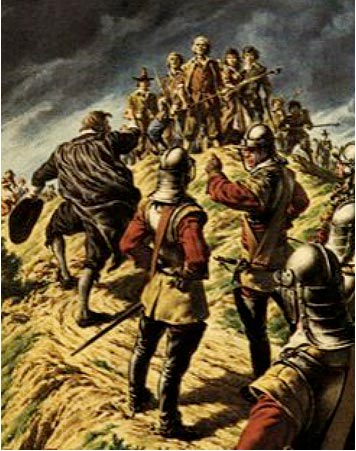
Their case was made with most force during the so-called "Putney Debates" - where the men of Cromwell's New Model Army debated the shape of England's new government and the rights of the people upon whose backs it would ultimately rest.

Responding to Oliver Cromwell's and Henry Ireton's argument that only those with a "fixed permanent interest" in the country - i.e. only property owners - should have the right to govern it, Colonel Thomas Rainsborough replied with what is generally held to be the first shot in the long battle for universal suffrage and equal civil rights:

For really I think that the poorest hee that is in England hath a life to live, as the greatest hee; and therefore truly, Sr, I think itt clear, that every Man that is to live under a Government ought first by his own Consent to put himself under that Government; and I do think that the poorest man in England is not at all bound in a strict sense to that Government that he hath not had a voice to put Himself under.

As revolutionary a statement now as it was then - especially when the people take seriously the proposition that they "hath a life to live".

This posting is exclusive to the Bowalley Road blogsite.

Sunday, 15 September 2013

Cunliffe Wins Labour Leadership

Winner, by a knock-out blow in the First Round, David Cunliffe! (Photo: Greg Presland)
 
A GREAT DAY for David Cunliffe, the Labour Party and the New Zealand working-class.

Whoso beset him round
With dismal stories,
Do but themselves confound;
His strength the more is.
No lion can him affright,
He'll with a giant fight,
But he will have the right
To be a pilgrim.
 
John Bunyan 1684

Now, let's get rid of this National-led Government!

This posting is exclusive to the Bowalley Road blogsite.

Friday, 13 September 2013

House Rules?

The Unacceptable Face Of Labour? The right-wing members of Labour’s Caucus who have set their faces against a turn to the left will not be swayed by the wishes of the party’s rank-and-file, or the votes of its trade union affiliates. They will vote with only one intent: to prevent David Cunliffe becoming Labour’s leader.
 
IF IT’S ANYONE BUT CUNLIFFE what will happen to the Labour Party? It’s a question many Labour members will be asking themselves as the hours between wondering and knowing dwindle.
 
What began with a dizzying head-rush of hope and enthusiasm is ending in doubt and worry.
 
At the heart of the membership’s concern is the likely behaviour of the Labour caucus. Many will be wondering why, when the new rules were being drafted, so much influence (40 percent) was reposed in Labour’s parliamentary delegation. Especially when the British Labour Party gives its MPs only one third of the say in who becomes leader.
 
As the contest has progressed, the simple mathematics of the voting system has driven home the alarming fact that each MP, in their own right, wields a vote worth 1.2 percent. Just 34 individuals, out of a party membership of around 8,000 ordinary members, will account for 40 percent of the outcome.
 
In the first flush of their democratic revolution, the rank-and-file of the Labour Party rather naively anticipated “their” MPs being guided by a mixture of the party’s will and the sentiment of the much larger group of New Zealanders who, while not holding membership cards, nevertheless vote for the Labour Party in election after election.
 
These are, after all, the people who put the Labour MPs where they are. Why wouldn’t Labour’s caucus pay heed to their wishes?
 
It’s a very good question. But, then, another very good question was: “Why didn’t the Labour caucus heed the wishes of the party membership in 2011? Why were they willing to squander 20 precious months on a man who, while possessing many impressive qualities, was demonstrably unsuited to the role of Labour leader?
 
The answer, of course, is because, for a variety of reasons, a majority of the Labour caucus was unwilling to see David Cunliffe assume the leadership of the Labour Party.
 
Mr Cunliffe’s enemies have gone to extraordinary lengths to persuade the news media that their adamant opposition is grounded in the man’s personal shortcomings. This is not the case. The vicious attacks launched against Mr Cunliffe by his ostensible “colleagues” are driven by the oldest of political motives.
 
These include the narrow political interests of those who have identified Mr Cunliffe as either a threat to their present position within the Labour caucus, or as a barrier to their further personal advancement. Indeed, the more obvious it becomes that Mr Cunliffe really is the choice of the party rank-and-file, and of Labour voters generally, the bigger threat and barrier he looms.
 
There is also a broader apprehension among Mr Cunliffe’s enemies that he (and the party organisation) will require the Opposition to adopt a more unequivocally social-democratic ideological stance. But, such a position has already been condemned by Mr Cunliffe’s critics as “naïve and stupid”. This is because a surprisingly large number of Labour’s Caucus no longer believe in social democracy (let alone the “democratic socialism” enshrined in their party’s constitution). To them, Labour is simply the party which replaces National. They want no part of a labour movement that sees itself as a direct and progressive challenge to the ambitions of the Right.
 
The right-wing members of Labour’s Caucus who think this way will not be swayed by the wishes of the party’s rank-and-file, or the votes of its trade union affiliates. They will vote with only one intent: to prevent David Cunliffe becoming Labour’s leader.
 
And, if enough of them think like this – they’ll succeed.
 
Should that be the outcome, the scale of disappointment and disillusionment within the Labour Party’s ranks will be unprecedented. Many will do their best to accept another Cunliffe defeat with a brave and loyal face. Others will simply turn away in disgust. A few will defect to the Greens – or even Mana.
 
But, for most, it will be taken as proof that participating in politics is no different from participating in casino gambling: the House always wins.
 
This essay was originally published in The Dominion Post, The Waikato Times, The Taranaki Daily News, The Timaru Herald, The Otago Daily Times and The Greymouth Star of Friday, 13 September 2013.