
Showing posts with label Ashley Bloomfield. Show all posts

Friday, 25 September 2020

True Believers In A False God.

Down The Rabbit Hole: "Social psychologists have found that when fearful people contemplate potential misfortunes, they tend to feel helpless and pessimistic, but when angry people contemplate the same, they feel a sense of optimism and control. And one simple way to transmute fear into anger is to perceive an evil agent behind whatever development is causing you uncertainty and disquiet." - Eric Levitz.

WHEN ADOLF HITLER committed suicide on 30 April 1945, thousands of Germans followed his example. The most famous copy-cats were Joseph Goebbels and his wife, Magda. Not only did they take their own lives, but also those of their six children. The idea of surviving the Fuhrer, being held accountable for everything he, and they, had done, seeing National Socialism overthrown and accepting the inevitable ruin of everything they had hoped for and fought for, was simply too overwhelming for many fanatical Nazis to contemplate.

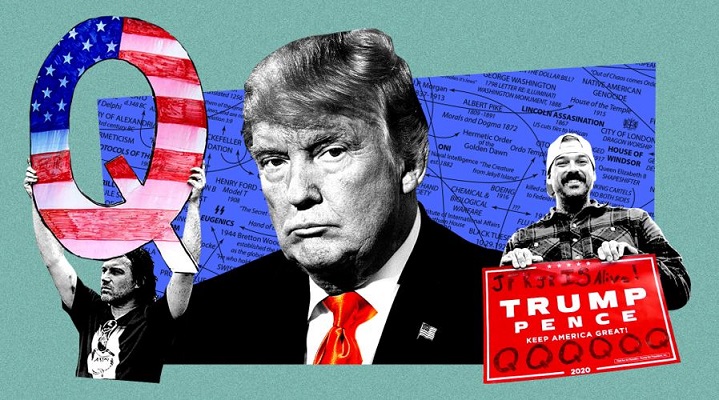
Good riddance! Well, yes, that’s one response. But just consider the following excerpt from US writer, Eric Levitz’s “QAnon Is Madness: But Believing It Can Be Rational” article posted on The Intelligencer website of 23/9/20:

“Speaking with voters in Wisconsin this month, Time reporter Charlotte Alter heard conspiracy theories from about 20 percent of her interview subjects. Many of these Wisconsinites were not familiar with QAnon but subscribed to its basic tenets. Tina Arthur, a small-business owner, told Alter that she was not a follower of QAnon but did believe that the Democrats were in league with a cabal of blood-drinking child rapists and that ‘if Biden wins, the world is over, basically … I would probably take my children and sit in the garage and turn my car on, and it would be over.’”

What the hell is going on, when a businesswoman from the Mid-Western United States is willing to wipe out her entire family rather than face the prospect of living under a Democratic President? Because, when all is said and done, “Sleepy Joe” Biden is a very far cry from Joseph Stalin, and even the most strident antifa protester is nowhere near as dangerous as the vengeance-seeking soldiers of the Red Army. How did as many as 20 percent of Americans end up tumbling down this dangerously hallucinatory rabbit-hole?

According to Levitz, conspiracy theories have much more to offer confused and frightened citizens than may, at first glance, be apparent:

“The tendency toward conspiracism is deeply rooted in the human psyche. It manifests across time and geography and is likely a product of evolutionary pressures. On an emotional level, human beings tend to find the idea of being threatened by forces beyond their comprehension or control much more upsetting than being threatened by an intelligible enemy. Social psychologists have found that when fearful people contemplate potential misfortunes, they tend to feel helpless and pessimistic, but when angry people contemplate the same, they feel a sense of optimism and control. And one simple way to transmute fear into anger is to perceive an evil agent behind whatever development is causing you uncertainty and disquiet.”

With this in mind, we begin to appreciate the powerful psychological insight behind the New Zealand Government’s “Unite Against Covid-19!” campaign. By personifying the virus, transforming it into an “evil agent” which New Zealanders could defeat collectively, the Government and the Ministry of Health headed-off the sort of QAnon craziness that has turned so many fearful Americans into gibbering paranoiacs.

The other key factor in this country’s success in preventing the widespread uptake of insane conspiracy theories was the regular 1:00pm briefings from Prime Minister Jacinda Ardern and Director-General of Health, Dr Ashley Bloomfield. Fear grows exponentially in the absence of timely and reliable information. New Zealand was, therefore, especially fortunate in having the “Jacinda and Ashley Show”. These two particularly gifted and credible communicators were able to deliver on an almost daily basis the answers and reassurance their frightened fellow citizens were so eager to receive. Such anger as was generated out of public fear tended to be directed against those who refused to “unite against the virus”. Not only did this popular enforcement of the Covid-19 Lockdown impede the disease’s spread, but it also served as a useful safety-valve for the tensions occasioned by the extraordinary limitations of individual freedom which the fight against the pandemic necessitated.

The comparison with the United States could hardly be more stark. Rather than the consistent and uplifting communications of Jacinda Ardern, the Americans were exposed to the constantly changing, often contradictory, messages of President Donald Trump. Also a formidable communicator, Trump deployed his talent in ways that fed, rather than calmed, his people’s fears, and fuelled their anger with hyper-politicised bulletins of unprecedented malignancy.

It would be wrong, however, to suggest that New Zealanders have been unanimous in their acceptance of the measures adopted to “stamp out” the virus. Although upwards of three-quarters of the population have registered either their “support” or “strong-support” for the Government’s handling of the Covid-19 crisis, that still leaves a quarter of the population unconvinced.

Some of these were the sort of hyper-individualists so often found in the upper reaches of societies dominated by the ideology of neoliberalism. Such people (most of them men) find the idea of standing in solidarity with the “sheeple” abhorrent. Equally unappealing, from the perspective of these “One Percenters”, is the unhelpful example set by the all-too-obvious success of collective intervention. Well-positioned to communicate their opposition, these Covid sceptics have been unceasing in their efforts to undermine the Government’s solidaristic appeals to “The Team of Five Million”.

The other pool of scepticism and resistance is fed by the fear and ignorance of New Zealand’s least educated and most marginalised citizens. With little cause to trust a state which bitter experience has taught them to regard as an alien and hostile entity, these folk remained largely untouched by the Government’s campaign against Covid-19. In terms of social-psychology, they are precisely the people who feel “threatened by forces beyond their comprehension or control”. Looking for “an intelligible enemy” to blame for their shitty world becoming even shittier, they have every reason to believe, and insufficient intellectual resources to refute, the conspiracy theories fed to them by the algorithms of social media and the political predators who so adroitly exploit them.

Once inside the rabbit holes of the conspiracists; once supplied with the identity of the “evil agents” against whom their now inflamed emotions can be directed; once filled with the optimism and sense of control that makes being angry in the company of like minds so much more bearable than being alone and frightened; once the hallucinations have become more compelling than reality; what then is the incentive to stop seeing things that aren’t there? Better by far to expand the rabbit hole until in encompasses the whole world.

And if reality reasserts itself: either in the form of the Fuhrer’s death and the Red Army’s victory; or in the person of President Biden and a Democratic Party-controlled Congress; then what is the point of going on? Better to grab the kids, administer the poison, and avoid shouldering the unbearable heaviness of being exposed as a true believer in a false god.


This essay was originally posted on The Daily Blog of Friday, 25 September 2020.

Tuesday, 1 September 2020

What Just Didn't Happen?

The New Old Triumvirate: Jacinda Ardern, back in 2017, confers with her longest-standing political allies, Grant Robertson and Chris Hipkins.


WHAT JUST HAPPENED? Over the course of the past 72 hours something changed. Exactly what isn’t clear, not yet, but something has. New Zealanders feel it in their bones, in their hearts, and they’re scared.

 When it’s impossible to know what has happened, the next best thing is to try and establish what hasn’t happened.

 Accordingly, I would like the Director-General of Health’s, Ashley Bloomfield’s, reassurance that the ridiculous – not to say dangerous – Covid-19 Alert, which more-or-less ordered every person living in South and West Auckland to be tested for the virus, was NOT a deliberate attempt to destabilise the New Zealand Government’s management of the pandemic.

 Because, what civil servant in their right mind would send out such a message without the formal, traceable, approval of those at the very summit of the civil service hierarchy? More to the point, what sort of senior public servant could fail to appreciate the sheer absurdity of the order and its potential for inducing something close to panic amongst the population of South and West Auckland?

 Occam’s Razor allows of only two reasonable explanations. 1) That the action was deliberate and its consequences foreseen. 2) That the calibre of the staff responsible for its release was so abysmal that the notice’s glaring deficiencies passed unnoticed. Neither explanation offers us much comfort. The first admits to sabotage. The second to utter incompetence. The question to be decided, therefore, is whether we are looking at a conspiracy or a cock-up?

 What motive would the individuals responsible for that errant notice have for sabotaging the Government’s orderly transition from Level 3 to Level 2.5?

 The most obvious answer lies in the all-too-evident trepidation among scientists, civil servants, and members of the general public, that the move out of Level 3 might be premature – dangerous even. Those holding this view have argued that the “perimeter” of the South Auckland Cluster had yet to be conclusively established. The alarming possibility therefore arises that the offending notice may have been issued as a form of institutional protest against what a faction within the All-of-Government Committee (AOGC)  responsible for managing the pandemic considered a reckless government decision? A decision driven not by the science, but by political and commercial interests no longer willing to be guided by expert opinion.

 Please Dr Bloomfield (wherever you are!) please tell me this is NOT what happened. Because if I’m right, and the release of that notice wasn’t simply another demonstration of massive institutional incompetence (to set alongside the many others) then public trust and confidence in the Government’s handling of the Covid-19 Pandemic, already visibly shaken, will crumble and collapse.

 Moreover (as if the above speculation isn’t wild enough) there’s the additional concern that extreme events, like the publication of that Covid-19 Alert, seldom happen in isolation.

 And that is why I would like the reassurance of the Prime Minister that she has NOT – at the insistence of the Finance Minister and the Health Minister – abandoned her hitherto rock-solid determination to put the welfare of the New Zealand people ahead of the profits of New Zealand businesses. Please, someone – anyone – tell me, tell the nation, that this is NOT what happened.

 While they’re at it, they could also tell us why it was that Chris Hipkins, interviewed on Magic Talk Radio just a couple of hours ahead of Jacinda’s appearance in the Beehive Theatrette at 1:00pm on Sunday, 30 August, insisted that the government would be “ploughing-on” with the transition from Level 3 to Level 2.5?

 The Health Minister confirmed at today’s (31/8/20) 1:00pm Covid Update that he was well aware of the situation relating to the “mistaken” Covid-19 Alert at the time of that Magic Talk interview. So, the question arises: Did Hipkins make the statement about “ploughing-on” to signal to our supposed AOGC rebels that their protest had been in vain?

 More to the point, was it also a very public warning to Jacinda that there could be no stepping back from the plan already agreed upon with her longest-standing and closest political allies – Grant Robertson and Chris Hipkins? Any deviation from the scheduled 11:59pm level-change could hardly fail to be interpreted by the news media as evidence of a serious split in the uppermost reaches of the Coalition Government. Not something a prime minister heading into a general election would be eager to acknowledge!

 The problem with this sort of speculation is where to call a halt. Viewed through my admittedly dramatic political prism, Jacinda’s decision to keep her former health minister, David Clark, in Dunedin – and his job – for a great deal longer than he had any right to expect begins to look like a shrewd method of ensuring the state’s response to the Covid-19 pandemic would be decided by the Prime Minister and her Director-General of Health. (Where is Ashley, BTW, he wasn’t at today’s update?)

 Did the Director-General’s failure to properly implement the Cabinet’s directives relating to border security so weaken his position that Robertson and Hipkins were able to elbow him aside and transform the wildly popular, science-driven, duumvirate of Jacinda and Ashley into a new, much more business-friendly, triumvirate of Grant, Jacinda and Chris?

 And if that is what happened, then what does it say about the government’s new direction of travel? Jacinda’s and Ashley’s decision to “go hard and go early” represented a revolutionary reversal of the usual neoliberal priorities. In effect, they opted to put people first and profits second. The immense and very obvious outpouring of public gratitude and affection that followed the extraordinary success of this strategy made Jacinda effectively invulnerable to attack. Until the saintly duumvirate could, somehow, be destabilised, the furious business community (ably assisted by their right-wing allies in the news media) could only whinge and moan. But then Ashley stumbled, and the business community seized its chance.

 This morning, on RNZ’s Nine-to-Noon political panel, Labour’s pollster, Stephen Mills, wondered aloud why Jacinda – backed in the polls but upwards of 80 percent of her fellow New Zealanders, had apparently chosen to abandon her hugely successful go-hard, go-early “elimination” strategy, in favour of a new strategy of Covid-19 “containment”.

 Please, someone – anyone – confirm for me, and the rest of the 80 percent, that the explanations offered in this post are nothing more than the fever-dreams of an ageing left-wing commentator. Please tell us that the sequences of events outlined above bear absolutely no relation to reality. That there has not been a coup against Jacinda’s “people first” Covid elimination strategy. That the 20 percent haven’t prevailed. Please, please, please, reassure Jacinda’s loyal team of four million that this is NOT what just happened!


This essay was originally posted on The Daily Blog of Tuesday, 1 September 2020.

Friday, 26 June 2020

Sack Him, Jacinda. Sack Him Now!

Are You Still Here? Just like his colleague, Phil Twyford – of KiwiBuild fame – David Clark juts out his chin and shamelessly apportions blame to everybody but himself. Even worse, he has turned viciously on Ashley Bloomfield, the nearest approximation to a competent, decent, humble and accountable public servant that this country possesses.

IF DAVID CLARK hasn’t been sacked by the time you read this, then Jacinda isn’t doing her job. His point-blank refusal to accept responsibility for the multiple institutional failures of his Health portfolio more than justifies Clark’s dismissal.

Ministers of the Crown only have one job: to be responsible. As members of both the legislature and the executive they are a living bridge between citizen and state. A ministerial refusal to accept responsibility for failures occurring on his watch is also a refusal to uphold the essence of our Westminster-style representative democracy. If Jacinda doesn’t get this, then she should be given a swift tutorial by someone who does.

Jacinda needs to get rid of Clark for another, much less high-falutin – but no less politically compelling – reason. He was unforgivably disrespectful of Ashley Bloomfield – and Newshub’s cameraman, Billy Paine, captured Bloomfield’s reaction for the whole world to see.

That should not be a survivable offence.

Week-in, week-out, like Jacinda herself, Ashley has stood behind a lectern in the Beehive Theatrette and kept us not only informed, but also calm. Has he let the ball fall through his hands of late? Yes, he has. But, for Christ’s sake, the guy has been carrying half New Zealand on his shoulders (with Jacinda carrying the other half) for months. That he hasn’t been able to catch every single operational curve-ball, thrown at him by every delinquent player in the New Zealand health system, is forgivable – isn’t it?

If anything is likely to provoke such forgiveness, then it must surely be the callous treatment meted out to him by the guy who thought the Level 4 rules were only there for the “Team of Five Million” to follow. The guy who went mountain-biking during Lockdown. The guy who took himself off to Dunedin instead of insisting that – as the responsible minister – he be allowed to stand at his boss’s side for the duration of the Covid-19 emergency. The guy who owned-up on nationwide television to being “a bit of an idiot”.

That guy doesn’t get to be mean to Ashley Bloomfield – and survive.

Surely, Jacinda, you see that? Surely you’re not guilty (as one outspoken right-wing gentleman suggested to me this morning) of having questioned, in the finest Machiavellian style, whether it might not be advisable, during the heroic phase of the Covid-19 war, to have Clark sequestered in Dunedin; bringing him back to Wellington only when all the inevitable blunders, committed by the exhausted employees of our understaffed and under-resourced health system, started coming to light? I told him firmly that you weren’t that sort of politician. Don’t you dare prove me wrong!

New Zealanders need to be shown, Jacinda, that you genuinely understand how pissed-off they are. It’s not just the sheer, mind-numbing dumbness of the mistakes that the people supposedly in charge have been making that’s got us all yelling at the television. Underneath it all there’s the sneaking suspicion that, once again, we’ve been played for fools. Staying in our bubbles; washing our hands; socially distancing; coughing into our elbows: doing all the things we were told to do; while the people in charge, the people paid more than the prime minister, were fucking everything up.

If you want to remain prime minister, Jacinda, you have to give us some sign that you get all this. Because if you don’t, then we, the voters, might start joining a few dots. You know what I’m talking about. We might just recall the young woman who stood in front of us and asked us to join her in transforming New Zealand through the “politics of kindness”. The young woman of “relentless positivity” and “practical idealism”, who said: “Let’s do this!” – and, God help us, persuaded Winston Peters to give her the chance.

But then what happened, Jacinda? After we had given you our votes, what happened next? Were the promises of transformation fulfilled? Did the people charged with rolling out the changes give us anything that looked even remotely like genuine reform? Or, were the voters forced to endure one disappointment after another? Were the only tangible results produced by the general incompetence of your ministers the derisory snorts and disillusioned sighs from the electors they had let down?

Your government’s consistent failure to deliver might have been forgiven if it had led to a radical shake-up of the entire coalition. If you had gotten tough with Winston and his NZ First colleagues: warning them that if the expectations of the people who voted for the governing parties were not met, then you would simply jump in a government car and make the short trip from the Beehive to Government House. If the numbers aren’t there for real change, Jacinda, then the only right move is to go out and win yourself some new numbers!

Sadly, Jacinda, you haven’t followed that course. Instead, and exactly as happened in relation to the failure of our health services to deliver secure defences against the re-entry of the Covid-19 virus, incompetence and arrogance have gone unpunished. Just like his colleague, Phil Twyford – of KiwiBuild fame – David Clark juts out his chin and shamelessly apportions blame to everybody but himself. Even worse, he has turned viciously on Ashley Bloomfield, the nearest approximation to a competent, decent, humble and accountable public servant that this country possesses.

And still, Jacinda, you do nothing. New Zealand’s self-confessed “idiot” of a Health Minister is still in possession of his warrant.

Why? And for how much longer?

This essay was originally posted on The Daily Blog of Friday, 26 June 2020.

Tuesday, 23 June 2020

Can Labour Still Win?

Time To Get Tough: What Jacinda Ardern needs to project in the wake of all those embarrassing new Covid-19 cases is a no more Ms Niceperson image. She has tried to be kind, and far too many selfish bastards have taken advantage. Now it is time to kick some idiot Kiwi butt – and kick it hard.

THE QUESTION IS, can Labour still win in September? A week or so ago, the answer would have been an unequivocal “Hell yeah!” Indeed, the general consensus about the forthcoming general election was that Labour would not only be re-elected, but would win enough seats to govern alone.

Never has Harold Wilson’s famous quip: “A week is a long time in politics” been more appropriately applied than to the brief space of days during which Jacinda Ardern transitioned from international poster-girl to clay-footed statue. A decidedly wobbly-looking statue!

It all boils down to trust. What’s required to build it. How easily it’s lost. And how much more effort – not to mention plenty of old-fashioned good luck – it takes to get it back. Jacinda, and the whole Labour operation which she, single-handedly, is holding up, faces a gruelling uphill struggle just to get back to where they were. Todd Muller, who had been looking suspiciously like dog-tucker, is now very much in with a chance.

Jacinda’s situation isn’t helped by the fact that an unhealthily large percentage of the Parliamentary Press Gallery is in the market for her scalp. They hated being seen as the bad guys. Every day that the Jacinda and Ashley Show was playing, they had to endure the public scorn that poured down upon them. The public had no idea what their leaders had to endure from the news media. But there it was, laid bare, live, on national television. The petty point-scoring. The holier-than-thou posturing. The preening “people’s prosecutors” all vying to ask the “gotcha” question guaranteed to make Jacinda squirm.

Ah, but now everything has changed. Overnight, the story of those two unfortunate women and their fateful road-trip to Wellington, has broken the spell. Overnight, what had looked like – and been accepted internationally – as a practically faultless performance on the part of the New Zealand government and its compassionate prime minister began to unravel. Now it’s just one big ball of tangled wool, and all the media kitty-cats’ little claws are giving it hell.

Saint Ashley has had his angel’s wings ripped bloodily from his back. Unfair? Of course it’s unfair! But that’s the whole nature of the political game, isn’t it? Win big. Lose big. And, being brutally honest, he really did need to make sure that the wires connecting his command-and-control levers were actually attached to something ready, willing and able to be commanded and controlled. It’s a bit late in the day, now, to discover that they weren’t.

Oh sure, Jacinda has called in the troops. That was a cool move. People like that sort of thing. But her next move, bringing in Megan Woods, wasn’t so smart at all. Jacinda needed to remain front and centre. No longer paired with a Director-General of Health, but with an Air Commodore. What she needed to project after the detection of all those embarrassing new Covid-19 cases was a no more Ms Niceperson image. She had tried to be kind, and far too many selfish bastards had taken advantage. Now it was time to kick some idiot Kiwi butt – and kick it hard.

Megan looks like an admission of failure. Political tragics living within the Wellington beltway may understand that she’s one tough cookie who gets the job done and suffers fools not at all. But all the public is likely to remember about Comrade Woods is that she was the person Jacinda brought in to clean up the god-almighty fuck-up that was KiwiBuild. Their entirely predictable conclusion: the Nats are right, this is another fuck-up. Their next entirely predictable conclusion: Labour just can’t get anything right – they’re bloody hopeless!

Is it hopeless? No, not yet. There’s still a bit of time to sort out this omnishambles. But, boy-oh-boy, it will require everybody in Jacinda’s kitchen cabinet to reach down deep into themselves and retrieve a whole lot more imagination, competence and courage than they have displayed to date. This government needs a plan – a solid, simple, no-frills, no-excuses plan for New Zealand’s economic recovery. Not a Treasury Plan, but a Labour plan. A plan that looks, smells, tastes and feels like the sort of remedy Mickey Savage, Bernie Sanders, or – oh, what the hell! – that AOC would be proud of. A plan that the Greens will swoon over, and that NZ First will reject outright.

Are you beginning to see where I’m going with this? No? Well let me make myself crystal clear.

To get out of the awful predicament in which she and her party now find themselves, Jacinda needs to goad Winston and Shane into doing something really dumb. Like refusing to back Jacinda’s and Grant’s democratic-socialist plan. The moment he does that the Prime Minister can justifiably pay a visit to Dame Patsy Reddy, advise her to dissolve Parliament and issue the writs for an early election.

When she’s done that, she can return to the Beehive Theatrette and deliver the speech of her life. A speech calling upon New Zealanders to give her the majority she needs to steer the country out of danger. A speech that asks the voters to set the principles of MMP aside for the duration of this once-in-a-generation national emergency. An emergency that New Zealanders dare not leave to the free-market instincts of the National Party to fix. A “give us the tools so we can finish the job” sort of speech.

As a garnish to this blood-rare steak dinner, she might then tip the wink to Labour voters in Auckland Central to cast their Electorate Vote for Chloe Swarbrick. You know, just to rub salt in Winston’s wounds!

In the meantime, while all this political drama is unfolding, Jacinda needs to make it very, very clear to Air Commodore Darren (Digby) Webb that she expects him and the NZDF to make this country’s borders tighter than a tin drum, and while it probably wouldn’t be a good idea to shoot anyone, a few cuts and bruises wouldn’t unduly bother her – or the rest of the country.

So, get to it, Jacinda. Strap some steel around those clay ankles of yours. Shut this omnishambles down. Change the conversation. And, for Christ’s sake – for all our sakes – win the bloody election!

This essay was originally posted on The Daily Blog of Tuesday, 23 June 2020.

Monday, 22 June 2020

Flat Earthers: For how much longer must New Zealand be damaged by Neoliberalism’s demented perceptions of reality?

Watching The World Burn: What was it that Michael Caine, playing the role of  Batman’s butler, said: “...some men aren’t looking for anything logical, like money. They can’t be bought, bullied, reasoned, or negotiated with. Some men just want to watch the world burn.” Just substitute the word “worthwhile” for “logical” and replace “money” with “human decency” and you’ve defined the amoral narcissistic pyromania that is neoliberalism.

IF SOMEONE TOLD YOU they could jump off your roof and float gently to the ground, you’d doubt their sanity. Gravity is something we all experience. All of us – bar the seriously deluded – understand that it cannot be overcome. At least, not without the help of parachutes, gliders, hot-air balloons, aeroplanes and rocket-ships. Most of us – but, bafflingly, not all of us – are similarly convinced that the earth is a sphere. Significantly, this conviction is born of the faith we place in science. A spherical earth is not something most of us are able to grasp intuitively. Rather, it is something we trust to be true because we accept the explanations of people clever enough to prove it. In short, most of what we believe derives from direct personal experience. The rest we take on faith. This can be a problem.

For example. If someone attempts to convince a Treasury official that the performance of state institutions is improved by appointing leaders on the basis of their proven expertise and long years of experience within the relevant organisations, and by offering state employees secure lifetime employment, then the chances are the official will respond as if you have just declared that the Earth is flat. Since the number of state servants who can still remember how the public sector functioned before the neoliberal revolution grows smaller with every passing year, the Treasury official’s dismissive response will, almost certainly, be based on faith not direct experience.

Were you to suggest that the entire neoliberal ideology – from which his ideas about the best way to organise the state sector are derived – makes no more sense than the notion of a flat Earth, he would be astonished. He would struggle to believe that any sane person could doubt the veracity of neoliberalism. Mentally, he would file your suggestion under “N” – for nuts.

The events of the past few days: the appalling failure of our neoliberalised state sector to keep our borders secure from the threat of the Covis-19 virus; ought to produce the same reaction from its defenders as a person who, having jumped off a roof, mysteriously finds himself failing to float gently to the ground.

Certainly, it is difficult to imagine a more convincing example of the way in which neoliberalism has corroded the whole ethos of public service. The civil servants of 50 years ago would have been a rock against which the special pleading of selfish visitors/citizens, and the asinine braying of journalists, would have broken without effect. They would have understood that officials like themselves were all that stood between the people of New Zealand and a renewed outbreak of the disease which had already gouged a huge hole in their economy. Unmoved by the howls of protest of people unaccustomed to being told what to do they would have enforced the rules without fear or favour. What does it say about the state of our state that the only people who can now be relied upon to protect it are the personnel of the NZ Defence Force?

The person I feel most sorry for is Dr Ashley Bloomfield. His own professional training (which, unusually in the neoliberalised state sector, actually relates to public health) told him that granting “compassionate” exceptions to the strict requirements of self-isolation and quarantine would be extremely unwise. That ruthlessly defending the border against Covid-19 was the only way to eliminate the virus. He had reckoned without the faux outrage of a news media seemingly unable to understand the need for all responsible New Zealanders to close ranks in the interests of national survival.

Day after day the journalists bleated. “What would you say to those who cannot say farewell to the their loved ones?” Simply by asking that question they must have known that they were helping to dismantle the crucial defences against a resumption of community transmission.

Would their counterparts at the time of the Blitz have asked Winston Churchill such a question? Would they have turned the natural grief of families caught up in a once-in-a-generation national crisis into an excuse for embarrassing the government? Would the journalists of 1940 have deliberately compromised the nation’s resistance for a cheap headline? Not bloody likely!

In the New Zealand of 2020, however, after years of neoliberal corrosion, the Parliamentary Press Gallery knows exactly how to break a civil servant’s resolve. They are well aware of the fundamental caution which utterly pervades the state sector. They know how determined senior members of the public service are to protect their ministers from the clamour of an aroused populace. Evoke sufficient emotion; enlist sufficient support from Opposition politicians; apply sufficient pressure; and to protect his Prime Minister even an Ashley Bloomfield will break. This is how we got compassionate exemption. The Gallery broke the will of the Director-General of Health and forced the Prime Minister to bend. I hope they’re happy.

And, of course, they are happy: in fact they’re delighted. So delighted that they’re still doing it. Still asking the Prime Minister and her Director-General: “What would you say to … ? Don’t you owe an apology to … ?

What was it that Michael Caine, playing the role of  Batman’s butler, said: “...some men aren’t looking for anything logical, like money. They can’t be bought, bullied, reasoned, or negotiated with. Some men just want to watch the world burn.” Just substitute the word “worthwhile” for “logical” and replace “money” with “human decency” and you’ve defined the amoral narcissistic pyromania that is neoliberalism.

No matter how high the casualties pile up, broken and bleeding, on the ground below, Neoliberalism keeps pushing humanity off the roof. Because, in their eyes, nobody is falling. In the world defined by their demented vision, we are all floating gently to the ground.

This essay was originally posted on The Daily Blog of Friday, 19 June 2020.

Friday, 1 May 2020

If The Answer Is "Treasury", Then Ask Another Question!

Ground Zero: It was the Treasury which planned, and in large measure led, the neoliberal revolution in New Zealand. In 1984, its official “briefing paper” to the incoming Labour Government – presented in book form and entitled Economic Management – became the Finance Minister’s, Roger Douglas’s, “Little Beige Book”. Step-by-step it led the new government down the most radical path of deregulation, privatisation and marketisation yet attempted in a western democracy. 

JACINDA ARDERN had the Director-General of Health, Dr Ashley Bloomfield, to stand alongside her in the Beehive Theatrette. Who should Grant Robertson stand alongside? The Finance Minister tells us he is talking with Treasury’s top people. Together, he assures us, they are charting a course out of the unfolding Covid-19 Recession. In effect, Robertson is inviting us to trust Treasury. If economics were a real science, like microbiology, then trusting Treasury would be a reasonable option. But economics isn’t a science. In fact, it’s not even close.

Treasury could send out it’s top person, Chief Executive and Secretary Caralee McLiesh, to stand alongside the Finance Minister, but unless she possesses presentation skills so far undisplayed in her short career at the top of New Zealand’s most powerful government department, it just wouldn’t be the same.

That’s because it was the Treasury which planned, and in large measure led, the neoliberal revolution in New Zealand. In 1984, its official “briefing paper” to the incoming Labour Government – presented in book form and entitled “Economic Management” – became the Finance Minister’s, Roger Douglas’s, “Little Beige Book”. Step-by-step it led the new government down the most radical path of deregulation, privatisation and marketisation yet attempted in a western democracy. Three years later, a second volume, ominously entitled “Government Management”, instructed Labour and National in how to finish the job.

Nothing released by the NZ Treasury in the last 36 years has indicated that it has deviated in any significant way from the ideological position it staked-out so boldly in the early 1980s. That no government elected in the last 36 years has felt confident enough to defy Treasury advice (at least, not in any meaningful way) merely confirms how enduring its ideological and organisational victories have been.

If the Finance Minister invites Ms McLiesh to stand at the other podium on the Beehive Theatrette stage it will tell us at least two things: 1) That the co-ordinates to economic recovery have been set using a neoliberal compass. 2) That the Finance Minister is happy to steer by Treasury’s stars.

New Zealanders are confident that the advice of their Director-General of Health, grounded solidly in medical science, is sound. We can trust Ashley. But, unless there’s been another revolution in the upper echelons of Treasury, its advice will continue to be grounded in the demonstrably unsound neoliberal ideology. That being the case, Caralee can be trusted to prescribe exactly the same medicine New Zealanders have been forced to swallow since 1984. Moreover, if Grant is standing there alongside her in the Beehive theatrette, nodding sombrely as she speaks, then he can be trusted absolutely to administer it.

It is only fair to acknowledge at this point that the Finance Minister isn’t exactly spoiled for choice when it comes to alternative ways out of the economic disaster inflicted upon us by the Covid-19 virus. So crushing were Treasury’s victories of the 1980s and 90s that until very recently the opponents of neoliberalism have lacked the intellectual confidence to advance anything approaching a credible alternative to the economic status quo.

Where, we may ask, is the comprehensive recovery plan submitted to the Finance Minister by the Council of Trade Unions? Where is the progressive equivalent of the plethora of books penned by the disciples of Milton Friedman and Friedrich Hayek in the 1970s and 80s? If the French economist/historian Thomas Piketty is supposed to be the twenty-first century’s answer to that great prophet of managed capitalism, John Maynard Keynes, then the Left has been sold a very soggy croissant.

Once again, being fair to Grant Robertson, it was Labour’s “Future of Work” exercise – over which he presided in the run-up to the 2017 General Election – that equipped the Finance Minister with such heterodox ideas as he has been willing to draw on in responding to the Covid-19 Crisis.

Rather than attempt to replicate the Prime-Minister’s highly effective daily briefings with Dr Bloomfield, perhaps it would be wiser for the Finance Minister to draw upon his Future of Work’s consultative precedent. Would it not constitute an “essential service” to New Zealand’s economic wellbeing to convene (with appropriate social-distancing) a conference embracing all the significant sectors of our society: bosses, workers, farmers, bankers, bureaucrats, professors, students, artists, beneficiaries, priests and non-profiteers; to collectively chart an equitable course to national recovery?

This essay was originally published in The Otago Daily Times and The Greymouth Star of Friday, 1 May 2020.

Sunday, 19 April 2020

"PANDEMIC - The Movie" Has Only Just Begun.

Big Screen Excitement: If New Zealand’s experience of Covid-19 was a movie we’d only have been watching for about 20 minutes. The main characters of “Pandemic – The Movie” have been introduced and have risen splendidly to meet the script’s first big challenges. We’re all rooting for Jacinda and Ashley – willing them to succeed. But, even as our identification with the heroes grows stronger, a little voice is reminding us that “Pandemic” still has 100 minutes left to run.

SO FAR, SO BLOODY FANTASTIC! All around the world people are watching the press conferences of New Zealand’s prime minister and comparing them to whatever you call those performances featuring the President of the United States. Imagine how decent, intelligent Americans must feel as they compare and contrast the style and the substance of these two very different political leaders. The experience must surely be as harrowing for them as it is affirming for us.

The cynics will object, of course, that it’s easy to be “nice” when everything is going well. Which is true. But, here’s the thing: New Zealanders’ experience of the Covid-19 Pandemic has been so much less fraught than the Americans’ because our system and our leadership rose to meet this extraordinary challenge and theirs did not. Our politicians and civil servants, acting together, and supported by the overwhelming majority of the people, made the right choices at the right time and for the right reasons – which is why everything is going so well. Better than many of us dared to hope.

If this was a movie, however, we’d only have been watching for about 20 minutes. The main characters of “Pandemic – The Movie” have been introduced and the best of them have risen splendidly to meet the script’s first big challenges. We’re all rooting for them – willing them to succeed. But, even as our identification with the heroes grows stronger, a little voice is reminding us that “Pandemic” still has 100 minutes left to run.

Because even if New Zealand succeeds in eliminating the Covid-19 virus – and that is still a long way off – our Prime Minister and her colleagues must meet the much larger and more daunting challenge of the virus’s economic consequences. The Treasury’s most optimistic scenario predicts an unemployment rate of around 10 percent as the New Zealand economy struggles to lift itself off its knees. Some economists are expecting as many as a third of this country’s business enterprises to fail. It is difficult to fully appreciate what this means in simple human terms: the collapse of so many hopes and dreams; the rising level of anxiety and despair; the dangerous casting about for someone or something to blame.

If the first 20 minutes of “Pandemic” have been inspiring, the next 60 are likely to be bloody terrifying.

How so? Because wrestling with an economic crisis is a very different proposition from managing a public health crisis. When it comes to the economy there is (as yet) no equivalent character to the steadfast and reassuring Director-General of Health, Dr Ashley Bloomfield. Economists like to think of their profession as a science, but it isn’t. “Political-Economy”, as people used to call economics, is a much more honest descriptor. It captures the central role which politics plays in how a society organises the means of production, distribution and exchange.

As Lenin rightly recognised, the whole complex business of how any particular society functions is reducible to just two one-word questions: Who? Whom? Or, as Leonard Cohen, rather less tersely, puts it in his song “Democracy”, economics is all about “the homicidal bitchin’ that goes down in every kitchen to determine who will serve and who will eat.”

People may be willing to let the scientific experts like Ashley Bloomfield, Michael Baker, Siouxsie Wiles, and Shaun Hendy guide them through a medical emergency, but a willingness to be guided by the often conflicting advice of bankers, industrialists, trade unionists and academics, is much less likely. Convincing New Zealanders to “unite against the economic depression” will be several orders of magnitude more difficult that convincing them to unite against Covid-19. Unity against a potentially deadly coronavirus is much more easily achieved than uniting the rich and the poor in a common struggle to rebuild a collapsing economy. That will be a much more daunting task.

Daunting – but not impossible. Already emerging from the present crisis is a broad intellectual consensus that the answers to the questions Who? Whom? which the Powers-That-Be have for the past 35 years deemed acceptable will no longer suffice. The Covid-19 Pandemic has brought home to all people of good will the indispensable nature of the state. Not even the Global Financial Crisis of 2008-09 was sufficient to topple the ideological hegemony of neoliberal economics, but this latest global catastrophe has brought it crashing down.

And this time, the neoliberal economists and financiers know it. Their efforts at self-defence have, however, been spectacularly self-defeating. The reason for this lack of success is simple. At its core, neoliberalism is a sociopathic ideology, and sociopathology is, by definition, incapable of recognising its own core deficiencies: grandiosity, narcissism, amorality and a complete lack of empathy.

The neoliberal “solutions” to the present crisis reflect these deficiencies. Their protagonists simply cannot comprehend why ordinary decent people recoil in horror from their campaign to “save the economy” by allowing the old, the sick and the weak to die in their tens-of-thousands. People may not know much about economics, but they are still perfectly capable of distinguishing right from wrong. The howling moral vacuum at the heart of Neoliberalism has finally been exposed by – of all people – the neoliberals themselves.

Though finished strategically, the tactical response of Neoliberalism in extremis is certain to enliven the middle section of “Pandemic”. But, if Jacinda Ardern, Grant Robertson, and whoever emerges as the humane economist equivalent of Dr Ashely Bloomfield, can maintain the tone and poise displayed in the battle against the virus, then the battle against the economic crisis may unfold in an equally satisfactory fashion.

Then again, the Government may not need an economic expert character. In his address to business leaders of 15 April, the Finance Minister, Grant Robertson, may have taken the burden of leading and explaining New Zealand’s economic recovery on to his own shoulders. These words in particular suggest that, in Robertson, the hour has met the man:

“The importance of the role of the state has been underlined by this crisis. I hold a strong personal belief in the power of the state to do good. It is through a well-funded, highly functional public service, that we have had the ability to coordinate and provide leadership for New Zealanders, guiding both the public health response and the economic response to this crisis.

“I believe it is of the utmost importance that the state continues to play an active part in the economic recovery, providing leadership and direction as we move forward through the challenging times ahead.

“Finally, I know that what we have asked New Zealanders to do in this crisis is huge. As we have all had to make sacrifices in doing our bit to stop the spread of the virus, so too will we all have a part to play in our economic recovery.”

It’s hard to imagine a better answer to the questions: Who? Whom? Especially since Robertson’s answer to both questions is the same:

Us.

It would certainly guarantee “Pandemic” a happy ending.

This essay was originally posted on The Daily Blog of Friday, 17 April 2020.