
Showing posts with label Covid-19 Lockdown of 2020. Show all posts

Friday, 25 September 2020

True Believers In A False God.

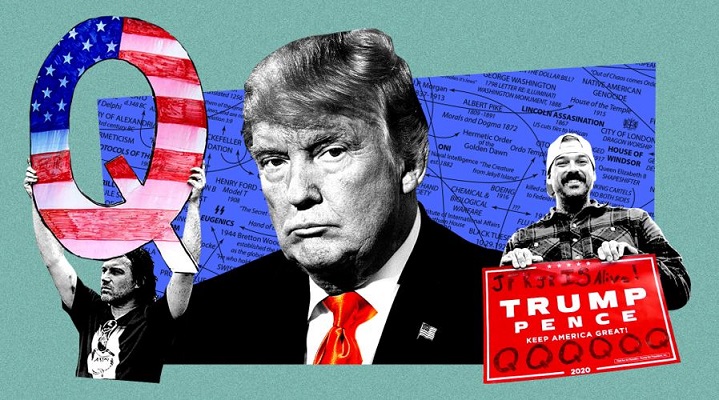
Down The Rabbit Hole: "Social psychologists have found that when fearful people contemplate potential misfortunes, they tend to feel helpless and pessimistic, but when angry people contemplate the same, they feel a sense of optimism and control. And one simple way to transmute fear into anger is to perceive an evil agent behind whatever development is causing you uncertainty and disquiet." - Eric Levitz.

WHEN ADOLF HITLER committed suicide on 30 April 1945, thousands of Germans followed his example. The most famous copy-cats were Joseph Goebbels and his wife, Magda. Not only did they take their own lives, but also those of their six children. The idea of surviving the Fuhrer, being held accountable for everything he, and they, had done, seeing National Socialism overthrown and accepting the inevitable ruin of everything they had hoped for and fought for, was simply too overwhelming for many fanatical Nazis to contemplate.

Good riddance! Well, yes, that’s one response. But just consider the following excerpt from US writer, Eric Levitz’s “QAnon Is Madness: But Believing It Can Be Rational” article posted on The Intelligencer website of 23/9/20:

“Speaking with voters in Wisconsin this month, Time reporter Charlotte Alter heard conspiracy theories from about 20 percent of her interview subjects. Many of these Wisconsinites were not familiar with QAnon but subscribed to its basic tenets. Tina Arthur, a small-business owner, told Alter that she was not a follower of QAnon but did believe that the Democrats were in league with a cabal of blood-drinking child rapists and that ‘if Biden wins, the world is over, basically … I would probably take my children and sit in the garage and turn my car on, and it would be over.’”

What the hell is going on, when a businesswoman from the Mid-Western United States is willing to wipe out her entire family rather than face the prospect of living under a Democratic President? Because, when all is said and done, “Sleepy Joe” Biden is a very far cry from Joseph Stalin, and even the most strident antifa protester is nowhere near as dangerous as the vengeance-seeking soldiers of the Red Army. How did as many as 20 percent of Americans end up tumbling down this dangerously hallucinatory rabbit-hole?

According to Levitz, conspiracy theories have much more to offer confused and frightened citizens than may, at first glance, be apparent:

“The tendency toward conspiracism is deeply rooted in the human psyche. It manifests across time and geography and is likely a product of evolutionary pressures. On an emotional level, human beings tend to find the idea of being threatened by forces beyond their comprehension or control much more upsetting than being threatened by an intelligible enemy. Social psychologists have found that when fearful people contemplate potential misfortunes, they tend to feel helpless and pessimistic, but when angry people contemplate the same, they feel a sense of optimism and control. And one simple way to transmute fear into anger is to perceive an evil agent behind whatever development is causing you uncertainty and disquiet.”

With this in mind, we begin to appreciate the powerful psychological insight behind the New Zealand Government’s “Unite Against Covid-19!” campaign. By personifying the virus, transforming it into an “evil agent” which New Zealanders could defeat collectively, the Government and the Ministry of Health headed-off the sort of QAnon craziness that has turned so many fearful Americans into gibbering paranoiacs.

The other key factor in this country’s success in preventing the widespread uptake of insane conspiracy theories was the regular 1:00pm briefings from Prime Minister Jacinda Ardern and Director-General of Health, Dr Ashley Bloomfield. Fear grows exponentially in the absence of timely and reliable information. New Zealand was, therefore, especially fortunate in having the “Jacinda and Ashley Show”. These two particularly gifted and credible communicators were able to deliver on an almost daily basis the answers and reassurance their frightened fellow citizens were so eager to receive. Such anger as was generated out of public fear tended to be directed against those who refused to “unite against the virus”. Not only did this popular enforcement of the Covid-19 Lockdown impede the disease’s spread, but it also served as a useful safety-valve for the tensions occasioned by the extraordinary limitations of individual freedom which the fight against the pandemic necessitated.

The comparison with the United States could hardly be more stark. Rather than the consistent and uplifting communications of Jacinda Ardern, the Americans were exposed to the constantly changing, often contradictory, messages of President Donald Trump. Also a formidable communicator, Trump deployed his talent in ways that fed, rather than calmed, his people’s fears, and fuelled their anger with hyper-politicised bulletins of unprecedented malignancy.

It would be wrong, however, to suggest that New Zealanders have been unanimous in their acceptance of the measures adopted to “stamp out” the virus. Although upwards of three-quarters of the population have registered either their “support” or “strong-support” for the Government’s handling of the Covid-19 crisis, that still leaves a quarter of the population unconvinced.

Some of these were the sort of hyper-individualists so often found in the upper reaches of societies dominated by the ideology of neoliberalism. Such people (most of them men) find the idea of standing in solidarity with the “sheeple” abhorrent. Equally unappealing, from the perspective of these “One Percenters”, is the unhelpful example set by the all-too-obvious success of collective intervention. Well-positioned to communicate their opposition, these Covid sceptics have been unceasing in their efforts to undermine the Government’s solidaristic appeals to “The Team of Five Million”.

The other pool of scepticism and resistance is fed by the fear and ignorance of New Zealand’s least educated and most marginalised citizens. With little cause to trust a state which bitter experience has taught them to regard as an alien and hostile entity, these folk remained largely untouched by the Government’s campaign against Covid-19. In terms of social-psychology, they are precisely the people who feel “threatened by forces beyond their comprehension or control”. Looking for “an intelligible enemy” to blame for their shitty world becoming even shittier, they have every reason to believe, and insufficient intellectual resources to refute, the conspiracy theories fed to them by the algorithms of social media and the political predators who so adroitly exploit them.

Once inside the rabbit holes of the conspiracists; once supplied with the identity of the “evil agents” against whom their now inflamed emotions can be directed; once filled with the optimism and sense of control that makes being angry in the company of like minds so much more bearable than being alone and frightened; once the hallucinations have become more compelling than reality; what then is the incentive to stop seeing things that aren’t there? Better by far to expand the rabbit hole until in encompasses the whole world.

And if reality reasserts itself: either in the form of the Fuhrer’s death and the Red Army’s victory; or in the person of President Biden and a Democratic Party-controlled Congress; then what is the point of going on? Better to grab the kids, administer the poison, and avoid shouldering the unbearable heaviness of being exposed as a true believer in a false god.


This essay was originally posted on The Daily Blog of Friday, 25 September 2020.

Tuesday, 22 September 2020

The Looming Fight.

Social Distancing Be Damned - It's Jacinda! Shortly after ascending to Labour’s leadership, Jacinda described herself as a “pragmatic idealist”. It was an inspired oxymoron – packing into just two words the essence of the social-democrat’s dilemma. It was good to know that she knew what lay ahead of her. That as undisputed leader of the centre-left, she would herself become the battlefield upon which these contradictory impulses: her idealism and her pragmatism; would engage one another.
 
THERE’S A FIGHT LOOMING. No, not with National – they’ll be licking their wounds for years. Not with Act, either. Their numbers will gradually decline as National’s slowly recover. And the looming fight certainly won’t be with the Greens. They have some very serious soul-searching to do out there in the political wilderness where the voters are poised to send them. Like all prophets, they will be required to wrestle with the Devil in lonely places, defeat him, or never be heard from again. No, the fight that’s looming will be where it always is when the future of New Zealand is being decided – in the Labour Party.

Now some on the Left may be anticipating a renewal of the fight that was brought to an abrupt end by David Cunliffe’s catastrophic performance in the general election of 2014. The election (by the slimmest of margins) of Andrew Little to Labour’s leadership was a vote, by what remained of Labour’s left, for what David Lange called “a cuppa” – a pause in the ongoing hostilities during which the wounded could be attended to and the dead decently buried. It was a long truce, during which nothing much happened either ideologically or practically. Under Little, a grey fog descended upon Labour. A poll-depressing pall which was only lifted by the sudden rise of Jacinda’s glorious sun.

If, as seems increasingly likely, that same brilliant Jacinda leads Labour to an absolute electoral victory on 17 October, all thought of some sort of factional renaissance should be dismissed out of hand. For the foreseeable future, what Jacinda wants, Jacinda is likely to get. Which means that the fight, at least initially, will be for the Prime Minister’s ear. Ground-breaking policies will be proposed. Bright futures sketched-out confidently on paper serviettes. Historic opportunities grandly explained. Only then will the real fight finally begin – the fight between Jacinda’s heart and Jacinda’s mind.

Shortly after ascending to Labour’s leadership, Jacinda described herself as a “pragmatic idealist”. It was an inspired oxymoron – packing into just two words the essence of the social-democrat’s dilemma. It was good to know that she knew what lay ahead of her. That as undisputed leader of the centre-left, she would herself become the battlefield upon which these contradictory impulses: her idealism and her pragmatism; would engage one another.

The coalition with NZ First and her understanding with the Greens spared the prime Minister the worst of it. For the past three years jacinda has been able to make out a plausible case for her idealism having little choice but to reach a series of pragmatic accommodations with “Mr Peters” innate conservatism. It was a good line, because it allowed her followers to believe that Jacinda’s idealism remained unbeaten and unbowed. That, given a chance, her bright blade would flash in the sunlight and the forces of inertia and indifference would be laid low beneath its righteous fury. Jacinda’s pragmatism, it seemed, was all about making sure that, when the moment came, her idealism would be ready.

Barring something truly awful intervening between now and election day, it would seem that this long awaited and keenly anticipated moment will soon be upon us. Jacinda’s pragmatism, if it is not to be twisted into a cynical and demoralising opportunism, will then be required to meet the extraordinary challenge of setting the unencumbered Labour government’s idealistic pace. How “unrelentingly positive” can Jacinda and her colleagues afford to be – and how kind?

Much will turn on how Jacinda perceives “idealism”. Does she equate it with the phenomenon that some call “wokeness”? Is it a simple matter of scratching every itch inflamed by the Twitterati’s ideological eczema? Will an unencumbered Labour Government put all TERFs to flight? Legislate for tino rangatiratanga? Ban all forms of hate speech? Destroy the dairy industry? Squeeze the rich until the pips squeak? Or, is Jacinda’s idealism something more organic? Something rooted in the idea of community? In the mutual obligations of citizenship?

We must hope it is the latter. Because if it is the former, then the next three years will be very fraught and full of political danger. “Wokeness” has about as much support in the New Zealand electorate as the Green Party – which is to say, bugger-all. Not that the woke understand that. As actual or wannabe members of the “progressive” wing of the political class, they are anxious to impose their own, tortuous, ideology upon what they regard as the deplorable prejudices of their unenlightened fellow citizens. If Jacinda’s idealism turns out to be woke idealism, then the people will flee from her in droves – and bitter disappointment.

But I do not believe that the looming fight will be a struggle between a woke Jacinda and the rest of us. I believe it will be a fight between Jacinda’s vision of a government that continues to foster the solidarity and sacrifice manifested in the battle against Covid-19, and those who want to put an end to it. Her idealism, so far, has been about bringing New Zealanders together. Is it too much to hope that an unencumbered Labour government, led by Jacinda, will be one which builds on New Zealanders’ new appreciation of the role an active and protective state can play in securing the common welfare of all its citizens?

Everything in Jacinda’s political career to date points to her almost instinctive understanding of how important it is (to quote Jim Anderton’s famous injunction) “to build your footpaths where the people walk”. Her political pragmatism has always recognised the futility of trying to force people to be good. Her political idealism is founded on her conviction that people find goodness in themselves, or not at all. “They are us”, she declared on 15 March 2019, and a whole nation showed the world what she meant. “Unite against Covid-19”, she urged, and New Zealand did just that. “Be kind”, she implored, and 50 percent-plus of us are willing to go on giving it a try.


This essay was originally posted on The Daily Blog of Tuesday, 22 September 2020

Tuesday, 1 September 2020

What Just Didn't Happen?

The New Old Triumvirate: Jacinda Ardern, back in 2017, confers with her longest-standing political allies, Grant Robertson and Chris Hipkins.


WHAT JUST HAPPENED? Over the course of the past 72 hours something changed. Exactly what isn’t clear, not yet, but something has. New Zealanders feel it in their bones, in their hearts, and they’re scared.

 When it’s impossible to know what has happened, the next best thing is to try and establish what hasn’t happened.

 Accordingly, I would like the Director-General of Health’s, Ashley Bloomfield’s, reassurance that the ridiculous – not to say dangerous – Covid-19 Alert, which more-or-less ordered every person living in South and West Auckland to be tested for the virus, was NOT a deliberate attempt to destabilise the New Zealand Government’s management of the pandemic.

 Because, what civil servant in their right mind would send out such a message without the formal, traceable, approval of those at the very summit of the civil service hierarchy? More to the point, what sort of senior public servant could fail to appreciate the sheer absurdity of the order and its potential for inducing something close to panic amongst the population of South and West Auckland?

 Occam’s Razor allows of only two reasonable explanations. 1) That the action was deliberate and its consequences foreseen. 2) That the calibre of the staff responsible for its release was so abysmal that the notice’s glaring deficiencies passed unnoticed. Neither explanation offers us much comfort. The first admits to sabotage. The second to utter incompetence. The question to be decided, therefore, is whether we are looking at a conspiracy or a cock-up?

 What motive would the individuals responsible for that errant notice have for sabotaging the Government’s orderly transition from Level 3 to Level 2.5?

 The most obvious answer lies in the all-too-evident trepidation among scientists, civil servants, and members of the general public, that the move out of Level 3 might be premature – dangerous even. Those holding this view have argued that the “perimeter” of the South Auckland Cluster had yet to be conclusively established. The alarming possibility therefore arises that the offending notice may have been issued as a form of institutional protest against what a faction within the All-of-Government Committee (AOGC)  responsible for managing the pandemic considered a reckless government decision? A decision driven not by the science, but by political and commercial interests no longer willing to be guided by expert opinion.

 Please Dr Bloomfield (wherever you are!) please tell me this is NOT what happened. Because if I’m right, and the release of that notice wasn’t simply another demonstration of massive institutional incompetence (to set alongside the many others) then public trust and confidence in the Government’s handling of the Covid-19 Pandemic, already visibly shaken, will crumble and collapse.

 Moreover (as if the above speculation isn’t wild enough) there’s the additional concern that extreme events, like the publication of that Covid-19 Alert, seldom happen in isolation.

 And that is why I would like the reassurance of the Prime Minister that she has NOT – at the insistence of the Finance Minister and the Health Minister – abandoned her hitherto rock-solid determination to put the welfare of the New Zealand people ahead of the profits of New Zealand businesses. Please, someone – anyone – tell me, tell the nation, that this is NOT what happened.

 While they’re at it, they could also tell us why it was that Chris Hipkins, interviewed on Magic Talk Radio just a couple of hours ahead of Jacinda’s appearance in the Beehive Theatrette at 1:00pm on Sunday, 30 August, insisted that the government would be “ploughing-on” with the transition from Level 3 to Level 2.5?

 The Health Minister confirmed at today’s (31/8/20) 1:00pm Covid Update that he was well aware of the situation relating to the “mistaken” Covid-19 Alert at the time of that Magic Talk interview. So, the question arises: Did Hipkins make the statement about “ploughing-on” to signal to our supposed AOGC rebels that their protest had been in vain?

 More to the point, was it also a very public warning to Jacinda that there could be no stepping back from the plan already agreed upon with her longest-standing and closest political allies – Grant Robertson and Chris Hipkins? Any deviation from the scheduled 11:59pm level-change could hardly fail to be interpreted by the news media as evidence of a serious split in the uppermost reaches of the Coalition Government. Not something a prime minister heading into a general election would be eager to acknowledge!

 The problem with this sort of speculation is where to call a halt. Viewed through my admittedly dramatic political prism, Jacinda’s decision to keep her former health minister, David Clark, in Dunedin – and his job – for a great deal longer than he had any right to expect begins to look like a shrewd method of ensuring the state’s response to the Covid-19 pandemic would be decided by the Prime Minister and her Director-General of Health. (Where is Ashley, BTW, he wasn’t at today’s update?)

 Did the Director-General’s failure to properly implement the Cabinet’s directives relating to border security so weaken his position that Robertson and Hipkins were able to elbow him aside and transform the wildly popular, science-driven, duumvirate of Jacinda and Ashley into a new, much more business-friendly, triumvirate of Grant, Jacinda and Chris?

 And if that is what happened, then what does it say about the government’s new direction of travel? Jacinda’s and Ashley’s decision to “go hard and go early” represented a revolutionary reversal of the usual neoliberal priorities. In effect, they opted to put people first and profits second. The immense and very obvious outpouring of public gratitude and affection that followed the extraordinary success of this strategy made Jacinda effectively invulnerable to attack. Until the saintly duumvirate could, somehow, be destabilised, the furious business community (ably assisted by their right-wing allies in the news media) could only whinge and moan. But then Ashley stumbled, and the business community seized its chance.

 This morning, on RNZ’s Nine-to-Noon political panel, Labour’s pollster, Stephen Mills, wondered aloud why Jacinda – backed in the polls but upwards of 80 percent of her fellow New Zealanders, had apparently chosen to abandon her hugely successful go-hard, go-early “elimination” strategy, in favour of a new strategy of Covid-19 “containment”.

 Please, someone – anyone – confirm for me, and the rest of the 80 percent, that the explanations offered in this post are nothing more than the fever-dreams of an ageing left-wing commentator. Please tell us that the sequences of events outlined above bear absolutely no relation to reality. That there has not been a coup against Jacinda’s “people first” Covid elimination strategy. That the 20 percent haven’t prevailed. Please, please, please, reassure Jacinda’s loyal team of four million that this is NOT what just happened!


This essay was originally posted on The Daily Blog of Tuesday, 1 September 2020.

Friday, 28 August 2020

Putting The People First.

Putting People First: Here in New Zealand, by a miracle of historical alchemy, we were blessed with a prime minister and a government who, against all expectations, reversed the neoliberal formula. In “going hard and going early”, Jacinda Ardern’s government had opted to put people first.

IT’S EASY to identify the people in charge – they’re the ones whose needs are attended to first. Remember the global financial crisis of 2008-09? In the United States, the question posed by that catastrophic economic meltdown was stark in its simplicity. Who will the government save: Main Street or Wall Street? The answer that came back was chillingly unequivocal. Wall Street.

 When the US House of Representatives for once attempted to live up to its name by voting down the financial sector’s self-drafted “rescue package”, the reaction of Wall Street was ferocious. Its minions in the Executive Branch descended upon the Capitol Building en masse, making it crystal clear to the errant legislators that they had chosen the wrong side. The vote was held again. Wall Street was saved.

 That’s what makes New Zealand’s response to the Covid-19 Pandemic so remarkable. With the example of the global financial crisis to guide them, many Kiwis were resigned to the needs of “business” being put ahead of everybody else. After all, that’s what they saw when they looked abroad – especially to New Zealand’s ideological kith and kin in the United States and the United Kingdom. Here, too, many predicted grimly, it will be profits first, people second.

 But they were wrong. Here in New Zealand, by a miracle of historical alchemy, we were blessed with a prime minister and a government who, against all expectations, reversed the neoliberal formula. In “going hard and going early”, Jacinda Ardern’s government had opted to put people first.

 For thirty-five years it has been a very different story. For thirty-five years New Zealanders have been told that their welfare is utterly dependent on the health of the business sector. Looking after the business sector, we have been encouraged to believe, is the same as looking after ourselves. Because, in the final analysis, if you don’t have a thriving business sector, then you don’t have anything.

Jacinda Ardern turned that proposition on its head. Looking after the people, she said, is the same as looking after the business sector. If you don’t have a healthy people, then you don’t have anything. To the utter astonishment of the nation’s business leaders and their media mouthpieces, the state intervened unreservedly and decisively. It locked the country down.

 And we got it. Blessedly free of the sort of economic expertise that insists such policies are completely counter-productive, New Zealanders cheered-on a government prepared to borrow tens-of-billions of dollars to keep them and their loved ones safe. When was the last time anyone had done that?

 Older New Zealanders recalled the stories their parents had told them about the Second World War. Stories about people united in a common cause. Stories about sacrifice and valour. Younger New Zealanders hardly dared to believe it was actually happening. Jacinda was defying economic gravity. But, when she talked about “the team of five million”, the vast majority of New Zealanders’ chests swelled with pride.

 Not everybody cheered Jacinda on. Almost from the moment the country went to Level 4, the volume of the complainers’ chorus began to swell. Instinctively, the social classes which had benefitted the most from the Neoliberal Revolution, grasped the enormous potential dangers that were set to flow from Jacinda’s reversal of social and economic priorities.

 It’s the motive force behind the talkback hosts’ spittle-flecked expostulations. The explanation for the business “community’s” endless whining and moaning. The reason why academics (who should know better) are lending their prestige to “Plan-Bs” which, when stripped of all the obfuscating non-science, are about allowing the aged and vulnerable members of our society to be sacrificed on the altar of “The Economy”. Some of the nation’s professors have even called for our democratic institutions to be set aside in favour of an administration of technical experts – like themselves.

 Neoliberals have every reason to fear what ordinary people have learned from the Covid-19 crisis. How are all those arguments about there not being enough money for all the things they so desperately need going to sound after the dollar-downpours of 2020? All those trite phrases about not being able to solve problems by “throwing money” at them – who’s going to believe that now?

 And if Jacinda and her team are re-elected on a landslide? Will they even try to put the genie back in the bottle?


This essay was originally published in The Otago Daily Times and The Greymouth Star of Friday, 28 August 2020.

Thursday, 27 August 2020

The Left’s Dilemma.

All Hands On Deck: As the clock ticks down to polling day, the Left’s priorities are, therefore, clear. Keep Labour in office (hopefully with just the Greens for coalition company) and inflict as much damage on the National Party and Act as possible. Having achieved those goals, however, it will be necessary to calculate with all speed the co-ordinates of a whole new set of targets. Covid or no Covid, all is not well in New Zealand. Much remains to be done. And the Left’s dilemma has always been that only the Labour Party can do it.


POLITICALLY SPEAKING, the Left is currently in a very awkward place. It is clearly in the whole country’s interest for leftists to do whatever they can to prevent the election of a National-Act government. A right-wing victory would not only place vulnerable New Zealanders at the mercy of the most reactionary elements of the political mainstream, but also embolden and empower the even more reactionary groups operating at the political fringes. In a world ravaged by Covid-19, such an outcome would be little short of catastrophic.

 But if the Left has a strong moral obligation to swing in behind the Jacinda Ardern-led government, it is also obliged to maintain a watching brief on its non-Covid activities. John Minto’s latest posting on The Daily Blog – “Labour’s Shame!” – provides a welcome reminder of the multiple policy failures attributable to the Labour-led coalition. John’s piece alerts us to the fact that even if the virus could be wished away, and life return to its “normal” pre-pandemic state, then all would be far from well in New Zealand.

 The crisis currently gripping the Canterbury District Health Board (CDHB) for example, is a classic case of how absolutely the neoliberal ideology still governs the provision of crucial social services in New Zealand. While the crisis, which has seen 7 out of the 11-strong senior management team of the CDHB – including its CEO – tender their resignations, is mostly attributable to the built-in deficiencies of the DHBs’ operational model, its immediate causes are entirely Labour-generated. The former Minister of Health, David Clark, is responsible for setting in motion the machinery that is steadily demolishing the effectiveness of the CDHB.

 Clark’s principal adviser, however, was the Chief Executive of the Ministry of Health, Dr Ashley Bloomfield. Yes, that Dr Ashley Bloomfield: the saintly Director-General of Health who, until recently, represented, alongside the Prime-Minister, the State’s highly successful response to the Covid-19 Pandemic.

 Bloomfield’s critical role in both the CDHB debacle and the fight against Covid-19 epitomises the Left’s dilemma. While the global pandemic has necessitated, in much the same way as the existential threat of Nazi Germany did during World War II, a temporary setting aside of ideological divisions; the virus’s eventual defeat will, inevitably, see those divisions reassert themselves. Just as Winston Churchill remained at heart an unreconstructed Tory, the New Zealand public service – and most of the ministers it advises – remain happily wedded to Neoliberalism. The Left is obliged to face this dilemma squarely, with the same unflinching honesty as John Minto.

 The difficulty, of course, is that having sung the praises of Jacinda Ardern and her Labour and Green comrades all the way up to 17 October, it is extremely jarring to then turn around and start piling on the criticism. In the mind of the Labour apparatchik (never a very spacious place) that sort of behaviour will be taken as proof of the “Far-Left’s” irredeemable perfidy. To the people surrounding Jacinda, victory is always the ultimate riposte. “If we were so bad,’, they will object, “however did we win?” Labourites always resist the obvious answer: because their party was the lesser of two evils. Not least because that conclusion requires of them the mental and moral clarity to recognise that though it may be the lesser, their party is, nonetheless, evil.

 Driving this point home is the only effective strategy available to the Left. Pointing out, as John does in his post, the all-too-real consequences of neoliberalism. Labour, once safely re-elected, needs to be assailed with the brute facts of the poverty and marginalisation its policies have done so little to alleviate.

 Almost as effective as rubbing the government’s nose in the misery it refuses to mitigate, is pointing out the naked class advantage which Labour’s policies confer upon people who look and sound uncomfortably like its own members of parliament. It takes more steel than most Labour MPs possess to openly acknowledge that they are not, and, for the most part, never have been, “leftists”. Most of them get a kick out of seeing themselves as part of working-class New Zealand’s long march towards social and economic equality. Demonstrating to them, with irrefutable data, that they are actually responsible for measures guaranteed to halt the forward march of Labour, causes them genuine distress. Nobody wearing a red rosette likes to be called a scab.

 As the clock ticks down to polling day, the Left’s priorities are, therefore, clear. Keep Labour in office (hopefully with just the Greens for coalition company) and inflict as much damage on the National Party and Act as possible. Having achieved those goals, however, it will be necessary to calculate with all speed the co-ordinates of a whole new set of targets. Covid or no Covid, all is not well in New Zealand. Much remains to be done. And the Left’s dilemma has always been that only the Labour Party can do it.


This essay was originally posted on The Daily Blog of Thursday, 27 August 2020.

Saturday, 22 August 2020

Laws Do Not Rule – People Do

Trying Our Patience: Quite rightly did the nineteenth century British novelist, Charles Dickens, proclaim: “The law is an ass!” Laws do not rule – people do. This is the incontrovertible fact which Mr Andrew Borrowdale, the man who required the High Court to rule on his challenges to the legality of the Covid-19 Lockdown, singularly failed to grasp.

THE ENABLING ACT was passed by the Reichstag on 23 March 1933. With this single piece of legislation, every act of the Reich Government and its Chancellor, Adolf Hitler, was given the force of law. Any conscientious German lawyer seeking to test the legality of the Nazis’ subsequent, democracy-crushing, edicts in Germany’s highest courts, would have been reassured that the “Rule of Law” remained inviolate.

 Quite rightly did the nineteenth century British novelist, Charles Dickens, proclaim: “The law is an ass!” Laws do not rule – people do. This is the incontrovertible fact which Mr Andrew Borrowdale, the man who required the High Court to rule on his challenges to the legality of the Covid-19 Lockdown, singularly failed to grasp.

 Not that Mr Borrowdale lacked encouragement for his Quixotic endeavour. All manner of pedants and purists were quick to figuratively pat him on the back for his services to the “Rule of Law”. As if the judgement of a few lawyers – albeit lawyers in flowing robes and horsehair wigs – should somehow be permitted to stand above the straightforward, self-protective judgements of ordinary men and women threatened by a global pandemic. As if the decisions made by the people’s elected representatives – for their protection – can be reasonably and responsibly struck down by a gaggle of job-for-life jurists elected by nobody at all.

 Thank God the judges of the High Court turned out to be a great deal more intelligent than the individuals who put so much stock in Mr Borrowdale’s appeal. Andrew Geddes, a law professor at the University of Otago summed it up nicely:

 “So it’s not that the Court got the decision wrong. Rather, it seems clear that the Court’s perception of its job, and the law at issue, was very much coloured by the same collective concerns that drove the government’s response to the virus. Preventing lots of people from dying from a disease is perhaps the government’s highest obligation, and the law has to be seen as enabling the government to carry out that task.”

 Or, as the celebrated Roman statesman, Marcus Tullius Cicero (106-43 BCE) so succinctly put it: Salus populi suprema lex – The safety of the people shall be the highest law.

 Obviously, preserving the people’s safety is, above all else, a political obligation – not least on the part of the people themselves. Consider the passage of the Enabling Act in 1933. Had the German Social Democrats and Communists not been at daggers drawn; had the German army not been so consumed by its desire to wipe out the humiliations of the Treaty of Versailles; then the farcical conditions in which the Enabling Act was passed (the German parliament was ringed with Nazi Stormtroopers, and the Communist Party MPs, having all been taken into “protective custody”, were absent from the Chamber) could not have arisen.

 Thirteen years earlier, in 1920, an attempt by extreme German nationalists, backed by the army and right-wing paramilitaries, to overthrow the Weimar Republic had been foiled by the decisive action of the Social-Democratic Party-led government. Its call for all German workers and civil servants to come out in a nationwide general strike was backed by all the other parties of the German Left. Twelve million workers and civil servants responded. The country ground to a halt. It was the largest and most successful strike in Germany’s history. The so-called “Kapp Putsch” collapsed.

 Three years after Kapp, in 1923, Adolf Hitler’s attempt to stage his own putsch (coup) was foiled by the Munich police. Formed up in a skirmish-line, the armed policemen ordered Hitler’s brownshirts to halt their march through the city. The Nazis (also armed) refused and came on. The Police commander gave the order to open fire. Those Nazis who still could (sixteen of them were killed) fled.

 In both cases, the German judiciary had nothing useful to contribute. It was not the Rule of Law which saved the Weimar Republic in 1920 and 1923, but the German people themselves. Just as, in 1933, it was not the Rule of Law which transferred all effective executive power into the hands of a political psychopath. That was the work of a Depression-ravaged and politically exhausted German population – just enough of whom were ready to trade their liberty and decency for economic security and an end to the Weimar Republic’s intractable political divisions. As clear a case of “be careful what you wish for” as one could hope for.

 In New Zealand, in 2020, the people have also prevailed. A leader they trusted, and who very clearly had their interests at heart, implored New Zealanders to unite against Covid-19 by staying home inside their bubbles. The New Zealand people responded by doing just that. Thus did Jacinda Ardern’s prioritisation of her fellow citizens’ welfare elevate her words to the status of suprema lex – the highest law.

 Jacinda acted hard and early on our behalf, and we should all be exceedingly grateful that she refused to abdicate her responsibility to the courts. That the courts appear to agree is welcome proof that there are at least three judges left in New Zealand who still understand Latin.


This essay was originally posted on The Daily Blog of Friday, 21 August 2020.

Friday, 14 August 2020

Here We Go Again.

A Heavy Burden: At times such as these, our prime minister could be forgiven for wondering whether some malign political spirit has laid a curse upon her. As if everything that she is, and everything of which she is capable, can only ever be revealed fully at moments of harm and horror and national crisis. As if, on some divinely wayward whim, this daughter of the House of Sunshine has been sent to rule the Land of Storms.

 Once more unto the breach, dear friends, once more.

 William Shakespeare – Henry V


 THERE I WAS, halfway through an episode of Vera, when my wife bursts into the sitting room, cellphone in hand. Jacinda and Ashley have called a special media conference for 9:15pm. It could only mean one thing. Community transmission of the Covid-19 virus had resumed. Our 102-day run of luck had run out.

 Jacinda Ardern is much younger than the British actor, Brenda Blethyn, who plays Vera Stanhope, the shrewd and indomitable Geordie police detective, but both women possess the special quality which allows them to demonstrate leadership and compassion simultaneously. Jacinda’s performance on Tuesday evening was distinguished by something else, however: sadness.

 She must have known, from the moment she received the “sit-rep” from the Director-General of Health, that her country and its people would be required to draw upon what scant reserves of courage and tolerance remained to them after their first encounter with Covid-19, to do battle with the monster a second time. She must have known, also, that she had no choice but to ask them, as Shakespeare’s King Henry V asks his exhausted troops, to make one more heroic effort against the foe.

 So, as always, there was clarity and forthrightness from New Zealand’s prime communicator, but there was sadness, too – and just a hint of weariness. As if the burden of leadership which she has carried so steadfastly since 2017 has suddenly become a lot heavier.

 At times such as these, our prime minister could be forgiven for wondering whether some malign political spirit has laid a curse upon her. As if everything that she is, and everything of which she is capable, can only ever be revealed fully at moments of harm and horror and national crisis. As if, on some divinely wayward whim, this daughter of the House of Sunshine has been sent to rule the Land of Storms.

 Then again, the acceptance of one’s fate: the understanding that Fortuna’s judgements can neither be appealed, nor deflected, but only borne with such stoicism and grace as one can muster, has always defined the classic hero.

 Perhaps that’s why so many New Zealanders hold their prime minister in such high regard. Because whether it be the Christchurch Mosque Shootings; the White Island Tragedy; or the Covid-19 Pandemic: Jacinda Ardern has consistently raised her shield against the slings and arrows of her outrageous political fortune, drawn her sword, and marched forward unflinchingly. Perhaps it also explains why so many New Zealanders have been willing to follow her.

 Many, but not all.

 It is the dirtiest of Humanity’s multitude of dirty secrets: that any display of genuine and unselfconscious excellence is bound to inspire the envy of those who, deep in their hearts, know they cannot – and will never – match it. This envious response to demonstrable talent is so deeply ingrained in a certain type of New Zealander that our culture has given it a name: “The Tall Poppy Syndrome”. It is our country’s curse: so few lofty flowers; so many secateurs.

 How much better off we would be as a country if in this – as in so many other matters – we allowed ourselves to be guided by the wisdom of the Maori. Though by no means immune to the injuries inflicted by envy and jealousy, Maori culture recognised that there are some values that  should never be sacrificed; some aspirations – and individuals – too important to abandon:

 Whāia te iti kahurangi ki te tūohu koe me he maunga teitei.

 Seek the treasure you value most dearly: if you bow your head, let it be to a lofty mountain.

 The resurgence of Covid-19 in the New Zealand community is a grave threat, not only to the lives of the elderly and vulnerable, but also to the businesses and livelihoods of millions of New Zealanders. Short of war, it is difficult to imagine a more profound challenge to the resilience of our state, its institutions and citizens.

 That challenge can be met in two ways: as a united people, determined to do all within its power to once again stamp out the virus; or as a disunited rabble, riven by envy, jealousy and malice.

 Once more, Jacinda Ardern is asking New Zealanders to wage war upon the Covid-19 enemy.

 Let’s knock the bastard off.


This essay was originally published in The Otago Daily Times and The Greymouth Star of Friday, 14 August 2020.

Is Billy TK Shouting “Fire” In A Crowded Theatre?


Fire-Starter? The claims advanced by BillyTe Kahika are false. The matter to be determined, therefore, is whether or not they are likely to cause panic. In ordinary times, the answer would be “No.” In ordinary times, the opinions of conspiracy theorists may be safely ignored. Indeed, in ordinary times, the state protects their opinions. Mr Te Kahika’s freedom of expression, as set forth in the New Zealand Bill of Rights Act, would not be infringed – in ordinary times. But, these are not ordinary times.


 JUST OVER A CENTURY ago, an American socialist, Charles T Schenck, tested the boundaries of free speech. He and his fellow socialist, Elizabeth Baer, were convicted under the Espionage Act (1917) for distributing pamphlets opposing the conscription of young American men for service in World War I. The pair appealed their conviction to the US Supreme Court, citing the First Amendment to the US Constitution’s protection of Freedom of Speech, but their conviction was upheld. The celebrated American jurist and Supreme Court Justice, Oliver Wendell Holmes, explained his decision in the following, famous, passage:

 “We admit that in many places and in ordinary times the defendants in saying all that was said in the circular would have been within their constitutional rights. But the character of every act depends upon the circumstances in which it is done. The most stringent protection of free speech would not protect a man in falsely shouting ‘Fire’ in a theatre and causing a panic… The question in every case is whether the words used are used in such circumstances and are of such a nature as to create a clear and present danger that they will bring about the substantive evils that Congress has a right to prevent. It is question of proximity and degree.”

 The “theatre” Holmes refers to is, of course, the United States at war. Schenck’s arguments against conscription – by undermining the US war effort – were, in the unanimous judgement of the Supreme Court, a direct violation of the people’s will – as expressed in the US Congress’s declaration of war against the Central Powers. Context, argues Holmes, is everything.

 One hundred years later, and half a world away, the issue of free speech and the context in which it does, and does not, require the law’s protection is still very much alive.

 Earlier today (13 August 2020) in Whangarei the Leader of the New Zealand Public Party, Billy Te Kahika Jr, addressed a small crowd of people who had joined a protest against the Government’s latest efforts to control the community transmission of the Covid-19 virus. In the course of that address, Mr Te Kahika alleged that the Government’s actions were part of a preconceived plan to deprive ordinary New Zealanders of their rights. His speech reinforced arguments he had already voiced on Facebook earlier in the week. Patriotic New Zealanders, Mr Te Kahika advised his audience, were leaking information to him about the Government’s plans to deploy the armed forces against its own citizens. Very soon, he claimed, soldiers would be testing New Zealanders compulsorily for Covid-19.

 These are inflammatory claims, prompting the question as to whether or not Mr Te Kahika is guilty of “falsely shouting ‘Fire’ in a theatre and causing a panic”?

 Certainly, the claims advanced by Mr Te Kahika are false. The matter to be determined, therefore, is whether or not they are likely to cause panic. In ordinary times, the answer would be “No.” In ordinary times, the opinions of conspiracy theorists may be safely ignored. Indeed, in ordinary times, the state protects their opinions. Mr Te Kahika’s freedom of expression, as set forth in the New Zealand Bill of Rights Act, would not be infringed – in ordinary times.

 But, these are not ordinary times.

 New Zealanders need only look across the Tasman Sea, to the State of Victoria, to understand the threat posed to society by an inadequate official response to any resurgence of the Covid-19 virus. Many people will become sick. Others will die. The local economy will be devastated. Any activity which threatens to facilitate and/or augment these evils must, therefore, be considered, in Holmes’s compelling phrase “a clear and present danger” to the common welfare.

 It is very difficult to interpret Mr Te Kahika’s activity as anything other than an attempt to impede, undermine and in every way frustrate the Government’s attempt to respond adequately to a proven resurgence of community transmission of Covid-19 in the city of Auckland and, quite possibly, across the rest of New Zealand. His unsubstantiated claims seem calculated to arouse fear, anger and hatred among those least equipped intellectually, emotionally and materially to challenge their veracity. When directed against those in authority, for expressly political purposes, such falsehoods have the power to cause immense harm.

 If Holmes’s important stipulation that “the character of every act depends upon the circumstances in which it is done”, then Mr Te Kahika’s actions can only be described as extremely reckless and irresponsible. Conscious, that they could quite easily contribute to a significant lessening in the public’s willingness to comply with the Covid-19 regulations – and, hence, to the spread of the virus – the Government would be entitled to take all necessary measures to silence Mr Te Kahika and his  political lieutenants.


The only consideration militating against such a course of action is likely to be whether or not the silencing of Mr Te Kahika would be more, or less, likely to facilitate the very substantive evils it was intended to prevent. While the crowds he speaks to remain as small as Whangarei’s, it is probably not worth making a “free speech” martyr out of Mr Te Kahika – especially if such martyrdom constitutes an important part of his election campaign. The Government would, nevertheless, be wise to keep a close eye on the NZPP and its inflammatory leader, and both eyes on the size of the crowds they attract.

 My own principled attachment to free speech is well attested, and, just for the record, I believe the US Supreme Court was wrong to convict Schenck and Baer for opposing the draft. I do, however, concur entirely with Justice Holmes that freedom of speech gives no person the right to shout “Fire!” in a crowded theatre.

 Nor to undermine the efforts of our government to preserve New Zealanders’ lives in the face of a global pandemic.


This essay was originally posted on The Daily Blog of Friday, 14 August 2020.

Tuesday, 21 July 2020

Fighting The Fear Virus.

Poisoning The Social Bloodstream: so many of us are not uniting against the virus. Instead, frightened and hateful people are lashing out in anger against their fellow citizens, and against their government. Rather than grasp the brutal – if humbling – truth that, notwithstanding their overweening pride and self-confidence, human-beings are not in absolute control of the biosphere, many are determined to give this global disaster a human cause. It’s China’s fault. It’s Bill Gates’s fault. It’s Jacinda Ardern’s fault. They’re the ones to blame!


WHAT IS THE SOURCE of this awful social poison? The evidence of its presence is everywhere. In the abuse hurled at nurses and check-out operators. In the contemptuous defiance of social-distancing rules displayed by the young couple striding down the footpath. In the commentary threads of Twitter and Facebook. In the inexhaustible malice of talkback radio. And, most disturbingly – from the perspective of someone who has spent his life writing about politics – in the almost complete absence of social solidarity amongst this country’s Opposition politicians.

 Is anger the cause as well as the symptom of this anti-social behaviour? Are we being poisoned by rage? And if that is the answer, then what, or who, is brewing it?

 The psychologists would tell us that the emotion fueling all this belligerence is fear. We hate what we fear, and many of us are filled with an overwhelming desire to destroy it. And if we cannot destroy it? Why then, we hate it all the more! Worse still, we begin casting about for someone to blame.

 It is easy (and very tempting) to condemn hate in all its forms. The rage which hate inspires can certainly be terrifyingly destructive – and all too easily inspire the very fears which give it birth. It is not, however, an invariably negative phenomenon. The great Welsh poet, Dylan Thomas, writing about lives lived well and badly, and the fear that Death’s inevitability ends up making a mockery of both; rejected all counsels of passivity and acceptance:


 Do not go gentle into that good night.

Rage, rage against the dying of the light.


The trick, it would seem, lies in knowing what to fear. What to hate.

 What we should all be fearing and hating, right now, is Covid-19. And if we must rage against something; if we must blame something; then let it be this frighteningly adaptive coronavirus. Because it is only in New Zealand’s – and the World’s – collective rage that the intellectual and moral energy for defeating this deadly virus and conquering our anxieties will be found. Some of us have scoffed at the slogan “Unite Against Covid-19”. Our cynicism is, however, misplaced. Uniting against the virus is exactly what we should do.

 And yet, so many of us are not uniting against the virus. Instead, frightened and hateful people are lashing out in anger against their fellow citizens, and against their government. Rather than grasp the brutal – if humbling – truth that, notwithstanding their overweening pride and self-confidence, human-beings are not in absolute control of the biosphere, many are determined to give this global disaster a human cause. It’s China’s fault. It’s Bill Gates’s fault. It’s Jacinda Ardern’s fault. They’re the ones to blame!

 It’s but a small step from believing that Covid-19 is a human creation, to deciding that it isn’t even real. It’s all a hoax – a way of placing us under the One World Government’s thumb. Why can’t people see it? Why is everyone so blind!

 That Twitter and Facebook are awash with these mad conspiracy theories is bad enough, but when their paranoid style is borrowed by talkback hosts and “opinion formers”, then the situation moves from bad to worse. And when the Deputy-Leader of the Opposition starts dog-whistling the same looney tunes? Well, that’s when we should put our fear of Covid-19 on “Pause”, and start worrying about the National Party!

 Clearly, the fate that the National Party fears much more than Covid-19 is another three years on the Opposition Benches. Equally clearly, it is their belief that the most direct route to victory lies through political fields sown with mistrust, suspicion and rancour. What need is there to offer the electors detailed and persuasive policies, when your own frightened and angry supporters are so obviously desperate for someone to blame, blame, and blame again – all the way to 17 October?

 Were it not for the presence of Dr Shane Reti in the National Party caucus, I would be close to despair. His calm, rational and generous performance, carried on RNZ’s Morning Report only two days after Gerry “I’m only asking questions” Brownlee’s conspiratorial sonata, was profoundly reassuring. Like Prime Minister Ardern, Dr Reti understands that the only antidote to social poison is social solidarity, and that the only thing New Zealanders have to fear – apart from Covid-19 – is fear itself.


This essay was originally published in The Otago Daily Times and The Greymouth Star of Friday, 21 August 2020.

Friday, 26 June 2020

Sack Him, Jacinda. Sack Him Now!

Are You Still Here? Just like his colleague, Phil Twyford – of KiwiBuild fame – David Clark juts out his chin and shamelessly apportions blame to everybody but himself. Even worse, he has turned viciously on Ashley Bloomfield, the nearest approximation to a competent, decent, humble and accountable public servant that this country possesses.

IF DAVID CLARK hasn’t been sacked by the time you read this, then Jacinda isn’t doing her job. His point-blank refusal to accept responsibility for the multiple institutional failures of his Health portfolio more than justifies Clark’s dismissal.

Ministers of the Crown only have one job: to be responsible. As members of both the legislature and the executive they are a living bridge between citizen and state. A ministerial refusal to accept responsibility for failures occurring on his watch is also a refusal to uphold the essence of our Westminster-style representative democracy. If Jacinda doesn’t get this, then she should be given a swift tutorial by someone who does.

Jacinda needs to get rid of Clark for another, much less high-falutin – but no less politically compelling – reason. He was unforgivably disrespectful of Ashley Bloomfield – and Newshub’s cameraman, Billy Paine, captured Bloomfield’s reaction for the whole world to see.

That should not be a survivable offence.

Week-in, week-out, like Jacinda herself, Ashley has stood behind a lectern in the Beehive Theatrette and kept us not only informed, but also calm. Has he let the ball fall through his hands of late? Yes, he has. But, for Christ’s sake, the guy has been carrying half New Zealand on his shoulders (with Jacinda carrying the other half) for months. That he hasn’t been able to catch every single operational curve-ball, thrown at him by every delinquent player in the New Zealand health system, is forgivable – isn’t it?

If anything is likely to provoke such forgiveness, then it must surely be the callous treatment meted out to him by the guy who thought the Level 4 rules were only there for the “Team of Five Million” to follow. The guy who went mountain-biking during Lockdown. The guy who took himself off to Dunedin instead of insisting that – as the responsible minister – he be allowed to stand at his boss’s side for the duration of the Covid-19 emergency. The guy who owned-up on nationwide television to being “a bit of an idiot”.

That guy doesn’t get to be mean to Ashley Bloomfield – and survive.

Surely, Jacinda, you see that? Surely you’re not guilty (as one outspoken right-wing gentleman suggested to me this morning) of having questioned, in the finest Machiavellian style, whether it might not be advisable, during the heroic phase of the Covid-19 war, to have Clark sequestered in Dunedin; bringing him back to Wellington only when all the inevitable blunders, committed by the exhausted employees of our understaffed and under-resourced health system, started coming to light? I told him firmly that you weren’t that sort of politician. Don’t you dare prove me wrong!

New Zealanders need to be shown, Jacinda, that you genuinely understand how pissed-off they are. It’s not just the sheer, mind-numbing dumbness of the mistakes that the people supposedly in charge have been making that’s got us all yelling at the television. Underneath it all there’s the sneaking suspicion that, once again, we’ve been played for fools. Staying in our bubbles; washing our hands; socially distancing; coughing into our elbows: doing all the things we were told to do; while the people in charge, the people paid more than the prime minister, were fucking everything up.

If you want to remain prime minister, Jacinda, you have to give us some sign that you get all this. Because if you don’t, then we, the voters, might start joining a few dots. You know what I’m talking about. We might just recall the young woman who stood in front of us and asked us to join her in transforming New Zealand through the “politics of kindness”. The young woman of “relentless positivity” and “practical idealism”, who said: “Let’s do this!” – and, God help us, persuaded Winston Peters to give her the chance.

But then what happened, Jacinda? After we had given you our votes, what happened next? Were the promises of transformation fulfilled? Did the people charged with rolling out the changes give us anything that looked even remotely like genuine reform? Or, were the voters forced to endure one disappointment after another? Were the only tangible results produced by the general incompetence of your ministers the derisory snorts and disillusioned sighs from the electors they had let down?

Your government’s consistent failure to deliver might have been forgiven if it had led to a radical shake-up of the entire coalition. If you had gotten tough with Winston and his NZ First colleagues: warning them that if the expectations of the people who voted for the governing parties were not met, then you would simply jump in a government car and make the short trip from the Beehive to Government House. If the numbers aren’t there for real change, Jacinda, then the only right move is to go out and win yourself some new numbers!

Sadly, Jacinda, you haven’t followed that course. Instead, and exactly as happened in relation to the failure of our health services to deliver secure defences against the re-entry of the Covid-19 virus, incompetence and arrogance have gone unpunished. Just like his colleague, Phil Twyford – of KiwiBuild fame – David Clark juts out his chin and shamelessly apportions blame to everybody but himself. Even worse, he has turned viciously on Ashley Bloomfield, the nearest approximation to a competent, decent, humble and accountable public servant that this country possesses.

And still, Jacinda, you do nothing. New Zealand’s self-confessed “idiot” of a Health Minister is still in possession of his warrant.

Why? And for how much longer?

This essay was originally posted on The Daily Blog of Friday, 26 June 2020.

Friday, 22 May 2020

Leaders Without Power

The Illusions Of Power: Does Jacinda Ardern, like Abraham Lincoln, wake in the dark watches of the night still enveloped in the terrors of life-and-death decision-making? Maybe – maybe not. She’s a twenty-first century prime minister, not so susceptible, perhaps, to the deep religious feeling and romanticism that was such a feature of nineteenth century life. But she is also human and therefore prey to what dreams may come, unbidden, to the sleeping mind.

THE PRESIDENT’S DREAM was always the same. It was dark, barely enough light for him to see that he was in the middle of a mighty river. The boat he was standing in had no oars, no sail and no rudder. It was borne forward by the power of the river’s fearsome currents. The President had no means of determining his craft’s course. The banks on either side were dim shapes in the darkness. He was alone – at the river’s mercy.

Abraham Lincoln related this recurring dream to his closest confidants on more than one occasion. It would come to him at those moments in his presidency (1860-1865) when events were driving the United States inexorably towards a crucial moment of decision. Since he was president during the blood-soaked years of the American Civil War, these usually took the form of great and decisive battles. The dream, he said, came to him in the summer of 1863 – just days before the tide-turning Battle of Gettysburg.

Lincoln’s recurring dream is a powerful evocation of the political leader’s lonely and at times terrifying responsibility. Those of us who are spared the agonies of life-and-death decision-making all-too-easily assume that the people in charge are just that – in charge. We imagine them issuing their commands and reality dutifully complying. How else could we think it right and proper to blame our politicians when things go wrong? They told us they would fix the problems by which our world is beset, and yet the problems remain. Who else should we blame?

The true experience of leadership, however, as Lincoln’s dream makes clear, could not be further from the average voter’s fanciful notions of command and control. So many things are happening at once that forming a clear picture of where you are and what you should be doing is impossible. If you ever possessed the means of driving and steering the situation you are in they have long since been lost. All you can feel beneath you is the sheer, ungovernable power of the events carrying you forward. All you can do is peer blindly into the failing light and do your best to remain upright.

The Coalition Government’s “document dump” of two Fridays ago bears out the metaphorical truth of Lincoln’s recurring dream. Contained within its more than 2,000 pages is the story of how New Zealand’s Prime Minister, her senior Cabinet colleagues and the country’s leading civil servants grappled with the smoke and fog of the unfolding Covid-19 Pandemic.

The picture that emerges is one of confusion bordering on panic; decision-making undertaken in extreme haste and with nothing like enough reliable information. It depicts a system that barely coped and institutions that came perilously close to failing.

But it is also a story of unflagging human dedication and prodigious energy. A case-study of the curious magic that emerges from sustained collective effort on others’ behalf. Most of all, however, it’s the story of a handful of people who absolutely had to keep their footing and who did not fall. Almost as if the impersonal currents propelling them forward sensed their courage and kept the boat steady.

Does Jacinda Ardern, like Abraham Lincoln, wake in the dark watches of the night still enveloped in the terrors of life-and-death decision-making? Maybe – maybe not. She’s a twenty-first century prime minister, not so susceptible, perhaps, to the deep religious feeling and romanticism that was such a feature of nineteenth century life. But she is also human and therefore prey to what dreams may come, unbidden, to the sleeping mind.

Like Lincoln’s last dream. To his wife, Mary, he described being alone in a White House grown uncharacteristically still and quiet. He moved through the mansion’s brightly-lit but empty rooms towards the sound of distant sobbing. Finally, in the East Room, he came upon a corpse, lying upon a catafalque and guarded by Union soldiers. Lincoln heard himself asking: “Who is dead in the White House?” One of soldiers made reply: “The President – killed by an assassin!” A heart-wrenching wail of sorrow rose from the gathered mourners.

In the days that remained before his visit to Ford’s Theatre, where Lincoln would be killed by an assassin, the President was haunted by this grim presentiment of his death. He could not, however, avoid his fate. Leaders never can.

This essay was originally published in The Otago Daily Times and The Greymouth Star of Friday, 22 May 2020.

Friday, 8 May 2020

The Safety Of The People Shall Be The Highest Law.

Salus populi suprema lex
The safety of the people shall be the highest law.
- Marcus Tullius Cicero (106-43 BC) Roman Jurist and Statesman

SIMON BRIDGES and his supporters (witting and unwitting) aren’t quite chanting “Lock her up!” Not yet anyway. But they’re headed in that general direction. Faced with a prime ministerial performance that the rest of the world, and most of her own compatriots, have judged to be outstanding, the Right, in desperation, is attempting to criminalise Jacinda Ardern’s “Go Early – Go Hard” strategy against the Covid-19 Pandemic. Shown the way by a couple of liberal professors, Bridges and his media allies are now demanding to know the legal basis for locking down New Zealand. If the Cabinet’s decision, made in haste under extreme conditions, is deemed to be ultra vires (beyond its powers) the way will be opened to endless and politically vexatious litigation.

What these legal purists and panic-stricken politicians do not appear to understand is that if it is the people who are ultimately the fount of all legal authority, then those same people must also possess the power, in extremis, and in the interests of keeping themselves and their loved ones safe, to elevate that existential imperative above all other legal and juridical considerations. With an election looming, any political party foolish enough to attempt to punish Jacinda Ardern and her team for keeping New Zealanders safe will be punished severely at the ballot box. And, if the people are not the ultimate source of all legal authority, well then, who is? Law professors? Lobbyists? The National Party!

The declaration of a State of Emergency is, by its very nature, an exceptional occurrence. Among the most extreme of all the powers wielded by executive authority, it is reserved for those moments when the normal appurtenances of state power are no longer deemed sufficient to maintain public safety. That only those constitutionally sanctioned to do so can declare a State of Emergency is less important than whether or not the persons so empowered believe that such a declaration will be effective. The declaration of a State of Emergency which does not enjoy broad popular support is, in effect, a declaration of war by the state upon its own citizens. Or, to put it another way: the safety of the people can only be maintained by exceptional legal means if the people themselves feel sufficiently threatened to abandon legal norms.

But who, in these situations, falls within the definition of “the people”? Clearly, not everyone can be included if the threat is located within the borders of the state. A nation under foreign attack; responding to a natural disaster; or facing down a global pandemic; will have no difficulty in accepting emergency regulations. Declaring a State of Emergency in the context of a political and/or economic challenge to the smooth functioning of society, however, is a much riskier proposition. Interfering with the free movement of individuals and/or the free disposition of their property in such circumstances can only be made effective by excluding the challenger/s from the usual definition of “the people”. For emergency measures to succeed, such individuals or groups they must first be transformed into “the enemy within”.

This what happened during the last great extended State of Emergency in New Zealand history: the 1951 Waterfront Dispute. The National Party Prime Minister of the day, Sid Holland and his uncompromising Minister of Labour, William “Big Bill” Sullivan, were able to brand the Waterside Workers Union “wreckers” and curtail their rights because the dispute arose in a context that made the demonization of the watersiders and their allies considerably easier than it would have been at just about any other time.

The Cold War had just turned “hot” in Korea. The militant trade unions had walked out of the Federation of Labour and viciously attacked its leaders: a situation which played into the hands of the FOL’s Machiavellian “boss”, Fintain Patrick Walsh. Between 1946 and 1949, the Labour Party, itself, had quite deliberately isolated, vilified and, in at least one instance, deregistered, militant, communist-led trade unions. This vilification, especially of the Waterside Workers Union, had continued on the pages of the country’s newspapers (most effectively through Gordon Minhinnick’s cartoons in The NZ Herald). Holland and Sullivan could, therefore, rely upon Walsh, the FOL and the daily press to back any attack on the WWU. They could also, crucially, be relatively confident that the Labour Party would remain neutral in the ensuing industrial war.

Because it controlled one of the economy’s crucial choke-points, the wharfies’ union had always been vulnerable to a government determined to destroy its power. Any lengthy period of industrial action could be successfully portrayed as constituting a clear and present danger, not only to the country’s exporters and importers, but to the whole community. This was due to the fact that in the 1950s vast quantities of everyday items were still distributed around the country by ship. Holland was able to argue that shutting down New Zealand’s ports constituted a very real threat to the public safety. As a consequence, his invocation of the draconian Public Safety Conservation Act (1932) was held to be justifiable.

It was enough – just – for the majority of New Zealanders to accept the National Government’s comprehensive restriction of their civil liberties, and the harsh persecution of their fellow citizens, that Holland’s quasi-fascist Emergency Regulations permitted. Had the Korean War not been raging; had the FOL not been split; had Labour been less hostile to the trade union left; and had the public been less vulnerable to a protracted shut-down of New Zealand’s ports; then the National Government probably wouldn’t have risked declaring a State of Emergency. But, with all these factors working in its favour, and with its decisive victory in the Snap Election which Holland called to secure the electorate’s ex post facto endorsement of his treatment of the watersiders, the National Party was given ample proof that, for most Kiwis, the famous maxim of the Roman statesman, Cicero: Salus populi suprema lex; the safety of the people shall be the highest law; was indisputable

In the light of New Zealanders’ conscientious adherence to the “Unite Against Covid-19” rules, Cicero’s maxim continues to meet with their approval. Kiwi acceptance of draconian emergency measures cannot be guaranteed, however, in the absence of two crucial provisos: 1) An overwhelming majority of the people must believe that the threat to their safety is real. 2) They must also be convinced that only the imposition of extreme measures will avert a national catastrophe.

Neither of these provisos applied to the political crisis confronting New Zealand in 1981. Invoking the provisions of the Public Safety Conservation Act was a move the Rob Muldoon-led National Government was unwilling to make in relation to that year’s highly controversial Springbok Tour. It knew that there was insufficient support across the whole country for hard-line emergency measures to be enforced without the use of deadly force. Such was the temper of the country in 1981 that the killing of protesters by police or soldiers would only have made the disorder on the nation’s streets ten times worse.

New Zealand history thus confirms that its people are, indeed, the best judges of their own political security, and will make an exception to the rule of law only when they believe their own and their loved ones’ safety is genuinely imperilled.

The Jacinda Ardern-led Coalition Government is the first since 1951 which, confronted with a clear and present danger to the public’s safety, has felt confident enough of their broad support to promulgate and enforce a stringent emergency regime of indefinite duration. The New Zealand people’s subsequent willingness to “Unite Against Covid-19” constitutes a ringing endorsement of both the Ardern-led Government and Cicero’s militant-democratic slogan.

As their own constitutional guardians, the people are uniquely positioned to recognise those (thankfully rare) moments when the only effective means of keeping themselves safe is by allowing their leaders to operate (temporarily) outside the black letters of the law. And woe betide anyone who tries to stop them!

This essay was originally posted on The Daily Blog of Friday, 8 May 2020.