Showing posts with label 1951 Waterfront Lockout. Show all posts

Monday, 14 August 2023

The Politics Of National Security.

Strategically Challenged: Of the threats listed by Defence Minister Andrew Little one can only observe, grimly, that they are universal. Every nation state must take precautions against “terrorism, cyberattacks, transnational crime, mis- and disinformation”, even if each state’s degree of vulnerability to these evils is a product of their ideological and political deportment vis-à-vis the rest of the world. 

THE RELEASE of New Zealand’s first National Security Strategy document revealed the inevitable limitations of such exercises. The gravest threats to any nation state are always and everywhere political. From fanatical ideologues ready and willing to commit acts of political violence to advance their cause, to political parties eager to exercise the tyranny of the majority over insubordinate minorities, it is politics that constitutes the most profound threat to the safety of the state. In a democracy, however, any official attempt to designate a political party or movement as a threat to national security would be decried as an outrageous attempt to screw the political scrum. Strategy documents relating to national security must, therefore, be so general in scope as to be useless for alerting the population to the dangers posed by specific political actors.

Which is not to say that historically there have not been instances of the New Zealand state’s security apparatus singling out a political party as a threat to national security. In common with most capitalist countries, the New Zealand state identified its local Communist Party as a palpable threat to the nation’s safety.

Most New Zealanders associate anti-communist witch-hunts with “McCarthyism” and the Cold War, but the truth is the New Zealand state, in the guise of the Police Special Branch, had been watching and harassing New Zealand communists ever since the Bolshevik Revolution of October 1917. It is certainly the case, however, that the coincidence of the McCarthyite “Red Scare”, the Korean War, and the hugely disruptive New Zealand Waterfront Lockout, contrived to bring this country’s power elites perilously close to identifying the parliamentary Opposition – Labour – as a national security threat.

The Lockout itself spawned a State of Emergency, complete with a suite of “Emergency Regulations” which effectively suspended New Zealanders’ democratic liberties for the duration of the crisis. This led to the Leader of the Labour Opposition, Walter Nash, being physically prevented from addressing a public meeting on the deepening crisis by a burly Police sergeant. With the Waterside Workers Union defeated, and the State of Emergency lifted, the National Prime Minister, Sid Holland, shrewdly sought retrospective validation for his Government’s actions by calling a snap-election for September 1951.

According to Otago historian Tom Brooking: “The campaign was probably the dirtiest in New Zealand’s political history. National declared that the election was a contest between ‘The People versus the Wreckers’. Hackneyed old stories that Nash had once been a bankrupt were dredged up and his earlier visit to Russia was cited as proof of his communist leanings.”

In the febrile atmosphere of Cold War hysteria and post-Lockout retribution which overshadowed the election campaign (a situation which New Zealand’s conservative newspapers were only too happy to inflame) Labour did not know which way to turn. Unsurprisingly, it was trounced by Holland’s National Party, which secured a 20-seat majority and an impressive 54 percent of the popular vote.

It was to shake-off the red-baiting slurs of the National Party and the conservative press that the Labour Party, in June of 1951, abandoned its explicitly socialist commitment to “the socialisation of the means of production, distribution and exchange”. While the party’s official colour remained a fiery revolutionary red, the complexion of its policies tended more and more towards a conciliatory pink.

To describe Labour’s policies for the 2023 General Election as “pink” would flatter them enormously. The truth is that, colour-wise, they’d fit snugly between green and blue on the ideological spectrum. Certainly, it would be bizarre to cast Defence Minister Andrew Little’s summation of New Zealand’s national security position in revolutionary colours:

Aotearoa New Zealand is facing more geostrategic challenges than we have had in decades - climate change, terrorism, cyberattacks, transnational crime, mis- and disinformation, and competition in our region which, up until recently, we thought was protected by its remoteness.

For a start, New Zealand’s “geostrategic” position is exactly where it has always been – next to Australia and far away from everybody else. In relation to climate change, it enjoys a relatively benign position vis-à-vis those continental nations currently caught between devastating heatwaves and cataclysmic flooding. As the past few months have amply demonstrated, New Zealand is not immune from the effects of global warming, but it is better positioned than many of its allies – and most of its enemies – when it comes to surviving the threat of climate change.

As for the other threats listed by Little, one can only observe, grimly, that they are universal. Every nation state must take precautions against “terrorism, cyberattacks, transnational crime, mis- and disinformation”, even if each state’s degree of vulnerability to these evils is a product of their ideological and political deportment vis-à-vis the rest of the world. If Sweden moves against its citizens’ freedom of expression by banning the desecration of the Koran, then its chances of experiencing an Islamist terrorist attack will be diminished. If New Zealand’s Defence Minister allows himself to be bullied by New Zealand’s Five Eyes partners into signing-up to Pillar 2 of AUKUS, then our exports to China are certain to suffer. In both cases, the outcome will be determined by the respective governments’ political choices – and, because both nations are democracies – the will of their people.

Were Little not constrained by New Zealand’s political conventions, he would be free to identify what really is the single gravest threat to this country’s national security – the Act Party.

If Act finds itself in a position to drive forward its core economic, social and constitutional programme, then the political reaction produced will likely be beyond the capacity of the New Zealand state to manage – without resorting to deadly force. Of course, the presence of blood in the streets will only increase the threat of terrorism, cyberattacks, crime, mis- and disinformation dramatically – most probably to the extent of civil war. The New Zealand state would, doubtless, emerge as the victor of this fratricidal/racial struggle (states almost always win) but only at a truly appalling cost in blood and treasure. New Zealand’s national security would require decades to restore.

But, Little cannot brand Act a threat to national security – not without exposing Labour (and all the other parties) to an equivalent charge. As a democracy, the New Zealand state is obliged to wear the consequences of the people’s electoral choices. If those choices amount to unleashing an existential threat to the safety of the state, then it is only because the nation’s politics have decayed to the point where a dangerous percentage of the population no longer considers it safe to abide by the collective judgement of their fellow citizens.

If the franchise is used as a weapon, then fewer and fewer people will find themselves in a position to accept its judgements with equanimity. The moment the preservation of national harmony ceases to be the fundamental purpose of New Zealand’s electoral politics, then safeguarding its national security becomes an impossibility.


This essay was originally posted on The Daily Blog of Friday, 11 August 2023.

Friday, 8 May 2020

The Safety Of The People Shall Be The Highest Law.

Salus populi suprema lex
The safety of the people shall be the highest law.
- Marcus Tullius Cicero (106-43 BC) Roman Jurist and Statesman

SIMON BRIDGES and his supporters (witting and unwitting) aren’t quite chanting “Lock her up!” Not yet anyway. But they’re headed in that general direction. Faced with a prime ministerial performance that the rest of the world, and most of her own compatriots, have judged to be outstanding, the Right, in desperation, is attempting to criminalise Jacinda Ardern’s “Go Early – Go Hard” strategy against the Covid-19 Pandemic. Shown the way by a couple of liberal professors, Bridges and his media allies are now demanding to know the legal basis for locking down New Zealand. If the Cabinet’s decision, made in haste under extreme conditions, is deemed to be ultra vires (beyond its powers) the way will be opened to endless and politically vexatious litigation.

What these legal purists and panic-stricken politicians do not appear to understand is that if it is the people who are ultimately the fount of all legal authority, then those same people must also possess the power, in extremis, and in the interests of keeping themselves and their loved ones safe, to elevate that existential imperative above all other legal and juridical considerations. With an election looming, any political party foolish enough to attempt to punish Jacinda Ardern and her team for keeping New Zealanders safe will be punished severely at the ballot box. And, if the people are not the ultimate source of all legal authority, well then, who is? Law professors? Lobbyists? The National Party!

The declaration of a State of Emergency is, by its very nature, an exceptional occurrence. Among the most extreme of all the powers wielded by executive authority, it is reserved for those moments when the normal appurtenances of state power are no longer deemed sufficient to maintain public safety. That only those constitutionally sanctioned to do so can declare a State of Emergency is less important than whether or not the persons so empowered believe that such a declaration will be effective. The declaration of a State of Emergency which does not enjoy broad popular support is, in effect, a declaration of war by the state upon its own citizens. Or, to put it another way: the safety of the people can only be maintained by exceptional legal means if the people themselves feel sufficiently threatened to abandon legal norms.

But who, in these situations, falls within the definition of “the people”? Clearly, not everyone can be included if the threat is located within the borders of the state. A nation under foreign attack; responding to a natural disaster; or facing down a global pandemic; will have no difficulty in accepting emergency regulations. Declaring a State of Emergency in the context of a political and/or economic challenge to the smooth functioning of society, however, is a much riskier proposition. Interfering with the free movement of individuals and/or the free disposition of their property in such circumstances can only be made effective by excluding the challenger/s from the usual definition of “the people”. For emergency measures to succeed, such individuals or groups they must first be transformed into “the enemy within”.

This what happened during the last great extended State of Emergency in New Zealand history: the 1951 Waterfront Dispute. The National Party Prime Minister of the day, Sid Holland and his uncompromising Minister of Labour, William “Big Bill” Sullivan, were able to brand the Waterside Workers Union “wreckers” and curtail their rights because the dispute arose in a context that made the demonization of the watersiders and their allies considerably easier than it would have been at just about any other time.

The Cold War had just turned “hot” in Korea. The militant trade unions had walked out of the Federation of Labour and viciously attacked its leaders: a situation which played into the hands of the FOL’s Machiavellian “boss”, Fintain Patrick Walsh. Between 1946 and 1949, the Labour Party, itself, had quite deliberately isolated, vilified and, in at least one instance, deregistered, militant, communist-led trade unions. This vilification, especially of the Waterside Workers Union, had continued on the pages of the country’s newspapers (most effectively through Gordon Minhinnick’s cartoons in The NZ Herald). Holland and Sullivan could, therefore, rely upon Walsh, the FOL and the daily press to back any attack on the WWU. They could also, crucially, be relatively confident that the Labour Party would remain neutral in the ensuing industrial war.

Because it controlled one of the economy’s crucial choke-points, the wharfies’ union had always been vulnerable to a government determined to destroy its power. Any lengthy period of industrial action could be successfully portrayed as constituting a clear and present danger, not only to the country’s exporters and importers, but to the whole community. This was due to the fact that in the 1950s vast quantities of everyday items were still distributed around the country by ship. Holland was able to argue that shutting down New Zealand’s ports constituted a very real threat to the public safety. As a consequence, his invocation of the draconian Public Safety Conservation Act (1932) was held to be justifiable.

It was enough – just – for the majority of New Zealanders to accept the National Government’s comprehensive restriction of their civil liberties, and the harsh persecution of their fellow citizens, that Holland’s quasi-fascist Emergency Regulations permitted. Had the Korean War not been raging; had the FOL not been split; had Labour been less hostile to the trade union left; and had the public been less vulnerable to a protracted shut-down of New Zealand’s ports; then the National Government probably wouldn’t have risked declaring a State of Emergency. But, with all these factors working in its favour, and with its decisive victory in the Snap Election which Holland called to secure the electorate’s ex post facto endorsement of his treatment of the watersiders, the National Party was given ample proof that, for most Kiwis, the famous maxim of the Roman statesman, Cicero: Salus populi suprema lex; the safety of the people shall be the highest law; was indisputable

In the light of New Zealanders’ conscientious adherence to the “Unite Against Covid-19” rules, Cicero’s maxim continues to meet with their approval. Kiwi acceptance of draconian emergency measures cannot be guaranteed, however, in the absence of two crucial provisos: 1) An overwhelming majority of the people must believe that the threat to their safety is real. 2) They must also be convinced that only the imposition of extreme measures will avert a national catastrophe.

Neither of these provisos applied to the political crisis confronting New Zealand in 1981. Invoking the provisions of the Public Safety Conservation Act was a move the Rob Muldoon-led National Government was unwilling to make in relation to that year’s highly controversial Springbok Tour. It knew that there was insufficient support across the whole country for hard-line emergency measures to be enforced without the use of deadly force. Such was the temper of the country in 1981 that the killing of protesters by police or soldiers would only have made the disorder on the nation’s streets ten times worse.

New Zealand history thus confirms that its people are, indeed, the best judges of their own political security, and will make an exception to the rule of law only when they believe their own and their loved ones’ safety is genuinely imperilled.

The Jacinda Ardern-led Coalition Government is the first since 1951 which, confronted with a clear and present danger to the public’s safety, has felt confident enough of their broad support to promulgate and enforce a stringent emergency regime of indefinite duration. The New Zealand people’s subsequent willingness to “Unite Against Covid-19” constitutes a ringing endorsement of both the Ardern-led Government and Cicero’s militant-democratic slogan.

As their own constitutional guardians, the people are uniquely positioned to recognise those (thankfully rare) moments when the only effective means of keeping themselves safe is by allowing their leaders to operate (temporarily) outside the black letters of the law. And woe betide anyone who tries to stop them!

This essay was originally posted on The Daily Blog of Friday, 8 May 2020.

Tuesday, 22 September 2015

National's Love-Affair Is With The Right - Not The Centre.

Speaking For The Nation - Acting For The Right: John Key at the Pike River Memorial Service. Promises that the 29 entombed miners would not have died in vain could not survive the recklessly self-interested lobbying of National's Far-Right electoral base - farmers and small business.
 
JOHN KEY IS PROUD of his government’s performance. Twelve months on from the 2014 General Election his message to the people of New Zealand is characteristically upbeat:
 
“Families are also being helped by an economy which is continuing to grow”, the Prime Minister enthuses in his anniversary media release. “There were over 49,000 new jobs created in the nine months to June 2015 and the average wage is up $1500.  The services sector – which includes tourism – has seen 35 months of straight growth.”
 
Fulminate as they might against his government’s deficiencies, Mr Key’s opponents have no effective answer to the argument advanced by the opinion polls. After seven years in office, the Key-led Government is still racking up percentages in the high 40s/low 50s – popularity scores without precedent in New Zealand’s political history. Small wonder, then, that conservative leaders from the other Anglophone countries (most notably the new Prime Minister of Australia, Malcolm Turnbull) sing his praises!
 
A journalistic consensus has grown up around the indisputable success of Mr Key’s ministry. The Prime Minister, it is argued, has forged a bond with “Middle New Zealand” which, to date, has proved indissoluble. Pundits talk about “John Key’s enduring love affair with Centrist New Zealand”. These are good lines – but is the Fourth Estate telling us the truth?
 
The proposition that the New Zealand National Party is a “centrist” political institution is hard to stand up. Certainly, it has suited some National Party prime ministers (Sir Keith Holyoake and John Key among them) to steer their political vessel into the sheltered waters of bi-partisan agreement. At its ideological core, however, National remains a party of the Right. Without the reliable support of that part of the New Zealand electorate which identifies itself as “right-wing”, National would not be able to form any sort of stable government.
 
The Litmus Test for just how right-wing National has always been – and remains – is its treatment of the trade unions. National’s first prime minister, Sid Holland (himself a former member of the far-right New Zealand Legion) lost little time in engineering the infamous lockout of the Waterside Workers Union in 1951. This colossal industrial confrontation, which pitted the National Government against the cream of organised labour, lasted 151 days and was only won by severely curtailing New Zealanders’ civil and political rights for the duration of the dispute.

Foundation Myth: The First National Government blooded itself in the 1951 Waterfront Lockout. Sixty-four years later, the party's hatred of trade unions remains undimmed.
 
Forty years later, National launched an even more extreme assault upon the trade unions. The Employment Contracts Act (1991) reduced the trade union movement to a pale shadow of its former strength. Rights enjoyed by New Zealand workers for close to a century were simply legislated away – entrenching the power of New Zealand’s employers to a degree unprecedented in this country’s history. In less than a decade union density in New Zealand fell from 45 percent to 20 percent. In today’s private sector less than one in ten workers belong to a union.
 
National’s hostility towards even this enfeebled labour movement remains as visceral as ever. No “centrist” government would have connived in the watering-down of the health and safety reforms arising out of the Pike River mining disaster. But National, driven by its far-right supporters in the farming and small-business sectors, was willing to endure both public ridicule and moral censure, rather than rebuff the recklessly self-interested lobbying of its electoral base.
 
At the heart of National’s hatred of the unions lies an even deeper fear of the working class as a whole. Like all right-wing parties, it strives to paint itself as the natural ally of “aspirational” members of both the working and middle classes. Even so, “getting ahead” will never count for as much in National Party circles as looking after those who “got ahead” long, long ago. These people are very clear about the direction in which the nation’s wealth should flow. National’s job is to make sure it keeps flowing their way – forever.
 
It’s why the Welfare State remains the National Party membership’s particular bugbear. Like an enormous dam, it captures wealth that would otherwise come to them. Sid Holland’s original intention was simply to repeal the Social Security Act (1938). But the New Zealand voter repeatedly refused to oblige him; only consenting to a National Government after Holland and his party had pledged to keep the welfare state in place.
 
One only has to listen to Mr Key’s colleagues pronounce on “welfare dependency”, however, or the need for private-sector sourced “social investment”, to understand how unrelenting this pressure from National’s core right-wing constituency remains. With affordable housing in unprecedented demand, would a “centrist” government advocate selling-off thousands of state houses?
 
Thirty years of state-sanctioned selfishness have swollen the ranks of right-wing New Zealand – prising thousands from Labour’s grip in the process. Mr Key rides high because the Left has fallen so low.
 
This essay was originally published in The Press of Tuesday, 22 September 2015.

Monday, 20 October 2014

Manufacturing Terrorism

Domestic Terror: Police constables and detectives outside the Wellington Trades Hall, 27 March 1984. After 33 years of vilification directed at trade unionists, at least one of their enemies finally made the leap from words to deeds, and an innocent caretaker, Ernie Abbott, lost his life.

“IF ANYONE BELIEVES there is absolutely no risk of a form of domestic terrorism here then they're actually deluded.” So says John Key, our Prime Minister, and of course he’s right. New Zealand has already been the victim of at least one fatal domestic terrorist bombing. The carefully planned and professionally executed attack resulted in the death of an elderly Wellingtonian. Sadly, the perpetrator (or perpetrators) of this terrorist outrage have yet to be brought to justice.
 
The Wellington Trades Hall Bombing of 27 March 1984 had only one victim, the building’s caretaker, Ernie Abbott. He was killed by three sticks of gelignite concealed in a suitcase and triggered by a movement-sensitive mercury switch. It is generally conceded in trade union circles that the bomb’s intended target was not the unfortunate caretaker but the impending meeting of the Wellington Trades Council Executive. Ernie Abbott (as is so often the case with terrorist attacks) was simply in the wrong place at the wrong time.
 
What differentiates the Wellington Trades Hall Bombing from more recent acts of terrorism around the world is that the bomber’s motives were ideological – not religious.
 
A deep hatred (and that is not too strong a word) for organised labour lies at the very core of the National Party’s ideology. Unions are despised and feared by National Party members because their unabashed collectivism challenges directly the individualist ideal so vital to the conservative’s self-image. It took the first National Government just fourteen months to engineer a run-of-the-mill dispute between the Waterside Workers’ Union and the ship-owners into a brutal and divisive industrial confrontation lasting five months, during which nearly all of the accepted notions of democracy and civil liberty were cast aside.
 
And if you think such animosity is a thing of the past, then just look at the recently re-elected National Government’s legislative agenda. At the very top you will find the long-delayed “reforms” of the Employment Relations Act. By the time Michael Woodhouse finishes the job begun by his predecessor, Simon Bridges, the already fragile capacity of trade unions to service their members will be reduced still further.
 
It is precisely within such officially-sanctioned (and all-too-often officially created) climates of fear, loathing, denigration and discrimination that domestic terrorism grows and acquires strength. In the 33 years that separated the 1951 Waterfront Dispute from the Wellington Trades Hall Bombing, at least one right-wing extremist was impelled beyond the political conviction that trade unions had no right to exist, to the homicidal belief that trade unionists – or, at least, their “misleaders” – had no right to live.
 

Cold Case: In spite of intensive enquiries, the identity of the Wellington Trades Hall Bombers has never been discovered. The file remains open.
 
Which is why the best defence against domestic terrorism is always political and religious tolerance and officially reiterated respect for the rights and liberties of the citizen. The very worst thing that any government can do to restrict the growth of terrorism is to either openly declare, or slyly imply, to a majority of the population that it is under threat from a dangerous and alien minority: the proverbial “enemy within”.
 
The designation of any minority population – the New Zealand Muslim community, for example – as a potential “breeding ground” for terrorists, immediately sets up a pernicious and potentially deadly dynamic.
 
Members of the majority culture may feel encouraged to take “action” against the potential “terrorists”. This has already happened in Australia where, following the massive police “anti-terrorist” raids of Muslim addresses in New South Wales and Queensland, Muslim women and girls have been verbally abused and physically attacked for wearing traditional attire.
 
In response to such persecution, the citizens living in these targeted communities may feel obligated to defend themselves against the majority culture. In such fraught circumstances, extremists of all kinds – local and foreign – will inevitably receive a more sympathetic hearing.
 
Finally, if Government’s response to the threat of terrorism is to increase dramatically the surveillance and interrogative powers of the State, then the officials so empowered, protected from both media scrutiny and judicial sanction, may themselves begin to behave in ways indistinguishable from the terrorists they are supposed to be protecting it from.
 
Holding people in solitary confinement for days or weeks without access to family or friends. Subjecting detainees to traumatic forms of interrogation. Is this not, itself, a form of terrorism?
 

State-Sponsored Terrorism: On 10 July 1985 French agents blew a hole in The Rainbow Warrior, killing Greenpeace's Portuguese photographer, Fernando Pereira.
 
Let’s not forget, New Zealand’s other fatal bombing, of the Rainbow Warrior, was perpetrated by state terrorists.
 
This essay was originally published by The Waikato Times, The Taranaki Daily News, The Timaru Herald, The Otago Daily Times and The Greymouth Star of Friday, 17 October 2014.

Friday, 10 October 2014

Unfretful Voters

The People's Choice: The contemporary conservative voters’ faith in the policies of their Prime Minister is no more susceptible to being undermined by dissident journalism than their predecessors’ was by militant unionism. New Zealanders, it seems, will forgive many sins in the name of maintaining stability and preserving prosperity.
 
A HOT WAR in Korea. Record prices for New Zealand’s agricultural exports. Overseas shipping companies waxing wrathful over restrictive practices and unneedful delays. A belligerent trade union unwilling to back down. A National Government slowly recovering the use of its political muscles after 14 years on the Opposition benches. Mix all these factors together and something’s bound to happen.
 
And something did.
 
The Waterfront Dispute of 1951 is remembered now (when it is remembered at all) as a mighty industrial stoush. The Watersiders and their allies squaring-off against the ship-owners and the first National Government under Sid Holland – a man every bit as belligerent as the watersiders’ leader, Jock Barnes.
 
Not surprisingly, Sid Holland won.
 
But that was then and this is now. Sixty-three years on, who cares? In 2014, “organised labour” is a fading historical memory. Today, outside the public sector, barely one worker in ten carries a union card. For young, twenty-first century Kiwis, the tales of ’51 might just as well be the tales of Ancient Greece.
 
Except it’s not the tale of the Watersiders’ heroic defeat that I want to tell. That’s an old story and Dick Scott told it much better than I ever could in his book 151 Days. No, the story I’m interested in is the story of how New Zealanders reacted to the events of 1951. And that is a story with some very distinct contemporary echoes.
 
This is how the veteran broadcaster, Gordon Dryden, remembered 1951 in his memoir Out of the Red:
 
“In my view the emergency regulations introduced on 26 February 1951 slashed at everything I believed in about journalism. It became against the law to report both sides of the story of the biggest industrial dispute in New Zealand history. It became against the law to make donations to help feed the families of workers who were on strike. It became unlawful for opponents of the Government to hold meetings.”
 
Dryden, in 1951, “was much more concerned with the issue of press freedom and democracy.”
 
But these were not the concerns of a clear majority of New Zealanders: 54 percent of whom delivered a resounding endorsement of Sid Holland’s draconian regulations by casting their votes for the National Party in the Snap Election of 1 September 1951.
 
And it wasn’t only the ordinary voters who declined to be outraged by the National Government’s sudden and unprecedented curtailment of civil liberties. In 1951, New Zealand boasted dozens of daily newspapers, but not one editor or proprietor prepared to put his freedom on the line for the freedom of the press. Nor was there a single judge willing to tender his resignation rather than enforce a law which would not have been out of place in Stalin’s Russia.
 
But, that was then.
 
In August 2014, the investigative journalist, Nicky Hager, published a book exposing the manner in which a person employed in the office of the Prime Minister, and Judith Collins, the Minister of Justice, colluded with a prominent right-wing blogger and a slew of working journalists to undermine, discredit and attack opponents of John Key’s National Government.
 
The many thousands of New Zealanders who read Mr Hager’s Dirty Politics were convinced that its revelations could not fail to erode the voters’ support for Mr Key and his colleagues. Like Gordon Dryden, their concerns were about “the issue of press freedom and democracy”.
 
But, they were wrong.
 
The contemporary conservative voters’ faith in the policies of their Prime Minister is no more susceptible to being undermined by dissident journalism than their predecessors’ was by militant unionism. New Zealanders, it seems, will forgive many sins in the name of maintaining stability and preserving prosperity.
 
Not even the news that, just twelve days after the 2014 election, Mr Hager’s house was subjected to a 10-hour search by five police officers, responding to the complaint of the right-wing blogger whose hacked e-mails constitute the core of the Dirty Politics exposé, is likely to impair the celebratory temper of the conservative Kiwi voter.
 
In his celebrated essay, Fretful Sleepers, written in the months following the 1951 confrontation, the New Zealand writer, Bill Pearson, observed:
 
“The New Zealander delegates authority, then forgets it ... There is no one more docile in the face of authority.”
 
If that was true then, is it still true now?
 
This essay was originally published in The Waikato Times, The Taranaki Daily News, The Timaru Herald, The Otago Daily Times and The Greymouth Star of Friday, 10 October 2014.

Thursday, 3 July 2014

A Factoid Is Born

Honestly, John's Victory Was This Big! The ease with which false information can be transformed into an ostensible statement of fact is unnerving. Simply by appearing in print, Steven Joyce's boast to National's annual conference about the scale of its electoral success made the transition from falsehood to factoid.

HAVE YOU EVER witnessed the birth of a political “factoid”?  A fact-what? A factoid, which is defined by the Free Merriam Dictionary as “an invented fact believed to be true because it appears in print.” In this instance, the “invented fact” made its first appearance last Saturday in Steven Joyce’s speech to his party’s annual conference in Wellington.
 
As National’s key campaign strategist, it was Mr Joyce’s job to drum home to conference delegates the extreme political danger of complacency. National must maximise its Party Vote, he warned them, because all of its potential coalition partners are so very, very small.
 
“We have got to look at matching the number we got last time which just happens to be the highest ever under MMP and I think the highest single vote for a party since the Waterfront Strike in 1951.”
 
And there it is – the factoid: National’s 2011 Party Vote was the highest ever under MMP and the highest vote achieved by any single party since 1951.
 
Now a factoid wouldn’t be a factoid if it didn’t bear some resemblance to the truth – and this example is no exception. At 47.31 percent, National’s 2011 Party Vote (and let’s remind ourselves here that the “Party Vote” is a measure specific to the MMP system) was indeed the highest ever recorded. It was also an astonishing achievement. Proportional voting systems hardly ever deliver so decisive a result.
 
Had he been of a mind, Mr Joyce might have expanded upon National’s 2011 performance by pointing out that it was 2.38 percentage points higher than its record 2008 result. After all, how often is it that a party, seeking re-election, actually registers an increase in its popular support? Rubbing salt into the floundering Opposition’s polling wounds, Mr Joyce might also have drawn delegates’ attention to Labour’s best performance under MMP: the modest 41.26 percent of the Party Vote it attracted in 2002.
 
So, National’s record Party Vote of 47.31 percent really is worth bragging about – and that’s a fact. But the second part of Mr Joyce’s boast – about it being the highest vote any party has achieved since the snap election of 1951 – well, that isn’t true at all.
 
Now, to be fair to Mr Joyce, he did only say that he thought National’s was the highest single vote for a party since the Waterfront Strike in 1951. He did not state it as a fact.
 
What he did do, however, and very cleverly, was associate John Key’s remarkable electoral achievements of 2008 and 2011 with the event that stands in National’s institutional memory as the party’s greatest ever victory over the forces of the Left.
 
Held in the bitter aftermath of the tumultuous Waterfront Dispute – New Zealand’s worst ever industrial confrontation – the snap election of 1951 marked the beginning of the National Party’s long ascendancy in post-war New Zealand politics. In the 33 years which separate 1951 from 1984, Labour held office for just 6 years.
 
National’s share of the popular vote in 1951? A decisive 54 percent. Ominously for the Labour Party, that election also took place in September.
 
Perhaps it was the latest Faifax-Ipsos poll showing National on 56.5 percent that reminded Mr Joyce of the 1951 election – the last in which a political party would take over half the popular vote.
 
Which is not to say that Labour and National haven’t in the intervening years come pretty close. In 1972, for example, the Norman Kirk-led Labour Party secured 48.4 percent of the popular vote. National’s Rob Muldoon romped home in 1975 with 47.6 percent. In 1987 David Lange lifted Labour’s 1984 total of 42.9 percent to 47.9 percent. Jim Bolger swept into office in 1990 with 47.82 percent of the popular vote – National’s best effort since 1951.
 
Mr Key’s 47.31 percent was an excellent effort (especially considering it was achieved under an electoral system designed to prevent a single party getting anything like half the votes cast) but it was NOT the highest single vote for a party since the Waterfront Strike in 1951.
 
Except that, by the following day, it was. Overnight, Mr Joyce’s thought had become a factoid, with Tracy Watkins writing in the Sunday Star-Times:
 
“He does not need to remind them either that at 47.3 percent support on election night 2011, National got the highest vote ever under MMP – and the highest vote achieved by any single party since the 1951 Waterfront Strike.”
 
It was that simple – and that quick. And you may be sure this new political factoid will be deployed by National supporters throughout the forthcoming campaign. Let the voters beware, because it won’t be the only one!
 
Oh, and in case you’re wondering, the highest vote ever received by a New Zealand political party was Labour’s triumphant 55.8 percent – way back in 1938.
 
This essay was originally published in The Press of Tuesday, 1 July 2014.

Friday, 2 November 2012

The Efficacy Of Violence

Make It Stop: Contrary to popular belief the most common response to the experience of violence is not retaliation, but shock, fear and appeasement. That's how violence works - both at the individual and the societal level. A nation, too, can be taught to cower in terror.

VIOLENCE WORKS. No matter what form it takes: physical, psychological, institutional; violence almost always gets its way. That’s because violence, and the pain it inflicts, almost always takes its victims by surprise and overwhelms their capacity to process and make sense of what is happening to them.
 
The overpowering personal priority, when subjected to violence, is simply to make it stop. We flee from violence, or, when that is impossible, we cower before it – doing everything we can to appease the person or institution responsible.
 
Even when the violence is not directed at us, but at others, our first reaction is to freeze; to back away; to make ourselves invisible to the perpetrator.
 
Now, many of you will object that alongside the “flight” instinct stands the “fight” instinct. If someone hits us, then we will hit back.
 
This may be true of those situations in which aggression is clearly signalled in advance: “What are you looking at?”
 
Such challenges enable us to assess the level of threat and to prepare ourselves both mentally and physically to meet it.
 
But violence is almost never unleashed in this manner. The seasoned street-fighter knows that victory belongs to the person who gets his (or her) retaliation in first. And it takes a highly skilled and experienced fighter to recover from and respond to an unannounced and unprovoked attack. The ability to meet violence with violence is not instinctive – it is learned.
 
The perpetrators of violence are well aware of these reactions and responses. Almost invariably, the physical or mental trauma they inflict throws their victims into shock – transforming them into docile, obedient automatons. Which is precisely the effect they intend.
 
The long-term effects of violence are even more useful to those who use it to exert power and control over others. People become extremely fearful – not only of the person or institution directly responsible – but of the whole world. Their trust in the essential rationality of human interactions is shattered. Very often they withdraw from society altogether. A terrible fatalism takes possession of them and not only the ability, but even the desire, to act independently is lost.
 
There was a man I knew many years ago in Dunedin. He was a wonderfully humane person, artistically gifted, outgoing and witty. A citizen held in high esteem. He was savagely beaten one night by a group of youths. His injuries were severe, but not immediately life-threatening. Nevertheless, they destroyed him. Terrified and disoriented, he barricaded himself against the perpetrators and never again ventured beyond his front door. His trust in the sanity and order of the world was shattered beyond hope of repair. He died soon after.
 
Why am I telling you all this? Simply, because New Zealand society is coming more and more to resemble the victim of a violent attack.
 
Like the Dunedin man I’ve just described, New Zealand used to be a wonderfully humane society. Around the world her progressive social reforms were held in high esteem and cited as proof that New Zealand was (to quote Richards Topical Encyclopaedia) “the Best-Governed Nation in the World”.
 
 
A Government So Sound And Humane: How the rest of the world viewed New Zealand in the late 1940s.
 
But in 1951 that country was brutally assaulted by its government. Twenty thousand of its most independent citizens were subjected to months of sustained institutional violence. Their compatriots froze in horror. For the next three decades fear and appeasement of the government was ingrained in a whole generation of New Zealanders.
 
And when their children reached adulthood the state attacked again. Between 1981 and 1991 a series of savage blows against the progressive legacy of the 1930s and 40s sent New Zealanders reeling. Parties and politicians they had trusted and supported their whole lives suddenly turned on them. Stripped of their jobs; robbed of their security; a significant fraction of the nation went into political shock.
 
Like their parents before them, a new generation of traumatised New Zealanders were encouraged to regard the state as something to be feared and distrusted. Like so many battered wives, they learned to keep their heads down and their mouths shut. They learned the importance of reading the moods of their violent masters; of anticipating their violent rages; of keeping clear of their fists.
 
And when others were attacked: beneficiaries, trade unionists, teachers? Well, they were just glad it was someone else on the receiving end.
 
That’s how violence works.
 
This essay was originally published in The Waikato Times, The Taranaki Daily News, The Dominion Post, The Timaru Herald, The Otago Daily Times and The Greymouth Star of Friday, 2 November 2012.

Friday, 9 March 2012

Frightening The Government

Frightening Their Government: Students gather for a demonstration on 16 October, 2010 in Paris against pension reform. Since the Student-Worker uprising of May 1968, French politicians have evinced a healthy respect for demonstrations and strikes. There was a time when the New Zealand state was similarly unwilling to risk the wrath of its citizens.

THERE’S A LINE in Michael Moore’s Sicko documentary that every democratic citizen should commit to memory. The radical film-maker declares: “Governments should always be afraid of their people, but people should never be afraid of their government.”

Mr Moore was comparing France with the United States, and wondering how two countries, both with revolutionary traditions, could end up so far apart. Americans’ fear and hatred of “Big Government” is legendary. But the French will challenge government policy at the drop of a chapeau.

In the USA you strike and demonstrate at your own risk. French governments do not like to risk demonstrations and strikes. In 1968 – well within the memory of senior French politicians – demonstrations and strikes brought the Fifth Republic to the very brink of revolution. It took the active intercession of the French Communist Party, and a ten-percent pay rise, to separate the workers from their youthful student allies. 

Governments in New Zealand were also afraid of the people – once. And the people gave them good reason.

The National Party was elected for the first time in 1949 on a rock-solid promise to abolish what they called “compulsory unionism”. In 1951 they provoked a fight with the Waterside Workers Union. If they could make an example of New Zealand’s toughest and most progressive union, then abolishing compulsory unionism would be a piece of cake.

What they got was a very different sort of example. For 151 days the wharfies and their allies fought Sid Holland’s government toe-to-toe. The Government “won” – but only because the Machiavellian boss of the Federation of Labour agreed to keep its 300,000 members “neutral”.

It would be another forty years before the National Party was prepared to have another crack at organised labour. And the only reason Bill Birch’s Employment Contracts Bill passed into law without serious amendment in 1991 was because the Council of Trade Unions, dominated by “moderate” state-sector union bosses, lacked the courage to give Mr Birch and his mates a bloody nose.

Well, we’ve had twenty years to appreciate the benefits of “moderation”. Perhaps we’ve all been much too polite for far too long.

Then again, civility and moderation are qualities highly prized by New Zealanders. Our country is one of the oldest, continuously-functioning democracies on Earth. As far as possible, we prefer to communicate with our political leaders through the Ballot Box. It’s only when they deliberately and stubbornly refuse to be advised by the democratic process that we get angry.

I guess that’s why Labour, the Greens, the CTU and Grey Power have opted to fight the partial privatisation of the state-owned energy companies by launching a Citizens Initiated Referendum. Between elections, it’s one of the few ways of using the Ballot Box to make your point. CIR’s are, of course, non-binding, but a Government refusal to be guided by its undoubted success, would be extremely provocative. Knowing a majority of the electorate was against their policy – but proceeding anyway – the National-led Government would be positively inviting the people to organise a more robust response.

The precedent is there in Greenpeace’s campaign against mining Schedule Four land. The spectacle of 50,000 New Zealanders marching up Auckland’s Queen Street was more than enough to throw Mr Key’s and his Government’s big blue bulldozer into reverse.

Greenpeace's 50,000 demonstrators threw National's big blue bulldozer into reverse.

Discretion will, once again prove to be the better part of National’s valour if Kiwis respond to the Labour/Green/CTU/Grey Power call for volunteers. If anything, the spectacle of ordinary citizens, muffled against the Autumn gales, standing on tens-of-thousands of street corners clutching clip-boards and ball-point pens, or knocking on the doors of tens-of-thousands of former National Party voters, is likely to prove even more terrifying than Robyn Malcolm, Lucy Lawless and their Greenpeace legions.

The task of gathering the 307,000 signatures required to force a referendum on asset sales is not a small one – but it can be done.

And, frankly, we need to do it. As citizens, we’ve been passive for far too long. As the veteran British Labour politician, Tony Benn, tells Michael Moore in Sicko: “An educated, healthy and confident nation is harder to govern.” Much harder than a nation that’s beaten-down, demoralised and genuinely frightened of its own government.

Democracy is not a political system for fearful people: to function properly it requires regular displays of unreasonable and immoderate courage.

This essay was originally published in The Otago Daily Times, The Waikato Times, The Taranaki Daily News, The Timaru Herald and The Greymouth Star of Friday, 9 February 2012.

Saturday, 28 February 2009

Remembering 1951

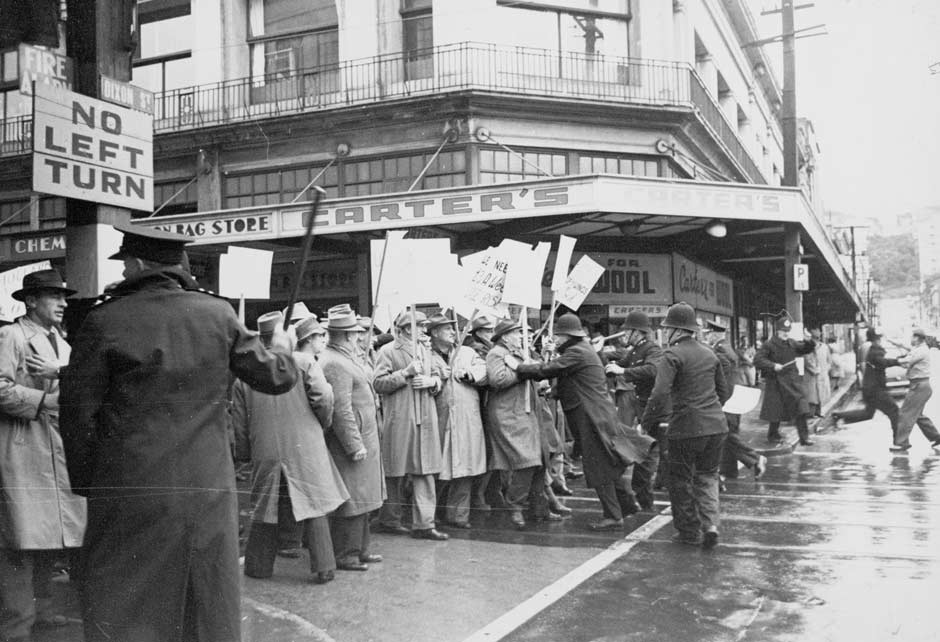
Police confront Watersider's protest march. Wellington, 1951.

This curious little posting over at The Standard caught my eye. In it "Irish Bill" rather piously informs his readers that the infamous Waterfront Lockout (which began on 27 February 1951) and even the Great Strike of 1913, are events which he "unlike other commentators on the Left" prefers to "commemorate" rather than "celebrate" because "in both cases working people suffered greatly for little gain".

Sadly, this rather sniffy attitude towards the two great industrial struggles of New Zealand history is all too typical of a certain kind of Labour Party member/supporter. To me, it betokens a disdainful attitude towards working-class independence in general, and militant trade unionism in particular. (The very best exponent of the mindset, even back when he was still a member of the NZLP, was Dr Michael Bassett, whose book, Confrontation ‘51 positively reeks of middle class superciliousness.)

Needless to say, I consider Irish Bill’s comments regarding the Lockout to be dead wrong. As Jock Barnes, himself, said in his foreword to Dick Scott’s celebrated 151 Days:

"As surely as night follows day, an offensive by the Holland Government against the workers of New Zealand was inevitable. And years of inspired press propaganda had made it clear that the New Zealand Waterside Workers Union would be objective number one. Its record of progressive thought and militant policy, not only for its own members but for the working class as a whole, had made that certain ….. But the intended blitzkrieg developed into a long and costly offensive. While thousands of workers, their wives and children, suffered dearly, money power took some mighty blows. It is still licking its wounds. The boss is always the worker’s greatest organiser, and [in 1951] he educated tens of thousands of workers in the fundamentals of capitalist economy. From that education the people will inevitably collect a rich dividend ….. The working class can thank those who fought [in 1951] for the conditions they still enjoy. Every day suffered by a miner’s wife and children, every further day that a freezing worker, watersider or seaman stood and fought back, reduced the chances of a general offensive."

In my book No Left Turn, I interogate Barnes's claims, but from a very different perspective to that of Irish Bill’s:

"Was [Barnes] right? Were the people of New Zealand, in ways which, for more than five decades, they have been actively discouraged from investigating, the genuine beneficiaries of the bitter industrial struggle that racked their little nation from 15 February until 15 July 1951? A swift survey of the principal historical judges of this event: Keith Sinclair, Bill Sutch, Michael Bassett, Bert Roth and James Belich; would suggest not. As far as New Zealand historiography is concerned "1951" was, at best, an heroic – if ultimately futile – reprise of 1913; further proof that the trade unions could not "take on the State and win". At worst, it was simply an avoidable and unmitigated disaster. But, as we shall see, 1951 marked not a sudden and irrational recrudescence of the insurrectionist impulses of 1908-1913, but the ruthless reimposition of the corporatist compromise between capital, labour and the state that was first broached in the depths of the Great Depression, and then consolidated through daily application during the Second World War. Adapting the union movement to the political and economic realities of Corporatism emerged as the prime political mission of the men who have emerged as the villains of the 1951 tragedy: Walsh and Young, Fraser and Nash. Their unacknowledged and unappreciated role? To keep the milk of Labour’s social and economic reforms, by separating out – and ruthlessly sacrificing – the cream of the labour movement."

For the next forty years, from 1951 to 1991, working people in New Zealand enjoyed the protection of the unqualified preference clause and national awards. Why? Because Sid Holland was really the worker’s friend? No. It was because Jock Barnes and the 20,000 trade unionists who held out against the Emergency Regulations for 151 days, taught the National Party a bitter lesson in the dangers of attempting to crush working class organisations by force majeure; just as Fintan Patrick Walsh and the moderate leaders of the Federation of Labour demonstrated to Holland and his successors the wisdom of maintaining a corporatist approach to industrial relations.

In this respect "1951" was not a defeat but a victory for the NZ working class. Their greatest defeat, in 1991, was visited upon them not at the hands of the traditional enemy, the National Party (although it did its best!) but from the hands of its own trade union leaders. Tragically, the CTU was led by men and women who, like Irish Bill, saw only defeat and failure in the great moments of working class resistance, and who forgot that, so long as you’re willing to fight, you can never truly lose. Because the example you provide for the generations to come of resistance to injustice, and self-sacrifice in a noble cause, is always in and of itself a triumph of the human spirit.