Showing posts with label Mainstream Media. Show all posts

Tuesday, 31 May 2022

Nanaia Mahuta’s Super-Narrative.

Dangerous Political Narrator? What this Labour Government risks is the emergence of what might be called a “super-narrative” in which all the negatives of co-governance, media capture, and Neo-Tribal Capitalism are rolled into one big story about the deliberate corruption of New Zealand democracy. The guilty parties would be an unholy alliance of Pakeha and Māori elites determined to keep public money flowing upwards into protected private hands. 

WHETHER NANAIA MAHUTA followed the conflict-of-interest rules set out in The Cabinet Manual hardly matters. A dangerous political narrative is forming around the appointment of, and awarding of contracts to, Mahuta’s whanau in circumstances that, at the very least, raise serious questions about this Government’s political judgement. Enlarging this narrative is the growing public perception that the mainstream news media is refusing to cover a story that would, in other circumstances, have attracted intense journalistic interest. The conflation of these two, highly damaging narratives with a third – the even more negative narrative of “co-governance” – has left the Labour Government in an extremely exposed and vulnerable position.

The Government’s failure to adequately prepare the New Zealand public for what Labour clearly regards as the inevitability of co-governance hasn’t helped. The party did not campaign on the issue, and kept He Puapua, the controversial “road-map” to full implementation of the United Nations Declaration on the Rights of Indigenous Peoples – i.e. co-governance – by 2040, under wraps. Similarly unheralded was the Government’s determination to establish a separate Māori Health Authority. And the application of co-governance principles to Mahuta’s deeply unpopular “Three Waters” project has done nothing to allay public fears that the country is being changed, in fundamental ways, without the electorate’s consent.

The apparent failure of the mainstream news media to follow up on the story is being attributed to the extraordinary conditions attached to the Public Interest Journalism Fund administered by New Zealand On Air. In essence, these conditions require media outlets in receipt of the Fund’s largesse to subscribe in advance to a highly contentious series of propositions concerning the Treaty of Waitangi – most particularly to the Waitangi Tribunal’s claim the Māori never ceded sovereignty to the British Crown, and that this “fact” requires the Fund’s recipients to accept and support the “partnership” model of Crown-Māori relations. The fear expressed by independent journalists is that the net effect of these conditions will be unquestioning mainstream media support for co-governance.

Since the widespread assumption among Pakeha New Zealanders is that co-governance and representative democracy are fundamentally incompatible, Labour’s willingness to be presented as co-governance’s friend runs the risk of being cast as democracy’s enemy.

Of even greater concern is the inevitability of this anti-democratic characterisation being extended to an ever-increasing fraction of the Māori population. Statements from Māori leaders appearing to discount the importance of, or even disparage, the principles of democracy have done little to slow this process. Neither have the intemperate statements of the former National Party Minister for Treaty Settlements, Chris Finlayson. His comment to the online magazine E-Tangata, describing those opposed to co-governance as “the KKK brigade”, merely reinforces the widespread public perception that the slightest public opposition to the proposed changes will bring down accusations of racism upon the opponent’s head.

The problem with this willingness to indulge in ad hominem attacks on people holding genuine reservations about the Government’s proposals is that more and more of them will decide that they might as well be hung for a sheep as a lamb, and embrace the very racism of which they stand accused. In this context, the revelations that some members of a Māori Minister of the Crown’s whanau have been the recipients of Government funds, and appointed to roles not unrelated to the furtherance of the Minister’s policies, will be taken as confirmation that all is not as it should be in Aotearoa-New Zealand.

What began as an anti-co-governance narrative, and then merged with an anti-mainstream news media narrative, risks joining with a much older and more deeply entrenched narrative concerning the entire Treaty settlement process. This is the narrative that identifies the primary beneficiaries of Treaty settlements as a collection of Crown-assembled tribal elites, along with their legal and commercial advisers. Over the past thirty years these “Neo-Tribal Capitalists” have been accused of investing hundreds-of-millions of taxpayer dollars in what amount to private tribal corporations, over which the intended recipients of these funds – hapu and whanau – exercise only the most indirect authority and receive only the most meagre of rewards.

The result could very easily be the emergence of what might be called a “super-narrative” in which all the negatives of co-governance, media capture, and Neo-Tribal Capitalism are rolled into one big story about the deliberate corruption of New Zealand democracy. The guilty parties would be an unholy alliance of Pakeha and Māori elites determined to keep public money flowing upwards into protected private hands. In this super-narrative, the structures set forth in He Puapua to secure tino rangatiratanga, will actually ensure the exclusion of the vast majority of New Zealanders from the key locations of power. The only positive consequence of which will be a common struggle for political and economic equality in which non-elite Māori and Pakeha will have every incentive to involve themselves.

The painful irony of this super-narrative scenario is that Labour will have positioned itself as its cause – not its remedy. Rather than repeating in the Twenty-First Century the fruitful political alliance between the Pakeha working-class and the victims/survivors of the deals done between the Crown and the Māori aristocracy in the Nineteenth and Twentieth, Labour will be seen to have facilitated the creation of a Treaty Partnership that not only undermines democracy, but also exacerbates the inequality between Māori and Pakeha, Pakeha and Pakeha, Māori and Māori.

What lies ahead, as the institutions of co-governance take shape, is the coming together of two very privileged birds of a feather: the Pakeha professionals and managers who have taken command of the society and economy created by Neoliberalism, and the Māori professionals and managers created to produce and operate the cultural and economic machinery of Neo-Tribal Capitalism.

This, ultimately, will be the spectre that arises out of the controversy swirling around Nanaia Mahuta. The spectre of the worst of both the Pakeha and the Māori worlds. Worlds in which the powerful trample all over the weak. Where tradition constrains the free exploration of ideas and techniques. And where the petty advantages of separation are elevated above the liberating effects of unity. Where “Aotearoa” creates two peoples out of one.


This essay was originally posted on The Daily Blog of Tuesday, 31 May 2022.

Tuesday, 18 May 2021

The TV3 Poll: Journalism or Propaganda?

Predictable “News”: Expecting the mainstream media to acknowledge its own deficiencies as the supposed protector and facilitator of democratic discussion and debate has become unrealistic. It no longer sees its role in such terms. Its responsibility, now, is to impart the truth – as officially defined – to the population, while doing everything within its power to ensure that this official version of reality is not effectively challenged by anyone – up to and including the Leader of the Opposition.

TV3’s PRESENTATION of the poll results delivered to them by Reid Research Ltd tells us a lot. The most important message to draw from the way it handled this “news” is how rapidly propaganda is replacing journalism in the mainstream news media. The data supplied by the pollsters confirms that there has been no major shift in political opinion since the general election of 17 October 2020. Given the decisiveness of the 2020 result, and the want of any developments of sufficient magnitude to cause Labour voters to change their minds, this stand-steady result should have come as no surprise. “Voters still happy with Jacinda” is not, however, a headline likely to stop viewers in their tracks. “Support for Judith Collins plummets”, on the other hand, just might.

Had TV3 been polling regularly since the election, with five or six sets of results accurately tracking the public’s feelings about the Leader of the Opposition; and had the latest results confirmed or confounded a rising or falling trendline; then such a headline might have been justified. But, TV3 has not been polling regularly. Indeed, the last poll it conducted was back in October 2020. Yes, that’s right, in the middle of last year’s election campaign. Naturally, the Leader of the Opposition was then polling around 18 percent. More than six months after losing the election by an historic margin, she is polling around 6 percent as New Zealand’s preferred prime minister. Well, gosh! What a surprise! Clearly, Collins’ days are numbered.

But wait, there’s more. Tova O’Brien, TV3’s political editor, would have known that Collins’ numbers were bound to drop back over a period of six months. The temptation would have been strong, therefore, to attach her predictably “plummeting” numbers to her recent campaign to elicit a coherent government response to the He Puapua Report, and whether or not it is guiding government policy.

Any failure to reproduce the extraordinary 17 percentage point surge in National’s numbers generated by Collins’ predecessor’s, Don Brash’s, in/famous “Orewa Speech”, would allow O’Brien and her colleagues to paint Collins’ He Puapua campaign as a flop. Even better, it would allow them to present the poll data as proof that New Zealanders have grown up and grown out of racial politics.

Just to be sure, however, O’Brien inserted a couple of questions to drive that message home. Were the Government’s policies separatist? she had Reid Research ask. And: Were the Opposition’s criticisms divisive? Entirely unsurprisingly, between 40 percent and half of respondents thought the government wasn’t being separatist, and that the Opposition was being divisive. For good measure, the viewers were further informed that roughly a quarter of National voters thought their party was being divisive and about the same number of Labour voters saw their party as separatist. All of which added up to? Almost nothing at all that was helpful.

Of much more use to TV3’s viewers would have been a carefully worded series of questions aimed at discovering just how much people knew about the He Puapua Report, and seeking their reaction to some of its recommendations. Ah, yes, but that would have cost TV3 an arm and a leg. It would also, almost certainly, have shown that most Kiwis know next-to-nothing about He Puapua, or its recommendations; and that, when appraised of some of the report’s more radical proposals, their responses tend to be less than favourable.

Of course, the responsibility for the public’s general ignorance about He Puapua, and the general direction of travel favoured by its authors, rests squarely with the likes of Ms O’Brien. Realistically-speaking, however, expecting the mainstream media to acknowledge its own deficiencies as the supposed protector and facilitator of democratic discussion and debate would be foolish. The mainstream media no longer sees its role in such terms. Its responsibility, now, is to impart the truth – as officially defined – to the population, while doing everything within its power to ensure that this official version of reality is not effectively challenged by anyone – up to and including the Leader of the Opposition.

This is how it works now. If a potentially damaging report like He Puapua makes it into the public arena, do not under any circumstances attempt to inform the public accurately and dispassionately about its contents. Instead, brand any publicly voiced misgivings about the report’s recommendations as “racist”. Give maximum coverage to accusations and recriminations arising from politicians’ responses to the report, and highlight the alleged divisiveness of their attempts to question or challenge its findings. Then, commission a poll, the entirely predictable results of which can be used to discredit the report’s critics: most particularly the leader of the political party most heavily invested in challenging its officially sanctioned version of reality.

It’s a game played out every day in Moscow and Beijing. The only serious distinction between the players there, and the players here, being that ‘there’ they know that the name of the game is “Propaganda”; while ‘here’ they still think it’s called “Journalism”.


This essay was originally posted on The Daily Blog of Tuesday, 18 May 2021.

Friday, 1 March 2019

The Media’s Double Standards.

Rubbisn-In, Rubbish-Out: If professional journalism, undertaken with courage and diligence, produces only what the powerful want us to hear, then our journalists are truly lost. In spite of their education and training, they have so profoundly internalised the values and expectations of their masters that their journalism can only reflect the interests of the people who pay them.

PRESIDENT DONALD TRUMP has been in Hanoi, talking peace with Kim Jong Un. The “Supreme leader” of the Democratic People’s Republic of Korea (DPRK) who sat across the table from the American President, has never faced any kind of election that would be recognised as fair and free – let alone democratic – by the United Nations. Indeed, the totalitarian Workers Party regime presides over a vast network of concentration camps teeming with political prisoners.

Economically speaking, the DPRK is fragile. In recent decades, its people have suffered a succession of devastating famines during which thousands of men, women and children are reported to have died of hunger and hunger-related diseases.

In marked contrast to the Islamic Republic of Iran, the DPRK possesses multiple nuclear warheads, and claims to have tested missiles capable of raining down devastation on the United States of America.

None of these facts dissuaded President Trump from praising Kin Jong Un or, indeed, referring to him as his friend.

This should not be construed as a condemnation of the US leader. In the memorable words of Winston Churchill: “Jaw, jaw is better than war, war.” If the meeting in Hanoi between Trump and Kim has eased military tensions on the Korean peninsula, even to a small degree, then the world should be mightily relieved and both men will fully deserve the international praise heaped upon them.

Serious questions do arise from the Hanoi Summit, however, concerning diplomatic and journalistic consistency. The United States and the Western news media both need to explain why the measured diplomacy and largely accurate reporting on display in Hanoi, has been so conspicuously absent with regard to Venezuela. The naked diplomatic aggression and outright lies which have characterised the West’s treatment of the Venezuelan Government could hardly be more different from its handling of the DPRK’s “Supreme Leader”.

The President of Venezuela, Nicolas Maduro and his fellow Chavistas have, since coming to power in 1998, submitted themselves to – and won – a plethora of democratic elections and constitutional referenda. Many of these have been confirmed as fair and free by no less an observer than the former US President, Jimmy Carter.

Venezuela, unlike the DPRK, is not studded with concentration camps teeming with political prisoners. On the contrary, the streets of Venezuela are teeming with Maduro’s political opponents. Many of these, supported by the United States, have engaged in acts of extreme violence against the Venezuelan Police and National Guard. Rather than respond with deadly force, however, the forces of law and order have consistently restricted themselves to non-lethal means of dispersing Venezuela's far-right protesters.

Where comparisons with the DPRK can be drawn is in relation to economic management. Maduro’s period in office has been marred by runaway inflation and severe shortages. These have given rise to widespread economic hardship and political frustration. Unlike the DPRK, however, Venezuela’s economic difficulties are driven by a combination of low oil prices and the deliberate economic sabotage instigated by Venezuela’s capitalist elites and their US backers. They are not the result of diverting all available resources to the production of a deadly nuclear arsenal. The only diversion of resources of which the Chavistas are guilty is from the state’s oil revenues to the Venezuelan poor.

The explanation for the United States oppressive behaviour towards Venezuela is readily available in any reputable history of the USA’s tutelary relationship with the nations of Latin America. Perceiving itself as the benevolent guardian of all those peoples unlucky enough to live south of the Rio Grande, the United States has intervened again and again. Refusing to sit idly by while its diplomatic wards embraced to the evils of “communism”, due, in the words of the former US Secretary of State, Henry Kissinger, to “the irresponsibility of their own people”.

But if the American state is straightforwardly imperialistic in its motivation, what is the Western media’s excuse? Why do the editors and journalists of not only the United States and its Nato allies, but also of supposedly free and independent nations like New Zealand, abandon all pretence of discovering and disseminating the truth to parrot the blatant lies of Venezuela’s enemies?

What would happen if One News or the Herald decided to see for itself what was really happening inside Venezuela and along her borders? What would befall the Kiwi journalist who made a point of speaking to the politicians of both the Left and the Right; to the inhabitants of the wealthy suburbs above Caracas, as well as those buried in its overcrowded slums; to police officers and national guardsmen as well as right-wing student protesters; to workers as well as peasants? Would he or she emerge from the exercise spouting exactly the same lines as the US State Department?

If the answer to that question is “Yes”, then we have a very big problem. If professional journalism, undertaken with courage and diligence, produces only what the powerful want us to hear, then our journalists are truly lost. In spite of their education and training, they have so profoundly internalised the values and expectations of their masters that their journalism can only reflect the interests of the people who pay them.

That’s a very grim conclusion, but what other is possible? When the American President can smile benignly at the “Supreme Leader” of a brutal totalitarian regime with nary a word of condemnation from our mainstream news media; but, in the first item up after the ad-break, the democratically-elected leader of a free, if bitterly divided, nation is routinely denounced as a brutal dictator?

This essay was originally posted on The Daily Blog of Friday, 1 March 2019.

Thursday, 3 July 2014

A Factoid Is Born

Honestly, John's Victory Was This Big! The ease with which false information can be transformed into an ostensible statement of fact is unnerving. Simply by appearing in print, Steven Joyce's boast to National's annual conference about the scale of its electoral success made the transition from falsehood to factoid.

HAVE YOU EVER witnessed the birth of a political “factoid”?  A fact-what? A factoid, which is defined by the Free Merriam Dictionary as “an invented fact believed to be true because it appears in print.” In this instance, the “invented fact” made its first appearance last Saturday in Steven Joyce’s speech to his party’s annual conference in Wellington.
 
As National’s key campaign strategist, it was Mr Joyce’s job to drum home to conference delegates the extreme political danger of complacency. National must maximise its Party Vote, he warned them, because all of its potential coalition partners are so very, very small.
 
“We have got to look at matching the number we got last time which just happens to be the highest ever under MMP and I think the highest single vote for a party since the Waterfront Strike in 1951.”
 
And there it is – the factoid: National’s 2011 Party Vote was the highest ever under MMP and the highest vote achieved by any single party since 1951.
 
Now a factoid wouldn’t be a factoid if it didn’t bear some resemblance to the truth – and this example is no exception. At 47.31 percent, National’s 2011 Party Vote (and let’s remind ourselves here that the “Party Vote” is a measure specific to the MMP system) was indeed the highest ever recorded. It was also an astonishing achievement. Proportional voting systems hardly ever deliver so decisive a result.
 
Had he been of a mind, Mr Joyce might have expanded upon National’s 2011 performance by pointing out that it was 2.38 percentage points higher than its record 2008 result. After all, how often is it that a party, seeking re-election, actually registers an increase in its popular support? Rubbing salt into the floundering Opposition’s polling wounds, Mr Joyce might also have drawn delegates’ attention to Labour’s best performance under MMP: the modest 41.26 percent of the Party Vote it attracted in 2002.
 
So, National’s record Party Vote of 47.31 percent really is worth bragging about – and that’s a fact. But the second part of Mr Joyce’s boast – about it being the highest vote any party has achieved since the snap election of 1951 – well, that isn’t true at all.
 
Now, to be fair to Mr Joyce, he did only say that he thought National’s was the highest single vote for a party since the Waterfront Strike in 1951. He did not state it as a fact.
 
What he did do, however, and very cleverly, was associate John Key’s remarkable electoral achievements of 2008 and 2011 with the event that stands in National’s institutional memory as the party’s greatest ever victory over the forces of the Left.
 
Held in the bitter aftermath of the tumultuous Waterfront Dispute – New Zealand’s worst ever industrial confrontation – the snap election of 1951 marked the beginning of the National Party’s long ascendancy in post-war New Zealand politics. In the 33 years which separate 1951 from 1984, Labour held office for just 6 years.
 
National’s share of the popular vote in 1951? A decisive 54 percent. Ominously for the Labour Party, that election also took place in September.
 
Perhaps it was the latest Faifax-Ipsos poll showing National on 56.5 percent that reminded Mr Joyce of the 1951 election – the last in which a political party would take over half the popular vote.
 
Which is not to say that Labour and National haven’t in the intervening years come pretty close. In 1972, for example, the Norman Kirk-led Labour Party secured 48.4 percent of the popular vote. National’s Rob Muldoon romped home in 1975 with 47.6 percent. In 1987 David Lange lifted Labour’s 1984 total of 42.9 percent to 47.9 percent. Jim Bolger swept into office in 1990 with 47.82 percent of the popular vote – National’s best effort since 1951.
 
Mr Key’s 47.31 percent was an excellent effort (especially considering it was achieved under an electoral system designed to prevent a single party getting anything like half the votes cast) but it was NOT the highest single vote for a party since the Waterfront Strike in 1951.
 
Except that, by the following day, it was. Overnight, Mr Joyce’s thought had become a factoid, with Tracy Watkins writing in the Sunday Star-Times:
 
“He does not need to remind them either that at 47.3 percent support on election night 2011, National got the highest vote ever under MMP – and the highest vote achieved by any single party since the 1951 Waterfront Strike.”
 
It was that simple – and that quick. And you may be sure this new political factoid will be deployed by National supporters throughout the forthcoming campaign. Let the voters beware, because it won’t be the only one!
 
Oh, and in case you’re wondering, the highest vote ever received by a New Zealand political party was Labour’s triumphant 55.8 percent – way back in 1938.
 
This essay was originally published in The Press of Tuesday, 1 July 2014.

Friday, 24 July 2009

Beyond Reasonable Rout

No room for reason: "Alice felt dreadfully puzzled. The Hatter's remark seemed to have no sort of meaning in it, and yet it was certainly English. `I don't quite understand you,' she said, as politely as she could." New Zealand politics and Lewis Carrol's "Wonderland" seem to have more and more in common.

IT’S one of the most alarming sentences I’ve ever read – made all the more disturbing by being written by one of this country’s most respected journalists.

This is what The New Zealand Herald’s political correspondent, John Armstrong, wrote: "However, her major political crime was to be guilty of sounding reasonable."

Is this where we are now? At the point where a Minister of the Crown can expose herself to serious political criticism for behaving reasonably?

The event which prompted Mr Armstrong’s "guilty" verdict was the controversy surrounding the addition of folic acid to bread.

When this measure was first suggested by health professionals trying to reduce the number of babies born each year with neural tube defects like Spina Bifida, it was met with broad cross-party support by our legislators.

The overwhelming consensus among the international scientific community was that fortifying the population’s dietary staple in this way was not only extremely safe, but that it would also contribute significantly to reducing the individual and family suffering inevitably associated with such serious disabilities.

The Australians were ready to join the other Western nations (including the USA and the UK) already protecting their expectant mothers by fortifying flour-based products with Vitamin B, and New Zealand’s Labour-led Government voted to follow suit.

And that is where the matter should have rested. Tragically, however, a substantial proportion of the general public, whipped into an irrational frenzy by the Food & Grocery Council’s CEO (and former National Party MP) Katherine Rich, and kept in that excited state by a handful of journalists and politicians, has spooked the National-led Government into suspending the folic acid programme.

As Mr Armstrong put it: "In such circumstances, scientific logic and reason is the first casualty."

There is no disputing that the new Food Safety Minister, Kate Wilkinson, lacked the requisite media savvy to withstand the live-to-air joint assault by Paul Holmes and Green MP, Sue Kedgeley, on TVNZ’s Q&A programme. Crucially, it was the Minister’s poor television "performance" – not the merits of the case – which, it’s generally agreed by New Zealand’s leading media commentators, doomed the folic acid programme to defeat.

As political commentator, Matthew Hooton, put it on Radio New Zealand-National’s Nine-to-Noon programme: "You do wonder: if Kate Wilkinson had been representing the Food & Grocery Council, and Katherine Rich had been the one who ended up being the Minister, whether there would have been a different result."

But is this really the way we want our country to be governed? Are we really content to let the fate of a scientifically sanctioned, utterly reasonable, and socially compassionate policy be determined by how well a particular minister performs in the intricately scripted and crassly artificial world of television? If it is, then we will have exchanged government policies based on scientific evidence and reasoned argument, for policies based on electronic demagoguery and the baying of the mob.

And we shouldn’t kid ourselves that there’s nothing morally wrong with the idea of turning politics into a kind of reality-tv show, in which unpopular policies are "voted off the island" by an electorate motivated by carefully contrived anxieties and insatiable greed.

Over the course of the next three years, more than a dozen babies who need not have been will be born with Spina Bifida. They and their families will suffer horribly – and unnecessarily – for the rest of their lives because the Food & Grocery Council demonstrated a more effective grasp of the principles of public relations than a handful of over-worked doctors.

Their mistake was to believe, along with the political philosopher Maurice Glassman, that: "The distinction between necessary and unnecessary suffering defines the limits of political rationality. In delineating a domain of pain which is amenable to concerted public amelioration from a sphere of grief that is immutable, it defines the power of society to respond to the miseries of life."

Confronted with the misery of Spina Bifida, and given the opportunity to ameliorate that misery through concerted public action, New Zealanders, through their government, have opted to leave the "domain of pain" undiminished.

We had the chance to reduce the unnecessary suffering of our fellow citizens, and we chose not to.

The best we can say of ourselves now, is that Mr Armstrong is unlikely to find us guilty of either "political rationality", or "sounding reasonable".

This essay was originally published in The Dominion Post, The Timaru Herald, The Taranaki Daily News, The Otago Daily Times, and The Greymouth Evening Star of Friday, 24 July 2009.

Monday, 25 May 2009

Making the Protest Count

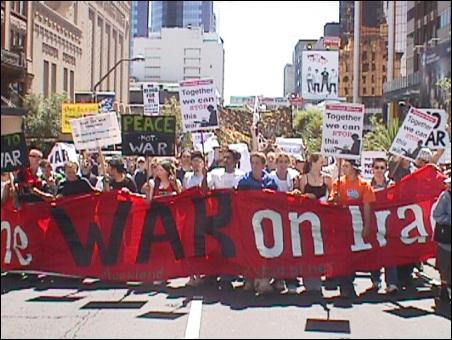
Auckland's last really big political demonstration, the 2003 protest against the Iraq War. The march stretched the full length of lower Queen Street, and was estimated at 20-25,000 strong. Today's hikoi (no pics available as yet) was the same size - but the mainstream news media put its strength at between 2,000 and 7,000. Why?

I’VE JUST RETURNED from the Auckland hikoi to discover that the mainstream news media are downplaying the significance of the demonstration by citing absurdly low estimates of the turnout.

Radio New Zealand is the worst offender, running for the past two hours with a figure of 2,000 (barely enough people to fill a city block).

The NZ Herald at least quotes a police officer, whose (wildly inaccurate) estimate was 5,000-7,000 marchers.

Now, let’s get real.

The march extended the full length of lower Queen Street – i.e. from the assembly-point in QEII Square to the Town Hall.

Just so we’re clear: that means that as the front ranks were arriving at the Town Hall, the last ranks were leaving the Square.

What’s more, the marchers occupied the full width of the carriageway – i.e. they stretched right across the road, from pavement to pavement.

This makes the calculation of the demonstration’s size very simple – if you know your history.

Since the late-1960s there have been several demonstrations that occupied the whole of lower Queen Street. There was the 1971 "Mobe" (mobilisation) against the Vietnam War. Ten years later there was the May 1st "Mobilsation Against the Tour" march up Queen Street. In 1983 there was a big union protest against Muldoon’s Wage-Price Freeze. In 1991 there was an even bigger union protest against the Employment Contracts Bill. In 2002 there was the Anti-GE March, and in 2003, Auckland’s last really big demonstration – until today – against the Iraq War.

Contemporary media cited those protests at between 20,000 and 30,000 strong.

Have human-beings doubled or tripled in size since 2003? Of course not! So where do these absurd figures of 2,000, 5,000 and 7,000 come from?

Is it because the reporters on the spot (and the policemen) have so little experience of large political demonstrations that they simply have no idea how to estimate their true size? I hope so, because the alternative – that reporters and the Police are deliberately underestimating the size of the protest for political/ideological reasons – is just too upsetting to contemplate.

Something historic happened on the streets of Auckland today. It would be nice if the news media could report it accurately.

FOOTNOTE: If we assume lower Queen Street to be roughly a kilometre in length and about 30 metres wide we get an area of 30,000 square metres. Now, if every protester is assumed to occupy just one square metre of space as he or she moves up Queen Street – that’s a maximum of 30,000 protesters, or, allowing for the odd gap, a minimum of 20,000. Basic arithmetic, really. What’s the matter with all our journalists!