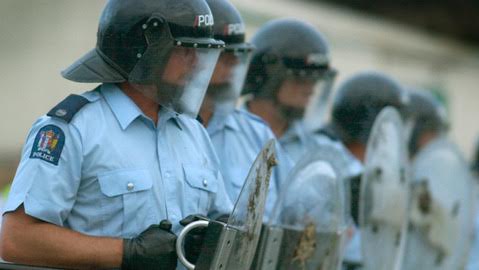
Showing posts with label 1981 Springbok Tour Protests. Show all posts

Monday, 18 November 2024

Unstoppable.

Too Big To Fail: Forty-three years after the 1981 Springbok Tour protests, Maori defenders of te Tiriti, by their own efforts, and using their own resources, are poised to descend on the capital with upwards of 100,000 followers at their back, and no force in front of them even remotely capable of turning them around.

THE ORGANISERS OF THE Hīkoi mō te Tiriti are predicting record-breaking numbers. As the advancing column of runners, marchers, and cars approaches the capital, its numbers are expected to swell into the hundreds-of-thousands. If these predictions are borne out by events, then the Hīkoi mō te Tiriti will, indeed, be the largest protest demonstration in New Zealand’s political history.

Although no single demonstration associated with the 1981 Springbok Tour came anywhere near 100,000 participants, the 56 days of the Tour, and the months leading up to it, indisputably witnessed in excess of 100,000 protesters on New Zealand’s streets.

Significantly, the convulsions of 1981 and the record numbers participating in the Hīkoi mō te Tiriti are not unrelated historically. The lessons drawn from 1981 by an entire generation of progressive activists have, in the intervening 43 years, resolved themselves into a seemingly unstoppable ideological narrative. That narrative now constitutes the driving-force behind the movement toward decolonisation and indigenisation.

The nationwide campaign to end sporting contacts with Apartheid South Africa began as a fight to see the guarantee of human equality embodied in the United Nations Universal Declaration of Human Rights upheld by the New Zealand Government. The Republic of South Africa had been suspended from the UN in 1974 for its refusal to observe the principles enshrined in the Declaration. Playing Rugby with a side purporting to “represent” South Africa was, accordingly, condemned by many New Zealanders as morally indefensible.

In New Zealand’s churches, universities, professional associations and trade unions, this opposition to the 1981 Springbok Tour was deeply entrenched. In the New Zealand of the early-1980s, however, the nation’s demographic structure more-or-less guaranteed that a very large percentage of the population would remain unmoved by the arguments of the Tour’s opponents. Rugby was hugely important to New Zealanders, more than half of whom, according to the opinion polls of the day, were anxious to “keep politics out of sport”.

These New Zealanders had a powerful champion in their country’s National Party prime minister, Rob Muldoon. Presenting himself as the defender of the “ordinary bloke”, he cast the Tour’s opponents as, at best, snobbish intellectuals, and, at worst, subversive communists. In this he could rely upon the nation’s news media, both private and public, to take such accusations seriously. The instincts of most publishers, broadcasters and editors in 1981 were deeply conservative. Many of them regarded protest demonstrations as potentially dangerous attempts to apply extra-parliamentary pressure upon the nation’s democratically elected representatives.

Contrast Muldoon’s strong opposition from the top in 1981 with the way in which the Hīkoi mō te Tiriti has been treated by Prime Minister Christopher Luxon in 2024. National’s leader has been careful not to openly criticise or condemn the Hikoi – with whose bitter criticisms of the Act Party leader’s Treaty Principles Bill he claims to be in at least partial agreement. Luxon and his government have also been careful to affirm publicly the right of New Zealanders to engage in peaceful protest. No thought in 2024 of portraying the Hikoi participants as enemies of anything so retrograde as the “ordinary bloke”.

The behaviour of the mainstream news media in 2024 offers an even stronger contrast with the way events were covered in 1981. From the moment the Hīkoi mō te Tiriti began its long journey to Wellington, the nation’s largest media operations have presented it as something akin to the living embodiment of the nation’s best and truest instincts.

At least one editorial leader-writer has depicted the Hikoi as a powerful and much needed corrective to the “colonial” attitudes embodied in Seymour’s bill. The possibility that 100,000 angry citizens massed outside the New Zealand Parliament might constitute a serious threat to the safety and security of the country’s democratic institutions does not appear to have given the nation’s journalists pause. Or, if it has, then the prospect of Members of Parliament – especially ACT MPs – being sorted-out and set-straight by the people is not one that bothers them unduly.

Clearly, much has changed since 1981. Certainly, the three Treaty principles set forth in Seymour’s bill (the language of which carries strong echoes of the Universal Declaration of Human Rights) would have been warmly endorsed by the overwhelming majority of New Zealanders 43 years ago. How, then, has this extraordinary transformation: from multiple demonstrations against the denial of human equality, to a nation-spanning hikoi denouncing its legislative affirmation; been accomplished?

The big idea driving the shift, both here and overseas, in the 1970s and 80s was that white people are blind to their own racism. In biblical terms, Europeans are very good at drawing attention to the mote in other peoples’ eyes, all the while ignoring the whopping great beam that is in their own.

How is it, demanded the Māori who’d marched alongside Pakeha anti-tour protesters, that you could become so incensed by the racism of white South Africa’s apartheid system, but had so little to say about the racist foundations of your own nation?

You took our land, built a happy little colonial state on top of it, and left us to contemplate your generous legacy of ruin and loss. The strategies we adopted for our own survival, most of which reflected our need to avoid te Riri Pakeha – the anger of the white man – you interpreted as evidence of our easy-going good-nature, and patted yourselves on the back for presiding over the “best race-relations in the world” The treaty our ancestors signed in 1840, in which the British Crown promised to protect the autonomy and resources of our tribes, your Chief Justice casually dismissed, just 37 years later, as “a simple nullity”. You’ll understand, then, if we look at you Pakeha and see nothing but a bunch of bloody hypocrites!

It was a list of charges to which the progressive Pakeha Left had no convincing answers, other than to hang their heads in guilt and shame, and promise to do all within their power to right the wrongs of colonisation, and restore to the maximum extent possible the rights of Aotearoa’s indigenous people.

That they chose to do this through the courts, rather than through Parliament, is a reflection of the fear and loathing many anti-tour protesters, university students in particular, took away from their encounters with supporters of the Springbok Tour. That these people were racists went without saying, but the vicious sexism experienced by female protesters came as a nasty shock. Male protesters were equally stunned by the homophobic slurs hurled at them by rugby supporters.

Obviously, from the progressive perspective, National Party voters could not to be trusted to do the right thing. But, sadly, neither could the party of the working class. Far too many Labour voters had been willing to abandon their democratic-socialist ideals for a game of footy. Long before Hilary Clinton came up with the description, New Zealand’s progressives made it their business to ensure that the important business of decolonising and indigenising Aotearoa was kept as far away as possible from such deplorable citizens.

A lot can happen in 43 years. New Zealand jurisprudence can be radically reoriented. The National Party can atone for the sins of Rob Muldoon by initiating the Treaty Settlement Process. Apart from its votes, Labour can give up expecting anything from, or doing very much for, the New Zealand working-class. Te Tiriti, itself, can cease to be regarded as a simple nullity and become New Zealand’s foundational constitutional document. From around 10 percent, Māori can grow to 20 percent of the population.

Most importantly, from being a noisy and morally aggravating adjunct to the anti-apartheid movement in 1981, Māori defenders of te Tiriti, in 2024, by their own efforts, and using their own resources, can descend upon New Zealand’s capital city with upwards of 100,000 followers at their back, and no force in front of them even remotely capable of turning them around.


This essay was posted exclusively on the Bowalley Road blog of Monday, 18 November 2024.

Saturday, 10 June 2023

Unequal To The Task?

A Dark Day: More than 40 years of affirming New Zealanders’ Right to Protest had left the NZ Police without the training or the equipment to “move on” hundreds of determined protesters (many of whom were working-class battlers and not at all averse to mixing-it-up with the cops). It took weeks to assemble the person-power necessary to clear the anti-vaccination mandates protesters’ encampment from Parliament Grounds. 

THOSE WHO DISMISS mass political protest as historically ephemeral, leaving nothing of significance behind it, are wrong. The Springbok Tour protests of 1981 made a huge impression on the NZ Police. So much so that, in the 40 years that have elapsed since the Tour, the policing of political protest in New Zealand has undergone a profound change. Just how vulnerable that change has left the New Zealand people was made frighteningly clear during the occupation and eventual clearing of Parliament Grounds in 2022. If the NZ Police are not now conducting a root-and-branch reform of their political protest policing methods, then they are failing in their duty as protectors of the state and its citizens.

In the weeks and months that followed the Springbok Tour, the Police found themselves repeatedly humiliated in the New Zealand courts. Thousands of New Zealanders had been arrested during the Tour but only a tiny minority of them were convicted – and even fewer were jailed. In case after case it became clear that, right from the start, the Judiciary had been ill-disposed towards the Tour, would rather it had not taken place, and were not prepared to saddle those who had protested against it with a criminal record. Consequently, only those guilty of the most egregious acts of protest (especially those involving aircraft) were subjected to the full rigor of the law.

The Judiciary’s unwillingness to punish protesters conveyed a disturbing message to the Police. On some issues, the usual close co-operation between the Judiciary and the Police could not be relied upon – quite the reverse, in fact. As instanced by the famous case in which protesters pled “Not Guilty” to being unlawfully on a building, but without the intent of committing any other offence. Their lawyer argued that his clients had every intent of committing other offences – hence their “Not Guilty” plea. The Judge, clearly amused, acquitted the defendants. The look of dismay and bewilderment on the face of the Police Sergeant prosecuting the case is readily imagined!

It did not take the Police very long to realise that they were being told to go easy on the sort of people who participate in protests against morally indefensible systems like Apartheid, and/or the pernicious ideologies that spawn them. Regardless of the fact that they are sworn to uphold the law, while it remains the law, Police researchers were left in little doubt that, in the Tour’s aftermath, a great many members of the New Zealand public identified the Police as the Government’s enforcers and the Springboks’ protectors. More bluntly, the Police had made it possible for an immoral and divisive tour by a racist Rugby team to go ahead.

The research data was unequivocal: the policing of the Springbok Tour protests had resulted in a significant decline in the public’s trust and confidence in the NZ Police. Worse, the people whose trust and confidence had been dented the most were, by-and-large, members of the urban professional middle-class. This was not a social formation whose support the Police could afford to lose. Their skills, coupled with their location in the power-structure, made them indispensable mouthpieces for, and buttresses of, the state. The working-class was expected to despise the fists and boots of the Police – but not the middle-class. Henceforth, its protesting children would be treated with kid gloves.

Winning back the trust and confidence of the urban professional middle-class wasn’t the only, or even the most daunting, of the challenges facing the NZ Police after the Springbok Tour. Police commanders were acutely aware that in policing the Tour their human and material resources had been stretched to the limit. Had someone been killed in the protests, the Police’s ability to preserve law and order without resorting to deadly force would likely have been exceeded. As it was, on the day of the Third Test between the Springboks and the All Blacks serious violence broke out on the streets surrounding Eden Park. Armed naval personnel from HMNZS Philomel were very close to being called to the assistance of the Civil Power. Deadly force came within an ace of being used.

Senior Police and the nation’s political leaders would have been aware of just what a near-run thing they had lived through in 1981. Very few of them, if any, would have wanted to risk another highly organised challenge to government policy.

The more thoughtful among them would have considered the policing of the Springbok Tour alongside the Police operation mounted three years earlier at Bastion Point. Clearing away the Māori occupiers of the Point had required an enormous number of Police officers, backed by significant logistical support from the NZ Defence Force. Politicians, public servants, police commanders and senior defence personnel, seeing the effort required to clear a few hundred protesters, operating in a single city, would have shuddered at the thought of one, two, many Bastion Points. In such circumstances, the use of deadly force would be inevitable.

But, even the possibility of the state resorting to deadly force was abhorrent to most New Zealanders – as the Police would learn the hard way in 2007 during the course of Operation Eight. The possibility of an armed terrorist cell training in the Ureweras could not be ignored by the Police – and it wasn’t. The deployment of masked police officers wearing helmets, body armour, and carrying semi-automatic rifles to the tiny settlement of Ruatoki, however, shocked and angered not only the local Tuhoe iwi, but also that same urban professional middle-class whose support for the Police had been so sorely tested 26 years before. Once again, the Judiciary and its minions were less-than-impressed. Once again the Police were humiliated.

The cumulative effect of these lessons in how far the Police’s “social licence” might be stretched was on display in February-March 2022 when Parliament Grounds were occupied by hundreds of New Zealanders protesting against the Labour Government’s handling of the Covid-19 Pandemic – most particularly its coercive vaccination mandates.

Over and over again, New Zealanders heard the Police Commissioner, Andrew Coster, reiterate the citizen’s “Right to Protest”.

Confronted by protesters who refused to play by the rules, however, Coster and his commanders were at a loss. Their confusion grew when the all-important urban professional middle-class began insisting that the Police clear the grounds – by any means necessary. The same people who had objected to 81’s riot squads, and the gun-toting “ninjas” at Ruatoki, were now insisting that Coster’s officers start cracking heads.

Except that more than 40 years of affirming New Zealanders’ Right to Protest had left the NZ Police without the training or the equipment to “move on” hundreds of determined protesters (many of whom were working-class battlers and not at all averse to mixing-it-up with the cops). The Police’s first attempt to enforce the law ended in ignominious retreat, and it took weeks to assemble the person-power necessary to clear the protesters’ encampment. Even then, the operation ended in fire and fury on a scale not seen in this country for 90 years.

Horrified New Zealanders, looking at the extraordinary photograph of Police officers with their backs to a granite wall, huddled together and cowering behind their Perspex shields, as all manner of missiles are hurled at them by furious protesters, suddenly realised that their state was no longer equal to the task of protecting its citizens from serious political violence.

What was (just) possible in 1978 and 1981, had ceased to be a sure-thing by 2022. And, on all three occasions, it was political protest that provided the critical test of what New Zealanders were – and were not – prepared to tolerate from the forces of the state.


This essay was originally posted on The Daily Blog of Friday, 9 June 2023.

Friday, 9 July 2021

Forty Years After.

Angry Encounters: New Zealand was extraordinarily lucky that no one – on either side of the Police barricades – was killed in the 1981 Springbok Tour protests. So high were feelings running that a murderous cycle of retaliation could very easily have been set in motion – with tragic and politically poisonous consequences.

FORTY YEARS AGO, New Zealand was convulsed by mass protests against the touring Springbok Rugby team. For 56 days, in big cities and small provincial towns, tens-of-thousands of New Zealanders risked injury and arrest to obstruct the South African tourists’ progress. Hamilton’s Rugby Park pitch was invaded by several hundred anti-tour protesters who, aided by what today would be described as a ‘credible terrorist threat’, succeeded in having the game called off. (A Waiuku farmer, Pat MacQuarrie, seemed ready to fly a rented Cessna aircraft into the stands, and the Police Commissioner could not be sure he was bluffing.)

New Zealand was extraordinarily lucky that no one – on either side of the Police barricades – was killed in the Springbok Tour protests. So high were feelings running that a murderous cycle of retaliation could very easily have been set in motion – with tragic and politically poisonous consequences.

Throughout the protests, however, one vital piece of information remained uppermost in the anti-tour movement’s strategic deliberations. They were a minority – and a relatively small minority at that. Set against the scores-of-thousands of Rugby fans who packed the stands, the thousands protesting outside Carisbrook, Lancaster, Athletic and Eden Parks must have looked pretty feeble. New Zealanders who believed that politics and sport should be kept separate vastly outnumbered those who argued that, thanks to Apartheid, the two had become inseparable. In 1981, the battle for the hearts and minds of the majority had yet to be won by the opponents of racism.

Being in the minority does, however, allow protesters to bear witness to their beliefs with the moral strength that numerical weakness often, paradoxically, confers upon a cause. Even their opponents can be impressed by the dogged determination and courage displayed by those willing to put their bodies on the line – non-violently – for a principle they hold dear. Think Gandhi. Think Dr Martin Luther King.

Forty years on, however, I can’t help thinking how self-righteous we must have seemed to a great many of our fellow citizens. There is a famous incident described by Geoff Chapple in his book 1981: The Tour:

“‘What is this? A rising of the workers?’ Yelled a passer-by on his way to the [Hamilton] game. ‘You’d better hope not fella,’ [Tim] Shadbolt yelled back. ‘Because most of the workers are down in the park.’”

The protest movement against the Springbok Tour was, overwhelmingly, a movement of the educated middle-class – and their offspring.

A few years later, in the clutches of Rogernomics, I often asked myself whether the indifference of so many tertiary-educated middle-class New Zealanders to the suffering of the working-class victims of the Fourth Labour Government’s brutal reforms was in some strange way an expression of their contempt for (and fear of) the “Rugby Thugs” who backed the Springbok Tour.

That formative historical event certainly widened many of the fissures dividing New Zealand society in the 1970s and 80s. The Tour exposed a lot of ugly truths about the way Kiwi men regarded Kiwi women. It shone a light on the tortured relationship between Maori and Pakeha. Most of all, however, it revealed the vast gulf between the educated middle-class and the people Rob Muldoon, the prime minister who made the Tour possible, liked to call “the ordinary Kiwi bloke”.

At the end of those eight tumultuous weeks the pollsters of the day discovered something quite remarkable. Public opinion had shifted. No longer was the support for sporting contacts with South Africa anything like so one-sided. Whether New Zealanders’ change of mind was due simply to the vituperation and violence unleashed by the tour; or to the penny finally dropping on the true meaning of apartheid; it became clearer and clearer that they didn’t want any more years like 1981.

It was a victory of sorts.

I suspect that we anti-tour protesters would have considered it an even bigger victory if we’d been told that our children, forty years hence, would be engaged in a revolutionary campaign to stamp out all forms of sexism and racism in Aotearoa. That the 2021 equivalents of those Rugby Thugs who, forty years earlier, had attacked their mums and dads, would soon be facing charges of “hate crime” and “hate speech”. And, this time, the Police would be on their side.

Truly is it said: “Be careful what you wish for.”


This essay was originally published in The Otago Daily Times and the Greymouth Evening Star of Friday, 9 July 2021.

Friday, 11 June 2021

Hard Questions - Hard Answers.

Bodies On The Line: Unsurprisingly, in the aftermath of the 1981 Springbok Tour, Maori asked their Pakeha friends and comrades to explain why they were willing to get their heads broken for the rights of indigenous Africans, but had yet to put their bodies on the line for the rights of indigenous New Zealanders?

NATIONAL’S PAUL GOLDSMITH has become the target of considerable criticism for his stance on the impact of colonisation on Maori. Most particularly, he has been attacked for expressing the view that “on balance” the legacy of colonisation must be adjudged positive. Goldsmith’s explicitly historical perspective is, necessarily, a broad one. Politically-speaking, however, his opinions are downright incendiary. If he didn’t anticipate the fierce reaction his words were bound to provoke, then much of the National Party’s tone-deafness on Maori-Pakeha relations is explained.

Certainly, it is hard to fathom how National could have been part of the general political discourse in Aotearoa-New Zealand without grasping the centrality of colonisation to the current debate about the future shape of this country’s institutions. How could the party have missed the way in which the colonisation of Aotearoa-New Zealand has come to play the same role here as slavery plays in the race-driven ideological conflicts currently convulsing the United States?

Is National genuinely unaware of just how many of the ills currently afflicting Maori are attributed to the impact of colonisation? Every set of negative statistics: from consistently low levels of educational attainment, to the grossly disproportionate number of Maori in Aotearoa-New Zealand’s prisons; the whole sad saga of a people’s on-going under-performance has been laid unhesitatingly – and with undeniable justification – at the door of colonisation. How can the country’s largest political party not know this?

Part of the answer, perhaps, lies in the common misconception that “colonisation” is a word to be conjugated exclusively in the past tense. That it relates only to long-dead statesmen wearing wing-collars and staring out at us stiffly from the black-and-white plates reproduced in history books. Something that happened long ago. Something done and dusted. Something about which it is possible (and permissible) for Opposition National MPs to offer considered historical judgements.

Well, it’s not – and it really is astonishing that Paul Goldsmith and his colleagues could possibly believe that it is. The clearing of Bastion Point didn’t happen in the Nineteenth Century, it happened just 43 years ago, in 1978. That’s well within the lifetime of the Baby Boomers – and even of some Generation Xers. Paul Goldsmith, for example, would have been a 7-year-old the last time a pugnacious National Party prime minister staged a full-scale demonstration of the political, legal and military power of the New Zealand colonial state – for the benefit of tangata whenua.

It was that same prime minister, Rob Muldoon, who, just three years later, communicated an equally unmistakeable message to his core supporters – i.e. that the rights of people of colour counted for much less than the rights of White Rugby supporters living in Aotearoa-New Zealand and Apartheid-era South Africa. Unsurprisingly, in the aftermath of the 1981 Springbok Tour, Maori asked their Pakeha friends and comrades to explain why they were willing to get their heads broken for the rights of indigenous Africans, but had yet to put their bodies on the line for the rights of indigenous New Zealanders?

Could it be, they wondered, that fighting for South African Blacks cost them nothing, except a few bruises and a few nights in jail (for which they could claim bragging rights for the next 40 years!) while fighting for the lost lands, language and dignity of the original Maori inhabitants of Aotearoa could end up costing them everything that 140 years of colonisation had bequeathed Pakeha?

That was a hard question – and only a few of the Springbok Tour protesters were willing to give Maori an honest answer.

Forty years later, exactly the same question is being put to all Pakeha – with even greater force. More importantly, it is not just Maori doing the asking. Two generations after the Tour, the same challenges that were once laid at the feet of a relatively small group of left-wing activists are being laid down for the whole nation of Aotearoa-New Zealand to pick up. The children and grandchildren of those Springbok Tour protesters are looking at their elders with a steadfast gaze. As if to say: “It’s time.”

And still, apparently, Paul Goldsmith and his National Party colleagues, do not get it.

Perhaps Abraham Lincoln, who ended slavery in North America, can help them. These words are from his second inaugural address, delivered on 4 March 1865:

Fondly do we hope ─ fervently do we pray ─ that this mighty scourge of war may speedily pass away. Yet, if God wills that it continue, until all the wealth piled by the bond-man’s two hundred and fifty years of unrequited toil shall be sunk, and until every drop of blood drawn with the lash, shall be paid by another drawn with the sword, as was said three thousand years ago, so still it must be said ‘the judgments of the Lord, are true and righteous altogether’.

Paul Goldsmith appears to believe Maori are in some way indebted to Pakeha. In truth, it’s the other way ‘round.


This essay was originally published in The Otago Daily Times and The Greymouth Star of Friday, 11 June 2021.

Friday, 8 May 2020

The Safety Of The People Shall Be The Highest Law.

Salus populi suprema lex
The safety of the people shall be the highest law.
- Marcus Tullius Cicero (106-43 BC) Roman Jurist and Statesman

SIMON BRIDGES and his supporters (witting and unwitting) aren’t quite chanting “Lock her up!” Not yet anyway. But they’re headed in that general direction. Faced with a prime ministerial performance that the rest of the world, and most of her own compatriots, have judged to be outstanding, the Right, in desperation, is attempting to criminalise Jacinda Ardern’s “Go Early – Go Hard” strategy against the Covid-19 Pandemic. Shown the way by a couple of liberal professors, Bridges and his media allies are now demanding to know the legal basis for locking down New Zealand. If the Cabinet’s decision, made in haste under extreme conditions, is deemed to be ultra vires (beyond its powers) the way will be opened to endless and politically vexatious litigation.

What these legal purists and panic-stricken politicians do not appear to understand is that if it is the people who are ultimately the fount of all legal authority, then those same people must also possess the power, in extremis, and in the interests of keeping themselves and their loved ones safe, to elevate that existential imperative above all other legal and juridical considerations. With an election looming, any political party foolish enough to attempt to punish Jacinda Ardern and her team for keeping New Zealanders safe will be punished severely at the ballot box. And, if the people are not the ultimate source of all legal authority, well then, who is? Law professors? Lobbyists? The National Party!

The declaration of a State of Emergency is, by its very nature, an exceptional occurrence. Among the most extreme of all the powers wielded by executive authority, it is reserved for those moments when the normal appurtenances of state power are no longer deemed sufficient to maintain public safety. That only those constitutionally sanctioned to do so can declare a State of Emergency is less important than whether or not the persons so empowered believe that such a declaration will be effective. The declaration of a State of Emergency which does not enjoy broad popular support is, in effect, a declaration of war by the state upon its own citizens. Or, to put it another way: the safety of the people can only be maintained by exceptional legal means if the people themselves feel sufficiently threatened to abandon legal norms.

But who, in these situations, falls within the definition of “the people”? Clearly, not everyone can be included if the threat is located within the borders of the state. A nation under foreign attack; responding to a natural disaster; or facing down a global pandemic; will have no difficulty in accepting emergency regulations. Declaring a State of Emergency in the context of a political and/or economic challenge to the smooth functioning of society, however, is a much riskier proposition. Interfering with the free movement of individuals and/or the free disposition of their property in such circumstances can only be made effective by excluding the challenger/s from the usual definition of “the people”. For emergency measures to succeed, such individuals or groups they must first be transformed into “the enemy within”.

This what happened during the last great extended State of Emergency in New Zealand history: the 1951 Waterfront Dispute. The National Party Prime Minister of the day, Sid Holland and his uncompromising Minister of Labour, William “Big Bill” Sullivan, were able to brand the Waterside Workers Union “wreckers” and curtail their rights because the dispute arose in a context that made the demonization of the watersiders and their allies considerably easier than it would have been at just about any other time.

The Cold War had just turned “hot” in Korea. The militant trade unions had walked out of the Federation of Labour and viciously attacked its leaders: a situation which played into the hands of the FOL’s Machiavellian “boss”, Fintain Patrick Walsh. Between 1946 and 1949, the Labour Party, itself, had quite deliberately isolated, vilified and, in at least one instance, deregistered, militant, communist-led trade unions. This vilification, especially of the Waterside Workers Union, had continued on the pages of the country’s newspapers (most effectively through Gordon Minhinnick’s cartoons in The NZ Herald). Holland and Sullivan could, therefore, rely upon Walsh, the FOL and the daily press to back any attack on the WWU. They could also, crucially, be relatively confident that the Labour Party would remain neutral in the ensuing industrial war.

Because it controlled one of the economy’s crucial choke-points, the wharfies’ union had always been vulnerable to a government determined to destroy its power. Any lengthy period of industrial action could be successfully portrayed as constituting a clear and present danger, not only to the country’s exporters and importers, but to the whole community. This was due to the fact that in the 1950s vast quantities of everyday items were still distributed around the country by ship. Holland was able to argue that shutting down New Zealand’s ports constituted a very real threat to the public safety. As a consequence, his invocation of the draconian Public Safety Conservation Act (1932) was held to be justifiable.

It was enough – just – for the majority of New Zealanders to accept the National Government’s comprehensive restriction of their civil liberties, and the harsh persecution of their fellow citizens, that Holland’s quasi-fascist Emergency Regulations permitted. Had the Korean War not been raging; had the FOL not been split; had Labour been less hostile to the trade union left; and had the public been less vulnerable to a protracted shut-down of New Zealand’s ports; then the National Government probably wouldn’t have risked declaring a State of Emergency. But, with all these factors working in its favour, and with its decisive victory in the Snap Election which Holland called to secure the electorate’s ex post facto endorsement of his treatment of the watersiders, the National Party was given ample proof that, for most Kiwis, the famous maxim of the Roman statesman, Cicero: Salus populi suprema lex; the safety of the people shall be the highest law; was indisputable

In the light of New Zealanders’ conscientious adherence to the “Unite Against Covid-19” rules, Cicero’s maxim continues to meet with their approval. Kiwi acceptance of draconian emergency measures cannot be guaranteed, however, in the absence of two crucial provisos: 1) An overwhelming majority of the people must believe that the threat to their safety is real. 2) They must also be convinced that only the imposition of extreme measures will avert a national catastrophe.

Neither of these provisos applied to the political crisis confronting New Zealand in 1981. Invoking the provisions of the Public Safety Conservation Act was a move the Rob Muldoon-led National Government was unwilling to make in relation to that year’s highly controversial Springbok Tour. It knew that there was insufficient support across the whole country for hard-line emergency measures to be enforced without the use of deadly force. Such was the temper of the country in 1981 that the killing of protesters by police or soldiers would only have made the disorder on the nation’s streets ten times worse.

New Zealand history thus confirms that its people are, indeed, the best judges of their own political security, and will make an exception to the rule of law only when they believe their own and their loved ones’ safety is genuinely imperilled.

The Jacinda Ardern-led Coalition Government is the first since 1951 which, confronted with a clear and present danger to the public’s safety, has felt confident enough of their broad support to promulgate and enforce a stringent emergency regime of indefinite duration. The New Zealand people’s subsequent willingness to “Unite Against Covid-19” constitutes a ringing endorsement of both the Ardern-led Government and Cicero’s militant-democratic slogan.

As their own constitutional guardians, the people are uniquely positioned to recognise those (thankfully rare) moments when the only effective means of keeping themselves safe is by allowing their leaders to operate (temporarily) outside the black letters of the law. And woe betide anyone who tries to stop them!

This essay was originally posted on The Daily Blog of Friday, 8 May 2020.

Tuesday, 21 April 2020

NZ Military Getting Ready To Aid The Civil Power.

Black Helicopters! Just because armed idiot misogynists hellbent on overturning the Covid-19 rules are feeling ever-so-slightly paranoid, doesn't mean the NZDF isn't out to get them!

IT WAS EASY to miss amidst the information overload of Lockdown at Level 4. A curiously thin news story, published by Stuff on 15 April, concerning “a routine military exercise” in South Auckland. The New Zealand Defence Force (NZDF) was keen to reassure people living in the area that the sound of gunfire, loud explosions and helicopters flying overhead were nothing to be concerned about. But, as is so often the case with NZDF media releases, that wasn’t the whole story – not by a long (and potentially deadly) shot.

Any government facing a crisis on the scale of the Covid-19 Pandemic will, at a pretty early stage in the proceedings, be briefed by their senior law enforcement and military advisers on how best to respond to a serious outbreak of civil disorder. For the likes of Jacinda Ardern and Grant Robertson this was likely to have been a sobering – and scary – experience.

The number of sworn police officers in New Zealand currently stands at around 10,000. The NZDF musters roughly the same number, 10,000, with a further 2,000 men and women in reserve. In other words, in a nation of just under 5 million, the state can call upon just 22,000 trained personnel to enforce its will. That’s one trained enforcer for every 227 citizens.

Obviously, the state’s best option, when faced with a serious outbreak of civil disorder, is to concentrate as many of its enforcers as possible at the scene. Equally obviously, those enforcers need to be trained and equipped to quell such disorder swiftly and decisively. To achieve this objective with a minimum of violence and injury, the first responders should ideally be police officers trained in crowd control – i.e. a “riot squad”.

This was the preferred option for maintaining law and order during the Springbok Tour protests of 1981, and it was highly successful. Only outside Eden Park on the final day of the Tour did the Police contemplate calling upon the military to aid the civil power. Armed naval personnel were mustered in readiness, but fortunately their services were not required. The “thin blue line” held.

Of course the overwhelming majority of anti-Apartheid protesters were law-abiding members of the New Zealand middle-class, and the main co-ordinating body of the anti-tour movement, the Halt All Racist Tours organisation (HART) was officially committed to non-violent civil-disobedience. That being the case, the highly-trained “Red” and “Blue” riot squads, equipped with visored helmets, metal shields and long batons, were more than equal to the task of making sure the games went ahead. They were bested by the protesters only once – at Hamilton’s Rugby Park.

Serious civil disorder arising out of the prolonged imposition of the lockdown rules is, however, unlikely to be undertaken by idealistic protesters committed to non-violent action. One has only to take in the images now flooding out of the United States, of loud and aggressive Trump supporters openly flouting the social-distancing rules imposed by state governors and legislatures. At present, most (but not all) of these protesters are unarmed. Should that change, however, the potential for a calamitous  eruption of violence is all too real.

Now, New Zealanders are not Americans: as a people we are about “fairness” much more than we are about “liberty”. But, as the reaction to the Government’s attempts to institute a more rational system of controlling the possession and use of firearms has made clear, there is a vocal minority of New Zealanders who appear to have absorbed completely the “gun culture” of the United States and clearly intend to replicate it their own country. Socio-economically, these folk tend to be found running New Zealand’s small businesses and farms. Most of them are men, and an alarming number of them seem to have enormous difficulty coming to terms with the fact that New Zealand is led by a young, progressive, mother of one.

When that same young woman is telling these guys that they have to stay at home; that their small businesses must remain shut; and that they are not permitted to go hunting with their precious firearms; then there has to be a reasonable chance that at least some of them are going to take a leaf out of the play-book of Trump’s supporters in Michigan and Wisconsin and demand that the economy be “liberated” from the Lockdown. How big a step is it, after all, from the infamous placard declaring Jacinda to be “a pretty communist” and the one carried high by a Trump supporter proclaiming “Social Distancing = Communism”?

Whenever they're confronted with courage and/or complexity, the idiot right call it communism.

All these angry white men, itching to lock and load their guns and hit the streets in protest should, however, pause and think again about those military exercises in South Auckland. Because it’s a pretty safe bet that what’s being trained there in secret is a ready-reaction force. In the worst case scenario, when Police intervention has failed to persuade destructive, violent and armed protesters to disperse, then this is the military unit that will be called upon to aid the civil power.

Idiot armed misogynists determined to overturn the nation’s efforts to eliminate the Covid-19 virus will need to learn that the arrival of this force is a very bad sign indeed. Its only purpose is to disperse armed and violent offenders swiftly and decisively – if necessary by the use of deadly force. Harsh? Certainly. But the rest of New Zealand will cheer them on. Why? Because Kiwis will not tolerate a bunch of violent, armed and self-entitled right-wing thugs putting them and their loved ones at risk. Moreover, unlike the President of the USA, New Zealand’s prime minister has absolutely no interest in encouraging them do so.

This essay was originally posted on The Daily Blog of Tuesday, 21 April 2020.

Tuesday, 25 June 2019

Confronting Racism In 1981 – And 2019

Turning Their Backs On Fear: The students of 38 years ago didn’t run to the nearest authority figure tearful and distraught: they padded-up, put on crash helmets, and went out onto the streets; risking pro-tour fists and police batons to do all that they could to end the genuinely and murderously white supremacist regime that was Apartheid South Africa. (Photo by Alan Cumming)

HOW VERY DIFFERENT the university campuses of 2019 are from the campuses of 1981. Thirty-eight years is a long time. There will be lecturers and tutors on campus today who weren’t even born in the year the Springboks came to tour. To those whose job it is to look back into the darker episodes of our past, New Zealand must seem like another country. Just how much that other country differed from the New Zealand of today was driven home to me while listening to RNZ journalist Katie Scotcher’s story on this morning’s (24/6/19) edition of Morning Report.

At the heart of that story were the feelings of shock, horror and disgust that gripped a University of Auckland staff member, and her class, when, just five days after the Christchurch Shootings, a young, Pakeha, male student gave voice to his profoundly racist beliefs. The staff member in question was outraged that the University authorities, upon receiving her complaint against the student’s behaviour, counselled her to say nothing more concerning the incident until the complaints process had been completed. This, she asserted, amounted to the university “silencing” a staff member who was attempting to confront the presence of “white supremacists” on the Auckland campus.

I couldn’t help wondering how that staff member would react if she was somehow transported back in time 38 years to the University of Otago campus of 1981.

Rough-and-ready polling conducted during that year’s Orientation Week had indicated that while roughly 60 percent of the student body opposed the forthcoming tour of the Springbok rugby team from Apartheid South Africa, at least a third of the student body supported the tour.

Determined to organise this large percentage of the student body, a young post-graduate history student and tutor by the name of Michael Laws (later to become a controversial National Party, then NZ First, Member of Parliament, and, later still, an even more controversial talk-back host and Mayor of Whanganui) formed what he called the “Students Civil Rights University Movement” (SCRUM). As the months went by, the membership of SCRUM increased to number hundreds of highly vocal student supporters of the Springbok Tour.

All-too-aware of the sizeable number of pro-tour students on campus, I felt obliged, as the editor of the Otago University Students Association’s newspaper, “Critic”, to invite Laws to submit a weekly opinion column. He accepted with alacrity, and “Dragonfly” was born. The subject matter of “Dragonfly” was by no means limited to the Tour, Laws was equally vociferous on a broad range of social issues – all of them approached from a decidedly (and, at times, outrageously) right-wing perspective.

Though many of my comrades urged me to do so, I never once considered what we would today call “de-platforming” Michael Laws. The student newspaper was paid for by the student body, and a significant part of that body were staunchly right-wing in their opinions. It was always my view that, in spite of my personal distaste for conservative students’ opinions, they had a right to see them represented on the pages of their newspaper. Certainly, they had no less a right to representation than those students who, like myself, viewed matters from a radically left-wing perspective.

I can only imagine how the staff member in Katie Scotcher’s story would have responded to Michael Laws. A champion New Zealand debater, he would, I suspect, have made a considerably more cogent case for his views than the rather unfortunate-sounding young man in her class. Indeed, she would have been required to do what my old history professor, John Omer-Cooper, did when, in the early months of 1981, he squared-off against Laws, his former student, in the Main Common Room, in a white-hot debate on whether the Springbok Tour should proceed.

Omer-Cooper, in front of hundreds of students, won that debate. Not by silencing Laws, but by simply out-arguing him. The professor had spent much of his life in southern Africa. He knew of what he spoke – and everybody in the MCR that day could see that he did.

I have never forgotten the professor’s response to Laws’ crowning accusation that he was abandoning the right thing for the expedient thing:

“Sometimes, Michael,” the professor said quietly, “the right thing, and the expedient thing, are the same thing.”

It seems to me, still, even after the passage of 38 years, that Professor John Omer-Cooper’s command of the evidence; his obvious moral commitment to the cause of racial equality; and his quiet dignity (in the face of all the rhetorical slings and arrows Laws could hurl at him) provided that student audience with a truly magnificent example of what a university was – and still should be – about.

Perhaps the most depressing aspect of Scotcher’s story was the staff member’s statement that after the confrontation with the young “white supremacist” a significant number of her students stopped coming to class. The contrast between these students’ response to overtly racist behaviour, and the response of Otago students to the provocations of SCRUM and the violence of the Police and the “Rugby Thugs” off-campus, is stark. The students of 38 years ago didn’t run to the nearest authority figure tearful and distraught: they padded-up, put on crash helmets, and went out onto the streets; risking pro-tour fists and police batons to do all that they could to end the genuinely and murderously white supremacist regime that was Apartheid South Africa.

What a pity that the staff member in Scotcher’s story didn’t present the infamous “Dawn Raids” against Pasifika immigrants (which triggered the young man’s outburst) as proof of how far this country has come since the days of Rob Muldoon and his ilk. She could have reminded her students that, even then, in the 1970s, there were thousands of horrified New Zealanders prepared to challenge the racist policies of their government.

Because that, in the end, is the point. By joining together in solidarity with the victims of imperialism and colonialism; by facing down both the personal and institutional racism that is its toxic legacy; we can bring it to an end. Public outrage halted the Dawn Raids. Apartheid South Africa is no more.

The evil of racism, again on the rise, will not be defeated by hiding from it and issuing complaints, but by confronting it openly and fearlessly – as tens-of-thousands of New Zealanders did in the aftermath of the Christchurch tragedy.

In the words of that pioneer of African-American civil rights, the freed slave, Frederick Douglass:

“Those who profess to favor freedom and yet deprecate agitation, are people who want crops without ploughing the ground; they want rain without thunder and lightning; they want the ocean without the awful roar of its many waters. The struggle may be a moral one, or it may be a physical one, or it may be both. But it must be a struggle.”

This essay was originally posted on The Daily Blog of Tuesday, 25 June 2019.

Saturday, 11 August 2018

Better Health & Safety Laws Could Have Stopped The 1981 Tour!

People Could Get Hurt Here! If we’d had the same health and safety rules back in 1981 as we have now, then the Springboks wouldn’t have got to play a single game!

IF ONLY the New Zealand of 1981 had possessed health and safety legislation to match the laws of 2018. It took Pat McQuarrie, at the controls of the light aircraft he had stolen from Taupo airport, and his threat to fly it into the grandstand of Hamilton’s Rugby Park, to persuade the Police Commissioner, Bob Walton, that it might be in the interests of the health and safety of the spectators gathered to watch the Springbok-Waikato Rugby match on 25 July 1981 to cancel the fixture.

Fast-forward 37 years and just think how easy it would be to achieve the same result today. No need for the likes of Pat McQuarrie in 2018. A few hundred raggle-taggle left-wing gypsies threatening to “confront” Rugby patrons if they attempted to enter the ground is all it would take to convince the New Zealand Rugby Union that the game would have to be called-off.

Crikey! If we’d had the same health and safety rules back then as we have now, then the Springboks wouldn’t have got to play a single game. The anti-tour movement was just so huge in 1981 that its entirely credible threat to organise major disruptions of air travel, the railways and the motorways would have been more than enough to induce Rob Muldoon to instruct the Rugby Union to withdraw their invitation to the South Africans.

Certainly, the state television network would have required little more than the threat of interference with its super-expensive transmission equipment to announce its determination to boycott the Springbok Tour altogether. Of course, without television coverage of the matches it would hardly have been worth the Rugby Union proceeding.

Such a shame that in 1981 the authorities cared so little for the health and safety of New Zealanders that they were prepared to deploy thousands of Police and employ the armed forces to lay thousands of metres of barbed-wire to ensure that the rights of Rugby players and spectators were not infringed. Not only that, but if any protester attempted to prevent the Rugby matches from proceeding then they could expect to be cracked over the head with a Policeman’s baton.

Yep. The consequences for exercising your right to free expression back in 1981 could be severe. When the Springbok-Waikato game was called-off, the protesters who had made it onto the field were lucky to escape with their lives. Bottles and beer-cans rained down upon their heads leaving many of them bloodied and bruised. Spectators pouring out of the park then attacked the first-aid station treating the injured.

New Zealanders back then were horrified at the level of violence unleashed on the protesters. But that’s only because people were much less aware in 1981 that if people “talked shit” then they deserved to “get bashed”. It was nowhere near as well understood in those days that speaking-out against the prevailing ideas of the day constituted nothing less than an open invitation to everybody who subscribed to those ideas to have at the dissidents with fist and boot.

The 1980s were such unenlightened times. The appalling events  of that era could never happen in the Aotearoa-New Zealand of 2018. Our health and safety laws simply wouldn’t permit it!

This essay was originally posted on The Daily Blog of Thursday, 9 August 2018.

Tuesday, 4 October 2016

Watching Without Love: The Ominous Implications Of "Hobson's Pledge".

Massive Resistance: The people behind Hobson's Pledge do not appear to have given any thought to what would happen to New Zealand if their programme was implemented in full. Can they really be so naïve as to believe that the nation's bicultural heritage could be legislatively dismantled without tipping the country into the most bitter civil strife since the land wars of the 1860s?
 
LET US SUPPOSE, purely for the sake of argument, that Hobson’s Pledge speaks for the majority of New Zealanders. That Captain Hobson’s famous response to the signing of the Treaty of Waitangi, “Now we are one people”, continues to reflect the bedrock of the Pakeha electorate’s understanding of New Zealand’s essential character.
 
Let’s further suppose that Hobson’s Pledge achieves all of its objectives. That, in an orgy of majoritarian recklessness, Parliament repeals every piece of “race-based” legislation. Affirmative action programmes are discontinued. All references to the Treaty of Waitangi and its “principles” are expunged from the statute books. Iwi representation on Crown entities is ended. Special Maori representation on local and regional councils disappears. And, finally, the Maori seats, a feature of New Zealand’s electoral landscape since 1867, are abolished.
 
Now let’s try to imagine what would be happening across New Zealand as this majoritarian assault on New Zealand’s bicultural heritage was taking place?
 
Because, rather surprisingly, no such imaginative exercise appears to have been part of Hobson’s Pledge’s deliberations. It’s as though its members believe that the implementation of its programme could be introduced without anyone, Maori or Pakeha, making any serious attempt to prevent it. Even though nearly all the people whose faces appear on the Hobson’s Pledge website look old enough to remember the 1981 Springbok Tour, how to handle the inevitable public opposition to their programme is not explained.
 
This is either a manifestation of Hobson’s Pledge’s political naivety, or evidence of a much darker purpose. If a general election delivers a majority committed to enacting Hobson Pledge’s programme, then public acceptance, and acquiescence, is simply taken for granted. It will be the law of the land, and the rule of law must be upheld. At any cost.
 
New Zealand has already been given a glimpse of how high that cost might be. On 5 May 2004, the streets of Wellington were filled with Maori protesting at the imminent passage of the foreshore and seabed legislation. Estimates of the demonstration’s size vary, but there were certainly enough angry activists on the streets that day to have trashed New Zealand’s capital – if the word had been given. That the word was not given is due, in no small part, to the existence of the Maori Seats, and to the opportunity they offered Tariana Turia and her confederates for lawful and peaceful redress.
 
Consider the response of the late Sir Paul Holmes to the images of that historic hikoi: “No New Zealander, frankly, could have watched proceedings today without a sense of pride, without being gripped by the heart, could have watched it without love.”
 
Would ‘pride’ and ‘love’ be the watchwords on the day a New Zealand parliamentary majority prepared to relegate the status of the Treaty of Waitangi to “a simple nullity”? To outlaw special Maori representation? To abolish the Maori seats? Or, would the streets of the nation’s capital, and every other city in the country, be filled with tens-of-thousands of angry citizens? Not all would be Maori, alongside the tangata whenua there would be an equal number of equally distraught young New Zealanders: all of them as determined as their Maori brothers and sisters to prevent the extinguishing of Aotearoa’s bicultural dream.
 
Those New Zealanders old enough to remember the clearing of Bastion Point in May 1978 will also recall just how far the operation stretched the coercive forces available to the Crown. Hundreds of Police and NZ Army personnel were required to ensure that the removal of just a handful of protesters was accomplished without serious injury or loss of life. This country simply does not possess the resources to enforce the passage of Hobson’s Pledge’s programme without resort to deadly force. To make it happen, the state would have to order police and soldiers to kill their fellow citizens.
 
Would they do it? Would police officers use deadly force on crowds that, in a nation this small, are bound to contain friends and relatives? Can the old kupapa tribes who still make up a large part of the NZ Defence Force, still be relied upon to kill their fellow Maori in large numbers – for the Crown? And, if they can, where would that leave us? Could we still call ourselves one people?
 
Hobson’s Pledge has forgotten that Captain’s Hobson’s words were uttered in the act of solemnising an agreement that bound together two peoples. Maori at Waitangi did not agree to hand over their lands, forests and fisheries and simply disappear. But that, in the end, is what Hobson’s Pledge is asking them to do – without a fight.
 
The Settler Government of the 1860s asked Maori to do the same. They refused then, and they refuse now. And, in this century, Pakeha can’t call on 12,000 imperial British troops to make it happen.
 
This essay was originally published in The Press of Tuesday, 4 October 2016.

Thursday, 30 June 2016

From Top To Bottom: Some Thought’s On Britain’s Brexit Nightmare.

How Did That Happen! The vote to leave the EU poses a direct threat to the futures of Neoliberalism’s expensively credentialed children. Like no other use of the ballot box in their lifetimes, it has frightened the Tops. It’s as if the yobs and the chavs have turned the world upside down, which, in a way, they have.
 
THE MAGNITUDE OF THE CRISIS now overtaking Britain is difficult to exaggerate. A society obsessed with class has somehow to deal with the impossible fact that those on the bottom have over-ruled those at the top. Yes, that has happened before in the history of the British Isles: in 1381, 1642, 1832 and 1945. But on all those occasions the Bottom was inspired and supported by a small but crucial faction of progressive Tops. Brexit is different. Brexit has turned the progressive historical tradition on its head. This time the Bottom has thrown in its lot with a rogue faction of reactionary Tops.
 
No one in New Zealand has summed up the situation more succinctly than ex-pat Brit, Josie Pagani. “Nearly every one of the working-class kids I went to school with voted to leave,” she lamented, “while everyone I went to university with voted to remain.” The bare statistics back up Josie’s observation. On the day of the Referendum, the Guardian website affirmed that the factor most closely related to whether a person had voted to Leave or Remain was their level of education.
 
Josie’s heartfelt cry recalled one of my most intense experiences of the 1981 Springbok Tour .
 
A protest crowd had gathered outside the Springbok’s Dunedin hotel. People were angry that the deal Hart had negotiated with the Police, under whose terms protesters were to be allowed within sight of Carisbrook, had been broken. In light rain, they sat down on the street and awaited developments.
 
Pretty soon the “Blue” riot squad emerged from the hotel car-park and jogged into position. Across the street a somewhat smaller crowd of Tour supporters had assembled to watch the fun. “Rug-bee!” they chanted, “Rug-bee!”
 
The Blue Squad commander ordered the protesters to disperse. Nobody moved. He ordered his men to advance, halting them at the very edge of the sit-down demonstration. From somewhere in the crowd, someone started singing the national anthem.
 
The officer in command looked at the crowd. He saw university professors, lawyers and school teachers; frail old ladies and young middle-class students. The lone singer had been joined by others: God of nations, at thy feet, in the bonds of love we meet, hear our voices, we entreat, God defend our free land. The Police commander sighed. Slowly, rank-by-rank, he withdrew his men.
 
The pro-tour crowd fell silent. What was happening? The truck-drivers and shop assistants, freezing workers and bar staff didn’t yet comprehend the slowly emerging truth. The new reality which, by the end of the 1980s, would become frighteningly clear. Their credentials for citizenship weren’t good enough. They no longer counted.
 
The Springbok Tour supporters’ 1981 vote of appreciation to Rob Muldoon’s National Government was the New Zealand Bottom’s last hurrah. Three years later, Rogernomics was unleashed upon New Zealand. To be recognised in the new New Zealand, citizens had to be appropriately credentialed. Educational qualifications, and the political correctness absorbed while acquiring them, were the new model citizen’s indispensable passports to the neoliberal age of globalisation. Those without either were fit only for exploitation and impoverishment. The “dignity of labour” joined words like “solidarity” and “equality” in the dustbin at the end of history.
 
The punishment awaiting Britain’s uncredentialed will be no less savage than that meted out to the “Rug-bee!” chanters of New Zealand. Indeed, it is likely to be even more brutal. The vote to leave the EU poses a direct threat to the futures of Neoliberalism’s expensively credentialed children. Like no other use of the ballot box in their lifetimes, it has frightened the Tops. It’s as if the yobs and the chavs have turned the world upside down, which, in a way, they have.
 
The retribution of the Tops will be swift and unforgiving.
 
Already there is speculation that the ouster of Corbyn is just the opening gambit in a sequence of political moves designed to overturn the referendum result. Labour’s new leader will mobilise the professional middle-class around the party’s demand for an early election. Having secured it, Labour’s will frame the forthcoming vote as a second referendum on Europe. Those who want to stay out of the EU will be invited to vote for Boris Johnson’s Tories. Those wishing to stay in will have only one viable option. The yobs and the chavs will be bought off with a handful of policy sweeteners. A neo-Blairite Labour Party will secure the Tops’ “Remain” mandate, and Britain will be awakened from her Brexit fever dream by the EU’s forgiving kiss.
 
And then the nightmare of the British working-class will begin in earnest.
 
This essay was originally posted on The Daily Blog of Thursday, 30 June 2016.

Tuesday, 26 January 2016

A “Menu” Of Protest: Confronting Riot Police Shouldn’t Be The Only Protest Option On 4 February.

Off-Putting - And Then Some! There will be many “Middle New Zealanders” reconsidering their level of commitment to the anti-TPPA cause in the light of this information. Very few will want to risk either themselves of their families by participating in a demonstration where that sort of heavy-handed policing is in prospect. What's needed is a safe, non-confrontational, alternative.
 
ONE OF THE MANY INNOVATIONS pioneered by Halt All Racist Tours (HART) in 1981 was the protest “menu”. Not every opponent of Apartheid relished the prospect of going head-to-head with the infamous “Red” and “Blue” riot squads. Nor, watching the violence unleashed following the cancelled Hamilton game, were there all that many protesters willing to confront the Springbok Tour’s most rabid supporters. Rather than see a large number of its own supporters stay away from the protests, however, the HART leadership came up with the idea of offering a menu of options.
 
For the most militant, there were “Special Ops”. Some of these involved small bands of protesters taking out the television signal relay-stations essential to broadcasting the games live. Other groups blocked motorways, ran onto airport runways, and immobilised the public transport services essential for getting Rugby fans to the match venue.
 
Perhaps the most famous of these “Special Ops” came on the final day of the Tour when a light aircraft made repeated runs over the Third Test, at Eden Park, dropping flour-bombs on Springbok and All Black alike!
 
Participants in these operations knew and accepted the risk of being arrested, tried and convicted. The flour-bomber of Eden Park, Marx Jones, spent eight months in prison for his spectacular protest. John Minto was sentenced to six months jail for blockading Rotorua Airport. Special Ops were not for the faint-hearted!
 
How The 1981 Springbok Tour Is Remembered: Helmeted protesters behind wooden shields face-off against Police riot squads wielding their signature PR-24 long batons. By no means all of the protests were so confrontational.
 
The next option on the protest menu involved testing the perimeter of the stadium where the Springboks were playing. This was the option that generated the images of the 1981 Springbok Tour with which New Zealanders are most familiar. The protesters are helmeted and padded-up against the Riot Squads’ infamous PR-24 long batons, and many carry wooden shields designed to prevent the sort of baton attack that injured so many defenceless protesters outside Christchurch’s Lancaster Park during the First Test.
 
The final option was intended for those who wished to avoid any kind of confrontation with either the Police or the Tour’s supporters. Many of those who availed themselves of this option were members of the mainstream Christian denominations. Others were elderly, or the parents of kids who wanted to participate safely in the anti-Apartheid protests. Such events took a variety of forms. Some groups opted for candlelight vigils and/or prayer meetings in the major centres’ churches and cathedrals. Others preferred to join strictly non-confrontational street marches protected by ordinary (i.e. non-riot-squad) police constables.
 
By offering its supporters these gradations of protest, HART maximised the full potential of the movement it had so patiently assembled over the entire decade of the 1970s. It was a shrewd tactical solution to the problem of what to do with people who wanted to do more than simply march up and down the street. The most militant opponents of the Tour were able to plan and execute radical protest actions of which HART remained entirely ignorant. Meanwhile, the perimeter-testers and the witness-bearers were able to engage in protests with which they felt morally (and legally) comfortable.
 
There is probably insufficient time for the anti-TPPA movement to develop a similar menu of protest actions against the signing of the TPPA on 4 February. “It’s Our Future” appears to be a much less structured organisation than HART, which boasted its own National Council for determining the anti-Apartheid movement’s strategic and tactical priorities.
 
Some consideration should, nevertheless, be given to the problem created by the Police’s announcement that it has been engaged for some time in “Public Order Training” – a.k.a. Riot Control. There will be many “Middle New Zealanders” reconsidering their level of commitment to the anti-TPPA cause in the light of this information. Very few will want to risk either themselves of their families by participating in a demonstration where that sort of heavy-handed policing is in prospect. In the absence of a “safe” alternative, people with jobs to lose and mortgages to pay are most unlikely to venture much further than the Town Hall on 26 January.
 
If, however, they were invited to turn up to the Auckland War Memorial in the Domain on 4 February, to recall the sacrifice of those who gave their lives for New Zealand’s national sovereignty, and to condemn John Key’s government for signing a document which puts that sovereignty at risk – thereby negating the sacrifice of so many young Kiwis – then it is my belief that many hundreds of Aucklanders who might otherwise have remained at home will seize the opportunity of registering a safe and responsible protest.
 
Something for Jane Kelsey and her comrades to think about. Because, this time, it’s not the rights and freedoms of Black South Africans that New Zealanders are fighting for – it’s their own.
 
This essay was originally posted on The Daily Blog of Monday, 25 January 2016.

Friday, 17 April 2015

A Prudent Restraint: The Fate Of Liberal Media In Conservative Societies.

Police Riot, Chicago, 28 August 1968: Leading members of the liberal media establishment telegrammed Chicago Mayor, Richard Daley, condemning the way his Police Department repeatedly singled out and deliberately beat newsmen, allegedly to "prevent reporting of an important confrontation between police and demonstrators which the American public as a whole has a right to know." The American public backed Dick Daley and his cops.

FOR THE LIBERAL US NEWS MEDIA,  28 August 1968 was “the day the music died”. That was the day Chicago’s finest unleashed what a later inquiry would describe as a “Police Riot”. In full view of the TV networks’ cameras, the Chicago Police Department fired canister after canister of tear gas, sprayed gallons of mace into people’s faces at point-blank range, and rained down torrents of billy-club blows on unarmed anti-war protesters, delegates to the Democratic Party’s National Convention, and – horror of horrors – working journalists. CBS News’s Dan Rather was roughed up as the cameras rolled, prompting his colleague, Walter Cronkite, to declare live, on nationwide television: “I think we’ve got a bunch of thugs here, Dan.”
 
It was shocking stuff, and the newspaper publishers, their editors, and the network bosses weren’t afraid to say so. Confident that they spoke for the overwhelming majority of decent, civic-minded American citizens, the owners of America’s largest and most liberal media institutions roundly rebuked the behaviour of the Chicago Police Department and their brutal boss, Mayor Richard Daley.
 
Imagine, then, the liberal establishment’s profound shock and dismay when the overwhelming majority of decent, civic-minded Americans backed Mayor Daley and his rioting policemen. In the fortnight following the riot, the Chicago Mayor’s Office received 74,000 letters supporting his response to the anti-war protests. Fewer than 8,000 were critical of the way the Mayor and his Police Department had handled the situation. The nation’s pollsters confirmed these correspondents’ sentiments. Political pundits would later say that Richard Nixon did not win the 1968 presidential election on 2 November; he won it on 28 August.
 
The American public’s response to the Chicago Police Riot had a noticeably chastening effect on the liberal US media. Writing just a week after the event, the widely syndicated US columnist and Pulitzer Prize winner, Joseph Kraft, drew attention to the deep class divisions that liberal journalism at once reflected and exacerbated:
 
“On the one hand there are highly educated upper-income whites sure of themselves and brimming with ideas for doing things differently. On the other hand, there is Middle America, the large majority of low income whites, traditional in their values and on the defensive against innovators.”
 
“In the circumstances,” Kraft concluded, “it seems to me that those of us in the media need to make a special effort to understand Middle America. Equally it seems wise to exercise a certain caution, a prudent restraint, in pressing a claim for a plenary indulgence to be in all places at all times the agent of the sovereign public.”
 
Thirteen years later, and 13,000 kilometres south-west of Chicago, the “sovereign public’s” view of the news media was strikingly similar. In 1981: The Tour, his history of the 1981 Springbok Tour, Geoff Chapple describes an encounter between a crowd of Hamilton rugby patrons denied their match with the South African team, and a 25-year-old Radio New Zealand reporter from Auckland:
 
“He was slung around with radio-telephone gear, and he was a target too. The rugby crowd shouted at him: ‘You caused all this to happen, you bastards!’”
 
If one listens carefully, amidst all the clamour of protest at the possible cancellation of TV3’s liberal news and current affairs programme, Campbell Live, there is an unmistakeable echo of the same outrage that gripped the champions of a free press in Chicago and Hamilton. It is also a pretty safe bet that most of it is coming from “highly educated upper-income whites sure of themselves and brimming with ideas for doing things differently”.
 
In his famous post-Chicago column, Kraft invoked the medieval Catholic Church’s concept of “plenary indulgence” (the wholesale forgiveness of sins) to convey some sense of the invincible moral confidence that afflicts so many liberal journalists. That the judgements flowing from such confidence might be construed (by those required to live in circumstances of considerably less moral clarity) as a species of reproof never enters their heads.
 
Also absent from their calculations is the uncomfortable fact that, in a robust secular democracy, truth and falsehood, right and wrong, are what the majority say they are. Nothing makes the majority madder than being preached at by those who came second.
 
If as many New Zealanders voted for Campbell Live with their remotes as currently watch Seven Sharp, its future would be assured.
 
This essay was originally published in The Waikato Times, The Taranaki Daily News, The Timaru Herald, The Otago Daily Times and The Greymouth Star of Friday, 17 April 2015.

Thursday, 16 October 2014

The Discordant Chimes Of Freedom: Why Labour Has Yet To Be Forgiven.

Whose Tune? The state of New Zealand politics in 2014 is a reflection of the decades-long discordant clash of the two great manifestations of humanity's will to be free: freedom from and freedom to. (The painting, Divine Light Series No. 45: The Suspended Broken Square, is by the Chinese artist, Zhang Yu.)
 
WHY DOES THE ELECTORATE routinely punish Labour and the Greens for their alleged “political correctness” but not National? It just doesn’t seem fair.
 
Consider, for example, the Crimes (Substituted Section 59) Amendment Act 2007 – the so-called “anti-smacking legislation” – which was passed by the House of Representatives with broad bi-partisan support (113 votes to 7) on 16 May 2007.
 
John Key had actually come to Helen Clark’s parliamentary rescue over this progressive (but highly controversial) measure by throwing most of National’s votes behind it. He’d even stood alongside the Prime Minister when the deal ensuring Sue Bradford’s private members bill would be passed by a substantial majority was announced.
 
And yet, in spite of his overt support for Bradford’s bill, neither Key nor his National Party suffered any significant electoral damage in the 2008 election.
 
The same could NOT be said of Clark and Labour. In fact, their support for the anti-smacking legislation is generally regarded as one of the more important factors contributing to the Labour-led Government’s loss.
 
Clearly Labour’s support for measures like the anti-smacking bill is viewed in a way that is very different from the way most voters view National’s politically correct gestures. In the end, I believe that it boils down to motive. It’s not so much what a political party supports as why.
 
When Labour was unambiguously the party of the working-class, the question of political motivation was reasonably clear. Labour backed the workers’ trade unions and was dutifully funded by them in return. Labour similarly strove, whenever it was given the chance, to improve the Welfare State it had created in the 1930s and 40s. It built state houses for working families and used the large state-owned enterprises – NZ Railways, the Post Office, and the Ministry of Works – to soak up unskilled labour which would otherwise be unemployed. Labour was also the party most closely associated with nation-building – not simply in the form of its massive public works projects, but also in the way of fostering and funding a distinct New Zealand identity and culture. The State Literary Fund and the NZ Symphony Orchestra were Labour Party creations.
 
In the 1950s and 60s Labour’s ranks were swelled by young, idealistic men who had come back from the Second World War determined to make all the suffering and destruction mean something. Politicians like Martyn Finlay, Phil Amos and Bob Tizard wanted to soften a society that could still be very harsh and unforgiving. To the radical economic reforms of the pre-war period they sought to add a strong measure of liberal social reform.
 
This younger generations’ liberal ideas were not universally welcomed in Labour’s ranks, where the influence of the Roman Catholic and Methodist churches remained very strong. On matters pertaining to Christian forgiveness and the sanctity of human life, such as Capital Punishment, the liberals and the more traditional elements of the party marched together. On matters pertaining to human sexuality and the role of women in society, however, there was considerably less agreement.
 
In the 1970s and 80s Labour’s ranks were swelled by yet another cohort of young idealists. Their formative political memories were not of economic depression and world war but of uninterrupted prosperity, national liberation movements, Cold War paranoia, mutual and assured nuclear destruction and the obscenity that was Vietnam.
 
The economic equality Labour had fought so hard to secure was experienced by the numerically vast Baby Boom generation as a near-obsessional concern with economic security. In political terms this quest for security took on a decidedly authoritarian cast. The so-called “RSA Generation” expected and exacted strict conformity to their notion of the good society.
 
The Baby Boomers were having none of it. Many of them – especially the many thousands swelling the university rolls – emphatically rejected their parents’ social and political docility. What they wanted was freedom. Not the freedom their parents had sought: freedom from. The freedom they were seeking was much more radical. It was the kind of freedom which had, throughout the course of human history, been reserved almost exclusively for the rich and the powerful: freedom to.
 
But freedom from was Labour’s defining rallying cry. Freedom from want, freedom from fear, freedom from ignorance and disease: these were the freedoms Labour offered. Freedom to was National’s rallying cry.
 
No one understood this better than Norman Kirk. In his address to the 1974 annual conference of Labour Party, made just four months before his death, he spelt out the difference between the two types of freedom:
 
Margaret Hayward, Big Norm’s private secretary, summarised his remarks in her Diary of the Kirk Years:
 

The Prophet: Norman Kirk at the Labour Party's 1974 annual conference.
 
“And the permissive society – it was just another way of saying ‘I can do what I like’. That would include not just the right to use marijuana but the right to exploit, to speculate, to put monetary gain above social duty.
 
“Some customs and laws might well become irrelevant through the passage of time, but the permissive society, carried to its logical end, meant that there was no law. ‘And if there is no law, the freedom of the permissive society is a trap and a prison for the weak in society.’ ”
 
Labour’s baby-boomers didn’t listen. Hadn’t the party already solved all the problems associated with freedom from? Wasn’t the country fully-employed, comfortably housed, kept healthy, and offered educational opportunities all the way to varsity at the State’s expense? Yes (in 1974) it was. So, Labour needed to shift its gaze from yesterday’s problems – the problems of scarcity – and focus, instead, on the problems of today and tomorrow – the problems of abundance. What the rising generation of voters wanted was the freedom to become something altogether different; something new; something better!
 
Except that material deprivation wasn’t the only problem that needed the Left’s attention.  For female, Maori and homosexual New Zealanders the problem was how to win their freedom from a daunting nexus of legal and social discrimination. Or, to turn the problem around: how to win the freedom to be themselves. The debate had been growing in both volume and intensity since the late-1960s. By the early 1980s, freedom from and freedom to had begun to merge.
 
And then, in 1981, all this progressive philosophical wrangling was suddenly confronted by an altogether unexpected New Zealand – one with very different ideas on the meaning of freedom. Presented with the Left’s demand that New Zealand do everything it could to secure Black South Africa’s freedom from racial oppression, this other New Zealand claimed the freedom to go about its lawful business without let or hindrance. Against the Left’s freedom to protest against injustice, the Right asserted the Rugby fans’ freedom to watch a sporting fixture in peace – free from moral and physical intimidation.
 
Faced with the inconvenient truth that freedom meant different things to different people, the Left predictably (and as events in South Africa, at least, would later prove, justifiably) determined that their definitions were superior.
 
That a huge number of working-class people had rejected the Left’s account of freedom did not give the latter pause. In spite of everything Labour had done for them, these workers had failed dismally the ethical test History had set for them. It was a judgement which, as the global rejection of freedom from in favour of freedom to gathered pace, was about to cost working people dearly.
 
In the Fourth Labour Government the Baby Boomer Left’s sense of moral superiority and its conviction that the time was ripe to escape the constricting hug of freedom from and embrace the exhilarating possibilities of freedom to came together in Roger Douglas’s fatal cocktail of ruthless and largely unmandated economic and social “reform”. Kirk’s prophecy of ten years earlier, that “the permissive society” – freedom to – “would include not just the right to use marijuana but the right to exploit, to speculate, to put monetary gain above social duty” was borne out – with a vengeance!
 
It was something that just about everybody actively engaged in the 1981 Springbok Tour protests remembers: the way pro- and anti-tour people could identify one another, often at considerable distances, with almost 100 percent accuracy. There was something about the way they dressed, the cut of their hair, their gait, the way they took in (or ignored) the world around them, that positively screamed-out their position on the Tour. It was a very useful survival skill for the outnumbered anti-tour protesters, but it no doubt proved useful to the pro-tour people as well.
 
I wonder, now, 33 years later, whether something similar still lingers in the New Zealand community. Whether the same subtle signals are still being broadcast and received by the antagonistic groupings within our divided society. Whether people look at Labour’s and National’s representatives and make exactly the same instant judgements that we made all those years ago. Is he or she one of us – or them?
 

Instantly Recognisable: Supporters and opponents of the 1981 Springbok Tour could spot each other from 100 metres.
 
I wonder, too, 30 years after the election of the Fourth Labour Government, how many Labour MPs realise how many New Zealanders are, once again, in the political marketplace for freedom from?
 
National will always get a pass from working people for promoting freedom to – it’s what they do and, frankly, it’s a freedom that a great many working people themselves hunger for. Labour, however, will always be judged more rigorously. It cannot get away with saying “I can do what I like.” To be Labour is to be forever associated with what Norman Kirk called our “social duty”.
 
In the bitter words that some unknown but desperate person spray-painted on the wall of the Christchurch Trades Hall in the late-1980s for the unions, the Labour Party and the Left in general to read:
 
“You were supposed to help.”
 
This essay was originally published by The Daily Blog of Wednesday, 15 October 2014.