Showing posts with label Policing Protests: Strategies and Tactics. Show all posts

Saturday, 10 June 2023

Unequal To The Task?

A Dark Day: More than 40 years of affirming New Zealanders’ Right to Protest had left the NZ Police without the training or the equipment to “move on” hundreds of determined protesters (many of whom were working-class battlers and not at all averse to mixing-it-up with the cops). It took weeks to assemble the person-power necessary to clear the anti-vaccination mandates protesters’ encampment from Parliament Grounds. 

THOSE WHO DISMISS mass political protest as historically ephemeral, leaving nothing of significance behind it, are wrong. The Springbok Tour protests of 1981 made a huge impression on the NZ Police. So much so that, in the 40 years that have elapsed since the Tour, the policing of political protest in New Zealand has undergone a profound change. Just how vulnerable that change has left the New Zealand people was made frighteningly clear during the occupation and eventual clearing of Parliament Grounds in 2022. If the NZ Police are not now conducting a root-and-branch reform of their political protest policing methods, then they are failing in their duty as protectors of the state and its citizens.

In the weeks and months that followed the Springbok Tour, the Police found themselves repeatedly humiliated in the New Zealand courts. Thousands of New Zealanders had been arrested during the Tour but only a tiny minority of them were convicted – and even fewer were jailed. In case after case it became clear that, right from the start, the Judiciary had been ill-disposed towards the Tour, would rather it had not taken place, and were not prepared to saddle those who had protested against it with a criminal record. Consequently, only those guilty of the most egregious acts of protest (especially those involving aircraft) were subjected to the full rigor of the law.

The Judiciary’s unwillingness to punish protesters conveyed a disturbing message to the Police. On some issues, the usual close co-operation between the Judiciary and the Police could not be relied upon – quite the reverse, in fact. As instanced by the famous case in which protesters pled “Not Guilty” to being unlawfully on a building, but without the intent of committing any other offence. Their lawyer argued that his clients had every intent of committing other offences – hence their “Not Guilty” plea. The Judge, clearly amused, acquitted the defendants. The look of dismay and bewilderment on the face of the Police Sergeant prosecuting the case is readily imagined!

It did not take the Police very long to realise that they were being told to go easy on the sort of people who participate in protests against morally indefensible systems like Apartheid, and/or the pernicious ideologies that spawn them. Regardless of the fact that they are sworn to uphold the law, while it remains the law, Police researchers were left in little doubt that, in the Tour’s aftermath, a great many members of the New Zealand public identified the Police as the Government’s enforcers and the Springboks’ protectors. More bluntly, the Police had made it possible for an immoral and divisive tour by a racist Rugby team to go ahead.

The research data was unequivocal: the policing of the Springbok Tour protests had resulted in a significant decline in the public’s trust and confidence in the NZ Police. Worse, the people whose trust and confidence had been dented the most were, by-and-large, members of the urban professional middle-class. This was not a social formation whose support the Police could afford to lose. Their skills, coupled with their location in the power-structure, made them indispensable mouthpieces for, and buttresses of, the state. The working-class was expected to despise the fists and boots of the Police – but not the middle-class. Henceforth, its protesting children would be treated with kid gloves.

Winning back the trust and confidence of the urban professional middle-class wasn’t the only, or even the most daunting, of the challenges facing the NZ Police after the Springbok Tour. Police commanders were acutely aware that in policing the Tour their human and material resources had been stretched to the limit. Had someone been killed in the protests, the Police’s ability to preserve law and order without resorting to deadly force would likely have been exceeded. As it was, on the day of the Third Test between the Springboks and the All Blacks serious violence broke out on the streets surrounding Eden Park. Armed naval personnel from HMNZS Philomel were very close to being called to the assistance of the Civil Power. Deadly force came within an ace of being used.

Senior Police and the nation’s political leaders would have been aware of just what a near-run thing they had lived through in 1981. Very few of them, if any, would have wanted to risk another highly organised challenge to government policy.

The more thoughtful among them would have considered the policing of the Springbok Tour alongside the Police operation mounted three years earlier at Bastion Point. Clearing away the Māori occupiers of the Point had required an enormous number of Police officers, backed by significant logistical support from the NZ Defence Force. Politicians, public servants, police commanders and senior defence personnel, seeing the effort required to clear a few hundred protesters, operating in a single city, would have shuddered at the thought of one, two, many Bastion Points. In such circumstances, the use of deadly force would be inevitable.

But, even the possibility of the state resorting to deadly force was abhorrent to most New Zealanders – as the Police would learn the hard way in 2007 during the course of Operation Eight. The possibility of an armed terrorist cell training in the Ureweras could not be ignored by the Police – and it wasn’t. The deployment of masked police officers wearing helmets, body armour, and carrying semi-automatic rifles to the tiny settlement of Ruatoki, however, shocked and angered not only the local Tuhoe iwi, but also that same urban professional middle-class whose support for the Police had been so sorely tested 26 years before. Once again, the Judiciary and its minions were less-than-impressed. Once again the Police were humiliated.

The cumulative effect of these lessons in how far the Police’s “social licence” might be stretched was on display in February-March 2022 when Parliament Grounds were occupied by hundreds of New Zealanders protesting against the Labour Government’s handling of the Covid-19 Pandemic – most particularly its coercive vaccination mandates.

Over and over again, New Zealanders heard the Police Commissioner, Andrew Coster, reiterate the citizen’s “Right to Protest”.

Confronted by protesters who refused to play by the rules, however, Coster and his commanders were at a loss. Their confusion grew when the all-important urban professional middle-class began insisting that the Police clear the grounds – by any means necessary. The same people who had objected to 81’s riot squads, and the gun-toting “ninjas” at Ruatoki, were now insisting that Coster’s officers start cracking heads.

Except that more than 40 years of affirming New Zealanders’ Right to Protest had left the NZ Police without the training or the equipment to “move on” hundreds of determined protesters (many of whom were working-class battlers and not at all averse to mixing-it-up with the cops). The Police’s first attempt to enforce the law ended in ignominious retreat, and it took weeks to assemble the person-power necessary to clear the protesters’ encampment. Even then, the operation ended in fire and fury on a scale not seen in this country for 90 years.

Horrified New Zealanders, looking at the extraordinary photograph of Police officers with their backs to a granite wall, huddled together and cowering behind their Perspex shields, as all manner of missiles are hurled at them by furious protesters, suddenly realised that their state was no longer equal to the task of protecting its citizens from serious political violence.

What was (just) possible in 1978 and 1981, had ceased to be a sure-thing by 2022. And, on all three occasions, it was political protest that provided the critical test of what New Zealanders were – and were not – prepared to tolerate from the forces of the state.


This essay was originally posted on The Daily Blog of Friday, 9 June 2023.

Friday, 4 March 2022

Beware the Backlash: The State Will Not Be Surprised A Second Time.

Right Back At Ya: In the minds of more and more New Zealanders it is now the defence of society itself that must take precedence over free speech. Increasingly, the defenders of free speech will come to be seen as the defenders of those who not only use their freedom of expression to cry “Fire!” in a crowded theatre, but then do all they can to persuade the audience to burn the theatre down.

THE FAR RIGHT ORGANISERS of the now suppressed occupation of Parliament Grounds will in no way consider themselves defeated. On the contrary, they will be celebrating their spectacular migration from the unnoticed ideological fringes to the glare of prime-time politics. In exactly the same way that a largely unknown provincial agitator was catapulted into the national German spotlight by his failed “Beer Hall Putsch” of 1923, the rioters of 2/3/22 have succeeded in seizing Middle New Zealand by the ear.

The Daily Blog’s editor, Martyn Bradbury, estimates that the dramatic events of 2/3/22 have recruited 100,000 followers for the Far-Right string-pullers behind the occupation and its cataclysmic finale. If he’s correct, then that is roughly enough voting power to crest the 5 percent MMP threshold and secure 6 seats in the House of Representatives – assuming, of course, that the Far-Right can arrive at an ideological consensus strong enough to permit the creation of a coherent political party.

There is, however, no evidence to suggest that such a coming together of the volatile elements on display in Parliament Grounds is imminent. Paradoxically, the same social media that brought the doings of the “Freedom Village” to around 30,000 people per day during the occupation all-too-easily emboldens those on the losing side of major debates to strike out on their own. Not only that, but it provides a public stage where the personal animosities of the major players can be played out for the edification of friends and foes alike.

In the absence of an Adolf Hitler-type figure with the requisite intellectual, ideological, rhetorical and political skills to transform the brawling and fissiparous Far-Right into an effective electoral force, the conclusions of the SIS’s Combined Threat Assessment Group (CTAG) are almost certainly correct. The locus for effective action on the Far-Right will shrink down to the level of the “Lone Wolf”. Those dangerously alienated individuals who see themselves as either the “saviours” of their race, or the “avengers” of those whose rights and freedoms have been stripped away by tyrannical blood-drinking paedophiles.

Under discussion here is terrorism – pure and simple. Across the national security community there will be many who, even as they witnessed the fire and smoke of the twenty-third day, were thinking of what a more organised and tactically aggressive leadership might have achieved on the first or second day of the protest, when the defences and defenders of Parliament were at their weakest.

Had 500 or 1,000 brawlers of the sort who hurled paving stones at the Police on 2/3/22 rushed up the steps of Parliament Buildings on 9/2/22 and forced their way through the doors – who could have stopped them? Would New Zealanders, like Americans, have been presented with live images of a crazed anti-vaxxer seated in the Speaker’s Chair? Would a noose-swinging lynch mob have made their way up the Beehive stairwells crying “Ja-cin-daaa!” And, having seen a dozen of their comrades shot down by the Prime Minister’s bodyguards, would they have set fire, not to pup-tents, but the Beehive itself?

There are senior “public servants” across Wellington brooding worriedly today upon what could so easily have happened because, exactly as the Royal Commission of Inquiry into the Christchurch Mosque Shootings warned, far too little attention has been paid, by those whose duty it is to protect the national security of New Zealand to, the Far-Right and its kindred subversives and terrorists.

Not the least worried of these public servants will be Police Commissioner Andrew Coster. He will be asking all manner of questions about why his own intelligence division failed to anticipate the scale of the crisis the foreign-inspired Far-Right promoters of Convoy 2022 were determined to provoke on the grounds of Parliament. One can only imagine the cold fury with which the Prime Minister directed the same questions at New Zealand’s chief law-enforcement officer.

With the events of 15 March 2019 – and now 2 March 2022 – etched upon her mind, Jacinda Ardern will be more determined than ever to curb the expression of hate speech. On her side of the House (and among a fair proportion of those seated on the opposite side) there will now be even less patience for those who attempt to keep the banner of free speech flying.

Among the public there will likely be a surge of support for the Government’s stance. In the minds of more and more New Zealanders it is now the defence of society itself that must take precedence. Increasingly, the defenders of free speech will come to be seen as the defenders of those who not only use their freedom of expression to cry “Fire!” in a crowded theatre, but then do all they can to persuade the audience to burn the theatre down.

That so many members of the Free Speech movement genuflect to the Right, rather than the Left, will only harden the resolve of those determined to silence the pedlars of arson and murder who – to borrow the Prime Minister’s expression – “desecrated” the holy precincts of New Zealand’s democracy.

Coming down hard on hate speech will only be the beginning. It is highly likely that the Law Commission will be tasked with reviewing the effectiveness of the legal weaponry currently available to a Government under siege. Geoffrey Palmer’s giddy 1980s bonfire of the repressive instruments of state power has taken on a less admirable lustre. Bonfires are no longer in vogue.

Finally, there is the formidable apparatus of New Zealand’s national security community, most particularly of the SIS and the GCSB. It should be presumed from here on out that those who blithely spout prejudice and hatred online will be simultaneously announcing themselves as “persons of interest” to all those who wield the swords of state protection.

To the stone-throwers and tent-burners out there, girding their loins for another crack at the lizard people and their lackeys, the most useful advice is simple and direct:

From now on, assume that you are not alone.


This essay was originally posted on The Daily Blog of Friday 4 March 2022.

Monday, 21 February 2022

What Happens Next?

The Man In Charge: Police Commissioner Andrew Coster admits that with the help of batons and, probably, tear gas (hitherto unused in New Zealand crowd control) he and his officers could clear Parliament Grounds. What he asks us all to think about, should he accede to the growing public pressure to ‘get tough’ with the protesters, is: What happens next?

ANDREW COSTER’S PERFORMANCE on Television New Zealand’s Q+A, broadcast on Sunday morning (20/2/22) was impressive. Many New Zealanders, increasingly frustrated by the Police’s apparent impotence in the face of what they acknowledge to be an unlawful protest, are calling for Coster to be sacked. In responding to Jack Tame’s questions, however, Coster offered the public some sobering (albeit rather cryptic) clues as to why he is not yet prepared to emulate the policing tactics currently on display in the Canadian capital, Ottawa.

Coster admits that with the help of batons and, probably, tear gas (hitherto unused in New Zealand crowd control) he and his officers could clear Parliament Grounds. What he asks us all to think about, should he accede to the growing public pressure to ‘get tough’ with the protesters, is: What happens next?

As Coster explained to Tame, the Police have a duty to do two things at once: Enforce the Law; and, Keep the Peace. In most circumstances there is no conflict between these two duties. In the case of the occupation of Parliament Grounds, however, enforcing the law may result in an extremely serious breach of the Peace.

Although he didn’t say so in as many words, Coster made it clear that what was likely to follow the violent clearance of Parliament Grounds was a prolonged and serious eruption of violence not just in Wellington, but across the nation.

Obviously, Police Commissioner Coster’s primary concern is for his front-line officers: the men and women who will bear the brunt of the protesters’ physical resistance.

The volatility of these folk was plainly in evidence on Thursday, 10 February, when the Police made a concerted effort to move the protest on. On more than one occasion, the Police line was driven back by individuals more than willing to mix it with the cops. That the line was not broken in an all-out assault is probably due to the fact that the officers were bareheaded, unarmed, and in their shirtsleeves. It was hard to conceptualise these vulnerable constables as implacable enforcers of state power.

Were Coster to deploy officers wearing riot gear – i.e. helmets, visors, gas-masks, and full body armour – armed with long-batons, tasers and pepper spray, with tear-gas and water-cannons in reserve, the protesters would see nothing but implacable enforcers of state power. Paradoxically, this would make his constables much easier to attack and injure. Certainly, the protest encampment contains plenty of potential weapons with which to fight back. Serious injuries (or worse) on both sides would be inevitable.

And that would only be the beginning.

Coster is well aware that, in Parliament Grounds, he and his officers are confronting a very different kind of protest movement. It’s intent is not only persuasive, but also coercive. The “Freedom Convoy” set out with the intention of forcing the democratically elected government of New Zealand to bow to its demands.

How else to explain the creation of a veritable laager of motor vehicles around the parliamentary complex? The hundreds of cars blocking the streets adjacent to Parliament are the protest encampment’s castle walls. While they remain, the logistics of removing the protesters non-violently are fiendishly difficult.

The protest organisers knew all this before they set out. Since then, they have certainly been made aware that the positioning of their followers’ vehicles is unlawful. Their point-blank refusal to move them offers ample confirmation of the protest’s coercive intent.

The organisers must also be aware that in the event of a concerted Police effort to clear the grounds, the barriers of parked cars will leave very few clear escape routes for the several hundred protesters camping there. Caught between the advancing Police lines and their own vehicles, the situation could very easily spiral out of control.

How aware of these potential dangers are the inhabitants of the protest camp? Hard to say. But, grasping the risks they are running shouldn’t demand too much hard thinking from the protesters. Unfortunately, many of them seem persuaded that the Police will not use force to remove them, and, even if they do, the protesters are confident they can “Hold the Line!”

But who are the organisers? It is among the most difficult problems confronting Coster and his senior commanders. In spite of all the evidence pointing to a lot of money and a lot of managerial expertise at work in and around the protest site, finding people with whom to negotiate a process of de-escalation is proving extremely difficult. Yes, there is Brian Tamaki’s Rights & Freedoms Coalition, and a slew of anti-vaccination and anti-mandate activists, but anyone looking for an organising committee, let alone a “leader”, will look in vain.

Then again, the Police may simply have been looking in the wrong place. The guiding intelligence behind this whole event may well be nowhere near Parliament Grounds. Indeed, it is even possible that the protest has been brought into existence for purposes unknown to all but a handful of hard-core participants.

Certainly, that is the impression Coster conveyed to Tame on Q+A. That he is holding-off on using more forceful methods to evict the protesters because those are precisely the tactics which faceless, online, string-pullers want him to employ. They want images of Police in riot-gear bloodying the heads of “ordinary Kiwi battlers” with their batons. They want to see people wincing under the sting of pepper-spray. They want to see tear-gas and water-cannons deployed for the first time in New Zealand history. They may even be hoping that in all the violence and chaos a protester – or a protester’s child – is killed.

Coster told Stuff’s Andrea Vance that he and his colleagues are only too aware of far-right elements embedded in the anti-vaccination mandates movement :

“I am hugely concerned about the mindset of some of the people, not just in that crowd, but generally behaviour that we see online at the moment ... Yes, we wanted to deal with that stuff.”

And rightly so! Because in a country already deeply polarised by the exigencies of combatting Covid-19, scenes of mayhem in Parliament Grounds will make it so much harder to drain the “sea of non-compliant Covid people” in which the fishes of far-right extremism are safely swimming.

Is it asking too much of the NZ Security Intelligence Service and the Government Communications Security Bureau to tear their eyes away from Five Eyes scare stories about Russia and China for a moment, and give some professional support to a Police Intelligence operation that is clearly struggling? Surely, an ever-expanding crowd of angry people who hate politicians and journalists and now have very little to lose by besieging the nation’s parliament might just fall within the definition of “Threat to National Security”?

With a recent Horizon poll telling the angry online ranters that upwards of 30 percent of New Zealanders are in support of the protesters on Parliament Grounds, the widening gulf between enforcing the law and keeping the peace will tax the capabilities and the professionalism of Andrew Foster in ways not seen since Police Commissioner Bob Walton oversaw the policing of the Springbok Tour more than 40 years ago.

Maybe the Beehive could give him a hand?


This essay was originally posted on the Interest.co.nz website of Monday, 21 February 2022.

Monday, 14 February 2022

Changing Their Story.

Situation Normal All Fucked Up: Already weakened by its poor handling of Delta and Omicron, this Government’s botched response to the Freedom Convoy has changed dramatically its political narrative.

IT IS DOUBTFUL whether Jacinda Ardern’s Labour Government understands just how completely it has lost control of the political narrative. Most likely, it is operating on the assumption that because most New Zealanders, like most MPs, are appalled at the behaviour of those occupying Parliament Grounds, all is well. It is a false assumption. Like the first victim of the “Freedom Convoy” weapon, Justin Trudeau, the Ardern Government’s refusal to “go hard and go early” against the protesters has created the worst of all political narratives: that it has become weak and ineffectual.

Not only has the occupation of Parliament Grounds made this government look weak, but it has also emboldened and, in the eyes of some, at least, ennobled the occupiers. Swift and decisive action to evict the occupiers was crucial, if only to forestall the creation of a David versus Goliath narrative in which every successful defiance of the forces of law and order only serves to make their movement stronger.

Those who share the occupiers frustration with the Government’s management of the Covid-19 pandemic, but who have, hitherto, not believed that successful resistance to its policies is possible, have been given cause to think again. They may represent fewer than one-in-ten New Zealanders, but one-in-ten of 5 million is 500,000. If only a tenth of that half-million citizens decided to join the Wellington protest camp, then this Government will very quickly find itself confronting a national security crisis of immense proportions.

It is a genuine mystery why neither the Government, nor the senior Police commanders, were able to grasp the nature of the challenge they were facing. It was clear to every thinking New Zealander that the protest action represented by the “Freedom Convoy” was of a new and potentially extremely dangerous kind. One didn’t have to be a master strategist to understand that once 200-300 motor vehicles converged on the centre of the capital city, the owners of those motor vehicles would, more or less immediately, control the centre of the capital city. New Zealanders knew that they had nothing to fear from protesters who gathered for a couple of hours to deliver their message and then dispersed. But, protesters who came to stay until their demands were met – this was a very different kettle of fish.

New Zealand’s senior police commanders cannot say that they weren’t warned. The Ottawa example was there before them. By failing to break the Canadian truckers’ blockade immediately, the Canadian authorities allowed the protest’s relatively limited set of demands to escalate wildly. Fatally, Prime Minister Trudeau opted to talk tough, but then refused to act tough. The latest poll out of Canada shows only 16 percent of Canadians are satisfied with his handling of the crisis. Trudeau’s failure to deal with the truckers’ protest swiftly and effectively may spell the end of his political career.

While the Policing Act 2008 makes it clear that in operational matters Ministers of the Crown are required to butt right out, there are other ways for the State to assert its duty to protect the rights of the citizenry and the rule of law. It would be interesting to know whether the Officials Committee for Domestic and External Security Coordination – commonly referred to as ODESC – was convened to address the national security implications of the Freedom Convoy. Chaired by the CEO of the Department of Prime Minister and Cabinet, ODESC can bring together all the instruments of the state apparatus required to coordinate an effective response – including the Police and the NZDF.

From the perspective of the ordinary person in the street, however, neither the Prime Minister nor the Police Commissioner, Andrew Coster, appeared to be taking the matter very seriously. Indeed, by constantly invoking people’s right to protest, they gave the impression that they were reluctant to do anything more than politely request the protesters to behave themselves and then “move on”. Only the Deputy Prime Minister, Grant Robertson, who, as a former student leader, was familiar with the unwritten rules of the demonstration game, appeared to grasp the qualitative difference between the Freedom Convoy and the protests he had helped to organise.

And then the Speaker of the House, Trevor Mallard, stuck his oar in.

The care and protection of the Parliamentary Precinct is, indisputably, the Speaker’s responsibility. The dignity of the office, and the need to at all times conduct himself professionally, should, however, have persuaded Mallard to limit his involvement to simply declaring the occupiers to be trespassers. The strategy and tactics required for their eviction should then have been left entirely to the Police.

To describe the extraordinary decision of the Speaker’s Office to, first, order the parliamentary ground’s lawn-sprinklers turned on, and then, the following night, to blast loud music across the grounds (presumably in an effort to either dislodge or disturb the occupiers in their tents) as “unfortunate” would be a gross understatement. Indeed, it is difficult to conceive of actions more likely to convince the occupiers that they are not dealing with serious people. Mallard’s actions may have hardened the occupiers’ determination to resist. Worse, by responding so childishly, he risks convincing them they can win.

For the long-suffering citizens of Wellington, and the rest of New Zealand looking on, the manifestly inadequate policing tactics employed to move the occupiers from Parliament Grounds, coupled with the Speaker’s ludicrous interventions, have combined to produce a political narrative of weakness, incompetence and pettiness that will be very hard to dispel. The spectacle of unhelmeted constables in their summer shirts, wearing flimsy surgical masks, being sent to stand eyeball-to-eyeball with shrieking, unvaccinated occupiers, was extremely hard to watch. So, too, was the sight of those same constables wading into the flailing, spitting crowd to effect arrests. Where was the Police Association, their union, when these egregious failures of health & safety were unfolding?

More to the point, where were the force multipliers essential to any operation in which hundreds of police officers are pitted against thousands of aggressively resisting protesters? How many games would have gone ahead during the Springbok Tour of 1981 if the then Police Commissioner, Bob Walton, had confronted HART’s protesters with unhelmeted constables in their shirtsleeves? The late Tom Newnham didn’t call his photographic history of the Tour “By Batons and Barbed Wire” for nothing!

The sheer carelessness with which Ardern and her colleagues have relinquished their winning political narrative is astonishing. Already weakened by its poor handling of Delta and Omicron, this Government’s botched response to the Freedom Convoy has changed their story dramatically. Labour no longer seems willing – as it was throughout 2020 – to go in hard and early for the Team of Five Million. In fact, it seems unwilling to go in hard at all. Small wonder, then, that the enemies of reason and science are feeling vindicated and emboldened. Or that the Team of Five Million is feeling a lot let down – and not a little fearful of what happens next.


This essay was originally posted on the Interest.co.nz website on Monday, 14 February 2022.

Friday, 11 February 2022

Policing Protests: Then, And Now.

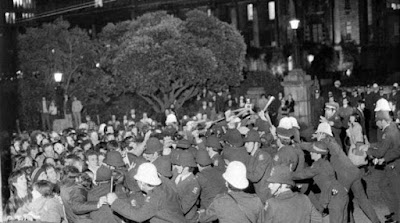
Then: Forty years ago the Police resorted to more direct methods of bringing protests, if not to an end, then to a sudden halt. I had friends who were bloodied by Police truncheons on Molesworth Street, right outside Parliament grounds, on the night of 29 July 1981. 

THE ONE AND ONLY TIME I’ve been arrested was for the offence of obstructing a carriageway. The arrest took place at the intersection of Rattray Street and Princes Street in Dunedin during the 1981 Springbok Tour. In attempting to assist a fellow protester, whose arm was pinned against a metal post, and who was obviously in considerable pain, I somehow ended up sprawled on the street. Deemed to be obstructing this important carriageway, I was bundled into the back of a windowless van and deposited in the holding cells of the Dunedin Police Station, where I spent the next few hours singing every protest song I knew. Small wonder that my involuntary constabulary audience tossed me back onto the streets!

I was thinking about that incident earlier this week as hundreds of motor vehicles made their way to Parliament grounds to protest the Labour Government’s handling of the Covid-19 Pandemic. It prompted me to wonder if that quaint old charge (of which, many months later, I was acquitted) is still on the statute books.

Well, it is. Under the Summary Offences Act 1981:

Every person is liable to a fine not exceeding $1,000 who, without reasonable excuse, obstructs any public way and, having been warned by a constable to desist,—

(a) continues with that obstruction; or

(b) does desist from that obstruction but subsequently obstructs that public way again, or some other public way in the same vicinity, in circumstances in which it is reasonable to deem the warning to have applied to the new obstruction as well as the original one.


That the anti-vaxxer convoy did not set out on their protest without apprehending that, at some point, their actions were bound to impede the normal, lawful, passage of other users of the public ways, strikes me as highly implausible.

Certainly, the protesters who blocked motorways, ran onto airport runways, attempted to blockade rugby fixtures, and even interrupted the television broadcast of the final test match between the All Blacks and the Springboks, were all-too-aware that their actions were unlawful. They fully expected to be, and usually were, confronted, apprehended and charged by the Police.

The protest organisers understood the political impact of otherwise law-abiding citizens courting arrest and risking conviction in the name of combatting the racist system of Apartheid. They were also aware of the sheer practical difficulty of the Police, the Courts, and Corrections processing and accommodating hundreds (or even thousands) of arrestees in secure facilities.

It was to overcome these difficulties that the police relied upon the minor offence of “Breach of the Peace” to arrest, briefly detain, and then release (without the need for formal charges) so many of the more “disruptive” anti-tour protesters.

On occasion, however, the Police resorted to more direct methods of bringing protests, if not to an end, then to a sudden halt. I had friends who were bloodied by Police truncheons on Molesworth Street, right outside Parliament grounds, on the night of 29 July 1981. I was there in Wilson’s Road, outside the First Test at Lancaster Park, when the “Blue” riot squad smashed into the front row of protesters with their notorious PR-24 long batons.

In one sense, it is mighty puzzling to witness a protest movement publicly announce its intention to engage in actions which appear to be – at least to the ordinary person in the street – a flagrant breach of the law, without incurring the stern intervention of both the Government and the Police that characterised the 1981 Springbok Tour protests.

In another sense, however, the behaviour of the authorities is perfectly understandable. The prospect of having to effect mass arrests of anti-vaxxers is, very clearly, one which the Police Commissioner and his fellow senior officers are loath to contemplate. His forces are overstretched as it is. Certainly, they have a great deal more to contend with than the cops responsible for policing the more innocent New Zealand of forty years ago.

Halting the anti-vaxxers in their tracks would require a level of force unseen in this country for decades. Some of the anti-vaxxer crowd would need more than a PR-24 to subdue them. The wholesale use of tasers, tear-gas and pepper-spray would be required. Even, ultimately, the use of deadly force.

In 1981, students like me went quietly. Will the anti-vaxxers do likewise in 2022?


This essay was originally published in The Otago Daily Times and The Greymouth Star of Friday, 11 February 2022.