Showing posts with label Anti-Vaccination Protest of February 2022. Show all posts

Tuesday, 22 February 2022

Our Dark Shadow: Analysing The Platform’s Profile of the Protesters.

Errant Voices: The people in the big cities didn’t get it. Why were “these people” so anti-social? Why had they so little inclination to serve the “collective good”? It never occurred to the well-heeled, well-housed and well-educated beneficiaries of neoliberal capitalism that while it was giving them everything, it seldom showed “these people” anything other than its anti-social face. As for the collective good, well, what was that?

THE PLATFORM has made an invaluable contribution to the increasingly fraught “debate” about the Anti-Vaccination Mandate Protest in Parliament Grounds. By commissioning Curia Research to create a rough profile of the protesters, the new website has facilitated the substitution of reliable poll-data for journalistic reckons. Now, at last, the public has at least some of the information needed to render an informed judgement. That the mainstream news media saw no merit in commissioning such an exercise testifies to its steady retreat from the principles of independent journalism.

The picture painted by Curia Research is of a protest crowd drawn overwhelmingly from rural and provincial New Zealand: Fully 67.6 percent of the persons questioned came from somewhere other than Auckland, Wellington and Christchurch. Rural dwellers made up 7.7 percent of the crowd; those living in provincial towns 18.9 percent; and provincial city-dwellers the remaining 41 percent. The latter figure is almost double the actual number of New Zealanders living in provincial cities.

This skewed provincial representation is significant. What it tells us is that the people participating in this protest have a great deal in common with the Americans who supported Donald Trump. They, too, hailed from places seldom visited by the metropolitan elites. Cities and towns that once boasted thriving industries and buoyant economies, but which, over the past 35 years, have seen far too many factories – along with the small businesses that serviced them – shut down and fail. Communities that once boasted public hospitals, polytechnics, post-offices and banks – not to mention their own proudly independent newspapers – have been stripped of key infrastructure and left to rot.

For many years, however, the primary victims of this neglect continued to vote for the parties of change: Labour, the Alliance, the Greens and NZ First; in hopes that their lives would be made better. Curia Research reveals that very close to 50 percent of the protesters occupying Parliament Grounds voted for one of Labour, the Greens and NZ First in 2020. This finding is powerfully reminiscent of the significant number of 2016 Trump voters who had backed Barack Obama in both the 2008 and 2012 presidential elections. Hell hath no fury, it would seem, like a voter scorned, disappointed and betrayed.

That nearly 30 percent of the protesters voted for Jacinda Ardern’s Labour Party in 2020 also suggests that at some point the Prime Minister said or did something that shattered their allegiance to her and the Team of Five Million she purported to lead. Given that the dominant reason/s for their presence outside Parliament is their strong opposition to Vaccine Mandates, one might reasonably speculate that it was Ardern’s reneging on her promise not to introduce vaccination mandates and passes that provoked these protesters into deserting the Labour Party.

That the consequences of refusing to be vaccinated appear to have fallen most heavily on occupations dominated by women: retail, hospitality, teaching, nursing, aged-care, midwifery; would also explain why Curia Research reports women making up 55 percent of the protest crowd.

Another factor relevant to the number of women participating in the protest could well be that in the rural and provincial communities ravaged by the economic impacts of neoliberalism it has, overwhelmingly, been women who have held together the threads of community and mutuality. Mothers, daughters and wives who had once been encouraged to look upon the State as their friend, have – decade after decade – been given every cause to see “the government” as their enemy.

The explanation for 27.2 percent of the protest crowd identifying as Māori is, almost certainly, much the same.

Throughout the 1980s and 90s, in Māori communities scattered across the provincial landscapes of the North Island, jobs, and the social cohesion that came with them, were laid waste by the neoliberal revolution. Without the industries that paid for it, key infrastructure has similarly decayed and disappeared.

Māori families left behind had two choices: depart for the big cities; or, stay put and work out another way to survive. The same Pakeha state that had stripped their iwi and hapu of their land, was now guilty of stripping them of their jobs, their incomes, and their dignity. What loyalty could they possibly owe to such a state? What reason could they possibly have to trust it – or its political representatives?

It is here that the other dominant theme recorded by Curia Research’s pollsters – Freedom – weighs-in so heavily. Abandoned, overlooked, ignored and despised, the people on the receiving-end of neoliberalism’s cold indifference had tragically – but unsurprisingly – internalised its ruthless individualistic ethos. Devalued and declassed, driven to the margins, they had nevertheless contrived to survive on their own terms and according to their own lights. If the state had no need for them, then they were happy to return the compliment. Theirs may have been a lean freedom – but it was hard-won, and would not be surrendered without a fight.

And then came Covid, and in its wake a state that would no longer leave them to their own devices. Suddenly, they were included in the “Team Of Five Million”. Suddenly, the state which had turned its back on its obligations to look after the people’s welfare was demanding that the people honour their obligation to keep it safe. Suspicious, but also secretly thrilled to once again be counted among the just, the outsiders and outcasts of the provincial lumpenproletariat did as Jacinda asked.

But the requirement to vaccinate – or be turned into a second-class citizen – turned out to be a bridge too far. The state which, just months before, had pronounced itself their friend was reverting to type. Now it was “No Jab, No Job”. Now they were being turned away from the pub. Now the state was coming for their hard-won, hard-scrabble freedom. The only thing of real value left in their downsized lives, seemed at imminent risk of being ripped from their hands.

The people in the big cities didn’t get it. Why were “these people” so anti-social? Why had they so little inclination to serve the “collective good”? It never occurred to the well-heeled, well-housed and well-educated beneficiaries of neoliberal capitalism that while it was giving them everything, it seldom showed “these people” anything other than its anti-social face. As for the collective good, well, what was that?

“These people”, whom the big city-dwellers struggle so hard to understand, are the people they have made. If they don’t care about their fellow citizens’ rights and freedoms, it’s because their “fellow citizens” never taught them how.

Did the algorithms of the social media giants have a role to play in this protest? Yes, of course. Are the dangerous inhabitants of the darkest corners of the Internet feeding the protesters’ anger? They are. But people are only made ready to swallow Big Lies by too few attempts to feed them Big Truths.

Who is it who gathers at the seat of our democracy? They are the feral children of our greed and indifference. Who is it who pounds upon Parliament’s doors? Our own dark shadow that, no matter how hard we try to break free of it, refuses to be left behind.


This essay was originally posted on The Daily Blog of Tuesday, 22 February 2022.

Monday, 21 February 2022

What Happens Next?

The Man In Charge: Police Commissioner Andrew Coster admits that with the help of batons and, probably, tear gas (hitherto unused in New Zealand crowd control) he and his officers could clear Parliament Grounds. What he asks us all to think about, should he accede to the growing public pressure to ‘get tough’ with the protesters, is: What happens next?

ANDREW COSTER’S PERFORMANCE on Television New Zealand’s Q+A, broadcast on Sunday morning (20/2/22) was impressive. Many New Zealanders, increasingly frustrated by the Police’s apparent impotence in the face of what they acknowledge to be an unlawful protest, are calling for Coster to be sacked. In responding to Jack Tame’s questions, however, Coster offered the public some sobering (albeit rather cryptic) clues as to why he is not yet prepared to emulate the policing tactics currently on display in the Canadian capital, Ottawa.

Coster admits that with the help of batons and, probably, tear gas (hitherto unused in New Zealand crowd control) he and his officers could clear Parliament Grounds. What he asks us all to think about, should he accede to the growing public pressure to ‘get tough’ with the protesters, is: What happens next?

As Coster explained to Tame, the Police have a duty to do two things at once: Enforce the Law; and, Keep the Peace. In most circumstances there is no conflict between these two duties. In the case of the occupation of Parliament Grounds, however, enforcing the law may result in an extremely serious breach of the Peace.

Although he didn’t say so in as many words, Coster made it clear that what was likely to follow the violent clearance of Parliament Grounds was a prolonged and serious eruption of violence not just in Wellington, but across the nation.

Obviously, Police Commissioner Coster’s primary concern is for his front-line officers: the men and women who will bear the brunt of the protesters’ physical resistance.

The volatility of these folk was plainly in evidence on Thursday, 10 February, when the Police made a concerted effort to move the protest on. On more than one occasion, the Police line was driven back by individuals more than willing to mix it with the cops. That the line was not broken in an all-out assault is probably due to the fact that the officers were bareheaded, unarmed, and in their shirtsleeves. It was hard to conceptualise these vulnerable constables as implacable enforcers of state power.

Were Coster to deploy officers wearing riot gear – i.e. helmets, visors, gas-masks, and full body armour – armed with long-batons, tasers and pepper spray, with tear-gas and water-cannons in reserve, the protesters would see nothing but implacable enforcers of state power. Paradoxically, this would make his constables much easier to attack and injure. Certainly, the protest encampment contains plenty of potential weapons with which to fight back. Serious injuries (or worse) on both sides would be inevitable.

And that would only be the beginning.

Coster is well aware that, in Parliament Grounds, he and his officers are confronting a very different kind of protest movement. It’s intent is not only persuasive, but also coercive. The “Freedom Convoy” set out with the intention of forcing the democratically elected government of New Zealand to bow to its demands.

How else to explain the creation of a veritable laager of motor vehicles around the parliamentary complex? The hundreds of cars blocking the streets adjacent to Parliament are the protest encampment’s castle walls. While they remain, the logistics of removing the protesters non-violently are fiendishly difficult.

The protest organisers knew all this before they set out. Since then, they have certainly been made aware that the positioning of their followers’ vehicles is unlawful. Their point-blank refusal to move them offers ample confirmation of the protest’s coercive intent.

The organisers must also be aware that in the event of a concerted Police effort to clear the grounds, the barriers of parked cars will leave very few clear escape routes for the several hundred protesters camping there. Caught between the advancing Police lines and their own vehicles, the situation could very easily spiral out of control.

How aware of these potential dangers are the inhabitants of the protest camp? Hard to say. But, grasping the risks they are running shouldn’t demand too much hard thinking from the protesters. Unfortunately, many of them seem persuaded that the Police will not use force to remove them, and, even if they do, the protesters are confident they can “Hold the Line!”

But who are the organisers? It is among the most difficult problems confronting Coster and his senior commanders. In spite of all the evidence pointing to a lot of money and a lot of managerial expertise at work in and around the protest site, finding people with whom to negotiate a process of de-escalation is proving extremely difficult. Yes, there is Brian Tamaki’s Rights & Freedoms Coalition, and a slew of anti-vaccination and anti-mandate activists, but anyone looking for an organising committee, let alone a “leader”, will look in vain.

Then again, the Police may simply have been looking in the wrong place. The guiding intelligence behind this whole event may well be nowhere near Parliament Grounds. Indeed, it is even possible that the protest has been brought into existence for purposes unknown to all but a handful of hard-core participants.

Certainly, that is the impression Coster conveyed to Tame on Q+A. That he is holding-off on using more forceful methods to evict the protesters because those are precisely the tactics which faceless, online, string-pullers want him to employ. They want images of Police in riot-gear bloodying the heads of “ordinary Kiwi battlers” with their batons. They want to see people wincing under the sting of pepper-spray. They want to see tear-gas and water-cannons deployed for the first time in New Zealand history. They may even be hoping that in all the violence and chaos a protester – or a protester’s child – is killed.

Coster told Stuff’s Andrea Vance that he and his colleagues are only too aware of far-right elements embedded in the anti-vaccination mandates movement :

“I am hugely concerned about the mindset of some of the people, not just in that crowd, but generally behaviour that we see online at the moment ... Yes, we wanted to deal with that stuff.”

And rightly so! Because in a country already deeply polarised by the exigencies of combatting Covid-19, scenes of mayhem in Parliament Grounds will make it so much harder to drain the “sea of non-compliant Covid people” in which the fishes of far-right extremism are safely swimming.

Is it asking too much of the NZ Security Intelligence Service and the Government Communications Security Bureau to tear their eyes away from Five Eyes scare stories about Russia and China for a moment, and give some professional support to a Police Intelligence operation that is clearly struggling? Surely, an ever-expanding crowd of angry people who hate politicians and journalists and now have very little to lose by besieging the nation’s parliament might just fall within the definition of “Threat to National Security”?

With a recent Horizon poll telling the angry online ranters that upwards of 30 percent of New Zealanders are in support of the protesters on Parliament Grounds, the widening gulf between enforcing the law and keeping the peace will tax the capabilities and the professionalism of Andrew Foster in ways not seen since Police Commissioner Bob Walton oversaw the policing of the Springbok Tour more than 40 years ago.

Maybe the Beehive could give him a hand?


This essay was originally posted on the Interest.co.nz website of Monday, 21 February 2022.

Friday, 18 February 2022

Jones Won: Ryan & Morten Nil.

The Man In The Middle: Neale Jones was not “smacked down” by Kathryn Ryan and Brigitte Morten. He was, however, interrupted, talked over, and made extremely difficult to hear. In spite of all these hindrances, he kept on fighting the good fight for close to half-an-hour with admirable clarity and forbearance. Unlike the other two participants in Monday’s RNZ Political Panel, Jones kept his focus on the dangerous realities of the protest taking place in and around Parliament Grounds.

NEALE JONES is to be congratulated. No, no – it’s alright – I haven’t hit my head. It is just that I have always believed in giving credit where credit is due – and Jones deserves a lot of credit. Had I been on the receiving end of Kathryn Ryan’s and Brigitte Morten’s right-wing tag team, as Jones was on RNZ’s Monday-morning Political Panel, I’m damn sure I wouldn’t have kept my cool as impressively as he did.

Ryan is usually a lot more circumspect in revealing her personal opinions than she was on Monday (14/2/22). That’s as it should be. Her role on the Panel is that of moderator – at least, one hopes that’s still her role! She is there to put the questions to the panellists and prevent them from interrupting, talking over one another, and generally attempting to dominate the discussion.

That is not what happened on Monday. Ryan threw herself, boots and all, into the debate over the protest blockade of Parliament. She interrupted, talked over, and – not to put too fine a point upon it – hectored Jones, to a degree that bordered on the unprofessional.

Unsurprisingly, Morten was quick to follow Ryan’s lead. She, too, interrupted and talked over Jones – seemingly with Ryan’s blessing.

Jones, however, remained unfazed by this blatant breech of the Political Panel’s rules of engagement. He stayed resolutely on-message, stoically refusing to let Ryan and Morten rattle him. He didn’t turn nasty. He didn’t lose his temper. He just kept on talking sense.

It would have helped the listeners immensely if his levels had been set to match those of the two women – then we wouldn’t have had to strain our ears to hear him. But on Monday morning everything seemed to be set against him.

The most intriguing aspect of the whole encounter was the political line taken by Ryan and Morten. Both women consistently refused to accept Jones’s argument that the protest was inspired by individuals and groups in the grip of outlandish conspiracy theories imported from the United States. Nor were they willing to accept the well-established Far Right provenance of these conspiracy theories. Throughout the half-hour Ryan and Morten attempted to paint the protest as the anguished cry of stressed-out Kiwi battlers determined to resist Government over-reach.

The fact that the so-called “Freedom Convoy” was always intended to establish a laager of motor vehicles within which a protest encampment in Parliament Grounds could be established and, more importantly, protected, in no way slowed Ryan and Morten down. They simply didn’t appear to be interested in exploring the strategic purpose of the Convoy’s organisers, or what lay behind their radical departure from the norms of New Zealand political protest.

Even more disturbing was the way they seemed to brush aside the unprecedented displays of aggression directed at New Zealand’s Members of Parliament and the Press Gallery. Wellington has witnessed many angry demonstrations in its history, but very few in which the rhetoric of at least some of the participants was explicitly homicidal. What was it that made Ryan and Morten so determined to re-focus the debate away from this deeply disturbing reality?

I couldn’t help being reminded of the Peter Ellis Case, where the most bizarre, outlandish, and obviously impossible accusations of the children interviewed were simply set to one side so as not to “prejudice” the jury. It simply didn’t suit whatever it was that Ryan and Morten were trying to do to have listeners reminded of the murderous fury directed by the protesters against politicians and journalists.

The least damaging explanation of Ryan’s behaviour is that she was overcompensating for what critics from the Far Right and the Far Left described as the Fourth Estate’s sneering, middle-class dismissal of the smelly protesters cluttering up its stately work environment. On-the-spot reports from intrepid Far Right and Far Left observers, reassuring New Zealanders that the overwhelming majority of the protesters were just ordinary Kiwis exercising their right to protest, have, as intended, shamed a number of mainstream journalists into revising their original stance. It’s possible Ryan is one of them.

Morten, however, is more than savvy enough to realise the damaging impact which the bad behaviour of the protesters, and the baffling failure of the Police to move them on, is having on the Government’s reputation. The longer the protest continues, and the longer the Government and the Police are seen to be standing by ineffectually, the better it is for the Opposition parties. Just because it would not be wise for Christopher Luxon to be seen taking the side of the occupiers, doesn’t mean that it is unwise for Morten to do everything she can to make it more difficult – from a PR perspective – for Labour and the Police to resolve the crisis.

The Jones boy, every bit as savvy as the Morten gal, knows this. Hence his dogged determination to keep his listeners’ minds focused on the true character of these latter-day “Freedom Riders”.

They are not honest toilers, they are people hell-bent on getting rid of the protections Labour has mandated to keep the real honest toilers safe. They do not have legitimate grievances – unless you reckon thwarting the sociopathic impulses of unvaccinated extremists constitutes a legitimate grievance. They are, however, people acting under the influence of individuals and groups with Far Right affiliations and aims. Scratch them, and you’ll bleed.

In summary, Neale Jones was not “smacked down” by Kathryn Ryan and Brigitte Morten. He was, however, interrupted, talked over, and made extremely difficult to hear. In spite of all these hindrances, he kept on fighting the good fight for close to half-an-hour with admirable clarity and forbearance. Unlike the other two participants in Monday’s Political Panel, Jones kept his focus on the dangerous realities of the protest taking place in and around Parliament Grounds.

For that he deserves our cheers – not our jeers.


This essay was originally posted on The Daily Blog of Friday, 18 February 2022.

Caught In The Crossfire.

Paradigm Shift: Suddenly, a motley crew of lumpenproletarians were being presented as ordinary, decent working-class battlers. Suddenly, their frothing irrationality and anti-social demands were being presented as reasonable propositions – worthy of serious discussion.

IT WAS ONLY a matter of time before the Let-Covid-Rip lobby cottoned-on to the political usefulness of the Freedom Convoy.

Throughout the two years of the Covid-19 pandemic the Government’s policies have come under fire from two very different positions.

The first to draw a bead on the Government’s efforts to protect New Zealanders from the Coronavirus were the business interests most directly affected by the closure of the border and lockdowns.

The Education Industry began squealing almost immediately. Understandably, I suppose, since its business model was predicated on a constant inward flow of full fee-paying overseas students.

Close behind them, and for very similar reasons, was the Tourism Industry. It had benefited hugely from the “hyper-tourism” of the previous ten years. Fuelled by super-cheap airfares, the ever-increasing inflow of foreign visitors had made tourism one of this country’s biggest earners of overseas funds.

Hot on the heels of education and tourism came the hospitality and retail sectors. Without overseas students and tourists, and with their domestic patrons and customers locked down inside their homes, the ongoing viability of many businesses operating in these sectors looked increasingly doubtful.

Nor should we forget the agricultural sector. Many New Zealanders were surprised by their country’s biggest earner’s hitherto unnoticed dependence on foreign workers to keep its farms, orchards and vineyards operating efficiently.

Put all these sectors together, and what you get is a powerful combination of interests constantly in the Government’s ear to open the borders and lift the lockdowns.

Similar lobbies sprang up more-or-less overnight in the UK, the USA and Europe. Their arguments in favour of letting the virus rip in order to build up “herd immunity”, not to mention their claims that the threat of the Coronavirus was being over-hyped, spread swiftly around the world.

Remember the arguments advanced by the promoters of our own “Plan B”?

The second firing position was set up in response to the development and roll-out of the Covid-19 vaccines. What had been expected to take years, was achieved in just a few months. Inevitably, given the already deeply entrenched communities of anti-vaccination sentiment here and around the world, shrill voices were soon declaring their absolute refusal to be injected with the new vaccines.

What the Let-Covid-Rip lobbyists hadn’t counted on, however, was the extraordinary success of Jacinda Ardern’s efforts to keep New Zealanders safe from Covid-19. With the overwhelming majority of citizens behind her, and results that spoke for themselves, the Prime Minister felt able to over-rule the business interests which, in so many other countries, had successfully bullied their politicians into opening up too early.

Ardern’s spectacular victory at the polls in 2020 offered further incentive for the Covid-impacted sectors to get along by going along.

For the anti-vaxxers, however, going along wasn’t an option. With the new Delta variant of Covid-19 making 90 percent-plus vaccination rates essential, the Government was required to introduce “No Jab, No Job” vaccination mandates and issue vaccination passes.

For the vaccine hesitant these measures were enough. For the hardcore vaccine resisters, however, the same irrationality which had driven them to refuse inoculation in the first instance, now drove them down social media rabbit-holes and into the arms of an irrationality that was much bigger and more malign.

Just how tightly that irrationality now grips them has been on display in Parliament Grounds for more than a week.

Initially, the Let-Covid-Rip apologists saw only what the rest of the country saw in the “Freedom Convoy” and its illegal encampment – nuts. Like most of us, they assumed the Police would move swiftly to reclaim the streets of Wellington from the protesters’ vehicles, and Parliament Grounds from its inchoate community of conspiracy theorists.

When that didn’t happen, and the public condemned the Government’s evident ineffectuality. When the absurdist interventions of Speaker Mallard caused people to wonder whether there were any adults at all left in the Government’s room. That was the moment when it began to dawn on the Let-Covid-Rip lobby that the longer this folly went on, the weaker Ardern’s Government would become.

Suddenly, a motley crew of lumpenproletarians were being presented as ordinary, decent working-class battlers. Suddenly, their frothing irrationality and anti-social demands were being presented as reasonable propositions – worthy of serious discussion.

Caught in their enemies’ deadly crossfire, our embattled Government turns in desperation towards the Police.


This essay was originally published in The Otago Daily Times and The Greymouth Star of Friday, 18 February 2022.

Thursday, 17 February 2022

Reality and the Left – A Bitter Divorce.

Things Fall Apart: The events of the past ten days offer ample evidence of just how seriously social decay has weakened New Zealand society. A more confident New Zealand Left, recognising the weakness of the system, and its acute vulnerability to those who would enlist the aid of “gangsters, racketeers, swindlers, petty criminals” would have no hesitation in identifying the so-called “Freedom Convoy” as the reactionary, quasi-fascist, enterprise it has always been.

WHERE IS REALITY HIDING amidst all these claims and counter-claims concerning the protest encampment in Parliament Grounds? In an excruciatingly post-modern political moment, reality seems to have gone AWOL, leaving behind only a noisy collection of competing narratives.

To make matters worse, the state itself, supposedly the supreme arbiter of what is and is not politically real, is refusing to do its job. Even though it is his sworn duty, the Commissioner of Police, Andrew Coster, has made it frighteningly clear to the public that he lacks both the will and the means to assert the state’s authority. The New Zealand Defence Force, meanwhile, holds itself aloof from the fray. Jacinda Ardern and Christopher Luxon, powerless to intervene, look on ineffectually. The crisis deepens.

Ask yourself: what does it mean when tow-truck drivers, asked to assist the Commissioner of Police, refuse? At what point during the last decade did citizens begin to tell themselves that they had no obligations to the society in which they live? That nobody had the right to tell them what to do – not even the Police? What business is it of theirs if the people of Wellington, their neighbours, need their help?

It has been reported that at least one towie openly declared his support for the protesters encamped on Parliament Grounds. Entirely understandable. The occupiers don’t accept that their government has the right to require their vaccination against Covid-19. Nor do they believe that they owe their fellow citizens even the slightest co-operation in the fight to limit the harm of the virus. That tow-truck driver recognised kindred spirits when he saw them. Andrew Coster and Wellingtonians could go fuck themselves.

Not all the towies were so bloody minded. According to media reports, some of them were just plain scared. They claimed to have been threatened with dire retribution if they allowed their trucks to be used by the Police. Considering those trucks carried the names and phone numbers of their owners, it’s not difficult to understand the impact of such threats. Were someone to burn down a towing company’s premises, torch its trucks, that would be multiple livelihoods lost and a business ruined. Who wouldn’t think twice?

Such tactics are, however, remarkably effective. I remember reading about Jimmy Hoffa and the Teamsters’ bitter battles with the trucking companies. The bosses could rely on local politicians, local judges, local editors and local cops to defend them against Hoffa’s strikers. The union was on a hiding-to-nothing, until Hoffa reached out to the Mafia. It only took a few dozen torched trucks for the bosses to get the message. The Teamsters won their improved contract. But the spoon Hoffa took to his dinner with the Devil wasn’t quite long enough. His beloved Teamsters’ Union now belonged to the Mob.

Now, you might think that people on the left of New Zealand politics would recognise the danger of holding up the occupation of Parliament Grounds as a praiseworthy assertion of working-class power. As if poverty and marginalisation, frustration and anger, ignorance and credulity are always and everywhere evidence of moral force and progressive intent.

Karl Marx himself recognised the acute political danger inherent in what he called the Lumpenproletariat. According to the Encyclopedia of Marxism, this social formation is composed of the “outcast, degenerated and submerged elements” of industrial society:

It includes beggars, prostitutes, gangsters, racketeers, swindlers, petty criminals, tramps, chronic unemployed or unemployables, persons who have been cast out by industry, and all sorts of declassed, degraded or degenerated elements. In times of prolonged crisis (depression), innumerable young people also, who cannot find an opportunity to enter into the social organism as producers, are pushed into this limbo of the outcast. Here demagogues and fascists of various stripes find some area of their mass base in time of struggle and social breakdown, when the ranks of the Lumpenproletariat are enormously swelled by ruined and declassed elements from all layers of a society in decay.

That our society is in decay can hardly be doubted. The events of the past ten days offer ample evidence of just how seriously that decay has weakened New Zealand society. A viable Left, recognising the weakness of the system, and its acute vulnerability to those who would enlist the aid of “gangsters, racketeers, swindlers, petty criminals” would have no hesitation in identifying the so-called “Freedom Convoy” as the reactionary, quasi-fascist, enterprise it has always been.

Alas, New Zealand no longer possesses a viable Left. Identity politics has schooled a whole generation to accept the self-definitions of “oppressed groups” at their face value. Drilling down into the actual character of such groups, and scrutinising their relationship to the ruling class, is not encouraged. Even among those leftists who still acknowledge the primacy of class politics there is a pronounced unwillingness to subject movements like the Freedom Convoy to any kind of rigorous class analysis.

For these leftists, it is enough that the occupiers of Parliament Grounds are, or were, members of the working-class. So desperate are these “revolutionaries” for the slightest hint of revolutionary consciousness that they are willing to overlook the absence of anything remotely resembling a concrete programme for the social and economic emancipation of the working class. The only programme in evidence among the occupiers is the one demanding the instant cessation of all measures aimed at minimising the hurt and suffering of Covid-19.

How self-proclaimed “socialists” could possibly mistake such a noxious potpourri of anti-social attitudes for anything remotely progressive is a mystery. Perhaps it is no more than the curious allure of the demi-monde, coupled with the magnetic eccentricities of the Bohemian temperament, that has led these desperate socialists to mistake reactionaries for revolutionaries. Clearly they have forgotten that Adolf Hitler himself was a Lumpenproletarian. A more “declassed, degraded and degenerated” specimen History has yet to supply!

It was the Italian socialist, Antonio Gramsci (1891-1937) who understood most completely the extraordinary fluidity of reality in periods of acute social stress and political disintegration. Moments in history when the hegemonic explanations of the ruling-class have lost, or are beginning to lose, their power to allay the fears and misgivings of subordinate classes. In such times – and we are living through them now – people are desperate for new and more persuasive narratives about the nature of reality.

Not all of those narratives are addressed to the best that is in human nature. Sorting out the lies of charlatans and demagogues from genuine revolutionary truths isn’t always easy – especially in this age of social-media algorithms. Leftists are often surprised to learn that Mussolini was a socialist before he became a fascist.

Gramsci put it best when he wrote: “The crisis consists precisely in the fact that the old is dying and the new cannot be born; in this interregnum a great variety of morbid symptoms appear.”

Or, more succinctly: “Now is the time of monsters.”


This essay was originally posted on The Daily Blog of Thursday, 17 February 2022.

Monday, 14 February 2022

Changing Their Story.

Situation Normal All Fucked Up: Already weakened by its poor handling of Delta and Omicron, this Government’s botched response to the Freedom Convoy has changed dramatically its political narrative.

IT IS DOUBTFUL whether Jacinda Ardern’s Labour Government understands just how completely it has lost control of the political narrative. Most likely, it is operating on the assumption that because most New Zealanders, like most MPs, are appalled at the behaviour of those occupying Parliament Grounds, all is well. It is a false assumption. Like the first victim of the “Freedom Convoy” weapon, Justin Trudeau, the Ardern Government’s refusal to “go hard and go early” against the protesters has created the worst of all political narratives: that it has become weak and ineffectual.

Not only has the occupation of Parliament Grounds made this government look weak, but it has also emboldened and, in the eyes of some, at least, ennobled the occupiers. Swift and decisive action to evict the occupiers was crucial, if only to forestall the creation of a David versus Goliath narrative in which every successful defiance of the forces of law and order only serves to make their movement stronger.

Those who share the occupiers frustration with the Government’s management of the Covid-19 pandemic, but who have, hitherto, not believed that successful resistance to its policies is possible, have been given cause to think again. They may represent fewer than one-in-ten New Zealanders, but one-in-ten of 5 million is 500,000. If only a tenth of that half-million citizens decided to join the Wellington protest camp, then this Government will very quickly find itself confronting a national security crisis of immense proportions.

It is a genuine mystery why neither the Government, nor the senior Police commanders, were able to grasp the nature of the challenge they were facing. It was clear to every thinking New Zealander that the protest action represented by the “Freedom Convoy” was of a new and potentially extremely dangerous kind. One didn’t have to be a master strategist to understand that once 200-300 motor vehicles converged on the centre of the capital city, the owners of those motor vehicles would, more or less immediately, control the centre of the capital city. New Zealanders knew that they had nothing to fear from protesters who gathered for a couple of hours to deliver their message and then dispersed. But, protesters who came to stay until their demands were met – this was a very different kettle of fish.

New Zealand’s senior police commanders cannot say that they weren’t warned. The Ottawa example was there before them. By failing to break the Canadian truckers’ blockade immediately, the Canadian authorities allowed the protest’s relatively limited set of demands to escalate wildly. Fatally, Prime Minister Trudeau opted to talk tough, but then refused to act tough. The latest poll out of Canada shows only 16 percent of Canadians are satisfied with his handling of the crisis. Trudeau’s failure to deal with the truckers’ protest swiftly and effectively may spell the end of his political career.

While the Policing Act 2008 makes it clear that in operational matters Ministers of the Crown are required to butt right out, there are other ways for the State to assert its duty to protect the rights of the citizenry and the rule of law. It would be interesting to know whether the Officials Committee for Domestic and External Security Coordination – commonly referred to as ODESC – was convened to address the national security implications of the Freedom Convoy. Chaired by the CEO of the Department of Prime Minister and Cabinet, ODESC can bring together all the instruments of the state apparatus required to coordinate an effective response – including the Police and the NZDF.

From the perspective of the ordinary person in the street, however, neither the Prime Minister nor the Police Commissioner, Andrew Coster, appeared to be taking the matter very seriously. Indeed, by constantly invoking people’s right to protest, they gave the impression that they were reluctant to do anything more than politely request the protesters to behave themselves and then “move on”. Only the Deputy Prime Minister, Grant Robertson, who, as a former student leader, was familiar with the unwritten rules of the demonstration game, appeared to grasp the qualitative difference between the Freedom Convoy and the protests he had helped to organise.

And then the Speaker of the House, Trevor Mallard, stuck his oar in.

The care and protection of the Parliamentary Precinct is, indisputably, the Speaker’s responsibility. The dignity of the office, and the need to at all times conduct himself professionally, should, however, have persuaded Mallard to limit his involvement to simply declaring the occupiers to be trespassers. The strategy and tactics required for their eviction should then have been left entirely to the Police.

To describe the extraordinary decision of the Speaker’s Office to, first, order the parliamentary ground’s lawn-sprinklers turned on, and then, the following night, to blast loud music across the grounds (presumably in an effort to either dislodge or disturb the occupiers in their tents) as “unfortunate” would be a gross understatement. Indeed, it is difficult to conceive of actions more likely to convince the occupiers that they are not dealing with serious people. Mallard’s actions may have hardened the occupiers’ determination to resist. Worse, by responding so childishly, he risks convincing them they can win.

For the long-suffering citizens of Wellington, and the rest of New Zealand looking on, the manifestly inadequate policing tactics employed to move the occupiers from Parliament Grounds, coupled with the Speaker’s ludicrous interventions, have combined to produce a political narrative of weakness, incompetence and pettiness that will be very hard to dispel. The spectacle of unhelmeted constables in their summer shirts, wearing flimsy surgical masks, being sent to stand eyeball-to-eyeball with shrieking, unvaccinated occupiers, was extremely hard to watch. So, too, was the sight of those same constables wading into the flailing, spitting crowd to effect arrests. Where was the Police Association, their union, when these egregious failures of health & safety were unfolding?

More to the point, where were the force multipliers essential to any operation in which hundreds of police officers are pitted against thousands of aggressively resisting protesters? How many games would have gone ahead during the Springbok Tour of 1981 if the then Police Commissioner, Bob Walton, had confronted HART’s protesters with unhelmeted constables in their shirtsleeves? The late Tom Newnham didn’t call his photographic history of the Tour “By Batons and Barbed Wire” for nothing!

The sheer carelessness with which Ardern and her colleagues have relinquished their winning political narrative is astonishing. Already weakened by its poor handling of Delta and Omicron, this Government’s botched response to the Freedom Convoy has changed their story dramatically. Labour no longer seems willing – as it was throughout 2020 – to go in hard and early for the Team of Five Million. In fact, it seems unwilling to go in hard at all. Small wonder, then, that the enemies of reason and science are feeling vindicated and emboldened. Or that the Team of Five Million is feeling a lot let down – and not a little fearful of what happens next.


This essay was originally posted on the Interest.co.nz website on Monday, 14 February 2022.

Friday, 11 February 2022

Policing Protests: Then, And Now.

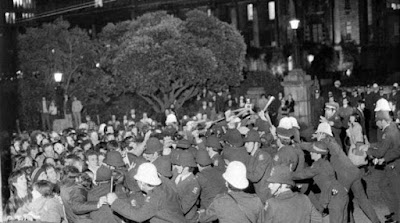
Then: Forty years ago the Police resorted to more direct methods of bringing protests, if not to an end, then to a sudden halt. I had friends who were bloodied by Police truncheons on Molesworth Street, right outside Parliament grounds, on the night of 29 July 1981. 

THE ONE AND ONLY TIME I’ve been arrested was for the offence of obstructing a carriageway. The arrest took place at the intersection of Rattray Street and Princes Street in Dunedin during the 1981 Springbok Tour. In attempting to assist a fellow protester, whose arm was pinned against a metal post, and who was obviously in considerable pain, I somehow ended up sprawled on the street. Deemed to be obstructing this important carriageway, I was bundled into the back of a windowless van and deposited in the holding cells of the Dunedin Police Station, where I spent the next few hours singing every protest song I knew. Small wonder that my involuntary constabulary audience tossed me back onto the streets!

I was thinking about that incident earlier this week as hundreds of motor vehicles made their way to Parliament grounds to protest the Labour Government’s handling of the Covid-19 Pandemic. It prompted me to wonder if that quaint old charge (of which, many months later, I was acquitted) is still on the statute books.

Well, it is. Under the Summary Offences Act 1981:

Every person is liable to a fine not exceeding $1,000 who, without reasonable excuse, obstructs any public way and, having been warned by a constable to desist,—

(a) continues with that obstruction; or

(b) does desist from that obstruction but subsequently obstructs that public way again, or some other public way in the same vicinity, in circumstances in which it is reasonable to deem the warning to have applied to the new obstruction as well as the original one.


That the anti-vaxxer convoy did not set out on their protest without apprehending that, at some point, their actions were bound to impede the normal, lawful, passage of other users of the public ways, strikes me as highly implausible.

Certainly, the protesters who blocked motorways, ran onto airport runways, attempted to blockade rugby fixtures, and even interrupted the television broadcast of the final test match between the All Blacks and the Springboks, were all-too-aware that their actions were unlawful. They fully expected to be, and usually were, confronted, apprehended and charged by the Police.

The protest organisers understood the political impact of otherwise law-abiding citizens courting arrest and risking conviction in the name of combatting the racist system of Apartheid. They were also aware of the sheer practical difficulty of the Police, the Courts, and Corrections processing and accommodating hundreds (or even thousands) of arrestees in secure facilities.

It was to overcome these difficulties that the police relied upon the minor offence of “Breach of the Peace” to arrest, briefly detain, and then release (without the need for formal charges) so many of the more “disruptive” anti-tour protesters.

On occasion, however, the Police resorted to more direct methods of bringing protests, if not to an end, then to a sudden halt. I had friends who were bloodied by Police truncheons on Molesworth Street, right outside Parliament grounds, on the night of 29 July 1981. I was there in Wilson’s Road, outside the First Test at Lancaster Park, when the “Blue” riot squad smashed into the front row of protesters with their notorious PR-24 long batons.

In one sense, it is mighty puzzling to witness a protest movement publicly announce its intention to engage in actions which appear to be – at least to the ordinary person in the street – a flagrant breach of the law, without incurring the stern intervention of both the Government and the Police that characterised the 1981 Springbok Tour protests.

In another sense, however, the behaviour of the authorities is perfectly understandable. The prospect of having to effect mass arrests of anti-vaxxers is, very clearly, one which the Police Commissioner and his fellow senior officers are loath to contemplate. His forces are overstretched as it is. Certainly, they have a great deal more to contend with than the cops responsible for policing the more innocent New Zealand of forty years ago.

Halting the anti-vaxxers in their tracks would require a level of force unseen in this country for decades. Some of the anti-vaxxer crowd would need more than a PR-24 to subdue them. The wholesale use of tasers, tear-gas and pepper-spray would be required. Even, ultimately, the use of deadly force.

In 1981, students like me went quietly. Will the anti-vaxxers do likewise in 2022?


This essay was originally published in The Otago Daily Times and The Greymouth Star of Friday, 11 February 2022.