
Showing posts with label Bureaucracy. Show all posts

Tuesday, 11 January 2022

Paradise Postponed.

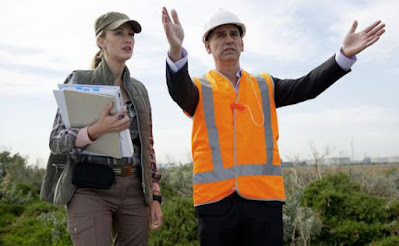
The Future That Got Away: Rob Sitch's ineffectual idealist, Tony Woodfood (played by himself) attempts to convince a fellow "nation-builder" that Australia's utopian future will be somewhere around here, and about this big, if the planning application is successful, and Canberra doesn't change its mind. As his eponymous TV series makes clear, the rule is: Utopia tomorrow and Utopia yesterday – but never Utopia today!

THE DISCOVERY OF “UTOPIA” has been the highlight of my summer. Only eight years after the series first screened on Australian television, I have been savouring its humour and insights on Netflix.

If the classic television series “Yes Minister” showcased the arguments for the neoliberal revolution of the 1980s, then Utopia serves up its consequences forty years down the track.

The series creators and principal writers, Rob Sitch, Santo Cilauro and Tom Gleisner, have captured to perfection the excruciatingly solipsistic world of the professionals and managers who keep our neoliberal society and its institutions running.

The use of the word “running” is, of course, entirely ironic. At the heart of Utopia’s humour is the sheer impossibility of a neoliberal bureaucracy running anything at all – other than its own self-promotion. (Otherwise known as: “Communicating government policies to key stakeholders.”)

Tellingly, the writers of Utopia do not describe their work as “satirical”, preferring instead to call it “observational”. Judging by the shrieks of recognition from real-life employees working in institutions reality-adjacent to Utopia’s fictional “Nation Building Authority” (NBA) the writers’ claim is valid. Apparently, not even comic geniuses like Sitch can make up absurdities to equal the all-too-real absurdities of the contemporary white-collar office environment.

For those of us who have attempted to keep track of the success or failure of the multitude of government initiatives announced over the past few decades, however, Utopia makes for extremely uncomfortable viewing. In episode after episode, the viewer is confronted with massive infrastructure projects that defy every attempt by CEO Tony Woodford (played by Sitch himself) and Nat Russell, his long-suffering Chief Operations Officer, to convert them into reality.

Watching Utopia, it suddenly becomes clear why KiwiBuild’s ambitious promise to build 100,000 houses was never real. Like the fictional NBA, KiwiBuild was a political construct, fashioned by political publicists, to meet a very specific set of transitory political needs.

While the rest of us believed (rather naively as it turned out) that KiwiBuild was about constructing real houses from concrete, timber, glass and roofing iron, its creators always understood that what they were actually promoting were symbols. Symbolic houses are not built with hammers and nails, but with ideas – the most important of which is the idea that the Government is committed to doing something about middle-class homelessness.

This explains why, in Utopia, the two most effective characters are Media Manager, Rhonda Stewart, and consultant Karsten Leith, her ever-willing media and marketing content creator. In painful contrast to the NBA, these two institutional bulldozers are absolutely brilliant a getting things done. If the media needs to be seeded with the first tentative musings concerning a yet-to-be-approved scheme, then Rhonda is your woman. Should the Cabinet approve a scoping study, Karsten is right there to whip-up a glossy brochure, or wow everyone with a flashy promotional video.

Reality poses no obstacles to Rhonda and Karsten. Always keen to “push” the achievements of the NBA (keeping the billions flowing) these two media manipulators are constantly re-announcing projects and re-launching them. Told that a major building project had yet to pour a single slab of concrete, they work up a glitzy multi-ministered “launch” of the fence surrounding the building-site!

Nuts? Well, yes, it is. But just cast your mind back to the number of media events organised to mark the “progress” of KiwiBuild. There were the ministers in their hard-hats and hi-viz vests: silver shovels in hand; smiling bravely for the camera.

Symbols piled upon symbols, but never bricks upon bricks.

Being Aussies, Sitch and his fellow writers invite their older viewers to recall the grand, nation-building infrastructure projects of yesteryear. CEO Tony references the Snowy River Project of the early post-war period. New Zealanders of a certain age will, likewise, recall the great hydro-electric schemes on the Waikato and Waitaki rivers that punctuated the same era.

The point which the creators of Utopia are constantly making throughout its four series (so far) is that the institutional madness depicted on-screen is the inevitable outcome of a neoliberal system which has set its face ideologically against the idea that the fundamental role of the state and its bureaucratic apparatus is to serve the needs of its citizens – especially those services out of which the private sector finds it almost impossible to extract a profit.

In both Australia and New Zealand neoliberal advisers and administrators have gone to considerable lengths to ensure that even if politicians are tempted to “do something” about an issue of genuine public concern (housing, public transport, climate change) the legal and institutional machinery needed to make it happen is no longer at hand.

The most obvious victim of this process in the New Zealand context is the Ministry of Works. Imagine what this government might have achieved on the housing front if it had had at its disposal a state-owned and controlled construction organisation which was capable, historically, of throwing up entire towns – Otematata, Twizel – to house workers engaged in building vast hydro-electric dams and canals for the state-owned electricity generator.

But, the long-term future focus which state ownership makes possible simply does not compute in the minds of the twenty-first century’s politicians and bureaucrats. Even if the future-proofing of society is a concept enjoying massive public support, the dangers associated with giving the voters what they want are simply too great to be risked.

This is the inconvenient truth which Utopia’s plot-lines are constantly presenting to the viewer. People want nation building. The country urgently needs the massive infrastructure planning and investment required to future-proof their security and prosperity. But, what do the politicians and bureaucrats do? They set up a flash Nation Building Authority and install an idealistic CEO to run it. But they don’t let it actually do anything – other than announce plans and launch fences.

Perhaps the most objectionable character in Utopia is Jim Gibson, the Government’s liaison man. The squinting, leering Gibson (superbly played by Anthony Lehmann) is nothing more nor less than a neoliberal commissar. Always there to steer any project offering too many public goods into the hands of private profiteers. Always working behind Tony’s and Nat’s backs, hand-in-glove with Rhonda, to preserve the public’s faith in the NBA’s nation-building mission while making sure that no project ever gets beyond being re-announced and re-launched.

The big reveal, politically-speaking, in 2022 is whether our own CEO, Jacinda Ardern, proves herself to be an idealistic but ineffectual “Tony”, or an amoral, but surprisingly effective, “Rhonda”. Will New Zealand continue to go nowhere fast? Or, will its people continue to accept the endless re-launches and re-announcements of its media savvy prime minister?

Utopia tomorrow and Utopia yesterday – but never Utopia today.


This essay was originally posted on the Interest.co.nz website on Monday, 10 January 2022.

Thursday, 5 July 2018

Keeping Power Homeless.

The Road Not Taken: The Workers, warned Karl Marx's contemporary and fellow revolutionary, Mikhail Bakunin, “once they become rulers or representatives of the people, cease to be workers. And from the heights of the State they begin to look down upon the toiling people. From that time on they represent not the people but themselves and their own claims to govern the people. Those who doubt this know precious little about human nature.”

WHERE DO WE GO when both the market and the state have been weighed in the balance and found wanting? How much better-off would the peoples of the world be if, instead of the towering ziggurats of global capitalism, their skylines were dominated by the equally absurd wedding-cake skyscrapers of global socialism? Would the planet be any less ravaged? Would bureaucracy be any less oppressive? Would the individual feel any freer – or less crushed?

The traditional Marxist response to these sorts of musings is that socialism, once fully established, would lead to a “withering away” of the state. Karl Marx himself equated life under communism with the manifestation of freedom in its broadest possible sense: “[I]n communist society, where nobody has one exclusive sphere of activity but each can become accomplished in any branch he wished, society regulates the general production and thus makes it possible for me to do one thing today and another tomorrow, to hunt in the morning, fish in the afternoon, rear cattle in the evening, criticize after dinner, just as I have a mind, without ever becoming hunter, fisherman, shepherd, or critic.”

Not a vision that would enthuse too many animal rights activists or vegans! Still, it’s easy to imagine a great many huntin’-shootin’-fishin’ Kiwis saying “Where do I sign-up?” Buried in Marx’s bucolic depiction of his communist paradise, however, is the easily overlooked phrase “society regulates the general production”. Society? Who’s that? And how does s/he “regulate the general production”? Who writes these regulations? Who enforces them? And out of which particular part of Planet Earth is all this “general production” to be extracted? You can see already how many serpents this passage sets loose in Marxist communism’s Garden of Eden!

Mikhail Bakunin, a contemporary of Marx – and a fellow revolutionary – was never one to let glib phrases about society regulating production pass him by without a very close inspection. He understood intuitively that the sort of society the socialists were hoping to bring into existence would necessitate a vast and all-embracing bureaucracy. It was a prospect that gave him considerable pause for thought – and not a few misgivings:

Workers, he said, “once they become rulers or representatives of the people, cease to be workers. And from the heights of the State they begin to look down upon the toiling people. From that time on they represent not the people but themselves and their own claims to govern the people. Those who doubt this know precious little about human nature.”

In those few lines, Bakunin describes the fatal flaw which lies at the heart of Marx’s vision. The flaw that, when Lenin’s Bolsheviks set about establishing the world’s first socialist state in post-World War One Russia, led ineluctably to the monstrous bureaucratic tyranny by which every one of the nations in which “actually existing socialism” held sway was to be so appallingly disfigured.

How to escape from this awful conundrum? Is there no way that the material abundance which human ingenuity’s technological creations make possible can be equitably distributed? Is there no way of overcoming the private and public bureaucracies so determined to preserve, at any cost, their power to create and administer scarcity? For what else is the state if not an elaborate mechanism for sorting-out (in Leonard Cohen’s arresting phrase) “who shall serve and who shall eat”?

Bakunin’s answer was as unequivocal as it was disturbing. If the state is oppressive by its very nature, then attempting to “take it over” is pointless. No matter how well-intentioned the revolutionaries may be when their banners are as yet unstained by the blood of their comrades, in the very act of exercising power over their fellow human-beings, of administering the state, the revolutionaries’ intentions are altered, distorted and, ultimately, perverted.

That being the case, said Bakunin, the only creditable aim of the true revolutionary is to smash the state: to destroy it; so that human-beings are free to take the “general production” directly into their own hands. Rather that create a brand new structure for power to dwell in, he counselled, keep it homeless. More importantly, learn to do without it altogether. In his own words: “Anyone who makes plans for after the revolution is a reactionary.”

Bakunin, the revolutionary contemporary of Marx, was neither a socialist, nor a communist.

He was an anarchist.

This essay was originally posted on The Daily Blog of Thursday, 5 July 2018.

Monday, 25 June 2018

Revolution And Bureaucracy.

Going Forward: "Every revolution evaporates and leaves behind only the slime of a new bureaucracy." - Franz Kafka. Painting by Bosc d'Anjou

EVERY REVOLUTION is both rescued and undone by the bureaucrats required to keep it alive. Sweeping away the old order is the easy part. The hard part is establishing a new order that will not fall apart at the first hint of political, economic and/or social trouble. A revolutionary bureaucracy must be more than resilient, however. It also needs to create the organisational architecture favourable to its long-term survival and growth. Unfortunately, these bureaucratic structures have a tendency to ossify. Imperceptibly, the new order becomes the old order and a new generation of revolutionaries begins to stir.

The dramatic economic reforms introduced by the Fourth Labour Government and its Finance Minister, Roger Douglas, were described by the political journalist, Colin James, as  “The Quiet Revolution”. In quick succession, New Zealand floated its currency, opened its borders and eliminated the subsidies which kept so much of its economy afloat. The Labour Government then proceeded to “corporatize” New Zealand’s publicly-owned industries: a process which saw tens-of-thousands of New Zealanders lose their jobs.

In the space of just a few months, the old economic and social order which National’s Rob Muldoon had struggled so hard to preserve was swept away. Not the least remarkable aspect of the “Rogernomics Revolution” was that it was accomplished without recourse to state-initiated violence.

Realising that what was being attempted in New Zealand was a carbon-copy of the economic programme imposed upon 1970s Chile by General Pinochet, one senior trade unionist warned the Labour Government that to carry through such radical reforms it would have to put troops on the streets. He was wrong. And the reason he was wrong was the breakneck speed with which the bureaucratic structures required to make the “free-market” revolution work were erected.

The explanation for the revolution’s rapid implementation lay in the fact that it was conceived by a tightly-knit group of senior bureaucrats located principally in the Reserve Bank and Treasury. Detailed blueprints for the new economic order they were seeking had already been drawn up. All these revolutionary bureaucrats lacked were the politicians needed to build it. In David Lange, Roger Douglas, Richard Prebble, Michael Bassett and Mike Moore they realised they had found them.

Only one significant obstacle to the revolution’s success remained in place – the public service ethos of the old bureaucracy that was being dismantled. A full and successful transition to the revolutionaries’ new economic system, driven by the imperatives of the free-market, would not be possible until the ingrained values of the old state-interventionist system it was replacing had been destroyed.

The State Sector Act 1988 was designed to do just that. Modelled on the administrative principles of the private sector, the new, free-market bureaucracy was led by Chief Executives on lucrative five-year contracts. Working on the assumption that the production of policy advice was no different from the production of baked beans, these new state-sector bosses could be recruited without risk from the private as well as the public sector. That being the case, it was considered prudent to source the new public sector mandarinate from those countries in which the free-market revolution had already triumphed.

Unofficially, it was also considered vital that these new free-market bureaucrats be strong enough to forestall the one eventuality that could undermine the new regime – the election of a left-wing government determined to roll back the free-market revolution of 1984-1993.

In the past, the “politicisation” of the public service had been about politicians “persuading” their bureaucratic advisors to do the government’s bidding. Under the new regime, this was turned on its head. The trick, now, was to “persuade” any cabinet ministers still foolishly clinging-on to left-wing ideas that their careers couldn’t possibly flourish until they finally accepted that the free-market revolution was irreversible.

If history teaches us anything, however, it is that nothing is irreversible. Mounting evidence of free-market capitalism’s failure has stimulated new economic thinking both here in New Zealand and around the world. The successors of those bureaucrats who facilitated the free-market revolution of the 1980s and 90s are now being asked to oversee its dramatic deconstruction. The eventuality they most feared, the election of a left-wing government determined to return the market to its proper place, has come to pass.

State Services Minister, Chris Hipkins, is demanding wholesale “transformation” of the public sector.

Vive la revolution

This essay was originally published in The Otago Daily Times and The Greymouth Star of Friday, 22 June 2018.