Showing posts with label KiwiBuild. Show all posts

Tuesday, 11 January 2022

Paradise Postponed.

The Future That Got Away: Rob Sitch's ineffectual idealist, Tony Woodfood (played by himself) attempts to convince a fellow "nation-builder" that Australia's utopian future will be somewhere around here, and about this big, if the planning application is successful, and Canberra doesn't change its mind. As his eponymous TV series makes clear, the rule is: Utopia tomorrow and Utopia yesterday – but never Utopia today!

THE DISCOVERY OF “UTOPIA” has been the highlight of my summer. Only eight years after the series first screened on Australian television, I have been savouring its humour and insights on Netflix.

If the classic television series “Yes Minister” showcased the arguments for the neoliberal revolution of the 1980s, then Utopia serves up its consequences forty years down the track.

The series creators and principal writers, Rob Sitch, Santo Cilauro and Tom Gleisner, have captured to perfection the excruciatingly solipsistic world of the professionals and managers who keep our neoliberal society and its institutions running.

The use of the word “running” is, of course, entirely ironic. At the heart of Utopia’s humour is the sheer impossibility of a neoliberal bureaucracy running anything at all – other than its own self-promotion. (Otherwise known as: “Communicating government policies to key stakeholders.”)

Tellingly, the writers of Utopia do not describe their work as “satirical”, preferring instead to call it “observational”. Judging by the shrieks of recognition from real-life employees working in institutions reality-adjacent to Utopia’s fictional “Nation Building Authority” (NBA) the writers’ claim is valid. Apparently, not even comic geniuses like Sitch can make up absurdities to equal the all-too-real absurdities of the contemporary white-collar office environment.

For those of us who have attempted to keep track of the success or failure of the multitude of government initiatives announced over the past few decades, however, Utopia makes for extremely uncomfortable viewing. In episode after episode, the viewer is confronted with massive infrastructure projects that defy every attempt by CEO Tony Woodford (played by Sitch himself) and Nat Russell, his long-suffering Chief Operations Officer, to convert them into reality.

Watching Utopia, it suddenly becomes clear why KiwiBuild’s ambitious promise to build 100,000 houses was never real. Like the fictional NBA, KiwiBuild was a political construct, fashioned by political publicists, to meet a very specific set of transitory political needs.

While the rest of us believed (rather naively as it turned out) that KiwiBuild was about constructing real houses from concrete, timber, glass and roofing iron, its creators always understood that what they were actually promoting were symbols. Symbolic houses are not built with hammers and nails, but with ideas – the most important of which is the idea that the Government is committed to doing something about middle-class homelessness.

This explains why, in Utopia, the two most effective characters are Media Manager, Rhonda Stewart, and consultant Karsten Leith, her ever-willing media and marketing content creator. In painful contrast to the NBA, these two institutional bulldozers are absolutely brilliant a getting things done. If the media needs to be seeded with the first tentative musings concerning a yet-to-be-approved scheme, then Rhonda is your woman. Should the Cabinet approve a scoping study, Karsten is right there to whip-up a glossy brochure, or wow everyone with a flashy promotional video.

Reality poses no obstacles to Rhonda and Karsten. Always keen to “push” the achievements of the NBA (keeping the billions flowing) these two media manipulators are constantly re-announcing projects and re-launching them. Told that a major building project had yet to pour a single slab of concrete, they work up a glitzy multi-ministered “launch” of the fence surrounding the building-site!

Nuts? Well, yes, it is. But just cast your mind back to the number of media events organised to mark the “progress” of KiwiBuild. There were the ministers in their hard-hats and hi-viz vests: silver shovels in hand; smiling bravely for the camera.

Symbols piled upon symbols, but never bricks upon bricks.

Being Aussies, Sitch and his fellow writers invite their older viewers to recall the grand, nation-building infrastructure projects of yesteryear. CEO Tony references the Snowy River Project of the early post-war period. New Zealanders of a certain age will, likewise, recall the great hydro-electric schemes on the Waikato and Waitaki rivers that punctuated the same era.

The point which the creators of Utopia are constantly making throughout its four series (so far) is that the institutional madness depicted on-screen is the inevitable outcome of a neoliberal system which has set its face ideologically against the idea that the fundamental role of the state and its bureaucratic apparatus is to serve the needs of its citizens – especially those services out of which the private sector finds it almost impossible to extract a profit.

In both Australia and New Zealand neoliberal advisers and administrators have gone to considerable lengths to ensure that even if politicians are tempted to “do something” about an issue of genuine public concern (housing, public transport, climate change) the legal and institutional machinery needed to make it happen is no longer at hand.

The most obvious victim of this process in the New Zealand context is the Ministry of Works. Imagine what this government might have achieved on the housing front if it had had at its disposal a state-owned and controlled construction organisation which was capable, historically, of throwing up entire towns – Otematata, Twizel – to house workers engaged in building vast hydro-electric dams and canals for the state-owned electricity generator.

But, the long-term future focus which state ownership makes possible simply does not compute in the minds of the twenty-first century’s politicians and bureaucrats. Even if the future-proofing of society is a concept enjoying massive public support, the dangers associated with giving the voters what they want are simply too great to be risked.

This is the inconvenient truth which Utopia’s plot-lines are constantly presenting to the viewer. People want nation building. The country urgently needs the massive infrastructure planning and investment required to future-proof their security and prosperity. But, what do the politicians and bureaucrats do? They set up a flash Nation Building Authority and install an idealistic CEO to run it. But they don’t let it actually do anything – other than announce plans and launch fences.

Perhaps the most objectionable character in Utopia is Jim Gibson, the Government’s liaison man. The squinting, leering Gibson (superbly played by Anthony Lehmann) is nothing more nor less than a neoliberal commissar. Always there to steer any project offering too many public goods into the hands of private profiteers. Always working behind Tony’s and Nat’s backs, hand-in-glove with Rhonda, to preserve the public’s faith in the NBA’s nation-building mission while making sure that no project ever gets beyond being re-announced and re-launched.

The big reveal, politically-speaking, in 2022 is whether our own CEO, Jacinda Ardern, proves herself to be an idealistic but ineffectual “Tony”, or an amoral, but surprisingly effective, “Rhonda”. Will New Zealand continue to go nowhere fast? Or, will its people continue to accept the endless re-launches and re-announcements of its media savvy prime minister?

Utopia tomorrow and Utopia yesterday – but never Utopia today.


This essay was originally posted on the Interest.co.nz website on Monday, 10 January 2022.

Friday, 2 November 2018

KiwiBuild Should Be Targeting The Poor.

Lotto - Oops, I Mean KiwiBuild Ballot - Winners: Derryn Jayne and Fletcher Ross pose with Phil Twyford and Jacinda Ardern outside their new KiwiBuild property in Papakura. Twyford is willing to buy Labour’s promised houses straight off the property developers’ plans. At a stroke, bad financial bets are transformed into sure things. Phil’s happy. The developers are happy. The banks are happy. And the winners of KiwiBuild ballots are over the moon.

KIWIBUILD, Labour’s flagship housing policy promising first-home-buyers 100,000 affordable dwellings by 2028, is a dog. It started out as a political fix and has yet to mature into coherent policy. Nowhere are Labour’s ambitions for KiwiBuild matched by the resources needed to fulfil them. Worst of all, the people most in need of 100,000 extra dwellings – beneficiaries and the working poor – are not the scheme’s targets. KiwiBuild is a perverse mixture of corporate and middle-class welfare, offering a handsome subsidy to builders and a generous hand-up to young professionals.

KiwiBuild began its life as David Shearer’s answer to David Cunliffe. In November of 2012, convinced that the Labour Left was plotting to replace him, Shearer was casting about desperately for a political circuit-breaker. He needed something that would halt the ambitious Cunliffe in his tracks and reassure the party’s rank-and-file that he was a Labour man through-and-through. KiwiBuild was that something. His announcement that the next Labour government would build 100,000 affordable homes for young New Zealanders brought Labour’s 2012 annual conference to its feet. In the warm glow of the membership’s support, an emboldened Shearer banished Cunliffe to the back-benches.

Having served its purpose, KiwiBuild was filed and forgotten. The necessary detailed development work on how it would be implemented, by whom, and at what cost, never progressed much beyond the hurried sketch vouchsafed to conference delegates and the news media six years ago. The consequences of Labour’s failure to fill in the gaps are now embarrassingly clear.

A Labour Party with stronger connections to the world beyond Parliament would have identified much sooner the practical limitations of KiwiBuild. The people and the products required to build 10,000 dwellings every year for 10 years simply aren’t out there. New Zealand’s construction industry remains chronically short of labour. The private sector will struggle to meet its own deadlines – let alone the government’s.

Unlike the First Labour Government, Jacinda Ardern’s coalition is attempting to build thousands of additional new dwellings with a construction industry at full-stretch. John A. (Jack) Lee, the man who oversaw Labour’s massive state-house-building programme between 1935-1938 could summon thousands of unemployed carpenters, tilers, plumbers, electricians and other construction workers to the cause of housing the people. Idle factories could be reactivated to supply the required building materials. This is what made “The Houses That Jack Built” possible. The absence of such vital enabling factors explains the houses that Phil Twyford cannot build in 2018.

Six years ago, when KiwiBuild was born, the full extent of the housing crisis had yet to emerge. Back then, affordability was the issue. The near impossibility of young professionals getting their feet on the first rungs of the housing ladder. Fortuitously, these same young professionals just happened to be the Shearer-led Labour Party’s prime electoral targets. First and foremost, KiwiBuild was a political “solution” to a middle-class “problem”.

Six years on, and the focus has shifted to beneficiaries and the working-poor sleeping in their cars or shivering in the overcrowded garages of family and friends. Voters for Jacinda’s transformational “politics of kindness” they may be, but they’ve not been deemed worthy of 10,000 houses per year. For these, the working-class people in whose name Jack Lee built the “social housing” of 80 years ago, 6,000 new state houses, in total, is considered adequate.

The irony is that, at an estimated price of $650,000, KiwiBuild’s “affordable homes” are rapidly moving beyond the reach of all but the luckiest of middle-class offspring. Those to whom the Bank of Mum and Dad still happily provides a deposit. Those for whom the wills of Mum and Dad hold out the prospect of eventual relief.

Undeterred, the Housing Minister presses on. Treasury may have revised downwards its projection of the scheme’s contribution to residential investment – but what do those “kids” know? Twyford is willing to buy Labour’s promised houses straight off the property developers’ plans. At a stroke, bad financial bets are transformed into sure things. Phil’s happy. The developers are happy. The banks are happy. And the winners of KiwiBuild ballots are over the moon.

About the only people who aren’t happy are those who believe that publicly funded social interventions on the scale of KiwiBuild should be directed first to those most in need. Tragically, however, the Coalition Government is selling the poor a pup.

This essay was originally published in The Otago Daily Times and The Greymouth Star of Friday, 2 November 2018.

Sunday, 18 February 2018

“The Data Is Simply Not Available, Minister.”

SIR HUMPHREY APPLEBY: "Yes Minister, promising to build 500,000 affordable homes would be a very courageous policy, indeed!"

IS LABOUR getting Sir-Humphreyfied on housing? For younger readers, Sir Humphrey Appleby is one of the leading protagonists in Antony Jay’s and Jonathan Lynn’s incomparable 1980s television satire “Yes Minister”. So compelling was the Sir Humphrey character (played to perfection by the late Nigel Hawthorne) that his name quickly became synonymous with the obfuscating, prevaricating, manipulative and often downright misleading senior civil servant who steers his ministerial master away from his better instincts towards the maintenance of the bureaucratic and political status quo.

Dr Chris Harris, a specialist in urban design and planning, raised the Sir Humphrey question with me after a careful reading of “Stocktake of New Zealand’s Housing”, the study authored by Alan Johnson of the Salvation Army, Otago Public Health Professor Philippa Howden-Chapman and economist Shamubeel Eaqub, which was released by the Housing Minister, Phil Twyford, on Monday afternoon.

One figure, in particular, caught his attention. This was Figure 3.4 “New Dwellings Consented, By Owner Type, 1970-2017” (see below). It’s most notable feature, explained Dr Harris, was the extraordinary spike in new dwelling consents which followed the election of the Third Labour Government, led by Norman Kirk, in 1972.


The graph shows consents flat-lining at around 23,000 per year in 1970, 1971 and 1972. Between the end of 1972 and the beginning of 1974, however, the number of dwelling consents shot up to an astonishing 39,000.

The first and most obvious question that springs to mind is: “How on earth did the Kirk Government do it?” Finding the answer to that question would, surely, be of considerable assistance to Minister Twyford as he sets about tackling New Zealand’s appalling shortage of affordable housing?

Presumably, the same thought occurred to the “Stocktake” authors. What was their conclusion? That’s when Dr Harris’s eye fell upon the concluding sentences of the paragraph printed immediately below Figure 3.4:

“While current levels of new house building compare favourably with the low levels of construction seen immediately after the global financial crisis, during the period 2009 to 2011, these current volumes are not historically exceptional particularly compared with the early 1970s. However, data on government involvement in the 70s boom is not available.”

Get that? Information on the way in which the Kirk Government managed to nearly double the number of houses being consented “is not available”. (My emphasis.)

In his e-mail alerting me to this extraordinary omission, Dr Harris writes:

“Note the last sentence! In fact, you can find out quite a lot from consulting the on-line NZ Official Yearbooks of the time. State Advances credit, available for actual housing construction but not speculation since 1919, was increased. And on top of that there was as yet no Accommodation Supplement to fritter away government housing money, so that it very much went on actual building. There was also a shift from building large stand-alone houses on the city fringe to building lots and lots of small and affordable flats in more urban locations, which is where the real shortage was, and had long been. And this was all directed from the top by Big Norm.

“Norman Kirk re-founded the old-time Ministry of Works as the Ministry of Works and Development in 1973, and founded the Housing Corporation in 1974, also to try and get more houses and flats built. It turned out that urban flats proved easiest and quicker to build once central government weighed-in to overcome the usual obstacles. This was a really important part of the recipe for getting runs on the board quickly. Our cities are still full of flats built in the 1970s – the standards were higher than in later decades. Mass-produced hollow concrete blocks, suitably reinforced, were the building material of choice. Concrete block walls signify a 1970s flat in the same way that a tiled roof is typical of a 1940s state house. 

“Big Norm's policy of pulling out as many stops as possible and focusing on flats really did work surprisingly quickly and the proof is in the consent graph. Our population back then was only a bit over three million, so the graph actually understates the success of the policies of the 1972-1975 Labour Government.

“Actual builds are always a bit less than consents granted. In the early 1970s the peak rate for actual housing construction was 34,300 units built in one year. This roughly equates to 50,000 a year today, if not more, and that nice round number might explain why Shamubeel Eaqub challenged the government to see to it that 500,000 housing units are built in ten years.

“Interestingly enough, few of the houses built under Kirk's administration were state houses. To get things moving quickly, the policy was very much one of collaboration with commercial builders and developers, who were offered guarantees to go and work flat out building small affordable units without worrying too much where the money was coming from, or whether the consent was going to be approved.”

Dr Harris goes on to observe:

“You have to wonder whether there is some kind of an embargo on the level of government activism that led to such a boost in housing production in the early 1970s. It's like an episode of Yes Minister in which the bureaucrats have hidden all the relevant files and the politicians don’t notice that they’re missing straight away. Adding to suspicion of a stitch up by a business-as-usual brigade is the fact that the word ‘credit’ does not appear in the report and there is only spotty and empirical reference to ‘finance’. So, no need to frighten the banks in other words. There also doesn't seem to be any mention of the really important part played by central government institutions in making things happen more effectively and in a streamlined way back in the past: institutions such as the State Advances Corporation, the MWD – which the Rogernomes abolished in 1988 while dialling-back state construction lending at the same time – and the Housing Corporation. The Housing Corporation is still with us of course, but only in a feeble and gutted sort of a way.”

Here, perhaps, is the explanation for Shamubeel Eaqub’s extraordinary forthrightness during Monday’s media conference in the Beehive Theatrette. With barely concealed frustration at what he clearly regards as the new government’s half-hearted housing effort, he urged the governing parties to break free of the fiscal “straightjacket” in which they are currently restrained by Finance Minister Grant Robertson’s Budget Responsibility Rules.

The last thing the “Sir Humphrey’s” at the top of our own civil service want, deeply imbued as they are with the neoliberal economic orthodoxy which has guided New Zealand public policy for more than 30 years, is for “their” ministers to begin searching back through the historical record to discover how, forty years ago, a newly-elected Labour Government responded to the needs of its people by – of all things – fulfilling them.


This essay was originally posted on The Daily Blog of Saturday, 17 February 2018.

Tuesday, 13 February 2018

Taking Stock: Is the Government Doing Enough to End the Housing Crisis?

A Fading Dream: “The past 25 years have seen the gradual demise of the so-called Kiwi Dream – a place where home ownership and the economic independence which this offers, was within reach of most working families. Home ownership rates have fallen to a 60-year low and could fall further. These falls have been alongside rapid house price inflation in many parts of New Zealand and, with this, deteriorating affordability. We are quickly becoming a society divided by the ownership of housing and its related wealth and recent housing and tax policy settings appear to have exacerbated this division.” - Stocktake of New Zealand's Housing, 12 February 2018.

THE FULL MAGNITUDE of the housing crisis confronting the new government stands revealed in its Stocktake of New Zealand’s Housing. Released this morning, the document paints a far worse picture of the situation than even the parties now in government presented to voters from the opposition benches.

In the words of the three authors of the stocktake, Alan Johnson of the Salvation Army, Otago Public Health Professor Philippa Howden-Chapman and economist Shamubeel Eaqub:

“The past 25 years have seen the gradual demise of the so-called Kiwi Dream – a place where home ownership and the economic independence which this offers, was within reach of most working families. Home ownership rates have fallen to a 60-year low and could fall further. These falls have been alongside rapid house price inflation in many parts of New Zealand and, with this, deteriorating affordability. We are quickly becoming a society divided by the ownership of housing and its related wealth and recent housing and tax policy settings appear to have exacerbated this division.”

The policies advanced by the Labour-NZF-Green government in response to New Zealand’s housing crisis – most particularly Labour’s KiwiBuild initiative – no longer impress informed observers as either bold or comprehensive enough to bring about a speedy resolution of the crisis. On the contrary, they seem doomed to fail: there being neither the material, nor the human, resources required to make them succeed.

One has only to look back at the first great wave of state-initiated and funded house construction to appreciate the full scale of the difficulties confronting the new government.

Between 1936 and 1949 the first Labour government was responsible for the construction of 30,000 state houses. In other words, over a period of 13 years, the Department of Housing Construction and its private sector contractors were able to build fewer than a third of the number of dwellings which the present government has promised to build in ten!

What’s more, those 30,000 state houses were built at a time when the New Zealand economy was awash with unemployed labour and underutilised resources impatient to be set to work. Labour’s state housing programme was the New Zealand equivalent of US President Franklin Roosevelt’s “New Deal”: a massive public works programme designed to both enhance the nation’s quality of life and provide steady and well-paid employment for its people.

One of the ways the First Labour Government accomplished these goals was by mandating the use of local materials in state house construction. This decision gave an immediate and massive boost to all those businesses ancillary to the construction industry. To help the private sector keep pace with the state-induced demand, the Department of Housing Construction established two publicly-owned factories dedicated to producing the standardised joinery used in state house interiors.

The present government’s chief promoter of the CPTPP, David Parker, might pause to consider that such a policy of buying and using only Kiwi-made and sourced materials is expressly forbidden in practically all of the free-trade agreements New Zealand has signed since 1984 – including the CPTPP.

The state housing programme of 1936-1949 involved an unprecedented mobilisation of New Zealand’s human and material resources to construct a total of 30,000 dwellings. Even allowing for the fact that New Zealand’s population has more than doubled in size, how likely is it that Labour’s Phil Twyford is going to out-build Jack Lee’s Department of Housing Construction by a factor of 3 – in just 10 years?

Is it even remotely feasible that: from a tight labour market already suffering serious skill shortages; and from a construction sector already running at full-tilt; this government will be able to elicit an average of 10,000 additional houses per year?

Because, just to be clear, that total of 30,000 state houses constructed between 1936 and 1949 was over-and-above the normal total of dwellings commissioned and constructed by and for private companies and individuals. It is not yet clear whether Twyford’s promise of 100,000 “affordable homes” between 2017 and 2027 is on-top-of, or included-in, the output of private house construction.

It is important to remind ourselves at this point that Twyford’s “affordable” KiwiBuild homes are expected to sell for between $500,000 and $600,000 – a price completely beyond the reach of the tens-of-thousands of New Zealanders who possess neither a home of their own, nor a secure tenancy in somebody else’s.

For these: the working-poor on rock-bottom wages; Kiwis struggling to survive on a benefit; and, increasingly, for pensioners without a freehold home of their own; the Labour-NZF-Green government is promising to build just 1,000 state houses a year.

With the findings from the Stocktake of New Zealand’s Housing in their hands. With their heads chock-full of data showing how desperate New Zealand’s housing situation has become, Mr Twyford and his colleagues are proposing to build 1,307 fewer state houses than Jack Lee and the First Labour Government managed to build in a little country laid flat by the greatest depression in human history – eighty years ago.


This essay was posted simultaneously on Bowalley Road and The Daily Blog of Tuesday, 13 February 2018.

Tuesday, 21 November 2017

Is The Talented Mr Twyford Talented Enough?

The Man With The Plan: The “Housing Crisis” strikes at the core expectations of hundreds-of-thousands of New Zealanders. By promising to meet those expectations, the Labour-led government has made itself a hostage to the supremely-confident individual who insists that he alone has the political skills to end the crisis – Phil Twyford.

PHIL TWYFORD is an eye-roller. Not that there’s anything wrong with that. We all know eye-rollers: those guys (and gals) who consider themselves to be so incontestably “across” a subject that anyone offering a contrary viewpoint is dismissed with an exasperated roll of the eyes. All well and good, providing the subject under discussion is rugby, or the best way to cook a Christmas turkey. But, if the subject under scrutiny is housing: the issue upon which this government is positioned to either succeed or fail; well then, that’s not so good. Not so good at all.

It doesn’t help that the Minister of Housing and Transport, in addition to being an eye-roller, is also a chin-jutter. As anyone who’s ever watched him on television can attest, he is prone to sailing into political discussions like one of those Ancient Greek war-galleys: with his chin standing-in for the battering-ram! Unhelpfully, by positioning his head in this way, Phil is more-or-less required to look down his nose – which only makes things worse!

Eye-rolling superiority, coupled with chin-jutting belligerence, can sometimes work for a politician. Especially when they’re simply part of a much larger ensemble of intimidating behavioural gestures. Just think of Sir Robert Muldoon – or Donald Trump! On the other hand, if you’re determined to be Mean Mr Mustard, then there’s absolutely no point in you also attempting to be Sweet Baby James! Or Phil, for that matter.

All very personal. But, a politician’s personality is not something to be casually disregarded. As Jacinda Ardern has so spectacularly demonstrated, the ability to project a likeable personality can take a politician – and her party – a very long way indeed! By the same token, an irritating political persona can all-too-easily distract voters from their government’s core messages, or, even worse, impede the progress of its core policies.

There is no policy more critical to this Government’s political survival than housing. The availability and affordability of warm, dry houses for all New Zealanders was a key voter motivator in the 2017 election. For many working-class Kiwis, simply finding somewhere to live – at a rent they can afford – has become a relentless struggle. At the same time, young middle-class Kiwis are beginning to despair of ever being able to afford to buy a home of their own. The “Housing Crisis” thus strikes at the core expectations of hundreds-of-thousands of New Zealanders. By promising to meet those expectations, the Labour-led government has made itself a hostage to the supremely-confident individual who insists that he alone has the political skills to end the crisis – Phil Twyford.

No pressure, then, Phil.

Except, every day, the pressures bearing on just about every aspect of the housing crisis grow. Most seriously, doubts have been expressed within both the Reserve Bank and Treasury about the viability of Labour’s flagship housing programme, “KiwiBuild”.

Promising to build 100,000 “affordable houses” in ten years, KiwiBuild has stood at the centre of Labour’s housing policy since 2012: a flashy hand-me-down from the doomed leadership of David Shearer. Essentially, KiwiBuild was a feel-good policy, cobbled-together by the Labour Right to defuse an internal party crisis. It was a rickety concept five years ago and, unfortunately, it’s gotten no stronger.

The problem with KiwiBuild, along with Labour’s other big promise to build an additional 1,000 state houses per annum, is that there simply isn’t an agency of sufficient size and authority; with sufficient financial resources, labour and building materials; to turn Labour’s promises into actual houses in anything like the numbers promised. Regardless, Twyford refuses to countenance the socialistic methods adopted by the First Labour Government, preferring, instead, to rely upon “the market” for a construction effort unprecedented in 80 years.

Accordingly, KiwiBuild looks set to become one of the largest Public-Private-Partnerships in New Zealand history. At least as large as the partnership between the First Labour Government and James Fletcher’s state house construction firm. Unfortunately, this is not 1937: there is simply no slack in the building industry: everything, including its labour force, is fully stretched. Nevertheless, Twyford remains “confident” that the private sector will come to the KiwiBuild party. In the absence of substantial state subsidisation, however, that seems unlikely.

The only path to fulfilling Labour’s housing promises is via the creation of a massive state-directed, properly resourced and publicly-funded entity, driven forward with the same monomaniacal zeal displayed by New Zealand’s first housing “czar”, John A Lee. Jacinda Ardern erred in over-loading Twyford with two key portfolios: Transport and Housing. She should have given the whole Transport portfolio to the Greens’ Julie Anne Genter.

Twyford does not believe he is overburdened. Nor does he accept that his reliance on the private sector will ensure Kiwibuild becomes a fatal political failure. Suggest otherwise and he will simply jut out his chin, and roll his eyes.


This essay was originally published in The Press of Tuesday, 21 November 2017.

Thursday, 6 October 2016

Sins Of Omission: Why Phil Twyford's Most Recent Post Fails To Convince.

Revealing Statement: Why would Labour's housing spokesperson, Phil Twyford, begin his most recent blog post by listing the achievements of New Zealand’s five Labour governments – only to omit entirely any reference to the second and third? As if Walter Nash’s second Labour government of 1957-1960, and the Norman Kirk/ Bill Rowling-led third, which governed from 1972-1975, never existed. Or, if they did, left no achievements worth mentioning behind them.
 
AS ANY GOOD DETECTIVE will tell you, it’s what suspects “fail to mention when questioned” that gives them away. The subjects a person doesn’t want to talk about can tell you as much about them as the things they’re only too happy to discuss. It’s a forensic rule-of-thumb that can be applied with equal success to the utterances of politicians.
 
What, for example, can we deduce from the most recent posting (5/10/16) from Labour’s Housing Spokesperson, Phil Twyford, on the subject of his party’s “housing reform agenda”? Why would a Labour politician begin by listing the achievements of New Zealand’s five Labour governments – only to omit entirely any reference to the second and third?
 
This is what Twyford wrote:
 
“All Governments are defined by the big challenges and how they meet them. For the first Labour Government it was lifting people out of the poverty of the Depression, and dealing with a World War. For the fourth Labour Government, for better or worse, it was modernising and opening up the economy after nine years of Muldoon. For the fifth it was restoring sanity and decency to government and the economy after the nasty divisive 90s.”
 
Extraordinary! It’s as if Walter Nash’s second Labour government of 1957-1960, and the Norman Kirk/ Bill Rowling-led third, which governed from 1972-1975, never existed. Or, if they did, left no achievements worth mentioning behind them. These are serious and highly suggestive omissions. But before we examine them more closely, a word or two must be devoted to Twyford’s characterisation of the fourth Labour government.
 
Most damning of all is that ugly verbal shrug, “for better or worse”. It represents the very worst kind of moral abdication. Twyford is perfectly aware that for tens-of-thousands of Labour supporters the unleashing of Roger Douglas’s neoliberal revolution was an unmitigated disaster. Whole industries, along with the communities that depended on them, were devastated by “Rogernomics”. For those Maori New Zealanders employed in the nation’s processing and manufacturing sectors, the changes signalled the onset of chronic economic and social pain. Thirty years after the “modernising and opening up” of the New Zealand economy, the consequences of the fourth Labour government continue to blight Maori lives.
 
Twyford’s choice of the words “modernising” and “opening up” are also highly revealing. Both expressions are positive (especially when placed alongside their antonyms “antiquated” and “restricting”) and Twyford’s use of them can only be interpreted as a vote of confidence in the fourth Labour government’s actions.
 
Having examined the “worse” side of Twyford’s “better or worse” dichotomy, we must also examine who had cause to experience Rogernomics as something “better” than the economic regime which preceded it. The financial and property speculators, asset-strippers and importers whose political contributions filled Labour’s coffers in the 1980s certainly had reason to sing the praises of the Rogernomics revolution. Curiously, Twyford seems less keen to solicit their support in 2016!
 
Twyford’s essentially positive assessment of the neoliberal policies of the fourth Labour government, coupled with his equally positive comments about the fifth, provide the explanation for his unwillingness to so much as mention the second and the third. Like the rest of his caucus colleagues, Twyford wants nothing to do with the nation-building policies of Labour leaders like Arnold Nordmeyer, Phil Holloway and Norman Kirk.
 
His aversion to the economic ideas of William Sutch and Wolfgang Rosenberg is even stronger. The whole notion of import substitution and state-led investment in new industries produces only synchronised eye-rolling among the current crop of Labour MPs. The party, under Helen Clark, may have restored “sanity and decency to government and the economy after the nasty divisive 90s” (although a great many people on the left of New Zealand politics would dispute Twyford’s rosy assessment!) but that does not mean Labour has the slightest intention of embracing the economic nationalist policies of the second and third Labour governments.
 
It is this refusal that makes Labour’s flagship housing policy – Kiwibuild – so disappointing. Were Labour committed to constructing 100,000 state houses over the next 10 years. If what was being proposed was a dedicated construction force, trained, paid and equipped by the state, and with the capacity to order construction materials in the volumes local and overseas suppliers require to reduce their prices (it currently costs $NZ1,300 per square metre to construct a home in New Zealand, compared to just $NZ600 per square metre in the United States!) then Kiwis could have some confidence in Labour’s promises to build affordable homes. But all Twyford is prepared to say is:
 
“Since the 1980s a generation have convinced themselves Government is not capable of doing anything right. That you can only trust the market. We are going to change that mindset. We are going to do it in partnership with the private sector – but we are going to build 100,000 affordable homes for first home buyers.”
 
Note that well: “first home buyers”. Note also the price of an affordable home in Auckland – approximately $600,000! Labour’s “partnership” with the private sector reduces Kiwibuild to little more than a giant welfare scheme for property developers – in whose pocket the party now so clearly nestles. John A. Lee, the Labour firebrand entrusted with Labour’s original state house construction programme, wouldn’t know whether to laugh … or cry!
 
It is not difficult, however, to imagine what a political detective might say:
 
“Philip Stoner Twyford, you are charged with hoodwinking the New Zealand electorate. You are not obliged to say anything (and, quite frankly, if this is best you can manage, you’d do better to keep your mouth shut) but your failure to acknowledge, when posting, the achievements of the second and third Labour governments, and your refusal to condemn the betrayals of the fourth, will certainly harm your defence in the High Court of History.”
 
This essay was originally posted on The Daily Blog of Wednesday, 5 October 2016.

Tuesday, 20 May 2014

Housing The People: Will The Next Labour Government Be As Economically Inventive As The First?

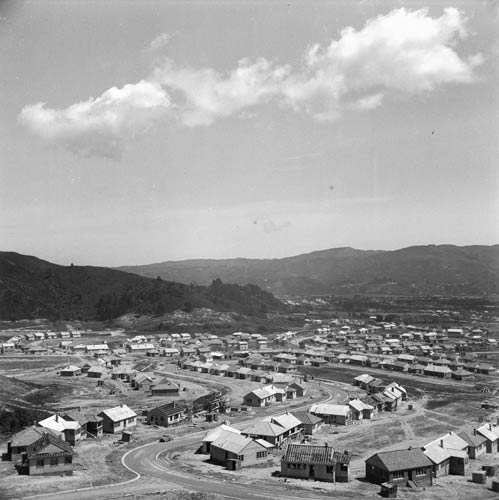
Housing The People: During the 1930s and 1940s New Zealand cities faced a chronic housing shortage. In response the government started a state rental housing scheme, which included building entire suburbs of houses. This is the Hutt Valley suburb of Naenae in 1944. Following the lay of the land, the curving streets were designed to reduce the monotony of straight streets. (Photograph and caption courtesy of Te Ara)

WHICH IS MORE DIFFICULT? Listening to the Prime Minister deny the existence of a housing crisis, or trying to make sense of Phil Twyford’s solution to it? The Organisation for Economic Co-operation and Development’s (OECD) has just ranked New Zealand 34 out of 34 when it comes to the over-valuation of residential property relative to rent and income. According to the OECD, New Zealand house prices, relative to rents, are 70 percent too high.
 
The Prime Minister will have none of this. Rather than reflecting some sort of crisis, soaring house prices are merely a symptom of the New Zealand housing market’s rude good health. Besides, says John Key, one has only to go on to ‘Trade Me’ to discover plenty of houses priced affordably at around the $NZ300,000 mark.
 
Twyford’s response to this nonsense began well enough on Radio New Zealand’s Morning Report. New Zealand’s very real housing crisis, he said, was the result of market failure: something which only the State possesses sufficient resources to correct. Labour’s KiwiBuild programme, he said, was pledged to building 100,000 affordable homes in ten years.
 
If only KiwiBuild meant the New Zealand State buying the land, constructing the houses and then leasing them out at affordable, income-related rentals to young New Zealand families. That, after all, was what the First Labour Government had done. Between 1935 and 1949 entire suburbs had been built by the State. Sturdy, well-designed “state houses”, constructed out of local materials, were erected in the tens-of-thousands.
 
Orakei, Mt Roskill, Mt Wellington, Panmure, Naenae, Taita, Corstophine – Labour’s commitment to “Housing the People” made as real as the concrete foundations these suburbs’ state houses stood on. In its propaganda for the 1938 General Election Labour quoted the words of Professor A. H. Ryan, of Queen’s University, Belfast, who told an Auckland audience: “I had the good fortune to visit the Orakei housing scheme. I have an extensive knowledge of housing schemes and have visited them all over Europe, and I want to congratulate New Zealand in having the finest housing scheme in the world.”
 
Sadly, KiwiBuild offers nothing like the First Labour Government’s housing policy. Essentially, it is a Public Private Partnership, in which the State facilitates the private sector’s construction of houses which it will then sell at “affordable” prices ($300,000 to 400,000 in Auckland) to first home buyers.
 
In other words, Labour is promising to help the sons and daughters of middle-class New Zealand into their first home. Twyford may talk in emotive terms about coming to the aid of people living in garages in South Auckland, but the houses that he, Labour and an army of grateful property developers are proposing to erect are not intended for them. Where are working families on the minimum wage going to find the deposit on a $350,000 house?
 
The question that rattles around in my head is “Why?” With the noble precedent of Labour’s first great exercise in “Housing the People” still standing on a thousand streets all over the country, what is preventing Twyford from following it? Does it all come down, like so many things the Labour Party would like to do, to a lack of money?
 
The cost of its housing policy certainly taxed the ingenuity of the First Labour Government. The answer they eventually came up with shocked New Zealand’s Civil Service mandarins to the core.
 
W.B. (Bill) Sutch, writing in his book The Quest for Security in New Zealand 1840 to 1966, describes the extent of Labour’s political inventiveness:
 
“To build the houses, credit was created by the Reserve Bank at a rate of 1.25 percent for the first £5 million. John A Lee was made Under-Secretary in Charge of Housing. He accepted on the understanding that money would be available from the Reserve Bank. This procedure was a political victory for those in the Labour Party who wanted to use the financial system to build New Zealand even though such an action might conflict with the banking authorities in New Zealand and in Britain and necessitate a change in ‘free trade’ conceptions. Said Lee later, ‘This was a contentious Party issue. With tens of thousands of men on relief work the Labour Party, Nash and Fraser apart, believed that the funds of the Reserve Bank should be used for essential capital works until available men, machinery and materials were being fully employed. We wanted to undo the politically enforced bankers’ deflation.’”
 
Can it really be true that the Labour Caucus of 2014 contains no one with the wit and courage of Jack Lee and his colleagues? Is there really no chance that the sort of unorthodox economic thinking that made possible the first great exercise in “Housing the People” will be replicated on Twyford’s watch?
 
Is there no one in Labour’s ranks who was present and understood what the late Sir Owen Woodhouse was telling them two years ago, on 3 November 2012, at the fortieth anniversary of the election of the Third Labour Government?
 
Sir Owen was the architect of New Zealand’s world-beating Accident Compensation Scheme. Originally, the scheme had been a pay-as-you-go operation – it’s costs being met out of the levies charged, augmented if necessary from the Consolidated Fund. In the late 1990s, however, in preparation for its eventual privatization, the National Party insisted that the Accident Compensation Corporation become fully-funded. In other words it was required to build up a fund sufficiently large to meet all of its existing and likely future obligations.
 
According to Sir Owen:
 
“… ACC has been regarded by some as an insurance scheme under another name. And eventually the need for an income flow was converted from pay-as-you-go to a commercial insurance-type funded system. It is an expensive mistake. For this reason, every year employers and owners of vehicles have been paying much larger amounts than need be in order to build up the large invested funds which now total more than 20 billions. The funded approach should cease in favour of ACC’s annual needs – the system that has always operated for health, education and all general social benefits. By this simple change levies and vehicle charges would be much reduced; they could be averaged across all industries; individual ACC accounts could be amalgamated. And only by this means can the system be extended to sickness as intended by the original report and later outlined as feasible by the Law Commission. It may be asked what of the large fund now in place?”
 
What indeed?
 
Sir Owen’s suggestion was that a “sufficient portion should be retained as the necessary contingency against the risk of major disaster with a balance to future levies”.
 
Well, yes, that would be one solution. But, were a future Labour Government to follow Sir Owen’s advice and revert to a pay-as-you-go ACC, then that $20 billion, or, at the very least, the annual income it generates, could be turned to other purposes.
 
Like “Housing the People”.
 
This essay was originally posted on The Daily Blog of Monday, 19 May 2014.