Showing posts with label CPTPP (Comprehensive and Progressive Trans-Pacific Partnership). Show all posts

Thursday, 22 February 2018

Too Little, Too Late: The Opportunity To Stop the CPTPP Has Passed.

Off The Hook: Since early-November 2017, the Labour-NZF-Green Government has been able to sell its message that the CPTPP represents a genuine improvement on the TPPA. So much so, that the street-based protest option has quietly dropped-off the anti-TPP agenda. That’s why the anti-TPP pressure group "It's Our Future" is promoting a “Day of Action” on 4 March 2018, rather than an honest-to-goodness protest march like the one that stunned New Zealand on 4 February 2016.

“TOO LITTLE, TOO LATE.” That’s what I would say to David Parker on the day he released the text of the Comprehensive and Progressive Trans-Pacific Partnership (CPTPP). With the signing ceremony due to take place in the Chilean capital, Santiago, on 8 March – a mere fortnight from the document’s release – the time available for thorough public scrutiny and debate is simply too short.

I would also say “Too little, too late” to Oliver Hailes, the new spokesperson for the anti-TPP pressure-group, It’s Our Future (IOF). He has announced a “Day of Action” against the CPTPP on Sunday, 4 March. But, at just four days out from the signing ceremony, what is IOF’s “action” supposed to achieve?

It’s hard to tell. In the bulletin released by Hailes, the Day of Action is described as:

“[A] Nationwide Day of Action across New Zealand in opposition to the Government’s plans. The Government intends to sign the treaty in Chile on Thursday 8 March and there will be an organised presence at Parliament on that day - watch this space, details are to come!”

Reading on, it becomes clear that IOF’s strategy in relation to the CPTPP is fundamentally unchanged from the strategy it adopted against its predecessor, the plain old Trans-Pacific Partnership Agreement (TPPA).

In Hailes’ own words:

“Signing is not the end of the process! [The CPTPP] must be presented to Parliament for debate, and then it will be referred to the Foreign Affairs, Defence and Trade Select Committee for examination. These are opportunities for all of you to have your say through written or oral submissions. Eventually the Select Committee will make a recommendation to the Government as to whether or not it should ratify the text and adopt implementing legislation to bring New Zealand law into line with its international commitments. And then, if the Government gets its way, New Zealand will undertake binding action. Each one of these steps provides an opportunity for you to intervene and let the Government know why it should turn back. Remember, the whole plan fell to pieces last time.”

Well, yes, it did, but only because President Donald Trump yanked the United States out of the Agreement at the last minute. Submissions to the Foreign Affairs, Defence and Trade Select Committee made absolutely to difference to the National Government’s plans to bring the TPPA into effect. It is fanciful to suggest that submitting to the same select committee on the CPTPP will produce anything other than exactly the same outcome.

Albert Einstein defined insanity as “doing the same thing over and over and expecting a different result”? The IOF should turn that quotation into a poster and pin it up on the wall above Oliver Hailes’ desk.

So, what would work? The answer, sadly, is that, right now, a fortnight out from the signing ceremony, it’s hard to see anything working.

Jacinda Ardern, Winston Peters and David Parker were vulnerable to the critics and opponents of what was then being called TPP-11 for only a very brief moment: the period immediately preceding, and immediately after, the Apec Meeting in Danang, Vietnam on 6-11 November 2017.

That was the period during which it became clear to all those who had trusted in Labour’s, NZ First’s and the Greens’ declared opposition to the TPPA, that the new coalition government was preparing to renege on its promises. If the IOF movement had called its 20,000-plus supporters onto the streets in early-November 2017, under the slogan “Hold Them To Their Word!”, then there might have been a chance of spooking Jacinda, Winston and David into resisting the pressure from MFAT, MBIE, MPI, Federated Farmers and Business NZ to treat their pre-election promise to defend New Zealand’s sovereignty as “just one of those things you say in Opposition and then forget about it Government”.

Sadly, the IOF did not activate its data-base of followers and lead them into the streets, with the result that, in the weeks and months that followed, the Government has been able to sell its message that the CPTPP represents a genuine improvement on the TPPA. So much so, that the street-based protest option has quietly dropped-off the anti-TPP agenda. That’s why Oliver Hailes is promoting a “Day of Action”, rather than an honest-to-goodness protest march like the one that stunned New Zealand on 4 February 2016.

Getting a handful of worthy souls to gather in city-centres and parks on 4 March 2018 and hold up a tired display of re-cycled placards and banners, is something IOF can manage. Putting 50,000 angry Kiwis on Queen Street is no longer within its power.

The impact will be negligible. A Government riding-high on 48 percent in the latest Colmar Brunton opinion poll has nothing to fear from a single day of [in]action.


This essay was originally posted on The Daily Blog of Thursday, 22 February 2018.

Wednesday, 7 February 2018

When ‘Maintaining The Rage’ Isn’t An Option.

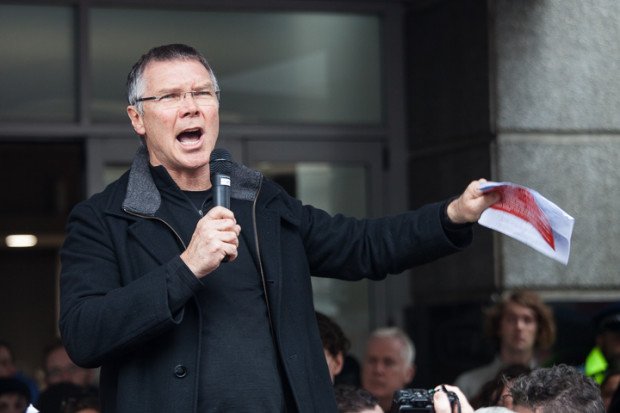
"Just One Of Those Things You Say In Opposition": Had the rage so evident on the streets of Auckland on 4 February 2016 been maintained, Jacinda Ardern, Winston Peters, and Labour’s intrepid Trade Minister, David Parker, would not have found it such an easy matter to renege on the undertakings Labour and NZ First had given on that day when it seemed prudent for Mr Parker to stand outside the US Consulate, microphone in hand, and pledge Labour to the defence of New Zealand’s sovereignty against trans-national corporate predators.

THE HARD-LEFT of New Zealand politics enjoys nothing more than enumerating the shortcomings of the Labour Party. No matter that the hard-left itself represents only a tiny fraction of the electorate (a deficiency confirmed with crushing finality whenever it fields candidates in a general election). Not to worry. This past week [i.e. the week ending 27 January 2018] the Labour-NZF coalition government’s decision to sign-up to the Comprehensive and Progressive Transpacific Partnership (CPTPP) has afforded its hard-left critics multiple opportunities to, once again, rail against the manifold shortcomings of social-democracy.

Were they of a mind, however, the despised social-democrats could mount a telling critique of the hard-left’s own dereliction of political duty. The focus of such criticism would be the hard-left’s failure to “maintain the rage” against the Trans-Pacific Partnership which, in February 2016, had just been demonstrated with truly exceptional power on the streets of Auckland.

So effective had the campaign of the “It’s Our Future” organisation been in rousing public indignation at the TPP’s multiple assaults on New Zealand sovereignty, that the Andrew Little-led Labour Party felt obliged to step away from the long-standing bi-partisan consensus on free trade and come out openly against its ratification. It was joined in this radical oppositional stance by Winston Peters’ NZ First Party and the Greens. Foreshadowed in this ad-hoc anti-TPP multi-party alliance, was the Labour-NZF-Green government sworn into office in October 2017.

Was the hard-left quick to warn the still-fizzing anti-TPP demonstrators that this sudden display of radicalism on the part of Labour, NZ First and the Greens was not to be trusted? Did it urge the movement to shift its focus from the streets of Auckland to Parliament Grounds in Wellington? Was a concerted campaign proposed to pressure MPs directly by besieging the House of Representatives and impeding the Select Committee hearings into the legislation ratifying the TPP? Was the hard-left able, as its predecessors had been in the days of the Halt All Racist Tours organisation, to transform participation in a single day of rage into a permanent reserve army of protestors, capable of being mobilised at a moment’s notice?

No, it was not.

Had it been, Jacinda Ardern, Winston Peters, and Labour’s intrepid Trade Minister, David Parker, would not have found it such an easy matter to renege on the undertakings Labour and NZ First had given on the day when it seemed prudent for Mr Parker to stand outside the US Consulate, microphone in hand, and pledge Labour to the defence of New Zealand’s sovereignty against trans-national corporate predators.

So, what did the hard-left do?

Well, it did exactly what it so loudly condemns the centre-left for doing: it attempted to engage constructively with the many and varied processes of institutional power so as to get the firmest possible grip on the levers of political influence. Even now, the effective leader of the anti-TPP movement, Professor Jane Kelsey, is cautioning her followers against precipitate action:

“And yes, I know there are people who want to get out on the streets. We need to think about when and where that might have maximum effect. But we can’t go off half-cocked. People need to be confident that they know why the TPPA-11 is as bad as the original, and believe that their voices collectively can make a difference. And we can.”

The difference between hard-leftists and social-democrats, however, is that although they could mount a critique of the hard-left’s failure to maintain the momentum of the 2016 protests, the social-democrats haven’t. Why? Because they understand that, at some point, rage in the streets must give way to the demands of practical politics.

Once Labour, NZ First and the Greens had all publicly committed themselves to opposing the TPP – as currently configured – the hard-left’s ability to turn people out into the street evaporated almost immediately. Maintaining the rage for months on end was never an option.

Fighting TPP was quite unlike fighting Apartheid – which could be relied upon to keep the world horrified with its constant and ever-worsening acts of racial oppression. A year ago, when Donald Trump pulled the USA out of the TPP, most of its opponents – and even some of its supporters – believed it was dead. And yet – it lives!

The tenacity with which the proponents of the TPP have fought for their project should, perhaps, cause the hard-left to pause from their castigation of Labour and its allies. Is it really credible to suggest that so many countries have worked so hard, for so long, to secure their own economic and political subordination?

Perhaps, once they had made themselves familiar with their fellow CPTPP partners’ arguments, Ardern, Peters and Parker realised that ‘maintaining the rage’ wasn’t an option for them either. Perhaps, in the face of massive Australian and Japanese economic pressure they reluctantly settled for the best deal they could get.


This essay was originally published in The Press of Tuesday, 30 January 2018.

Tuesday, 21 November 2017

Building an “Active Democracy” through “Constructive Engagement”. Chris Trotter responds to John Minto.

 Woman In The Hot Seat: New Zealand needs to develop new relationships with the countries of the Pacific Rim. And those new relationships need to be based on progressive ideals, mutual protection and solid economic self-interest – with the latter being underpinned and facilitated through mutually beneficial multilateral trade agreements. Throughout history, trade and peace have marched hand-in-hand. New Zealand diplomacy needs to reflect that fact.

“UNBELIEVABLE! WRONG! IDIOTIC!” One of the many admirable qualities about John Minto is that he never leaves anyone in any doubt about where he stands. His rejection of the strategy of “constructive engagement” with the Labour-NZ First-Green Government is unequivocal. For John, only “active democratic opposition” to Labour’s rather tentative embrace of the Comprehensive and Progressive Trans-Pacific Partnership (CPTPP) will suffice. In spite of the fact that barely thirty days have passed since Winston Peters anointed Jacinda Ardern as New Zealand’s first progressive prime minister in nine years, John is ready to call the Left onto the streets in protest at her government’s refusal to walk away from the CPTPP.

John’s argument for actively opposing the coalition government on this issue is driven by his conviction that the CPTPP is, substantially, the same document that the previous National Government signed up to in 2016. If this is true, then his question – “Why would any self-respecting New Zealander oppose the TPPA when National was in government and then excuse Labour for signing up to it?” – is entirely fair. But is the CPTPP substantially the same document as the TPPA? Unfortunately for John’s argument, the answer is an emphatic “No!”

The withdrawal of the United States from the TPP has fundamentally weakened the agreement and prompted its signatories to set in motion a plethora of revisionist initiatives. In the absence of the US, most of the worst clauses of the TPP are in abeyance until the Americans are ready to return to the fold – at which point the remaining signatories are practically certain to demand their renegotiation. True, the hated Investor/State Dispute Settlement (ISDS) provisions stand part of the new CPTPP, but only in an attenuated form, and with a majority of the signatories actively pursuing bi-lateral “side agreements” intended to render them toothless.

These agreements are evidence of the growing global effort to diminish the power and scope of corporate interference in the affairs of nation states which the ISDS processes represent. This resistance to corporate power is not limited to “working people around the world”, as John suggests. On the contrary, it is being spearheaded by the same national governments which were forced to bail-out the delinquent financial institutions responsible for the Global Financial Crisis of 2008-09. Donald Trump, himself, is a fierce opponent of the ISDS provisions of multilateral trade agreements – quite rightly perceiving them as a threat to United States’ sovereignty. John is insisting that Jacinda’s government lop-off the ISDS provisions as some sort of grand anti-corporate gesture. She and her advisers, wisely in my view, are content to let them wither on the vine.

The Coalition Government’s circumspection in regard to the CPTPP is admirable in another, very import, respect. It indicates the Labour-led Government’s determination to avoid being drawn into the looming geopolitical stand-off between the United States and China.

Many New Zealanders would have noticed the diplomatic bonding that took place between Jacinda and the Canadian Prime Minister, Justin Trudeau, in Danang and Manilla. This relationship is important – especially in the light of Australia’s recent, heavy-handed pushback against Jacinda’s Manus Island initiative. The new government is clearly looking to build diplomatic relationships untainted by America’s and Australia’s aggressive geopolitical ambitions. Wooing Canada is a good start. If followed by a strengthening of New Zealand’s relationships with the peoples of South America, it may allow us to “respectfully decline” to participate in Donald Trump’s, Shinzo Abe’s and Malcolm Turnbull’s “Indo-Pacific Strategy”.

With Australia as its southern pivot, the Indo-Pacific Strategy envisages the United States, Japan and India running a two-ocean-straddling policy of economic and military containment against the People’s Republic.

This is not a strategy New Zealand should have any part of, and yet, as John rightly points out: “The big Australian banks have been [plundering our economy] for decades. In 2015 for example the BNZ, ANZ, ASB and Westpac took over $4.4 billion in profit from this country.” New Zealand needs to prepare – and quickly – for the day when it may need to unequivocally distance itself from the increasingly bellicose policies of the US, Japan, Australia and India. When that day comes, the Australian bullying we have witnessed over the past week will be made to look like child’s play!

New Zealand needs to develop new relationships with the countries of the Pacific Rim. And those new relationships need to be based on progressive ideals, mutual protection and solid economic self-interest – with the latter being underpinned and facilitated through mutually beneficial multilateral trade agreements. Throughout history, trade and peace have marched hand-in-hand. New Zealand diplomacy needs to reflect that fact.

Is the CPTPP perfect, John? Of course, it isn’t. But, it is a substantially different document from the TPP-11, and the original TPPA. Rather than see the as-yet-unsigned agreement as a reason to get out and protest on the streets, it is my contention that we should view it as an opportunity to construct a new, progressive consensus about New Zealand’s place in the world – one which eschews the dangerous ambitions of our larger neighbours. It seems to me that Jacinda has already caught a glimpse of this radically different future, and she is as determined as we are to reposition New Zealand in a way that keeps its people safe, prosperous and independent.

My term for this drive towards a new consensus encompassing New Zealand’s diplomatic, military and economic future is “constructive engagement”. John might prefer to call it “active democracy”. Whatever its name, I do not believe it is in any way unbelievable, idiotic or wrong to call for a united front of progressive activists on the ground, to complement and energise the united front of progressive parties – Labour, NZ First and the Greens – in Parliament.


This essay was originally posted on The Daily Blog of Tuesday, 21 November 2017.