
 |
| Once More, From The Top: When the tribe is imperilled, all eyes turn to the chief. So long as the tribe believes the chief is doing everything within her power to keep them safe, she will remain impervious to criticism. |
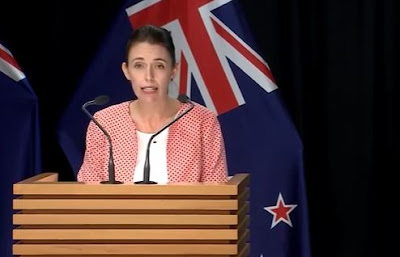
IT’S FUNNY, the things you think of at significant historical moments. Listening to Prime Minister Jacinda Ardern confirm that the Omicron variant of Covid-19 is now abroad in the North and South Islands of New Zealand, I thought of Abraham Lincoln.
In his second Inaugural Address (1865) President Lincoln spoke about the outbreak, four years earlier, of the civil war which was then drawing to its bloody conclusion.
“All dreaded it, all sought to avert it.” Lincoln intoned. And yet, seemingly impervious to all human effort, “the war came.”
For the past few weeks Omicron has, similarly, cast its threatening shadow: a relentless enemy force whose advance can be observed, but not deflected. Mesmerising, and, for the immune-compromised – terrifying. No doubt the Government and its advisers, dreading its arrival, have been casting about them desperately for some practical means of averting it. And yet, Omicron has come.
Clearly, the Prime Minister and her team, their bright optimism at the Beehive podium notwithstanding, are expecting the worst. The three stages, or “scenarios” of resistance, outlined by Ardern and her Director-General of Health, Ashley Bloomfield, on Sunday, 23 January, anticipate a relentless rise in the number of cases well beyond New Zealanders’ experience of the pandemic to date.
A military person would recognise immediately the principle at work in the Government’s strategy: “defence-in-depth.” Sequences of resistance have been defined: positions from which, when defeat appears imminent, the defenders can pull back to new lines of defence. The hope being that, before any further resistance becomes impossible, the enemy’s attack will, itself, have ground to a halt. At this critical point, unable to advance any further, he will begin to fall back. Exhausted – if not defeated.
The problem with the defence-in-depth strategy is that it implicitly acknowledges the enemy’s superiority. Wearing him down is possible, but only at the cost of a truly daunting casualty rate. One of the most stunning examples of the defence-in-depth strategy – the 1943 Battle of Kursk – ground the German offensive to a halt, inflicting irreparable damage on the Wehrmacht. The cost was something close to a million Soviet lives. (German losses are estimated at approximately quarter-of-a-million.)
The challenge facing Ardern and Bloomfield is one born of their own extraordinary success at fighting the earlier variants of Covid-19. New Zealanders, in vivid contrast to the British and the Americans, have no experience of large numbers of their fellow citizens dying every day. To date, just 52 lives have been lost to Covid-19 since the Pandemic reached New Zealand’s shores in early 2020. In the worst case scenario envisaged by the Government’s modellers, that number could easily be exceeded on a daily basis.
How the country would respond to such a grim death-toll is difficult to predict. Undoubtedly there would be some – quite likely including many of the medical experts New Zealanders have come to rely on for guidance on Covid-19 – who would urge the Government to abandon its “Traffic Light” management system in favour of the considerably more draconian “Elimination” strategy of 2020-21.
Resisting such calls, especially in the face of terrifying case numbers and a rapidly rising death-toll, will be very difficult for the Labour Government. In such circumstances, the temptation to reach for tried and tested solutions is extremely hard to resist – as evidenced in Europe and the United States. If the Opposition parties are able to argue successfully that the human cost of flattening the exponential Omicron curve is wildly in excess of what ordinary Kiwis are willing to bear, then the Government’s present aversion to re-imposing lockdowns and regional travel restrictions is likely to be jettisoned without ceremony.
Such a victory for the Opposition would not, however, advance their cause by very much in political terms. The almost jaunty demeanour of the Prime Minister at yesterday’s media conference was doubtless a reaction to the central paradox of this pandemic. No matter how many mistakes a government might make in preparing for, and responding to, successive waves of Covid-19; and no matter how successfully such failures might be exploited by its political opponents; all is forgiven and forgotten the moment the crisis arrives.
When the tribe is imperilled, all eyes turn to the chief. So long as the tribe believes the chief is doing everything within her power to keep them safe, she will remain impervious to criticism. Indeed, her critics refusal to put the tribe first will likely elicit a lot more glowers than gratitude.
The bright halo of crisis leadership tends to produce a lingering after image on the retinas of the electorate. How else to explain the results of the latest poll conducted by Curia Research for the Taxpayers Union? With 41 percent support, Ardern’s Labour Party has more than held its ground against the challenge of National’s new leader, Christopher Luxon. If an election were held tomorrow, Labour, with the Greens in support, would be returned to office with three seats to spare.
The very slight up-tick in Labour’s support has taken place in spite of the fact that none of its key policy objectives are even close to being met. Indeed, on the housing and homelessness front, the situation shows almost no signs of substantive improvement. In addition to its failure to make a real dent in child poverty, Labour is also asking poor families to deal with a level of price inflation unseen for more than a decade. Against this backdrop, Labour’s numbers should be falling fast – not going up by 1.7 percent!
The Prime Minister’s attention will, however, have been focussed on a very different set of numbers. The astonishing drop in the number of community cases of the Delta variant of Covid-19 will doubtless have reassured Labour’s well-educated, middle-class voters that “Jacinda” is still deserving of their loyalty. It is in the eyes of these voters that the Prime Minister needs to keep her halo of crisis leadership brightly glowing.
As fear and grief rise in sync with Omicron’s terrifying spread, the Prime Minister will be careful to keep herself in front of the double-vaccinated and the boosted, whose children and grandchildren are baring their upper-arms to the vaccinators’ needles. [Al Jazeera has a clear and very useful video on the Omicron variant, here. - C.T.]
It is the catch in “Jacinda’s” throat they will hear as she announces the tragic daily tally of Covid fatalities. And it is “General Ardern” they will salute, as her Army of Five Million battles bravely from defence-line to defence-line to halt the Omicron onslaught.
And, because all Covid variants surge, and peak, and then, after a few months of mayhem, go into decline, the Prime Minister’s heroic after-image will remain imprinted upon the voters’ retinas long after they have entered, and left, the polling-booths in 2023.
This essay was originally posted on the Interest.co.nz website of Monday, 24 January 2022.
