Showing posts with label The Political Consequences of Covid-19. Show all posts

Thursday, 8 September 2022

Left To Rot.

Recovering Their Voice: Not bereft – not this time. Anomie cannot survive the rebirth of hope. Alienation flees before a compelling story. In 1984, it came from a party promising to “lift them up where they belonged”. In 2022, it is coming from a party urging them to lift themselves up.

IF YOU WANT TO KNOW why Labour leaves the most disadvantaged New Zealanders to rot in motels – ask the Rogernomes. Ever since Labour abandoned its democratic-socialist beliefs and embraced neoliberalism in 1984, the party has been at pains to keep the disadvantaged politically disorganised and dependent on the good will of the state. They do not do this in expectation of their votes – any votes they get from the welfare underclass are a bonus – they do it because they don’t want them to vote at all.

To fully appreciate the reasoning behind Labour’s demobilisation strategy, it is necessary to go back to the year 1984 and take a look around. New Zealand society was mobilised in a way that “Rogernomic’s Children” – the generations that grew up with no memories of what New Zealand was like before the neoliberal “revolution” – would struggle to accept. Civil society had power in those years. Citizens had power. Even the poor and the unemployed had power.

Right across the country unemployed workers and beneficiaries were being organised. The state bureaucracy still believed that its primary purpose was to help – not hinder – its citizens. Accordingly, the state made funds available to just about any organisation set up to help citizens in need. This included groups set up to assist the unemployed and beneficiaries access the support and services to which they were legally entitled. Centres were established where people on benefits could meet and discuss their problems. By the middle of 1984, more and more beneficiaries were becoming politicised. How politicised? Politicised enough to turn out and vote in record numbers. In 1984, nearly 94 percent of registered voters made it to a polling-booth.

In spite of the fact that these politicised beneficiaries had voted overwhelmingly for David Lange’s Labour Party, the neoliberal cabal of Roger Douglas, David Caygill, Richard Prebble, Michael Bassett and Mike Moore, were acutely aware that politicised workers and beneficiaries were, potentially, their worst enemies. The changes they were about to unleash on New Zealand would swell the numbers of the poor and the marginalised. The last thing the Rogernomes needed was for the victims of their neoliberal policies to find a voice.

The Fourth Labour Government’s solution was as cynical as it was clever.

First, it set up an elaborate employment programme for middle-class people who had lost their jobs called “Access”. Come up with an idea for “helping” the poor and disadvantaged and the government appointed Regional Employment and Access Councils (composed of one third employers, one third unions, and one third representing the rest of society) had money to give you – lots of money.

The key difference between these Access schemes and the Project Employment Programme schemes which had resourced the organisers of the beneficiaries’ movement was that the Access schemes had to be strictly apolitical. The people running them (on excellent salaries!) were to be the poor’s responsible helpers and guides – not their political advocates.

Ostensibly, the people attending these Access schemes were there to be assisted into appropriate paid employment. In reality, they were there to provide a rationale for the generous resourcing of Access managers. Unsurprisingly, very few of these were willing to bite the Labour hands that fed them.

To those unemployed and beneficiaries lacking the entrepreneurial skills to take advantage of the Access schemes, the Fourth Labour Government offered the dole: the whole dole; and nothing but the dole. The bureaucrats in charge of social welfare were not encouraged, as they are now, to micromanage their “clients”. Their “stick” was nowhere near as big and frightening as the one they wield today. The idea was brutally simple: give the poor money, herd them into low-cost housing, and let them rot.

Poverty is only dangerous, politically, when it is widely shared. Confine real poverty to between a quarter and a third of the entire population, rob its victims of the political leadership needed to mobilise them as an electoral force, and the poor become the precise opposite of dangerous – they become harmless.

Once poverty acquires a stigma: once its victims begin to blame themselves for their misfortunes; self-hatred sets in. People begin to withdraw from a society that no longer offers them a place to stand. To alleviate their misery they turn to alcohol, drugs, gambling, sex – anything that serves to dull the pain of unbelonging. In the end they become anomic – beyond caring, beyond acting, beyond help. Or, from the neoliberals’ point-of-view: Safe.

The one weakness in the neoliberal plan for the poor is its cost. If poverty and unemployment grows, then the cost of keeping its victims safe rapidly becomes prohibitive. Ruth Richardson’s “Mother of All Budgets” slashed benefits obscenely. That lessened the state’s burden, but it did not remove it. Welfare roll reduction thus became the new priority: get the poor off the benefit – by any means necessary. It was a song National and Labour sang with equal gusto.

Until Covid.

Turns out that having between a quarter and a third of the population roped-off from the rest of the nation: prey to poverty, plagued by crime, prone to violence, and just not giving a fuck; isn’t all that helpful when it comes to fighting a pandemic. Even less helpful is the inconvenient fact that a disproportionate number of these unreachable ones have brown skins.

The state tried, and the state failed – badly – to reach out to the Māori and Pasifika communities being devastated by Covid-19. To vaccinate as many vulnerable citizens as possible, the hard-and-fast rule, enforced by successive neoliberal governments for thirty-five years, was set aside. Grass-roots advocacy groups were empowered and resourced to get the Covid vaccine out and into the arms of the poor.

The contrast between the “help” provided by the state, and the care provided by their own people, proved to be decisive. Because something else was being injected into them along with the Pfizer vaccine. It was a story in which even they, the poor and the stigmatised, had a place to stand. A story about a country that had once been theirs: about rights and resources guaranteed by a treaty that was not honoured; about a country that could be theirs again – but only if they made a conscious choice to re-create it.

This was a dangerous story for a Labour Government still content, like its predecessors, to push the poor out of the picture. Not into the low-cost housing of the 1980s – that is long gone – but into motels. Out of sight, out of mind. Second-class citizens in third-rate private accommodation. Cramped. Cold. Preyed upon by gangsters in uniform. Desperate. Left to rot.

But not bereft – not this time. Anomie cannot survive the rebirth of hope. Alienation flees before a compelling story. In 1984, it came from a party promising to “lift them up where they belonged”. In 2022, it is coming from a party urging them to lift themselves up.

That party is currently polling 5 percent. After nearly forty years, the poor have recovered their voice.


This essay was originally posted on The Daily Blog of Thursday, 8 September 2022.

Monday, 24 January 2022

Omicron Has Come.

Once More, From The Top: When the tribe is imperilled, all eyes turn to the chief. So long as the tribe believes the chief is doing everything within her power to keep them safe, she will remain impervious to criticism.

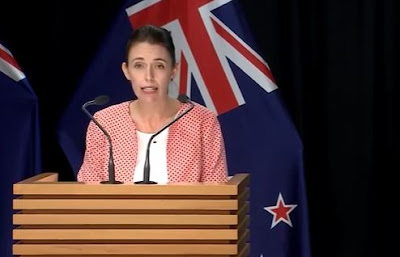
IT’S FUNNY, the things you think of at significant historical moments. Listening to Prime Minister Jacinda Ardern confirm that the Omicron variant of Covid-19 is now abroad in the North and South Islands of New Zealand, I thought of Abraham Lincoln.

In his second Inaugural Address (1865) President Lincoln spoke about the outbreak, four years earlier, of the civil war which was then drawing to its bloody conclusion.

“All dreaded it, all sought to avert it.” Lincoln intoned. And yet, seemingly impervious to all human effort, “the war came.”

For the past few weeks Omicron has, similarly, cast its threatening shadow: a relentless enemy force whose advance can be observed, but not deflected. Mesmerising, and, for the immune-compromised – terrifying. No doubt the Government and its advisers, dreading its arrival, have been casting about them desperately for some practical means of averting it. And yet, Omicron has come.

Clearly, the Prime Minister and her team, their bright optimism at the Beehive podium notwithstanding, are expecting the worst. The three stages, or “scenarios” of resistance, outlined by Ardern and her Director-General of Health, Ashley Bloomfield, on Sunday, 23 January, anticipate a relentless rise in the number of cases well beyond New Zealanders’ experience of the pandemic to date.

A military person would recognise immediately the principle at work in the Government’s strategy: “defence-in-depth.” Sequences of resistance have been defined: positions from which, when defeat appears imminent, the defenders can pull back to new lines of defence. The hope being that, before any further resistance becomes impossible, the enemy’s attack will, itself, have ground to a halt. At this critical point, unable to advance any further, he will begin to fall back. Exhausted – if not defeated.

The problem with the defence-in-depth strategy is that it implicitly acknowledges the enemy’s superiority. Wearing him down is possible, but only at the cost of a truly daunting casualty rate. One of the most stunning examples of the defence-in-depth strategy – the 1943 Battle of Kursk – ground the German offensive to a halt, inflicting irreparable damage on the Wehrmacht. The cost was something close to a million Soviet lives. (German losses are estimated at approximately quarter-of-a-million.)

The challenge facing Ardern and Bloomfield is one born of their own extraordinary success at fighting the earlier variants of Covid-19. New Zealanders, in vivid contrast to the British and the Americans, have no experience of large numbers of their fellow citizens dying every day. To date, just 52 lives have been lost to Covid-19 since the Pandemic reached New Zealand’s shores in early 2020. In the worst case scenario envisaged by the Government’s modellers, that number could easily be exceeded on a daily basis.

How the country would respond to such a grim death-toll is difficult to predict. Undoubtedly there would be some – quite likely including many of the medical experts New Zealanders have come to rely on for guidance on Covid-19 – who would urge the Government to abandon its “Traffic Light” management system in favour of the considerably more draconian “Elimination” strategy of 2020-21.

Resisting such calls, especially in the face of terrifying case numbers and a rapidly rising death-toll, will be very difficult for the Labour Government. In such circumstances, the temptation to reach for tried and tested solutions is extremely hard to resist – as evidenced in Europe and the United States. If the Opposition parties are able to argue successfully that the human cost of flattening the exponential Omicron curve is wildly in excess of what ordinary Kiwis are willing to bear, then the Government’s present aversion to re-imposing lockdowns and regional travel restrictions is likely to be jettisoned without ceremony.

Such a victory for the Opposition would not, however, advance their cause by very much in political terms. The almost jaunty demeanour of the Prime Minister at yesterday’s media conference was doubtless a reaction to the central paradox of this pandemic. No matter how many mistakes a government might make in preparing for, and responding to, successive waves of Covid-19; and no matter how successfully such failures might be exploited by its political opponents; all is forgiven and forgotten the moment the crisis arrives.

When the tribe is imperilled, all eyes turn to the chief. So long as the tribe believes the chief is doing everything within her power to keep them safe, she will remain impervious to criticism. Indeed, her critics refusal to put the tribe first will likely elicit a lot more glowers than gratitude.

The bright halo of crisis leadership tends to produce a lingering after image on the retinas of the electorate. How else to explain the results of the latest poll conducted by Curia Research for the Taxpayers Union? With 41 percent support, Ardern’s Labour Party has more than held its ground against the challenge of National’s new leader, Christopher Luxon. If an election were held tomorrow, Labour, with the Greens in support, would be returned to office with three seats to spare.

The very slight up-tick in Labour’s support has taken place in spite of the fact that none of its key policy objectives are even close to being met. Indeed, on the housing and homelessness front, the situation shows almost no signs of substantive improvement. In addition to its failure to make a real dent in child poverty, Labour is also asking poor families to deal with a level of price inflation unseen for more than a decade. Against this backdrop, Labour’s numbers should be falling fast – not going up by 1.7 percent!

The Prime Minister’s attention will, however, have been focussed on a very different set of numbers. The astonishing drop in the number of community cases of the Delta variant of Covid-19 will doubtless have reassured Labour’s well-educated, middle-class voters that “Jacinda” is still deserving of their loyalty. It is in the eyes of these voters that the Prime Minister needs to keep her halo of crisis leadership brightly glowing.

As fear and grief rise in sync with Omicron’s terrifying spread, the Prime Minister will be careful to keep herself in front of the double-vaccinated and the boosted, whose children and grandchildren are baring their upper-arms to the vaccinators’ needles. [Al Jazeera has a clear and very useful video on the Omicron variant, here. - C.T.]

It is the catch in “Jacinda’s” throat they will hear as she announces the tragic daily tally of Covid fatalities. And it is “General Ardern” they will salute, as her Army of Five Million battles bravely from defence-line to defence-line to halt the Omicron onslaught.

And, because all Covid variants surge, and peak, and then, after a few months of mayhem, go into decline, the Prime Minister’s heroic after-image will remain imprinted upon the voters’ retinas long after they have entered, and left, the polling-booths in 2023.


This essay was originally posted on the Interest.co.nz website of Monday, 24 January 2022.