
Showing posts with label Ecological Imperialism. Show all posts

Wednesday, 17 August 2016

Speaking-Up For Arboreal Exoticism.

Space Invaders: Sadly, for the extreme conservationists, the conquests of ecological imperialism cannot be rolled back. The creation in Aotearoa/New Zealand of yet another Neo-Europe in the years following 1840 was completed in less than a century. The founders of Christchurch were part of that process, as these lofty oaks in Hagley Park attest.

THE FATE OF CHRISTCHURCH’S TREES is currently a low-level debate. It shouldn’t be. If the partisans of indigenous flora emerge triumphant over the lovers of Oaks and Cherry Trees, then Christchurch will become a season-less, olive-drab city. Retaining the beauty of their city’s exotic heritage vegetation requires Cantabrians to make their voices heard. Now.
 
Aucklanders, too, must stay alert. Not only are their city’s trees at risk of wholesale felling by property developers, but the likely next Mayor of Auckland, Phil Goff, is promising to repair the damage by planting a million trees every year – “mostly natives”. Auckland’s floral glory, like Christchurch’s, is under threat.
 
New Zealand is cited by Professor Alfred Crosby as the most extreme example of a “Neo-Europe” on Planet Earth. To a far greater extent than those who settled North America and Australia, New Zealand’s European colonists would dramatically transform the new landscape in which they found themselves. This “ecological imperialism”, as Professor Crosby describes the biological expansion of Europe, extended not only to the exotic flora introduced by the newcomers, but also to their release of a host of exotic fauna.
 
These cows and sheep now constitute the foundation of our key export industries. In this respect, New Zealand is no different to Canada, the United States or Australia. Its location in the planet’s southern temperate zone facilitated the rapid and extraordinarily successful transfer of agricultural, industrial, cultural and political processes perfected in Eurasia over a period of 10,000 years. Evidence of both the durability and extent of that success is all around us.
 
New Zealand’s success as a Neo-Europe is not, however, a matter of universal celebration. As Emeritus Professor of Nature Conservation at Lincoln University, Ian Spellerberg, wrote in June:
 
“There is more to plants that just species and varieties. There are plant communities with myriads of interactions between all the plant and animal species and their physical environment. Humans have mixed and stirred the biogeography of plants around the world. As well as causing plant extinctions, we have introduced exotic species into foreign surroundings and in doing so have extinguished the natural interactions. Such practices are as bad as habitat destruction and the ultimate threat to native plants – their extinction.”
 
At the heart of this argument lies the anachronistic desire to restore New Zealand’s natural environment to its pristine – that is to say pre-human – status.
 
That these islands boasted a unique natural environment is indisputable. Bereft of large reptilian and mammalian predators, it became a world of insects and birds. Its extreme geographical isolation encouraged the evolution of such extraordinary megafauna as the Moa and the Giant Weta.
 
It also meant that Aotearoa/New Zealand was the last substantial landmass on Planet Earth to be populated by human-beings. In marked contrast to the Americas and Australia, where Homo Sapiens have been present for between 25,000 and 50,000 years, the human settlement of these islands began a mere 800 years ago.
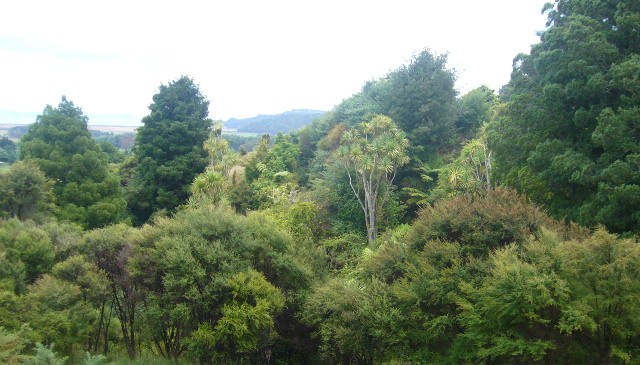
 
The New Zealand Bush: Evergreen - in every sense of the word.
 
The flora encountered by these Polynesian settlers was little changed from the age of the dinosaurs. The deciduous trees that register the transition of the seasons to contemporary New Zealanders with such beauty and bounty were almost entirely absent. With a handful of no doubt welcome exceptions, such as Kowhai yellow and blood-red Pohutukawa, the world the Maori encountered was dominated by vast forests of grey-green trees and ferns: an arboreal empire enlivened only by the cacophonous calling of birds.
 
It is easy to imagine how fervently a conservationist like Professor Spellerberg might wish to restore this vanished empire of trees and birds. It must have been a magical (if somewhat forbidding) place for the European botanists who first encountered it. In 1769, even after 600 years of sparse human habitation, much of the pre-human environment remained. Outside of Antarctica, that could not be said of any other place on Earth.
 
Sadly, for the extreme conservationists, the conquests of the ecological imperialists cannot be rolled back. The creation of yet another Neo-Europe in the years following 1840 was completed in less than a century. The founders of Christchurch were part of that process, as the lofty oaks in Hagley Park attest.
 
That it was a destructive process cannot be disputed, but it was also a creative process. The introduction of plants and animals from Europe, and elsewhere, has made New Zealand a staggeringly colourful and productive place. The idea that we should consciously deprive ourselves of the colour and variety bequeathed to us by exotic plant species – trees especially – bespeaks a romanticism that is as puritanical as it is misguided.
 
In his heart, Professor Spellerberg must understand that, ultimately, to achieve the sort of ecological restoration he is seeking, New Zealand would have to be emptied of human-beings. But only after every last oak, birch, poplar and pine had been uprooted and burned.
 
This essay was originally published in The Press of Tuesday, 15 August 2016.

Tuesday, 27 November 2012

Welcome To Middle Earth

Re-imagining New Zealand: Forty years of official biculturalism and assertive indigeneity have failed to suppress the colonisers' desire to refashion their new world in the image of the old. In this regard, "Middle Earth" has proved to be a much more comfortable cultural fit than "Aotearoa".
 
ONE HUNDRED PERCENT Middle Earth. That’s how the tourism industry has decided to promote New Zealand. Our national airline has even contributed one of its airliners, emblazoned nose to tail with images from The Hobbit movie, to elevate the promotional cause. This flying billboard will wow those attending the film’s “red carpet” premiere with a low-level fly-past.
 
Asked by a local journalist for his response to Air New Zealand’s generosity, an executive from the movie’s maker, Warner Bros, didn’t know whether to laugh out loud or titter. His consternation is understandable. Very few countries have been as willing to abase themselves quite so completely to the “soft-power” of Hollywood as we poor deluded Kiwis.
 
Having successfully persuaded New Zealand’s government to re-word its labour and immigration laws to industry specifications, increase its financial incentives and provide Warner Bros with millions of dollars’ worth of free publicity, the Hollywood moguls should be blushing with shame. More likely they’re kicking themselves for not demanding more.
 
And considering what we’ve been willing to do unasked – who could blame them! A friend of mine, returning from a trip to the United States, told me of his cringing embarrassment upon discovering that Air New Zealand’s passenger safety instructional video now doubles as a trailer for The Hobbit (complete with the Gollum character crawling up the aisle in search of  his “Prescioussss” – presumably the nearest exit!)
 
Why are we doing this to ourselves? Why are we so quick to dismiss even the slightest criticism of the Middle Earth franchise? How has The Hobbit’s director, Sir Peter Jackson, acquired such a powerful grip upon the public’s imagination and affection, and thus upon the direction of Government policy? What has caused a little nation located in the South Pacific to expend so much time, energy and money transforming itself into a bucolic version of medieval England?
 
Perhaps, after nearly forty years of official decolonisation, Sir Peter’s masterful adaptation of Tolkien’s masterpieces has opened a long-locked door to the colonisers’ cultural storehouse. Most New Zealanders are, when all is said and done, English speakers and (as Maori have been telling us for nearly forty years) culture and language are inextricably linked.
 
Transported half way across the planet our ancestors lost little time in reshaping Aotearoa’s natural landscape with flora and fauna appropriate to their vocabulary. And alongside the oaks and elms, sheep and cattle they’d introduced, they also constructed churches, schools, town halls and railway stations designed to “age” their young colony. It’s why the centre of Christchurch used to, and the heart of Dunedin still does, look like it’s stood there for centuries.
 
Ageing The Colony: St Andrew's Presbyterian Church, Auckland: "A baroque tower in Symonds Street that appears to have stood there since 1730." (Photo by Chris Harris)
 
Two great waves of cultural change have laid much of this “Better Britain” flat. The first was the wave of brutal modernist architecture which reduced the neo-classical and Gothic buildings of our Victorian forebears to rubble. And as modernism flattened New Zealand’s constructed landscape, so the second great wave: officially sanctioned bi-culturalism and assertive indigeneity; deconstructed its fondest cultural assumptions and undermined its intellectual confidence.
 
This great laying to waste of the West’s best stories, which goes by the name of Post-Modernism, is described by the social theorist, Frederic Jameson, as “the cultural logic of late-capitalism”. It’s most devastating characteristic is its power to dissolve boundaries. High and popular culture mingle promiscuously in the post-modern societies of the 21st Century; as do past and present, fact and fiction, science and religion.
 
Sir Peter Jackson floats freely in this post-modern world – as his mischievous 1995 faux documentary, Forgotten Silver, made very clear. Who better, then, to overlay Tolkien’s Middle Earth upon a New Zealand landscape already transformed by the ecological imperialism of its Victorian colonisers? The Lord of the Rings trilogy, and now The Hobbit, may “only” be movies, but that has not prevented them from turning Mt Ngaurahoe into “Mt Doom” and Matamata into “Hobbiton”.
 
Tolkein’s writings may be fictional but they possess a cultural power that is very real. And thanks to the cinematographic skills of Sir Peter Jackson and the digital magic of Weta Workshops, Pakeha New Zealanders have been given reference points that owe nothing to their country’s indigenous culture. In our post-modern world, where reality has taken on an alarmingly subjective quality, “Middle Earth” is a much more comfortable fit than “Aotearoa”.
 
More comfortable, too, for dwellers in a “West” beset with economic, political, environmental and cultural challenges. A West in whose eyes New Zealand stands as a refuge every bit as wholesome and protected as “The Shire”. New Zealanders’ desire for cultural reassurance and comfort is thus reinforced by an international audience desperate to escape the daunting challenges of multiculturalism and austerity.
 
No, the tourism industry and Air New Zealand should have little difficulty in filling those airliners. Not while Middle Earth is so much more enjoyable than the real one.
 
This essay was originally published in The Press of Tuesday, 27th November 2012.