Showing posts with label Christchurch. Show all posts

Saturday, 28 April 2018

Conversation In The Public Square.

“And those conversations continued in the newspapers, on the local radio and television stations, on the stage of the playhouse, in the cinemas. It all merged into one grand public conversation: loud, uncoordinated and gloriously democratic!”

IT WAS A BRIGHT mid-autumn day and I was waiting for an important call. Turning a corner, I found myself in the city’s broad public square. Given the time of day, it was surprisingly empty. There were fewer trees than I remembered and the tall corporate towers that reared up on every side restricted the amount of sunlight. There was one patch of it, however, a few metres distant, and a bench upon which I could sit and soak it up.

So intent was I upon the screen of my cell-phone that I did not notice the old man’s arrival.

“Put it away, son,” he chided, “and take in the world of three dimensions.”

I laughed rather self-consciously and explained that I was waiting for an important call.

“It won’t come any quicker, for all of your rapt attention.”

“That’s true,” I said, slipping the phone into my pocket. “Not that there’s much to see in the square today.”

“Not compared to some of the days I’ve seen”, he sighed.

“I bet you’ve seen some sights in your time,” I replied. “Could tell some stories?”

“That, I could, son, that I could. This was such a vital place once – the centre of the whole city. Everybody came through here, one way or the other. And around the four sides of the square, were all the important buildings. The cathedral, the council chambers, the university – they were all here. Along with the playhouse, three or four cinemas, the public library and art gallery. I remember the newspaper offices – both of them – and the television studios.

“At lunchtime, and at the end of the working day, all the people who worked in those buildings would pour out into this public square. They would mix and mingle, argue and fight, fall in – and out – of love. This square was where the city came alive. It’s future shape and purpose were forged in a thousand – ten thousand – passionate conversations.”

I looked around. None of the buildings he’d described remained. In their place rose the headquarters of banks, insurance companies and accounting firms: glass and steel towers rising up, up, up above the public square. Some had preserved the facades of the older structures they’d replaced. They looked forlorn and out-of-place. As foreign to their new function as the corporations who had, so public spiritedly, preserved them.

“And those conversations continued in the newspapers, on the local radio and television stations, on the stage of the playhouse, in the cinemas. It all merged into one grand public conversation: loud, uncoordinated and gloriously democratic!”

“It makes me wonder how the city could afford it all”, I responded.

“It’s a question I ask myself, son. We were so much smaller then, and yet we were able to sustain so much more than we do today. Look at those buildings, son. Thousands of people work in them – many more than in the past. And yet, at lunchtime and at the end of the day they scurry across the square, eyes glued to their cellphones, talking to no one. The passion’s gone, son. It breaks my heart.”

“No, no, it hasn’t gone”, I replied hastily. “It’s just gone on-line. Checkout Facebook and Twitter – you find plenty of passion there!”

“Facebook! Twitter!” The old man practically spat out the words. “They’re eating the younger generation’s soul! And making Mark Zuckerberg millions of dollars every second! Listen, son, I remember standing in this square when it was full-to-bursting with young men and women. They carried banners and waved placards and shouted slogans. They came here to end a war; to sever all ties with Apartheid sport; to abolish nuclear weapons. And they weren’t brought here by Facebook or Twitter. They were brought here by pamphlets and posters; articles and columns; documentaries and current affairs shows on radio and television. Dear God, son! It’s what the public square is for!

From my pocket, my cellphone trilled insistently.

“Excuse me for a moment,” I said apologetically, “But I have to take this.”

I turned away, clamping the phone tight to my ear to hear more clearly what the person at the other end of the call was saying.

“Good news!”, I cried.

But the old man had gone.


The column you have just read is my last for The Press. I sign-off with an immense sense of gratitude at having been afforded the privilege of addressing its readers for the past eight years. Cantabrians have lived through a great many tragic and tumultuous events since 2010 and I wish to thank most sincerely all those who, in the midst of stress and strife, still found the time to read and respond to my words. In taking my leave, may I wish the brave and resilient citizens of Christchurch the very best of futures.


This short story was originally published in The Press of Tuesday 24 April 2018.

Wednesday, 17 August 2016

Speaking-Up For Arboreal Exoticism.

Space Invaders: Sadly, for the extreme conservationists, the conquests of ecological imperialism cannot be rolled back. The creation in Aotearoa/New Zealand of yet another Neo-Europe in the years following 1840 was completed in less than a century. The founders of Christchurch were part of that process, as these lofty oaks in Hagley Park attest.

THE FATE OF CHRISTCHURCH’S TREES is currently a low-level debate. It shouldn’t be. If the partisans of indigenous flora emerge triumphant over the lovers of Oaks and Cherry Trees, then Christchurch will become a season-less, olive-drab city. Retaining the beauty of their city’s exotic heritage vegetation requires Cantabrians to make their voices heard. Now.
 
Aucklanders, too, must stay alert. Not only are their city’s trees at risk of wholesale felling by property developers, but the likely next Mayor of Auckland, Phil Goff, is promising to repair the damage by planting a million trees every year – “mostly natives”. Auckland’s floral glory, like Christchurch’s, is under threat.
 
New Zealand is cited by Professor Alfred Crosby as the most extreme example of a “Neo-Europe” on Planet Earth. To a far greater extent than those who settled North America and Australia, New Zealand’s European colonists would dramatically transform the new landscape in which they found themselves. This “ecological imperialism”, as Professor Crosby describes the biological expansion of Europe, extended not only to the exotic flora introduced by the newcomers, but also to their release of a host of exotic fauna.
 
These cows and sheep now constitute the foundation of our key export industries. In this respect, New Zealand is no different to Canada, the United States or Australia. Its location in the planet’s southern temperate zone facilitated the rapid and extraordinarily successful transfer of agricultural, industrial, cultural and political processes perfected in Eurasia over a period of 10,000 years. Evidence of both the durability and extent of that success is all around us.
 
New Zealand’s success as a Neo-Europe is not, however, a matter of universal celebration. As Emeritus Professor of Nature Conservation at Lincoln University, Ian Spellerberg, wrote in June:
 
“There is more to plants that just species and varieties. There are plant communities with myriads of interactions between all the plant and animal species and their physical environment. Humans have mixed and stirred the biogeography of plants around the world. As well as causing plant extinctions, we have introduced exotic species into foreign surroundings and in doing so have extinguished the natural interactions. Such practices are as bad as habitat destruction and the ultimate threat to native plants – their extinction.”
 
At the heart of this argument lies the anachronistic desire to restore New Zealand’s natural environment to its pristine – that is to say pre-human – status.
 
That these islands boasted a unique natural environment is indisputable. Bereft of large reptilian and mammalian predators, it became a world of insects and birds. Its extreme geographical isolation encouraged the evolution of such extraordinary megafauna as the Moa and the Giant Weta.
 
It also meant that Aotearoa/New Zealand was the last substantial landmass on Planet Earth to be populated by human-beings. In marked contrast to the Americas and Australia, where Homo Sapiens have been present for between 25,000 and 50,000 years, the human settlement of these islands began a mere 800 years ago.
 
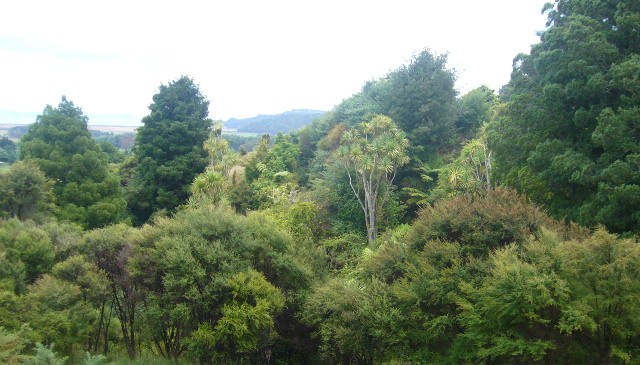
The New Zealand Bush: Evergreen - in every sense of the word.
 
The flora encountered by these Polynesian settlers was little changed from the age of the dinosaurs. The deciduous trees that register the transition of the seasons to contemporary New Zealanders with such beauty and bounty were almost entirely absent. With a handful of no doubt welcome exceptions, such as Kowhai yellow and blood-red Pohutukawa, the world the Maori encountered was dominated by vast forests of grey-green trees and ferns: an arboreal empire enlivened only by the cacophonous calling of birds.
 
It is easy to imagine how fervently a conservationist like Professor Spellerberg might wish to restore this vanished empire of trees and birds. It must have been a magical (if somewhat forbidding) place for the European botanists who first encountered it. In 1769, even after 600 years of sparse human habitation, much of the pre-human environment remained. Outside of Antarctica, that could not be said of any other place on Earth.
 
Sadly, for the extreme conservationists, the conquests of the ecological imperialists cannot be rolled back. The creation of yet another Neo-Europe in the years following 1840 was completed in less than a century. The founders of Christchurch were part of that process, as the lofty oaks in Hagley Park attest.
 
That it was a destructive process cannot be disputed, but it was also a creative process. The introduction of plants and animals from Europe, and elsewhere, has made New Zealand a staggeringly colourful and productive place. The idea that we should consciously deprive ourselves of the colour and variety bequeathed to us by exotic plant species – trees especially – bespeaks a romanticism that is as puritanical as it is misguided.
 
In his heart, Professor Spellerberg must understand that, ultimately, to achieve the sort of ecological restoration he is seeking, New Zealand would have to be emptied of human-beings. But only after every last oak, birch, poplar and pine had been uprooted and burned.
 
This essay was originally published in The Press of Tuesday, 15 August 2016.

Tuesday, 31 January 2012

Christchurch City Council Needs Choristers - Not Soloists

A Dangerous Duet: The failure of leadership on the part of the Christchurch City Council's CEO, Tony Marryatt (Left) and its Mayor, Bob Parker (Right) has plunged the city's sole remaining local democratic institution into crisis. The appointment of a Government "Observer" to "advise" Cantabrians' democratically elected representatives has only added to their humiliation.

CANTABRIANS DESERVED BETTER from the Christchurch City Council. Thanks to the inability of their elected representatives to fulfil their civic responsibilities, the citizens of Christchurch may lose their right to local democratic representation.

The humiliation of a government-appointed “observer” has already been visited upon the Council, and the threat of outright dissolution, though unspoken, is very real. Political gridlock in the face of critical decisions that cannot wait was the excuse for shutting down the Canterbury Regional Council. It’s a daunting precedent.

The tragic aspect of Christchurch’s local government crisis is that it comes at a time when the need for effective democratic representation has never been greater. The huge destruction wrought by a succession of earthquakes has spawned an equally huge array of public and private remedial bureaucracies. Equipped with formidable powers, these bureaucracies march to the mechanical drum-beat of hierarchy and administrative fiat – not democratic accountability. The men and women elected to the Christchurch City Council constitute the only effective local check upon the power of these institutions. To be the voice of the quake-stricken people of Christchurch, they must cease acting as soloists and become choristers.

But to meld a council of strong-willed and opinionated individuals into a united team of citizens’ advocates requires leadership of the highest order. Unfortunately, this has not been forthcoming. Neither the Mayor, Bob Parker, nor the Council CEO, Tony Marryatt, appear to have grasped the urgency of transforming the Council into the principal advocate of – and for – Christchurch’s battered citizens. On the contrary, both men seem to have scant regard for the three principles indispensable to the construction of unity: transparency; consultation; and accountability.

Local democracy is not about gathering together a bare majority of compliant cronies whose sole contribution to local government is to rubber-stamp the joint recommendations of the Mayor and his CEO. And it is certainly not about the Mayor’s cronies, puffed-up with pride at their insider status, heaping scorn upon those councillors denied admission to the magic circle of power. Indeed, nothing is more calculated to breed disunity, disaffection and defensiveness: the very feelings that cause politicians to resort to that time-honoured response to secrecy and exclusion – the leak.

Of all the many sins capable of arousing the fury of administrative authoritarians the leaking of privileged information is the most egregious. Their invariable response is to double-down on the secrecy while setting in motion a witch-hunt for the person or persons responsible. The “Us versus Them” mentality is thus transferred from the council table to the council bureaucracy. In consequence, the political and administrative dysfunction, far from being reduced, intensifies.

Administrative Authoritarianism thus lies at the heart of Christchurch’s local government crisis. In a nutshell, the administrative authoritarian regards the elected representative as an ill-informed, unprofessional irritant to the “effective and efficient” operation of whatever institution they have been hired (usually on an exorbitant salary) to administer.

A CEO in the grip of administrative authoritarianism has a vested interest in surrounding himself with vainglorious but intellectually vacuous politicians; persons easily persuaded to stand in the glare of the media’s spotlights and “sell” policies they had no hand in fashioning, and about which they have little to contribute beyond the talking-points handed to them by the CEO’s public relations “experts”.

Two manifestations of administrative authoritarianism deserve special attention. The so far unsuccessful attempts by local government officials to impose legal restraints on the degree to which elected representatives can participate in contentious debates. And, the Local Government Commission’s on-going campaign to reduce the number of elected representatives on city councils and with them the ratio of councillors to citizens.

In 1993, Christchurch – which then boasted a council of twenty-four elected representatives – won the coveted Carl Bertelsmann Prize for “Best Governed City in the World”. A decade later the Local Government Commission reduced the number of Christchurch City Councillors to twelve. Where once the Mayor and CEO of Christchurch City had to round-up twelve to thirteen compliant councillors, they now needed to corral only six or seven.

The subordination of active democratic participation to “effective and efficient” management is a dangerous development at the best of times, but in the face of natural disasters on the scale of the Christchurch earthquakes it is nothing less than catastrophic.

Citizens desperate to “get things done” all-too-easily fall prey to the hard-edged promptings of administrative authoritarians – handing over powers that should never be surrendered to those who dismiss democracy as an unwelcome hindrance to “good governance”.

Disasters bring with them remedial institutions guided by – at best – a ruthless utilitarianism. Which is why, amidst impassive bureaucracies dedicated to “the greatest good for the greatest number” there must remain a united and democratic Christchurch City Council, jealously guarding its power to protect and serve that most vulnerable, but important, of persons: the individual citizen.

This essay was originally published in The Press of Tuesday, 31st January 2012.

Friday, 24 April 2009

Size Matters!


Christchurch's futuristic Art Gallery: In 1993 Christchurch won the Carl Bertelsmann Prize, and was declared "The Best Run City in the World". That was when it had a ratio of 1 city councillor to every 13,000 citizens. In 2004 the Local Government Commission decided to increase that ratio to 1 councillor per 20,000 citizens. Five years on, and the "People's Republic of Christchurch" has degenerated into "Sideshow Bob" Parker's Tory Circus. Look upon Christchurch, Aucklanders - and despair!

THE rest of New Zealand’s mirth at the Auckland’s mayors’ bitchy reaction to the National-Act-Maori Party Government’s plans for an Auckland "super-city" is easily imagined. To non-Auckland eyes the region’s civic leaders must come across like six little boys in a sandpit arguing over who gets to play with the digger.

As a shrewd Cantabrian, the Local Government Minister, Rodney Hide, knows how impatient the rest of New Zealand gets with this sort of bickering. Residing in much smaller local authorities, most Kiwis simply don’t understand how different North Shore City is from Manukau, or grasp the sheer size of the cultural gulf separating John Bank’s Remuera from Bob Harvey’s Henderson. By casting himself as the sensible adult: someone willing to confiscate the digger and frog-march the squabbling mayoral urchins out of the Auckland sandpit; Mr Hide knows he can only go up in the rest of the country’s political estimation.

But, I suspect the rest of the country would think much less kindly of the Local Government Minister if he announced his decision to merge Invercargill with Dunedin; Oamaru with Timaru; Ashburton with Christchurch; or New Plymouth with Wellington. And, I don’t think their citizens would find anything funny in a plan to reduce the number of councillors elected to represent them by more than two-thirds. They might laugh at the idea of their towns and cities being broken up into dozens of neighbourhood "boards", responsible for bottle-stores, brothels, graffiti and dog-catching, but it would be the sort of laugh people give when their car breaks down miles from nowhere – and it starts to rain.

Southerners should be very thankful that the brute facts of geography militate against their suffering Auckland’s fate. The 200-plus kilometres separating Dunedin’s and Invercargill’s citizens will always be their best guarantee of political independence. Auckland’s curse is that communities which were once a day’s ride from one another are now (on a good day) less than an hour’s drive away. Auckland – in a conceptual sense – is an accident of technology. Trains, trams, busses and cars have encouraged civic amnesia, and the unique histories of Auckland’s villages, towns and cities are largely forgotten.

"Well, that’s progress", I hear all you southerners say – and maybe you’re right. But if we must all be bound to the wheel that draw us together, then let us at least ensure that it is supported by many spokes.

The designers of the Auckland super-city placed good governance ahead of good government: the power to make decisions affecting people’s lives, before a lively people’s decision-making power.

Members of the American school of local government architecture, they have worked from the elitist principle of "fewer but better" elected representatives. By "better", incidentally, they generally mean businessmen.

Like Tucson, Arizona, USA, whose 525,529 citizens are represented by just six city councillors – a ratio of 1:87,588. I suppose we should be thankful Mr Hide settled on a ratio of 1:65,000.

Comparison with European local government is instructive. Not-surprisingly, nations with a recent history of tyranny tend to place a much higher value on representative institutions. The Berlin City Council, for example, has 149 members – a ratio of 1:23,000. While the City Council of Paris – as befits the cradle of revolutionary democracy – boasts 163 councillors: a ratio of 1:13,300 – lower than Waitakere’s!

The Royal Commission on Auckland Governance, or Mr Hide, could have given Auckland an equally generous example of democratic architecture. Simply by deciding to preserve the current ratio of councillors to citizens, they would have created a Greater Auckland Assembly of 70 members. Sheffield – half Greater Auckland’s size – has 84. Glasgow, a city of 580,690 has 79 councillors (1:7,350)

Berlin, Paris, Sheffield, Glasgow: these are among of the most progressive and best governed cities in the world. Yes, their councils are large, but it's their size that gives them the edge over cities organised on the American model of "fewer but better".

And, if you’re riposte to these figures is: "Ah, but those are all overseas examples. This is New Zealand." Think about this.

Christchurch, a city of 316,221 used to have a city council of 24 (A councillor to citizen ratio of 1:13,175 – about the same as Paris.) In 1993, that high level of democratic representation, and the progressive policies which flowed from it – especially the increased efficiency of communal services in competition with private enterprise – had earned Christchurch the coveted Carl Bertelsmann Prize, and the title of "Best Run City in the World. Tragically, in 2004, the Local Government Commission, egged on by Canterbury businessmen, and, once again following the American model of local government, slashed the number of Christchurch City Councillors to just 16 (1:20,000).

Since then, the city has lost its democratic edge. The Council is now thoroughly dominated by its pro-privatisation bureaucracy, and ruled by a right-wing populist celebrity mayor. The "People’s Republic of Christchurch" has degenerated into "Sideshow Bob" Parker’s Tory Circus.

Look upon Christchurch, Aucklanders – and despair.

The above is a slightly modified version of the essay which appeared in The Timaru Herald, The Taranaki Daily News, The Otago Daily Times, and The Greymouth Evening Star on Friday, 17 April 2009.