
Showing posts with label Herbert Marcuse. Show all posts

Tuesday, 24 February 2015

Gods And Monsters: Reflections On Saturday's "Auckland Pride Parade".

How You Can Tell That The Struggle Has Been Lost: When a parade intended as a celebration of people's rights is taken over by the State's primary instruments of coercion and control.
 
IMAGINE A MAY-DAY PARADE headed up by representatives of the Army, Navy and Air Force. With Police and Corrections officers following close behind! A little further back, Members of Parliament from the governing party wave gamely at the crowds lining the parade route. Only after all these groups have marched past, proudly declaring their solidarity with the working-class, do the country’s trade unions finally make their appearance. (May Day is, after all, a workers’ festival!)  Even so, interspersed among the union bands and banners, are expensive floats, sponsored by some of the country’s largest and most successful banks and businesses.
 
What would such a parade say about the status and purpose of the country’s trade union movement? Surely a May Day parade in which the country’s soldiers, policemen and jailers were given pride of place could only have been organised in the old Soviet Union or one of its East European satellites?
 
The prominent presence of the state’s key institutions of coercion and control would be proof positive that the trade union movement had long since ceased to be in any way subversive, transgressive, or emancipatory. It would signal that trade unionists had become “okay” people to know, and that their representatives could safely be invited to gatherings frequented by the good and the great.
 
It would also proclaim that the state was no longer frightened of trade unions or trade unionists. And why would it be? When nothing trade unions did in any way interfered with or disrupted the smooth operation of the system. What was not to like, when trade unionists now counted themselves among the strongest supporters of the political, economic and social status quo.
 
The final proof that the trade union movement had been completely swallowed up by the Establishment would a media release from the Council of Trade Unions celebrating the parade as “bigger, better and more mainstream” than ever before, and praising the “massive symbolism” of the armed forces’ and the Police’s participation.
 
Presumably, the CTU media release would end by pointing out that: “The contrast between the bad old days, when the Police were better known for batoning strikers on the picket-line, and when the army’s trucks were used for the transportation of scabs; and the progressive present, when nearly all large institutions can boast at least one Trade Union Liaison Officer; could hardly be more striking.”
 
Watching a May Day Parade in which everyone from the Army and the Police, to MPs and City Councillors were proudly waving red flags and punching the air with clenched-fist salutes would be deeply, deeply depressing. It would mean that the movement I had devoted much of my adult life to promoting and defending had been drained of all its radicalism and danger.
 
I would feel as shocked and alienated as I imagine many LGBTIQA Aucklanders felt when they saw what used to be called “The Hero Parade” turned into a showcase for the “openness and diversity” of  the New Zealand Defence Force, the Police, the Department of Corrections, Air New Zealand, assorted commercial radio stations and the ANZ Bank. As if all the vicious prejudices and hidden brutalities of “mainstream” New Zealand society have floated away like so many helium-filled balloons over Western Park.
 
New Zealand led the world in passing legislation that not only made collective bargaining legal but also supported it with taxpayer-funded institutions. Did that legislation succeed in overcoming the stigma attached to all those who demanded a greater share of the wealth their labour had created? No, it did not. There remained, deeply entrenched in New Zealand’s capitalist society, the most powerful antipathy towards trade unions. So much so that, in 1991, the National Party passed the Employment Contracts Act – in which even the term “trade union” did not appear.
 
Has the passage of legislation decriminalising homosexuality, recognising civil unions and legalising gay marriage truly eliminated the deeply entrenched negativity towards all things LGBTIQA in “mainstream” New Zealand society? Are we really as welcoming of “diversity”, so forgiving of difference, as Saturday’s “Auckland Pride Parade” organisers insisted? The tragically large number of young people committing suicide in response to their families’ and their peers’ reception of their sexual natures suggests that we are still very far from that goal.
 
More than forty years ago, the radical sociologist Herbert Marcuse coined the phrase “repressive tolerance” to describe the way capitalist society was subverting the traditional concept of liberal tolerance and transforming it into its opposite – subtle domination. All those institutions and social tendencies considered hostile to capitalism’s interests were gradually being absorbed into its processes and neutralised. As I watched the Auckland Pride Parade make its way along Ponsonby Road on Saturday night, and contrasted its corporate slickness with the wild and gloriously transgressive Hero Parades of the 1990s, I silently congratulated old Marcuse for his insight.
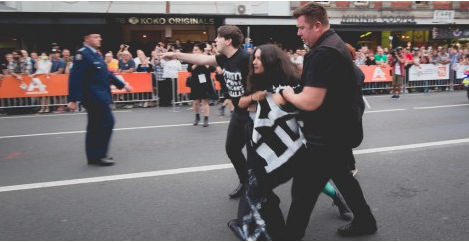
 
Protest: Thankfully, there was at least one human-being at Saturday's parade who still knew how to say "No!"
 
And later, when I read about the young person whose arm was broken by a security guard for daring to protest against the oxymoronic travesty of soldiers, police officers and jailers celebrating unconventional sexualities, I offered up a silent prayer to the gods and monsters of perversity and resistance: the ones who embolden rebels and keep the authorities off-balance. Among that gawking and guffawing crowd, they’d reassured me, there was at least one human-being who still knew how to say: “No!”
 
This essay was originally posted on The Daily Blog of Monday, 23 February 2015.

Tuesday, 6 March 2012

Living In One Dimension

Ticky-Tacky Existence: Malvina Reynolds' wickedly subversive 1962 song Little Boxes (which later became the theme of the HBO hit series, Weeds) captures to perfection the one dimensional nature of existence in "advanced industrial society". Herbert Marcuse's One Dimensional Man (1964) further elaborated the ideology of "ticky-tackiness". Sadly, New Zealand continues to experience the social and political effects of one dimensional living.

THERE’S A CERTAIN TYPE of New Zealander, I’m sure you’ve met him – or her. Pinched, unsmiling, always angry: the sort of person who is quick to condemn (and eager to punish) an ever-expanding list of social and political “deviants”. The “normal”, “right-thinking”, “decent” sort of Kiwi who writes letters to the editor of the local newspaper.

If you visit these New Zealanders’ homes you’d find order and cleanliness. There’ll be a flat-screen TV in the living-room, but no books; evidence of money and “success” everywhere you look, but hardly a trace of life, or love, anywhere.

There must be an enormous number of these angry and loveless New Zealanders because both of our major political parties pander to them shamelessly. Our politicians’ knee-jerk recourse to increasingly punitive (but evidence-free) “solutions” and its inevitable corollary, the steady dilution of our civil rights, is directly attributable to the electoral clout of this sad, mad segment of the population.

The radical German sociologist, Herbert Marcuse, dubbed this cruelly diminished variety of human-being “one dimensional man”.

Driven from his homeland by the Nazi takeover in 1933, Marcuse came to rest in the uttermost west of the United States; Los Angeles, California. As it would do so often in the decades to come, California in the late-1930s was pre-figuring the culture of mass affluence. In LA’s sprawling suburbs Marcuse discovered human-beings defined not by what they were, or even by what they did, but by what they owned. In the mass consumer society which California anticipated, people’s sense of self was determined by the things they possessed. Happiness had ceased to be something they discovered, and was fast becoming something they acquired.

New Zealand’s post-war social development followed closely Marcuse’s one dimensional model. In Auckland, particularly, the sprawling “ticky-tacky” suburbs, snaking motorways and ubiquitous private automobile paid imitative homàge to the USA’s consumption-driven society.

The big question, which even Marcuse struggled to answer, is: what sort of human-being is likely to emerge from a consumption-driven society whose members have known nothing else?

We hear a great deal from the Right about inter-generational “welfare dependency” and how it threatens to exclude citizens from the paid workforce and the socially integrative functions it performs. We hear much less about inter-generational “consumption dependency” and its effects on individuals, families, and the planet it is devastating.

If “one dimensional man” can overcome the personal challenges of everyday life through the acquisition of things, then surely social challenges can be met in the same way? If the answer to personal unhappiness is to surround oneself with more commodities, then social ills should similarly be curable by “more”.

Pervasive “welfare dependency” can be overcome by providing more “incentives” to return to the workforce. More crime by more police, equipped with more weapons and invested with more coercive powers. And if more policing doesn’t do the trick, then more laws, more punitive sentences and more prisons must be the answer.

In a political order dominated by one dimensional men, the state increasingly assumes the role of a glorified supermarket or shopping mall. If one dimensional individuals’ hunger for authenticity can be assuaged by simple consumption, then one dimensional society should be capable of healing itself with solutions of equal simplicity. This has to be true because complexity is the one thing that one dimensional society can neither acknowledge nor tolerate.

Why? Because if there are some hurts that things cannot heal; some wrongs that simple solutions cannot right; some qualities, like wisdom, compassion and solidarity, that stockpiling commodities will never confer; then the implicit bargain at the core of the our consumption-driven society, you work for things, and things make you happy, breaks down.

At that point books suddenly become more important that flat-screen TV sets, and the notion that simply by giving your vote to a political party you can solve all of society’s problems stands revealed for the nonsense it always was. At that point anger and the urge to punish are acknowledged as lying at the core of our problems, not applauded as the necessary precursors to fair and just solutions.

And surely this is the explanation for the peculiar distemper of contemporary society? That the continued accumulation of things is palpably insufficient to the maintenance of our own (let alone the planet’s) happiness, but that no one (with the noble exception of the Greens) is offering anything resembling an alternative. Behind the anger and the sadness of New Zealand’s one dimensional citizens, and the intellectual poverty of one dimensional political parties peddling simplistic non-solutions to ever-more-complex problems, lies the frustration of the consumer whose happiness-creating commodities have stopped working.

In the end, what’s the point of offering three-dimensional flat-screen TVs, if all they reveal is the ever-expanding quantum of happiness our one-dimensional citizens have yet to acquire?

This essay was originally published in The Press of Tuesday, 6 March 2012.