
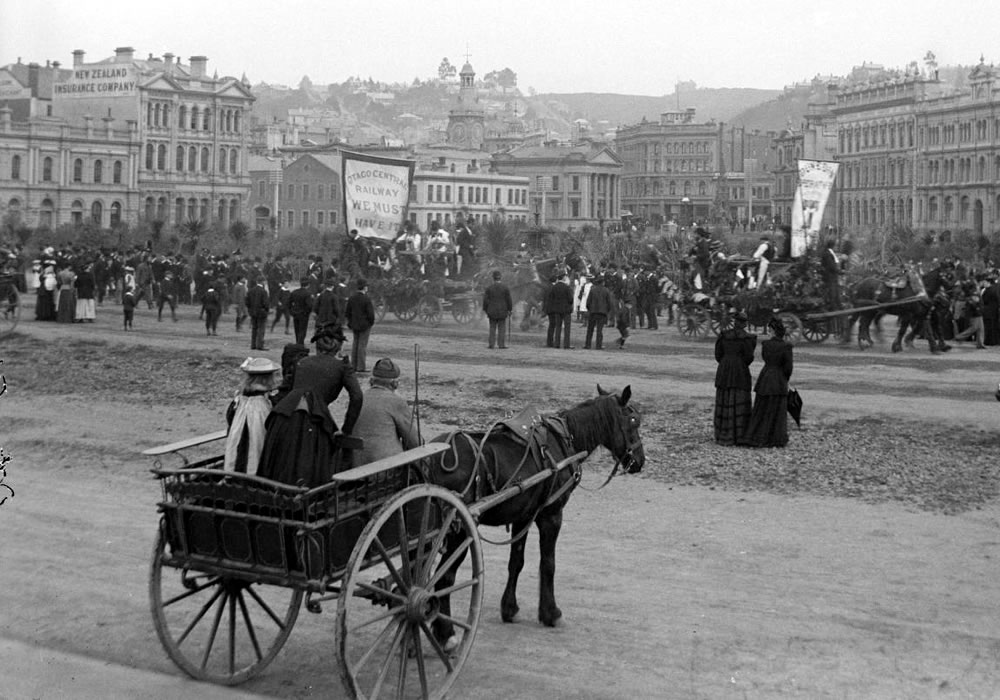
Labour Day, Dunedin, 1894: As the unions mass in what is now Dunedin's Queen's Gardens, a mother leans forward to tell her children about the meaning of Labour Day. What would a mother tell her children about "the cause of labour" in 2013? That it died in 1991? Or, that it will be reborn in 2014?
WHAT SORT OF PEOPLE were they, this mother and her children?
The photograph is dated Labour Day, 1894. The little family stands in a dog
cart, watching, while across the dusty roadway several hundred unionists, their
bright banners billowing against the regular lines of the city’s commercial
hub, muster for their grand procession. The strict Victorian civility of the
scene cannot mask the underlying political context: Labour versus Capital. How
did that mother convey Labour Day’s meaning to her children on that overcast morning
in October, 109 years ago?
Perhaps her husband, the children’s father, was among the
union throng. He may have helped to build one of the many floats about to make
their way up the city’s main street. Most of the trades were represented:
carpenters, butchers, bakers; their carts festooned with the all the paraphernalia
of their occupation. The bakers have loaded up great barrels of flour. On the
cart’s sideboards a painted banner proclaims: “Peace and Plenty”.
The connections were clearer then. When work lay at the very
heart of the human experience, and when the correspondence between the
condition of labour and the condition of the community was obvious and
indisputable. Without the carpenters, stonemasons and glaziers there would be
no city to live in. Without the butchers and the bakers, no meat and no bread.
In the minds of the nineteenth century working-classes, mere
ownership did not constitute the be-all and end-all of social significance. A
factory without workers was an empty and expensive shell. The butchery or
bakery, without butchers or bakers, had nothing to sell. Capital without Labour
was a ledger entry – nothing more.
And perhaps that brute fact was easier to see in the
colonies than in the Old Country. The churches and the town halls of nineteenth
century New Zealand and Australia (and the rapidly growing states of the
American West) may have looked as though they had stood above their Squares and
Octagons for centuries, but the colonists knew better. The men and women who
had built Christchurch, Dunedin, Melbourne, Adelaide and Chicago, all understood
that the great settler cities which had exploded out of the raw landscapes of
imperial ambition were overwhelmingly and unquestionably collective
enterprises. Capital and Labour had arrived together: neither lived but by the
efforts of the other.
It’s what the carpenter, Sam Parnell, had grasped the moment
his feet touched the Petone foreshore in 1840. That this was a new land, with
new rules, where the expectations of the masters back in England would be
subject to radical revision. Here, the worker would labour for eight of the
day’s 24 hours. Eight more would be for his rest. And the remaining eight would
be for himself and his family. If the masters wanted or needed more than eight
hours, then they would be obliged to pay their employees a handsome premium for
the “over-time”.
Perhaps this was the grand old tale that the mother in the
photograph told her children as they watched the Labour Day procession form up
on that October morning long ago.
Newer stories, too, she’d have to tell. About how the
Reverend Rutherford Waddell had preached against “The Sin of Cheapness”,
exposing the sweated labour of the seamstresses, and how, from the resulting
public outrage, the Tailoresses’ Union had been born. Of the Great Maritime
Strike of 1890, she would have spoken. Of how the seafarers, the watersiders
and the coal miners came together on 28 October 1889 to form the Maritime
Council (New Zealand’s first effective union combination). She would have told
her children how, though the nationwide strike was broken, the cause of labour did
not falter: for in that same year the Liberals were swept to power on the votes
of working men. And re-elected, she would have added, her eyes shining with
pride, on the votes of working women. And of how the Liberal Government,
earlier that very year, had passed the Industrial Conciliation and Arbitration
Act – which would, on New Year’s Day, make the workers of New Zealand the envy
of workers all the world around.
That woman’s children would, of course, live to see the
great wave of social progress in which their parents participated rolled back upon
the rocky reefs of war and economic catastrophe. The millennial dreams of their
mother’s and father’s generation would not be realised, but the unrelenting
push of the unions would achieve many of their most cherished objectives. The Welfare
State and the 40-hour week would both become law when Labour finally took up
the reins of government in its own name in 1935.
So what, if anything, should mothers tell their children
about the meaning of Labour Day in 2013? That dreams, like photographs, can
fade? Or that history, like spring, reminds us what hope is for?
This essay was
originally published in The Press of Tuesday,
29 October 2013.
